
You are using an out of date browser. It may not display this or other websites correctly.
You should upgrade or use an alternative browser.
You should upgrade or use an alternative browser.
DARPA / GA-ASI LONGSHOT Missile Carrying Drone
I was not expecting a 3000lb thrust engine in the Longshot. I was expecting a smaller engine, call it Tomahawk sized.
That would greatly reduce the range of the drone. Or rather, the drone has to fly back to a place where it can be recovered.
I am not buying the 3,000 lb thrust figure. That’s an order of magnitude more thrust than a cruise missile would need and borders on the thrust class the USAF is interested in for CCAs (3,000 - 8,000). If that were trues, then long shot is a lot larger than I thought and not at all expendable - you cannot just throw out engines in that class in a cost effective manner. Long shot would be more of an optional recovery air launched CCA.
Interesting that longshot has a flight phase included post missile separation. We had this in mind but, IMOHO, it wasn't in any way something clearly stated so far.
Great catch!
I wonder if the goal be recovery or just to act as a decoy post firing? I had thought long shot was to be expendable, but more and more it seems like they might be working towards something more complex and reusable.
Wouldn't a system linked to sensitive electronics such as a missile would make an interesting treasure trove for an enemy?
Depends on what you build into it. Missiles are recovered intact all the time. Also one might expect long shot to only be used in a peer conflict and often over water. In any case, expecting all of your long shots to come home also is unrealistic, so opponent exploitation is not really a consideration when weighing pros and cons of expendable vs optional recovery.
Explorer121
ACCESS: Confidential
- Joined
- 17 June 2024
- Messages
- 56
- Reaction score
- 130
The most expensive thing the longshot needs is a secure datalink to get targeting information from stealth aircraft or drones within range of air or ground targets. I'm not sure how much intelligence can be gathered from that, but I imagine they can be rigged to burn in water or something. The engines can be made much cheaper if the engine lifespan is a few hours, maybe even fully 3d printed.
Explorer121
ACCESS: Confidential
- Joined
- 17 June 2024
- Messages
- 56
- Reaction score
- 130
The longshot should be able to receive target and flight path information of its own and be capable of being 'handed over' to the stand-in fighter/sensor for the launch command. If that can be done with the datalink on the internal missile(s), that would be really awesome.
Think glide bomb kit. If you consider the guidance sensor as being part of the bomb body, wings and tail units are just passive add-ons. Here the aircraft pylon just interact with the weapon that just has a mod upgrade that is called Longshot.
The longshot embedded software use the extra moving surfaces, wings, tails and power plant as governs and sustainer.
Once the missile releases itself from Longshot, a simple GPS/INS guidance system turn back Longshot to a geolocated recovery point. My guess was that it will sail like a glider from to that point (Longshot would be extremely light after weapon release with ample lift available for a gliding/sailing recover).
GPS/INS are systems embedded with many weapons already that, probably, do not present a specific intelligence exposure. The only jewel here would be the Guidance/Piloting software of Longshot, nothing that any science program in many countries could not replicate with the right people.
The longshot embedded software use the extra moving surfaces, wings, tails and power plant as governs and sustainer.
Once the missile releases itself from Longshot, a simple GPS/INS guidance system turn back Longshot to a geolocated recovery point. My guess was that it will sail like a glider from to that point (Longshot would be extremely light after weapon release with ample lift available for a gliding/sailing recover).
GPS/INS are systems embedded with many weapons already that, probably, do not present a specific intelligence exposure. The only jewel here would be the Guidance/Piloting software of Longshot, nothing that any science program in many countries could not replicate with the right people.
Last edited:
Scott Kenny
ACCESS: USAP
- Joined
- 15 May 2023
- Messages
- 19,514
- Reaction score
- 27,959
Weren't J85s originally designed as disposable engines for drones?I am not buying the 3,000 lb thrust figure. That’s an order of magnitude more thrust than a cruise missile would need and borders on the thrust class the USAF is interested in for CCAs (3,000 - 8,000). If that were trues, then long shot is a lot larger than I thought and not at all expendable - you cannot just throw out engines in that class in a cost effective manner. Long shot would be more of an optional recovery air launched CCA.
Weren't J85s originally designed as disposable engines for drones?
I think they were developed originally to power the ADM-20 Quail decoy drone (The B-52 carried up to four of them in its Bombays).
Weren't J85s originally designed as disposable engines for drones?
Is there some expendable weapon that uses that engine I am not aware of?
yeetmahboi
ACCESS: Top Secret
- Joined
- 6 April 2022
- Messages
- 1,025
- Reaction score
- 1,434
Quail?
Is there some expendable weapon that uses that engine I am not aware of?
Not for a weapon but aside from the ADM-20 Quail there was a variant of the Firebee drone that used the J85, this was the MQM-34D version:
During the 1970s the U.S. Army updated some of their MQM-34Ds for use as targets for FIM-92 Stinger man-portable SAMs, refitting these drones with a General Electric J85-GE-7 turbojet of 2,500 lbf thrust which were salvaged from old ADM-20 Quaildecoys. The modified MQM-34Ds featured a revised forward fuselage with a circular nose intake that gave them an appearance similar to that of a "stretched" first-generation Q-2A target, and were given the designation of MQM-34D Mod II.
Quail?
ADM-20 Quail:
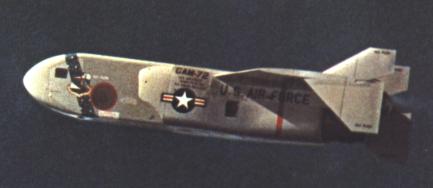


Last edited:
Quail?
Ok, sure, if you go back half a century, you got me.
yeetmahboi
ACCESS: Top Secret
- Joined
- 6 April 2022
- Messages
- 1,025
- Reaction score
- 1,434
It'd be easier to build even cheaper engines in that specific operating regime with modern materials and manufacturing methodologies.
We could do this, much better today, with an actual market to boot.
The RB.162 was designed to meet an anticipated need for a lift engine to power VTOL aircraft with the emphasis on simplicity, durability and lightweight construction. Development costs were shared by Britain, France and Germany after signing a joint memorandum of agreement. The engine was the worlds first turbojet to use composite fibre glass compressor casings and plastic compressor blades to save weight which also had the effect of reducing production costs. The engine has no oil system, a metered dose of oil instead being injected into the two main bearings by the compressed air used to turn the compressor at startup. Although the RB.162 was a successful design, the expected large VTOL aircraft market did not materialise and the engine was only produced in limited numbers.
We could do this, much better today, with an actual market to boot.
It'd be easier to build even cheaper engines in that specific operating regime with modern materials and manufacturing methodologies.
We could do this, much better today, with an actual market to boot.
There’s nothing awe inspiring about a 3,000 lb thrust engine. Can you make it cheap enough to make it disposable? I am rather doubtful. ADM-20 comes from a different time, budget, and set of priorities, and I doubt it was cheap when adjusted for inflation.
Kratos and GE are already studying a cheap disposable, 20hr service life, 1500lb engine, the GEK1500 that will come after the, soon to be available, GEK800.
https://ir.kratosdefense.com/news-r...aerospace-sign-teaming-agreement-expand-small
https://ir.kratosdefense.com/news-r...aerospace-sign-teaming-agreement-expand-small

- Joined
- 4 May 2008
- Messages
- 2,445
- Reaction score
- 827
3,000 lbf is way off. The whole Longshot assembly can't weigh more than a JASSM or it won't be carried on wing pylons of F-15s and F-16s. So if it had a 3,000 lbf engine, it would have a thrust to weight largely in excess of one!I am not buying the 3,000 lb thrust figure. That’s an order of magnitude more thrust than a cruise missile would need and borders on the thrust class the USAF is interested in for CCAs (3,000 - 8,000). If that were trues, then long shot is a lot larger than I thought and not at all expendable - you cannot just throw out engines in that class in a cost effective manner. Long shot would be more of an optional recovery air launched CCA.
The "J85" is confusingly NOT the General Electric engine, rather it's a small attritable engine from TDI, where the 85 refers to the 8.5" diameter. It's an engine in the 200 lbf thrust range.
Scott Kenny
ACCESS: USAP
- Joined
- 15 May 2023
- Messages
- 19,514
- Reaction score
- 27,959
Must have conflated the 8.5" J85 with the engine used in T-38s.This 3000lbf allegation comes from a YouTube video...

- Joined
- 30 May 2023
- Messages
- 664
- Reaction score
- 1,436
LONGSHOT really does seem to be an air-launched CCA Increment 0.5
Attachments
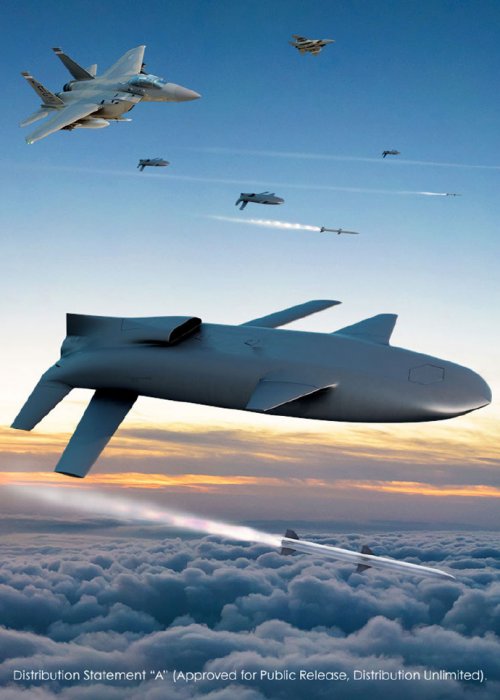
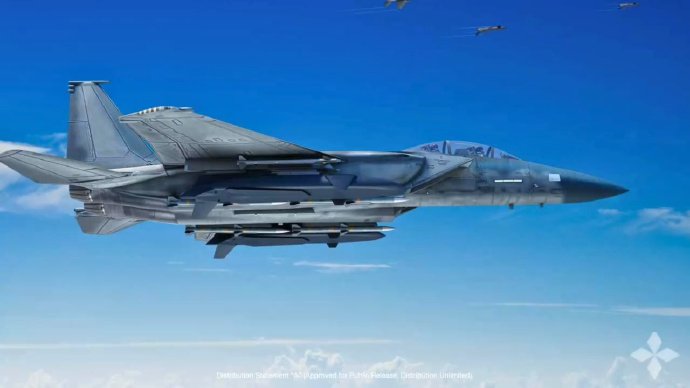
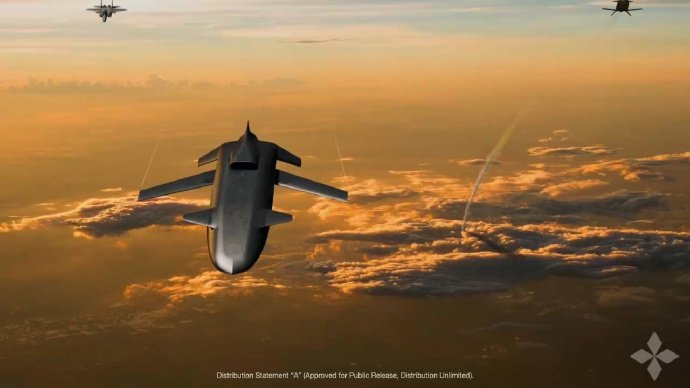
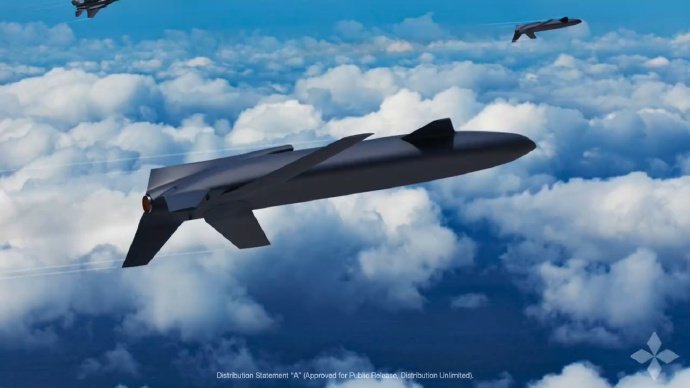
Forward Swept wing and Canards!! You ain´t an old guy anymore if you grew in the 90´s.
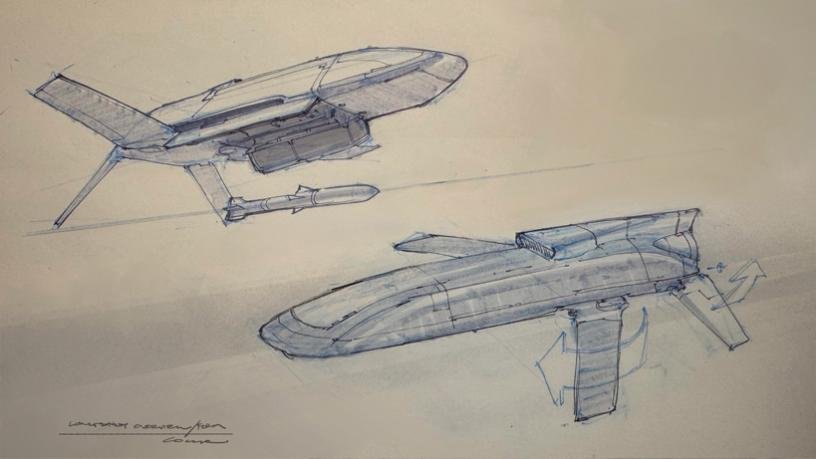
For the configuration, we can see there that it was chosen to deal with the large variation in CG during the mission (something we have foreseen early when the RFI project was revealed. So, we should not eventually be surprised if we learn ultimately that LongShot is recoverable (at least during the less stringent firing conditions).
For the configuration, we can see there that it was chosen to deal with the large variation in CG during the mission (something we have foreseen early when the RFI project was revealed. So, we should not eventually be surprised if we learn ultimately that LongShot is recoverable (at least during the less stringent firing conditions).

- Joined
- 3 June 2006
- Messages
- 3,538
- Reaction score
- 6,212
More renderings.[...)
New renderings:
Source (X fka twitter):
View: https://x.com/GenAtomics_ASI/status/1970179211978846429
Attachments
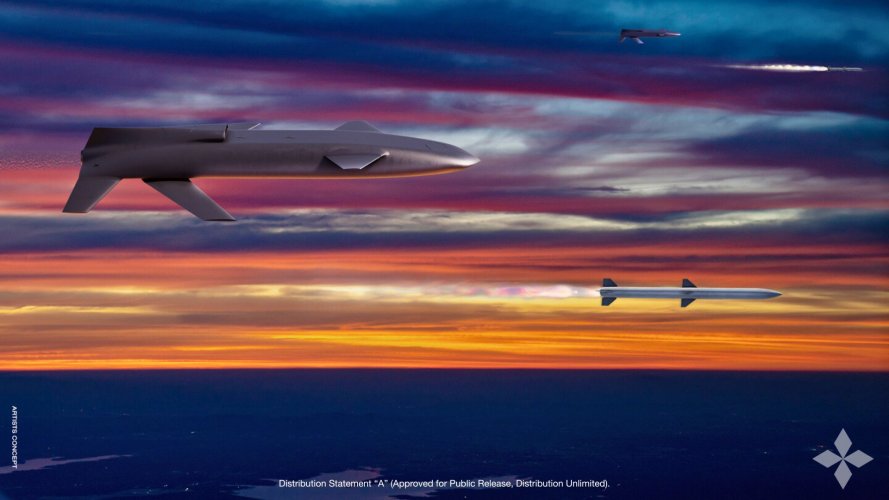
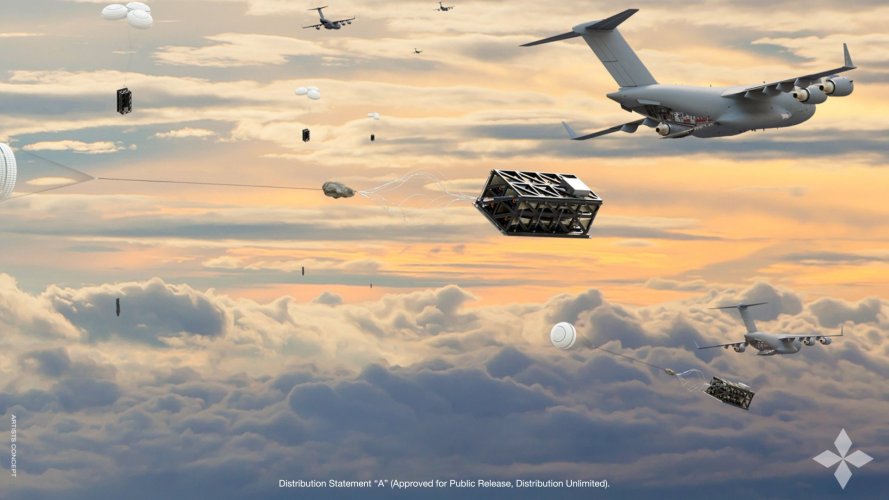
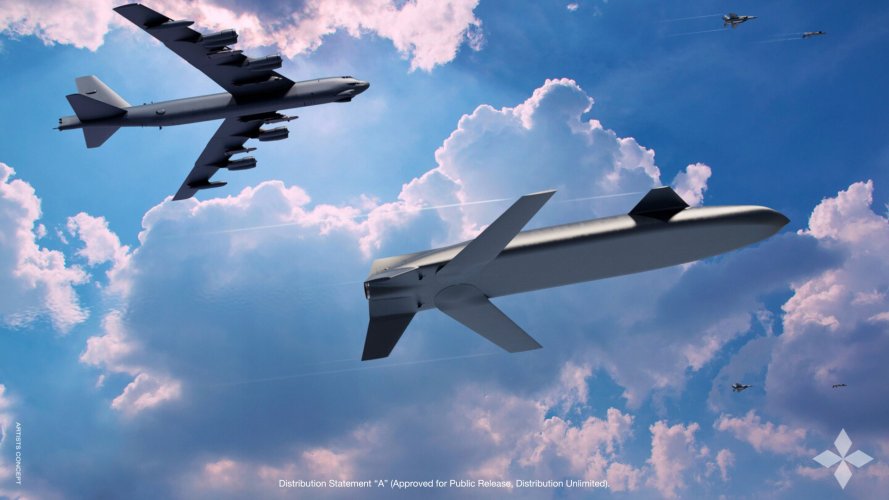

Attachments
Forward Swept wing and Canards!! You ain´t an old guy anymore if you grew in the 90´s.
For the configuration, we can see there that it was chosen to deal with the large variation in CG during the mission (something we have foreseen early when the RFI project was revealed. So, we should not eventually be surprised if we learn ultimately that LongShot is recoverable (at least during the less stringent firing conditions).
Keeping the launcher stable during the firing process is probably still important even if recovery is not a goal. If nothing else, you might want to fire AAMs individually. Recovery would require extra equipment, airframe hardening (I presume parachute recovery), and a sufficiently long enough range that is seems a little impractical to me. There certainly are lots of recoverable high subsonic performance USVs used as targets (eg various Kratos products), but these do not have to carry 700+ lbs off AAM and associated launch equipment/volume. Shooting for low costs single use seems more practical to me, especially when the AAM payload is a couple million dollars on the low end.
Keeping the launcher stable during the firing process is probably still important even if recovery is not a goal. If nothing else, you might want to fire AAMs individually.
Absolutely. Hence the rear wing (´think at the CG at the end of the mission with missiles and fuel expended) that has variable sweep angle and the canard to ensure stability in launching configuration.
But then, I think you are forgetting the empty mass. With no fuel, no missiles (that should also be seen as structural beams for the design), it´s probably only an empty shell... With a lot of lift and low structural strength.
I suggested back then a gliding return with thermals soaring when needed, all at fairly low speed to not endanger the structural integrity (that only means at commune glider speed - nothing fancy). A pilotless LongShot can probably keep its FCS alive for hours or days the time to fly back to a convenient point of recovery.
With the low mass (hence low approach speed), a belly landing would certainly do the trick.
Last edited:

Forest Green
ACCESS: USAP
- Joined
- 11 June 2019
- Messages
- 14,499
- Reaction score
- 31,531
F-15 Depicted Launching LongShot Air-To-Air Missile Carrier Drone In New Renderings
https://www.twz.com/air/f-15-launches-longshot-air-to-air-missile-carrier-drone-in-new-renderings
Scott Kenny
ACCESS: USAP
- Joined
- 15 May 2023
- Messages
- 19,514
- Reaction score
- 27,959
I don't think the B-21 has side bays. I used to, but I don't now. Or rather, the bays between engines and centerline bay are avionics and Environmental Control systems, cooling etc.Notice also that the form factor would probably fit in B-21 side wb.

- Joined
- 1 April 2006
- Messages
- 12,276
- Reaction score
- 15,084
Those bays are not for missiles - that was clear from the maiden flight. What prevents you from thinking that Longshots can be used from rotary launcher substituting one or two ALCMs/LRSOs?
Attachments

Last edited:
Scott Kenny
ACCESS: USAP
- Joined
- 15 May 2023
- Messages
- 19,514
- Reaction score
- 27,959
Agreed.Those bays are not for missiles - that was clear from the maiden flight.
I'd been thinking that it'd be desirable for small, faster moving doors for defensive missiles. AAMs and especially SiAWs.
Sheer size. A Longshot carrying 2x AMRAAM-Cs needs to hold 2x13" boxes, though the boxes can overlap some. You're looking at an overlapped box in the neighborhood of 24"x13"What prevents you from thinking that Longshots can be used from rotary launcher substituting one or two ALCMs/LRSOs?
Seems like this commentary from War on the Rocks on LongShot slipped in under everyone’s radar.
The Affordable Mass the Air Force Is Looking For Is Hiding in Plain Sight
The Affordable Mass the Air Force Is Looking For Is Hiding in Plain Sight
Similar threads
-

-
 DARPA moving forward with development of nuclear powered spacecraft
- Started by Flyaway
- Replies: 34
-
-
-
 AFRL Low-Cost Attritable Aircraft Technology (LCAAT) Program
- Started by Triton
- Replies: 179