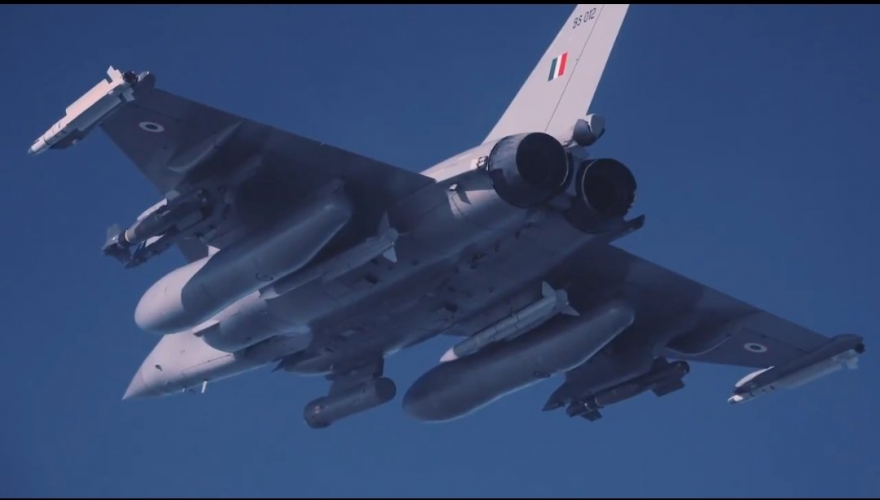
No (effective) offensive fighter sweep. India has those Flankers, have a squadron of those lock up any Pakistan AF defenders that want to come up and play.
Flankers were there (likely 1 was shot down). But in their ~2000 condition (same radar as in 2001; same weapon from 1992; huge RCS; outdated RWR), it isn't much of an escort.
It's two uglies in fact - MICA-EM and RVV-AE are both early ARH weapons with 80-ish range head-on (i.e. realistically they're borderline WVR weapons). In an engagement starting at 200km, they're dead weight&RCS amplifiers.
They got better right after the war (Astra mk.1 integration finally went ahead, plus Astra itself got range extended to ~160km head-on), but that apparently wasn't available in Sindoor, and it's likely only integrated on a portion of the fleet(Indian MKI upgrades are being rolled on gradually). Others are now getting RVV-SD and RVV-BD as a stopgap.
New Indian radar, rwr and EW are still (far) in the future.
No jamming. I know the US and Oz are the only countries that have Growlers, but to apparently not have the strike aircrafts' onboard or pod jammers screaming?
Well, that's the subject of this topic...
Normally, that's exactly what a self-defense jammer should be doing, and Spectra is an immediate "ugh?".
It's ok for systems to fail (especially jammers, it's soft kill after all), but Spectra in particular is the single largest, heaviest, and most extravagant internal self-defense system of this kind - squeezed into a relatively small fighter, at a great cost (both absolute and in design terms). It's a damn expensive system on a very expensive fighter.
Was this (unusual) bet wrong?
For example, J-10 family doesn't bother with a substantial internal jammer at all, and can only bring a smallish KG600 on a chin station (which they only really bring on A2G missions). Maybe you're better off investing whatever weight, power, and volume margins into a bigger radar?
Perhaps this (also unusual) bet was the right call?
It's a significant issue: first, you don't really need Rafale to bring 800 TRM radar and a small SPJ pod into a fight. Tejas mk.1a can do that much perfectly fine.
Second - Rafale was chosen over two competing aircraft: Typhoon (in MMRCA finale) and FGFA(aka, Su-57e). More broadly, chosen air force a2a fighting composition (Rafale procurement from abroad + very deep domestic MKI upgrade) left many people(within and outside India; within and outside IAF) dissatisfied. There's a lot of space for controversy and finger-pointing here, especially as India doubles down on the type for at least a decade to come. You may guess this conversation goes well beyond just technical merits (down to some heated forum wars here, haha).
No SEAD to take ground radars offline.
SEAD was probably out of the question altogether. One thing is "striking terrorists"(who happen to be Pakistani civilian families, sentenced to death by a foreign government without any appeal; but at least there's some warped logic there), another thing is simply attacking military early warning assets of a (nuclear) Pakistan in a blinding strike. Pakistani launch authority, if my memory serves me right, is with the military, in a style not too dissimilar from what we now see in Iran. Disrupt communications and radar picture too much - and officer on duty may decide that, well, that's it. Nuclear combat, toe to toe with the Bharatskis.
View: https://www.youtube.com/watch?v=qXp8SnXUvEo
Another aspect (speaking of which) - SEAD, meaning ARM strikes? I am not sure, but deployed indian sead capability is Kh-31p via either MKI (see RWR commentary from above) or MiG-29UPG (with a combined Indian/Italian(ELT-568) self-defense system; can it provide targeting to russian ARM?).
Finally, India does have escort jamming pods (SAP-14, 2-18ghz; again, used on MKI). Were they used? Does outdated RWR on MKI impact their effectiveness?
Was there even AWACS support?
It's hard to tell; as I mentioned before, for the 2019 events, there was a very thorough and sober Indian POV on Bharat-Rakshak forums (from a retired IAF general, I believe). Nothing of this kind emerged this time.
Which is part of the issue - we, for example, know that some PL-15s missed, some connected. How many? How many per plane? How early/late did the Indian formations react? What happened after the initial ambush?
Even with the assumption of initial failure of EW, there's a whole sea of possible evaluations of what happened after. But we just don't know.