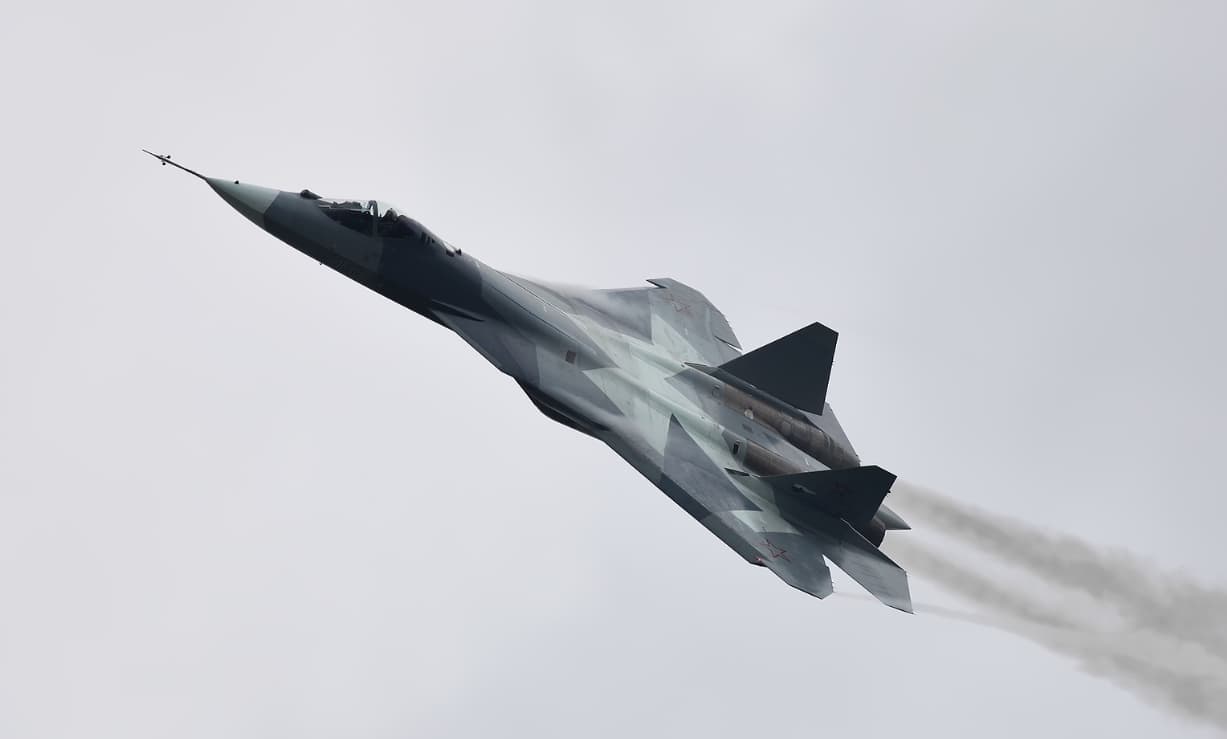
Posts evicted from Sukhoi T-75 LTS (CheckMate) topic

Status
Not open for further replies.

Deino

Moderator
Staff member
Top Contributor
Senior Member
Joined
2 January 2006
Messages
4,147
Reaction score
7,740
Thank you and well, that PAK DA and LTS are actively being worked on shouldn't be a surprise to anyone, as you said, there are plenty of signs if one knows where to look.

I'm curious if PAK DA or H-20 will make their first flight sooner. Given that at least with regards to public information there's little on either aside from hushed "there will come something" and patents and papers in foreign languages (PAK DA subsystems and simulator, H-20 supposed supersonic nature being explored).

It's a good time to be interested in either Chinese or Russian aviation these days, truly.


Is this a serious question or a joke?

Su-57 and J-20 had a comparable start, and while the J-20 is now flying a good 400 machines, two significantly improved models have only recently been put into service, the J-35 - comparable in the class with the S-75 - is now also flying operationally and two prototypes of the next generation are being tested, Russia is still tinkering with the original version of the Su-57, announcing a lot, but still only has less than 30 machines in use ... and you honestly wonder if the PAK-DA could fly before the H-20?
 
Last edited:
Is this
A serious question or a joke?

Su-57 and J-20 had a comparable start, and while the J-20 is now flying a good 400 machines, two significantly improved models have only recently been put into service, the J-35 - comparable in the class with the S-75 - is now also flying operationally and two prototypes of the next generation are being tested, Russia is still tinkering with the original version of the Su-57, announcing a lot, but still only has less than 30 machines in use ... and you honestly wonder if the PAK-DA could fly before the H-20?

Less than 30 Su-57S would mean we live in late 2023, early 2024. So you're off there. As for the H-20, there has been lots of rumors but not much to show for from the XAC so far. And with the production of the J-35 and J-20 going on, as well as the development of the J-36 and J-50 (disregarding all the UAVs for simplicity sake), it's to be wondered just how much focus is on H-20 currently, how urgent of an acquisition it is according to PLAAF higher ups. And while the H-6s are the least capable bombers in service currently, they are incredibly numerous and a large portion has been modernized. So the question remains. While with PAK DA, there has been more substantial stuff so far with regards to clues. Now, Russia has restarted production of the Tu-160 with the modernized M2, so that could indicate either delay, the need for 160s to be greater or that they intend to get the PAK DA up and running parallel with new facilities being constructed during the flight test phase (a prototype, which is essentially bespoke doesn't need a whole new facility, that's production stuff for later).

So yes I think it's a valid question, despite China having the larger economy and aviation sector. Your fallacy is to assume it's a matter of capability when in fact it's a matter of priority. And so far we have little to assume that H-20 is high on the priority list, but the same applies to PAK DA, so it's up in the air.
 
Is this
A serious question or a joke?

Su-57 and J-20 had a comparable start, and while the J-20 is now flying a good 400 machines, two significantly improved models have only recently been put into service, the J-35 - comparable in the class with the S-75 - is now also flying operationally and two prototypes of the next generation are being tested, Russia is still tinkering with the original version of the Su-57, announcing a lot, but still only has less than 30 machines in use ... and you honestly wonder if the PAK-DA could fly before the H-20?


400 J-20s? That sounds a bit too high, I would be surprised if it’s even 300 but I could be wrong. Either way not sure how the J-20 is relevant to the SU-57/75.

As for SU-57 production, it’s evident that the low rate of production is because of the Megapolis program which was started in late 2018 which will have major overhauls in design, avionics and engines. No reason to manufacture dozens of inferior SU-57s when a much more capable version is going to come out in late 2025 or early 2026. In my opinion the SU-57s are used as a stop gap and for training pilots, technicians and developing tactics and learning the aircraft and its features and functions.
 
  • Like
Reactions: Geo
I'd argue even if all of that isn't the case it's still "more capable" in various ways. It's probably going to retain superior flight characteristics, and I don't mean aerobatics but speed, altitude, thrust to weight (with the new engines). And will obviously be able to carry more ordnance, be it more AAMs or ALCM. While the LTS utilizes a smaller weapons bay as far as we know. Leveraging common weapons, but in a reduced quantity. I do agree though that it will most likely be more LO optimized, just how the J-35 most likely is compared to the J-20. But the two heavy weights will remain overall the more menacing threat I'd say, with powerful, large radar (or multiple radars) and more powerful engines. I can envision in case of the Su-57, Su-75 and Su-70 (S-70) that the Su-70 and Su-75 operate further forward, with the Su-57 operating from further behind while supporting the other two through long range fire, aided by it's own sensors and the distributed sensors of the others. Somewhere between a missile truck and an armed AEW&C, it's low observable features will obviously help to increase it's survivability and will make it possible to move this whole constellation further forward, but I'm unsure if it could go where the Su-75 could go.

I personally doubt massive changes to the fuselage. To individual component like the engine nozzles and nacelles I could see improvements being made, the nozzles being basically confirmed. I'd also expect a new generation of RAM being used and some minor fuselage changes being made, just how J-20A addressed deficiencies of the J-20. But I don't think they'll essentially make a new aircraft, which a widening and flattening of the fuselage would lead to. I think the major improvements however will be the AL-51 and improvements to the avionics suite, radar, weapons integration and I think maintenence as well. The Su-57M is after all meant to address deficiencies discovered during active service of the Su-57S, alleviate them and integrate the AL-51.

Yes. We can't expect any visible changes in aerodynamics, let alone structural modifications (Megapolis).

All those rumors about a "wider and flatter" fuselage stemmed from a misinterpretation of statements made during the latest interview with Sergey Bogdan. I saw the original interview, and he was speaking in a completely different context.
 
A moderator LMAOing posts they disagree with...

OT: Russia is behind by a lot. Due to a lot of issues (starting in the 90s IMO), Russia does not have the capacity to mass produce machines. I think the Su-57 deal with Algeria and the potential re-up of a deal with India can help, but it won't fix everything. In WWII Axis terms, China is Germany and Russia is Italy.
 
Is this
A serious question or a joke?

Su-57 and J-20 had a comparable start, and while the J-20 is now flying a good 400 machines, two significantly improved models have only recently been put into service, the J-35 - comparable in the class with the S-75 - is now also flying operationally and two prototypes of the next generation are being tested, Russia is still tinkering with the original version of the Su-57, announcing a lot, but still only has less than 30 machines in use ... and you honestly wonder if the PAK-DA could fly before the H-20?

To be fair Chinese are churning out more gen5 designs than rest of the world combined , as a manufactuing super power and in terms of PP GDP worlds largest economy by a considerable margin ,F35 being only mass-produced program and its interesting US has pretty much curtailed orders to bare minimum. Russians are also mid war that is, burning trough most of their budget and legarcy platorms are still a priority.

Well we could always look at our European production 5-6x the russian defence budget 10x the GDP , not a single gen5 in sight. Last new plane developed sometime in the 80's .

Also while folks like to poke fun at Russia not making this or that , same is true to enormously greater extent in the west , if Donald wakes up on the wrong side ,most aircraft projects outside US in the west and Korea grind to a halt as there is massive US tech content, same goes for US foreign partners like UK, Italy or Germany stop supplying US , much of military hardware production including F35 grinds to a halt and would take years to 'import substitute' all the systems ,gearboxes, engines etc. Most defence production is quite globalised as is all aircraft manufacturing . Practicaly none of Gen5 in development outside US are full cycle developments where every component is developed for it
 
Last edited:
A moderator LMAOing posts they disagree with...

OT: Russia is behind by a lot. Due to a lot of issues (starting in the 90s IMO), Russia does not have the capacity to mass produce machines. I think the Su-57 deal with Algeria and the potential re-up of a deal with India can help, but it won't fix everything. In WWII Axis terms, China is Germany and Russia is Italy.

If Russia has demonstrated anything since 2022 it's the capability to produce military hardware en masse. Easily exceeding the entire output of Europe combined (despite sanctions and corruption).
 
I think the Su-75, as a fifth-generation fighter, is arriving a bit too late. If it hasn’t even flown yet, it likely won’t enter service for another 10 years, and full-scale production may not start until 15 years from now — that’s already around 2040. So I believe the developers should consider adapting it toward sixth-generation concepts.

If that’s too difficult technologically, it might still be feasible conceptually. For example, they could create a paired system: one aircraft acting as a mini-AWACS platform, and the other as a missile carrier. The missile carrier wouldn’t have a radar, improving its stealth and reducing cost, which would allow it to get closer to the enemy. The other aircraft could be equipped with large side-mounted radars — possibly with a radar surface area up to three times greater than what fits in the nose.

Their main mission could be air patrol, which allows faster response compared to the traditional interceptor concept that requires takeoff and high-speed interception. The fact that these jets are single-engine means lower cost and longer flight endurance.

The lack of supercruise capability isn’t critical either — the aircraft could perform defensive maneuvers and, using gravity, quickly gain speed and drop altitude. At low altitude, sustained high-speed flight isn't efficient anyway due to air resistance. Meanwhile, incoming enemy missiles would slow down in the atmosphere once their engines burn out.

I don’t see any major issues with this concept — the aircraft's strengths are fully utilized, while its weaknesses are effectively compensated.
 
A moderator LMAOing posts they disagree with...
this may shock you but moderators are members here too and allowed to post just like any other member is. Being a moderator does not prevent this. Also when the moderator in question is widely recognised as an expert in the Chinese aerospace sector it is wise to take note of what they say.
 
this may shock you but moderators are members here too and allowed to post just like any other member is. Being a moderator does not prevent this. Also when the moderator in question is widely recognised as an expert in the Chinese aerospace sector it is wise to take note of what they say.

Isn't he just a German teacher turned PLA watcher? I'm not sure if that's the kind of credentials that give one authority over something. Especially over something that isn't related to Chinese military aviation, but Russian military aviation and evidently false (numbers of service airframes for example).

I agree on the rest though, mods are users like everyone else and can laugh, like or discuss how they want.

Edit: just to clarify, I respect what Deino does and has been doing for many years. Making PLA OSINT more accessible to a western audience. After all, I'm also on the SDF which he not only moderates but also IIRC founded and heavily contributes towards. I just don't think Russian aviation is his strength compared to PLA related matters. And I'd further argue there is little point in comparing two institutions so fundamentally different, that there's little common ground to find to begin with.
 
Last edited:
400 J-20s? That sounds a bit too high, I would be surprised if it’s even 300 but I could be wrong. Either way not sure how the J-20 is relevant to the SU-57/75.

Annual production of the J-20 is allegedly at or over 100 airframes, so it's not particularly hard to believe. But there are two things to consider, for one we don't know how many J-20s were ordered by the PLAAF. On the other hand the VKS ordered an initial batch of 76 aircraft, of which around half are already in service. What use would there be to burn through this initial order just to have an idle production line and no work until the Su-57M/M1 is ready for serial production? It doesn't make any sense, especially given that the Su-57 currently isn't in critical need, remember the old MiG-31 already easily dominates everything that flies in Ukraine, as does the newer Su-35S. Su-57 deployments serve more as tests for weapons systems and other mission systems on board the aircraft. A Kh-69 launched by a Su-57 like it has happened a couple times now can be substituted by Iskander-M or Iskander-K, as well as Kh-101.

Secondly, the Chinese have the most powerful economy in the world, don't need to work around sanctions and have essentially a blank check for the PLAAF. So 100 J-20s per year is not only possible, anything else would be quite honestly illogical. Furthermore and in my eyes more importantly, China is faced with a way higher threat level than Russia is. China's main adversary is the US which perceives as an existential threat that needs to be at the very least to be contained and isolated. The US models their entire defence strategy around this notion, completely focused on China. The B-21, F-47, MQ-25, F/A-XX, YFQ-42, YFQ-44, DDG(X) etc. are all designed specifically to fight China in the Indo-Pacific. So China not only has the capability, but also the genuine need to rapidly modernize their forces. These J-11s, Su-30s, J-8s etc. are of no use. They need hundreds of J-20s and J-35s to replace these and other systems. Not only in a bit to match USAF and USN airpower, but to exceed it in the region which serves as an effective deterrent. For comparison, Russia is faced with an incompetent but wealthy Europe who wastes it's money on boutique systems. The biggest threat to Russia are the remnants of US forces in Europe and it's not even close. But that threat is more so addressed with drones, missiles, bodies and tanks than it is with sophisticated long range fighters. So it is, all things considered not urgent.

Finishing their initial order too early has no benefit and the threat environment is far less sever than what China faces, which also most likely placed a far higher order to begin with and probably extended that further with the J-20A and J-20S now.

Now the thing is, non of this J-20 (or even Su-57 stuff) belongs here, so we should get back on topic or don't comment until new info is out.
 
Yes. We can't expect any visible changes in aerodynamics, let alone structural modifications (Megapolis).

All those rumors about a "wider and flatter" fuselage stemmed from a misinterpretation of statements made during the latest interview with Sergey Bogdan. I saw the original interview, and he was speaking in a completely different context.

Do you have the interview? I couldn’t find anything myself.
 
this may shock you but moderators are members here too and allowed to post just like any other member is. Ring a moderator does not prevent this. Also when the moderator in question is widely recon as an expert in the Chinese aerospace sector it is wise to take note of what they say.
On Chinese. Not on Russian.
 
this may shock you but moderators are members here too and allowed to post just like any other member is. Being a moderator does not prevent this. Also when the moderator in question is widely recognised as an expert in the Chinese aerospace sector it is wise to take note of what they say.

Said moderator was also adamant that Chinese purchase of Su-35 was never going to happen, he was quite vocal about it on Keypub around that timeframe IIRC.

Not that I disagree with his opinion with regards to the introduction date of PAK-DA versus China's next gen bomber, and of course, he is entitled to his own opinion, as all other posters are.
 
Do you have the interview? I couldn’t find anything myself.
Oh, Galaxy, I’d have to dig through some Russian TV archives. The interview with Bogdan was part of a report aired before LIMA 2025, around mid-May.
Bogdan talks there about upgrades to the Su-57—new engines, new radar, AI...—and also, in general, mentions some Felon's design advantages, like the wide and flat fuselage.
You can find the transcript here:
 
Oh, Galaxy, I’d have to dig through some Russian TV archives. The interview with Bogdan was part of a report aired before LIMA 2025, around mid-May.
Bogdan talks there about upgrades to the Su-57—new engines, new radar, AI...—and also, in general, mentions some Felon's design advantages, like the wide and flat fuselage.
You can find the transcript here:


What an odd thing for Bogdan to say. The SU-57 is certainly wide but it’s the furthest thing from “flat” and pretty poor for RCS when you consider the multiple corner reflectors and poor blending of the nacelles. They should have just made a flat fuselage, I’m not sure what benefits the designer see with such an antiquated design….slightly more lift and marginal range? And at what cost? I would rather have an aircraft that can survive deep in enemy airspace than one that has better lift but gets shot down.

The SU-75 is mostly meant for export but it is a far superior design when it comes to RCS and survivability…that is just bizarre and backwards project management on behalf of Sukhoi engineers and project managers.
 
What an odd thing for Bogdan to say. The SU-57 is certainly wide but it’s the furthest thing from “flat” and pretty poor for RCS when you consider the multiple corner reflectors and poor blending of the nacelles. They should have just made a flat fuselage, I’m not sure what benefits the designer see with such an antiquated design….slightly more lift and marginal range? And at what cost? I would rather have an aircraft that can survive deep in enemy airspace than one that has better lift but gets shot down.

The SU-75 is mostly meant for export but it is a far superior design when it comes to RCS and survivability…that is just bizarre and backwards project management on behalf of Sukhoi engineers and project managers.

I imagine it has more to do with VKS requirements than Sukhoi , end of the day manufacturers build to customers requirements.
 
Isn't he just a German teacher turned PLA watcher? I'm not sure if that's the kind of credentials that give one authority over something.
Taking the time to research and write multiple books on a topic is a bit more than a simple "watcher" and is certainly a lot more credential than an anonymous forum poster.
 
Taking the time to research and write multiple books on a topic is a bit more than a simple "watcher" and is certainly a lot more credential than an anonymous forum poster.
I'm not aware he published books on the VKS and Russian military aviation history. I'd be very interested to pick up a copy.

Also this isn't a discussion about individual users now, isn't it? I think you and I should let this rest now. For the sake of the thread.
 
Taking the time to research and write multiple books on a topic is a bit more than a simple "watcher" and is certainly a lot more credential than an anonymous forum poster.
Pulling rank just because who you refer to wrote some books (on a parallel subject btw) is distasteful to say the least. Especially when the "credentials" weight you refer to are unfixably biased by petty political views and other issues. And yes there are some anonymous forum posters far more knowledgeable and informed on the subject, both on this forum and elsewhere. Other authors actually specializing on the subject such as Yefim Gordon get a lot of flak but i'd rate him far above who you refer to.
 
I'm not aware he published books on the VKS and Russian military aviation history. I'd be very interested to pick up a copy.

Also this isn't a discussion about individual users now, isn't it? I think you and I should let this rest now. For the sake of the thread.

Pulling rank just because who you refer to wrote some books (on a parallel subject btw) is distasteful to say the least. Especially when the "credentials" weight you refer to are unfixably biased by petty political views and other issues. And yes there are some anonymous forum posters far more knowledgeable and informed on the subject, both on this forum and elsewhere. Other authors actually specializing on the subject such as Yefim Gordon get a lot of flak but i'd rate him far above who you refer to.
The comments Deino made were related to Chinese military aviation:

Original question:
I'm curious if PAK DA or H-20 will make their first flight sooner.
Response:
Is this
A serious question or a joke?

Su-57 and J-20 had a comparable start, and while the J-20 is now flying a good 400 machines, two significantly improved models have only recently been put into service, the J-35 - comparable in the class with the S-75 - is now also flying operationally and two prototypes of the next generation are being tested, Russia is still tinkering with the original version of the Su-57, announcing a lot, but still only has less than 30 machines in use ... and you honestly wonder if the PAK-DA could fly before the H-20?
As for your "pulling rank" comment, grow up!
 
Yes, one may certainly question quality of Russian higher level planning, if SOE manufacturer consistently does guesswork better.
We could probably replace "Russian" with any other country and that sentence would still be correct.
 
Yes, it looks like the underside is flat except for where the engines are.

And now I have significant doubts about the stealthiness of those nacelles.
The intakes seem fairly optimized for low observability, however the nacelles/rear portion of the entire intake-engine assembly seem overall less optimized.

Goes hand in hand with the rumored priority of the front aspect of the aircrafts signature.
 
@Galaxy

I think Bogdan meant this by flat.
View attachment 777618View attachment 777619
View attachment 777620

The underside from nose to tail looks pretty flat (with just two big bumps/intakes :p)

Agree?
i can make you a shape full of flat surfaces but have the rcs of a barn, its yard and fences included. it's a meaningless if not dishonest statement.

Now maybe the su-57 design isn't so much the incompetence of the program itself but a lack of stealth techniques that make a certain shaping work.

Do you think russian engineers are so incompetent as to not know that blended surfaces without disruption reduce scattering? Course not.

Blending of curve bumps and bulges only contribute to significant rcs reduction if the understanding of material science allows for a surface that significantly convert specular waves into surface waves. If you don't have that know-how, it's pointless to increase weight and complexity by trying to smoothly blend the belly. The su-57 shaping isn't a reflection on ignorance of basic stealth principles but a best of compromises per the limited know-how in associated stealth techniques that would make certain shaping principles work effectively.
 
@donnage99
Then I guess Bogdan doesn’t know what he’s talking about.

Every single time there is a debate about stealth it always ends in the same way. Can you guess what way will it end?
 
@donnage99
Then I guess Bogdan doesn’t know what he’s talking about.

Every single time there is a debate about stealth it always ends in the same way. Can you guess what way will it end?
just marketing/propaganda. Not exclusive to su-57 personnel. Top of my head I can remember several comical statements by f-35, superhornet, and rafale program managers/test pilots
 
just marketing/propaganda. Not exclusive to su-57 personnel. Top of my head I can remember several comical statements by f-35, superhornet, and rafale program managers/test pilots


So what was the propaganda statement by Bogdan? Russia literally has the worst military marketing on earth and that is not even up for debating. Russian marketing is virtually none existent besides doing some air shows and even then Russia brings rough prototypes. Russia doesn’t even specify how many sorties specific Russian aircraft flown in Syria or Ukraine or how many targets they struck or how many tons of munitions were used or how many flight hours were accumulated or what high value targets were hit or how many pilots achieved kills. To this day there is only one Russian pilot in the Ukraine conflict that is known or credited with kills even though there are obviously more. Compare that to the Gulf war were the US advertised sorties, flight hours, targets hit, aircraft kills, pilots with kills, ect. The most impressive marketing feat for Russia was the SU-75 presentation which was equivalent to what western companies do. In contrast the SU-57 was presented with no paint or primer, exposed rivets, temporary engines, canopy, ect.


The SU-57 is very potent and has some capabilities not present in other aircraft. Its weak points are its RCS particularly the lower fuselage and lack of blended sensors. Other than that it has impressive range, long range munitions for both air to air and air to ground, 360 degree or close to it radar coverage, good sensor fusion, MAWS, high maneuverability, integration of loyal wingman (Okhotnik), some abilities similar to F-35 with ability to ‘see through the aircraft’ ect.
 
@Galaxy comprehension is needed. none of what you said refute what I said. I wasn't talking about russian marketing as a whole neither was I making a general criticism of the su-57 as a whole package. Instead of immediately have a knee jerk reaction, click on the quote I was quoting so you could see the context.

Also, side note, I'm not sure its lower fuselage is its most damning rcs weakness. Sure rear aspect is important for a true VLO aircraft intended to punch deep or launch missiles within their respective no escape zone. But su-57 never aimed to reach that high, contending with launching long range missiles from afar. The most damning rcs aspect - No edge alignment in the radar radome, in fact 90 degrees angle to head on radar return, the most important aspect for a fighter.

Does it mean the engineers were ignorant about basic stealth principle? No. But it speaks of the lack in know-how knowledge of making FSS, and materials that convert specular waves into surface waves, to make such edge alignment of the radome even worth the trouble.

Again, not meant to shit on the aircraft as a whole if you just get over the fanboism. the assumption here is the engineers are fully aware of basic knowledge of rcs management. Any glaring shortcoming is a reflection of lack of know-how in other techniques that make these basic principles work to begin with
 
@Galaxy comprehension is needed. none of what you said refute what I said. I wasn't talking about russian marketing as a whole neither was I making a general criticism of the su-57 as a whole package. Instead of immediately have a knee jerk reaction, click on the quote I was quoting so you could see the context.

Also, side note, I'm not sure its lower fuselage is its most damning rcs weakness. Sure rear aspect is important for a true VLO aircraft intended to punch deep or launch missiles within their respective no escape zone. But su-57 never aimed to reach that high, contending with launching long range missiles from afar. The most damning rcs aspect - No edge alignment in the radar radome, in fact 90 degrees angle to head on radar return, the most important aspect for a fighter.

Does it mean the engineers were ignorant about basic stealth principle? No. But it speaks of the lack in know-how knowledge of making FSS, and materials that convert specular waves into surface waves, to make such edge alignment of the radome even worth the trouble.

Again, not meant to shit on the aircraft as a whole if you just get over the fanboism. the assumption here is the engineers are fully aware of basic knowledge of rcs management. Any glaring shortcoming is a reflection of lack of know-how in other techniques that make these basic principles work to begin with

So the designer know what they are doing but it’s some other idiots that lack basic knowledge and techniques that some how make some unnamed principles work. RCS reduction methods have been known since the 1970s with scientific books written on the subject as well as many studies published in universities. Russians know everything there is to know.


The MiG-35 has serrations before its random and the Russians already tested a serrated random on a pak-fa prototype. One can only speculate why early prototypes omitted the serrated random, possibly more cost and time in machining, possibly not shown to reduce RCS enough to warrant incorporating it in production aircraft possibly both or more reasons.

IMG_2533.jpeg

IMG_2530.jpeg
 
No. This statement alone shows that you had no comprehension of what I was saying. If you don't understand. Ask for clarification. Don't just knee jerk respond with a complete irrelevant counter argument.


If you can just get over the knee jerk "my daddy russia is best don't you dare" you would have understood the nuances, or maybe you don't, by the fact that you saying basic principle of stealth is well understood and published in the white world, which is precisely one of the premise I was arguing from. Holy cow, dude. You remind me of every husband's worst nightmare of a wife whose triggered emotion immediately turn their husband's statements into a hostile argument.
Unfortunately you don’t know what you are even talking about. Su-57 has serrated radome.
 
Unfortunately you don’t know what you are even talking about. Su-57 has serrated radome.
Picture of su-57 in assembly as of july 2025 still show no serrated edges. proposal of t-75 yes. su-57 yet to be seen. but given that it's proposed for t-75, one can optimistically argue that Russia has mastered material science to effectively convert specular waves to surface waves to make edge alignments of radome worthwhile and will find its way back into future su-57
 
Picture of su-57 in assembly as of july 2025 still show no serrated edges. proposal of t-75 yes. su-57 yet to be seen. but given that it's proposed for t-75, one can optimistically argue that Russia has mastered material science to effectively convert specular waves to surface waves to make edge alignments of radome worthwhile and will find its way back into future su-57


Where was a „Picture of su-57 in assembly as of july 2025“ posted?
 
What don’t I understand? You said “Any glaring shortcoming is a reflection of lack of know-how in other techniques that make these basic principles work to begin with”.
And if you actually read the previous statement - "the assumption here is the engineers are fully aware of basic knowledge of rcs management."

And previously, when discussing having disruption among major surfaces on the su-57, I said "Do you think russian engineers are so incompetent as to not know that blended surfaces without disruption reduce scattering? Course not."
I can't provide a serious response to your post because you didn't even comprehend my original post in the first place. You arguing against points you think I made not the one I actually made.

Example - You showed a couple test articles mig-29 su-57 pole test with serrated edges to prove that russians know how to make them, which is precisely my point, edge alignment isn't something the russians weren't aware of or just accidentally missed. the reason why it's not shown on any su57 this deep into the program (but hopefully the future) is because without the material science to convert specular waves into surface waves and control their travels to the edges where they would scatter in a controlled manner, edge alignment of the radome ITSELF might not provide effective result in reduction to make it worthwhile (not to mention how the need for frequency selective surface might complicate that whole area).
 
Last edited:
So the designer know what they are doing but it’s some other idiots that lack basic knowledge and techniques that some how make some unnamed principles work. RCS reduction methods have been known since the 1970s with scientific books written on the subject as well as many studies published in universities. Russians know everything there is to know.
They don't, because they never made a truly stealth vehicle to date.

Knowing how to calculate and reduce RCS is one thing. Rockwell knew that. They didn't win ATF because Northrop & Lockheed had built actual flying stealth aircraft and had been through the learning curve of designing building and operating. There is no substitute for doing it, iteratively.

The MiG-35 has serrations before its random and the Russians already tested a serrated random on a pak-fa prototype. One can only speculate why early prototypes omitted the serrated random, possibly more cost and time in machining, possibly not shown to reduce RCS enough to warrant incorporating it in production aircraft possibly both or more reasons.
Radome. It's spelt radome.
 
They clearly possessed some knowledge for RCS measures if they made a serrate radome on a mig and a flat nozzle on a sukhoi around the time Ufimtsev's PTD theory was praised by skunkworks engineers. They have seen all the bells and whistles of serrated canopies and polygon shaped IRST systems from other 5th gens to conclude how they will design the Su-75 assuming if they never knew those features offered RCS reduction.
I don't know if the X had more years of experience, then Y in matter subject stealth applies much when newer talent make better solutions then old talent that have worked on stealth(people keep suggesting the flat nozzles on the Su-57 are better than the F-22) because I don't see anyone criticizing the stealth on the KAAN project(Turkey has far less years of experience on stealth then US/Russia) other than some moderator having an axe to grind about their engines every time I pop my head into that thread.
 
I don't see anyone criticizing the stealth on the KAAN project(Turkey has far less years of experience on stealth then US/Russia) other than some moderator having an axe to grind about their engines every time I pop my head into that thread.
Didn't Turkey also have assistance from LockMart like South Korea did on the KF-21? Assistance enough to say "it took us a long time to work out that piece, we strongly recommend you not make that part of the initial design requirements if you want the plane flying in squadrons in 10 years. Yes, keep working on it, but save that for the -B model."
 
@Null experience only provides you an advantage with regards to manufacturing processes, logistical processes, etc.

Design isn't based on experience, it's based on hard mathematics. Even with less resources overall it's far from impossible to create a design that matches that of someone with more resources available. They might arrive at the optimal solution quicker, or are able to scale production easier, but ultimately in the age of widely available information, the sharing of quality scientific papers and literature it's hard to outright deny someone the same tools. And theoretically you can create an object of equal or comparable quality with the same set of tools. In practice there will be nuances, but that's just pure design theory. Putting theory into practice is something I won't touch upon. In the aerospace industry that involves plenty of material science, manufacturing processes and specialized tools for manufacturing which can vary in quality and cost, all important things irl which I won't bother myself or you with now.
 
Status
Not open for further replies.
Back
Top Bottom