Unless you have seen the actual contracts, it is hard to comment. One might be surprised that even 'boring' things get contracted to companies such as these.

The F-16V proves what a modernized fighter can do—enhanced radar, advanced computing and real-time interoperability with NATO allies. Hear what the pilots had to say!

What the...?Probably that it deserves to be displayed at a Chengdu museum.


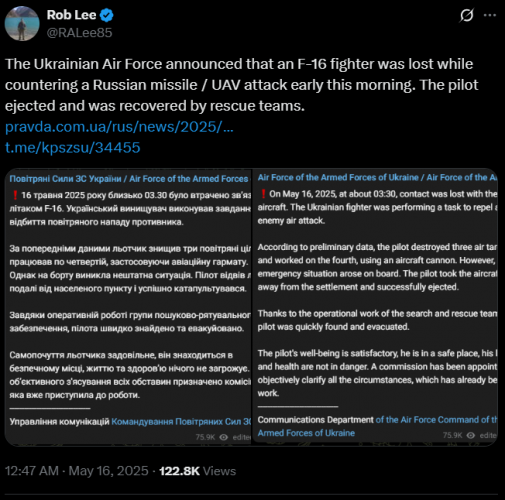
So drones are downing sukhoi's and falcons apparently.
View attachment 770280
but that "an emergency occured" during the interceptuon of drones and the pilot had to eject from the aircraft... Not the same as being downed by a drone.
If they can add extra funding to the budget then they should certainly be procuring more F-16 and F-15 otherwise the US Air Force is increasingly looking like they are flying a bunch of classic cars.
Not really very honest reporting by TWZ, I expect Allen taking the questions on notice is essentially his way of saying we aren't even thinking about that. Unless there was a drastic increase in F-16 production it is unlikely the price would reduce significantly compared to just buying more F-35s setting aside the cost pathway to develop a Blk 80 that was actually worthwhile for the USAF to operate. The real solution is to fund the F-35 at the rate previously expected, in the 80+ a year mark, and not languish in the 40s.
What is the main if any difference to the Scorpion from the JHMCS Helmet Mounted Displays?


At this point in time, given JHMCS production started in '02, maintainability and parts availability may be a major issue.What is the main if any difference to the Scorpion from the JHMCS Helmet Mounted Displays?

The latest F-16 variant is also being integrated with the JHMCS II which was launched back in 2012/13. Existing JHMCS users can choose between upgrading to JHMCS II, upgrading existing JHMCS to JHMCS - Digital or the Scoprion HMD which is a more cost effective option to all new helmet like a JHMCS II or something else.Scorpion HMD is newer (designed in 2008), designed using a full color wave-guide display (not a visor projection), can be used with NVG's, lighter weight, more accurate, does not require a custom helmet...
Being able to be used with NVGs was part of the JHMCS spec, so that's not an advantage for Scorpion. Meanwhile, if you're hanging a couple of pounds of gear off a helmet that has to go through ejection forces, then an individually fitted, integrated design may be precisely what you want, particularly if it can integrate night vision without hanging NVGs off the front of the helmet.Scorpion HMD ... can be used with NVG's, ...does not require a custom helmet...

Can you blame them for taking precautions though? They haven't met these jets in a real combat environment yet , so this is hardly something shocking enough to use as a propaganda material.
You gotta expect the unexpected...
USAF testing AGM-84N Block II+ Harpoon models off their F-16D (looking very snazzy in Have Glass V)
The "N" model as of right now is unique to the Navy and carried by Super Hornets.
Who would be the potential users of AShMs carried by F-16s?
I suppose Korea and countries in SEA?
SEA Nations maybe e.g Phillipines who also interested in acquiring F-16's. Thailland too. Tho expect MTCR compliant shorter range version.

My first thought was actually PACAF, as the only other user of LRASM is Australia. With three wings of F-16s, PACAF can take advantage of existing warstock rather than having to wait for B-1s.Who would be the potential users of AShMs carried by F-16s?
I suppose Korea and countries in SEA?
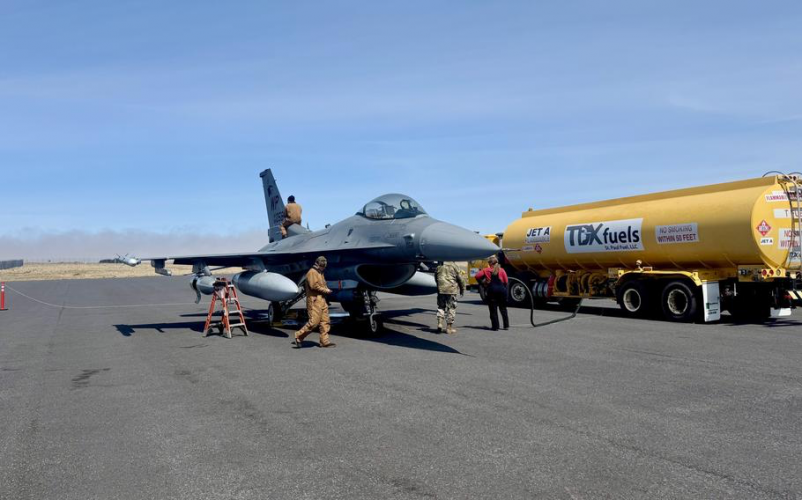
I don't think so. New Blk 70 aircraft have APG-83 and also still have the bird slicers unless that is a USAF only mod.When reading this "Feel Good" story on Stripes, I noticed these F-16's were lacking their "Bird Slicer" IFF antennas on the nose - has APG-83 removed their need?

has APG-83 removed their need?
When reading this "Feel Good" story on Stripes, I noticed these F-16's were lacking their "Bird Slicer" IFF antennas on the nose - has APG-83 removed their need?
https://www.stripes.com/theaters/as...emergency-landing-alaska-island-18016762.html
View attachment 772492

F-2 has then as does the Legacy Hornet.I hope I can ask this question without going completely Crazy Ivan on the thread but... how many fighter jets have the bird slicer IFF arrays in front of the windscreens like the F-16s do? I've seen them, I believe, on the IDF Chung Kuo light fighter out of Taiwan, but I don't think I've seen them anywhere else.
By golly, you are correct. (I am ashamed to say I looked them up to make sure, for which I apologize most humbly.)F-2 has then as does the Legacy Hornet.
Gen. Deptula: There’s no legal prohibition that outright prevents U.S. pilots—those no longer on active duty—from supporting Ukraine, just as many U.S. ground veterans have done. The real challenge is practical and political, not legal. Flying an F-16 in combat isn’t just about sitting in the cockpit—it’s about full integration into command and control systems, rules of engagement, and the overall air campaign plan. That said, with proper diplomatic channels and agreements in place, it’s entirely feasible to allow experienced American pilots to contribute—particularly in advisory or training roles, as well as in combat if they fly under Ukrainian command.
Let’s not forget: Ukraine’s air defense depends heavily on Western-supplied systems, and American pilots bring unmatched expertise in maximizing those systems' potential. If the decision were made, and the integration issues worked out, they could make an immediate difference.

And there's nothing Russia can do about it. In this video, I dive into how Ukraine’s Air Force, backed by the non-profit Come Back Alive and state oil company Ukrnafta, has deployed a fleet of custom-built ground vehicles to support F-16 operations from just about anywhere. Think mobile weapon loaders, tactical briefing rooms on wheels, and what I can only describe as an Air Force RV, with a shower.
This is the very definition of "austere" and expeditionary operations.
Ukraine’s airfields are being hunted relentlessly by Russian drones and missiles, and standing still is a bad idea. So, the Ukrainians are doing what they do best: moving fast, adapting faster, and teaching NATO how to wage war in the 21st century.
I break down the entire system, from the Iveco and Peugeot-based mobile maintenance trucks to the MAN 6x6 mission planning rigs, and explain why this mobile strategy could be NATO’s future, not just Ukraine’s present.
This video also explores how this dispersed operations model fits perfectly with NATO’s Agile Combat Employment (ACE) doctrine, and what it means for the survivability of F-16s in a contested battlespace. From highway landings to mobile command centers, Ukraine is turning its air war into a rolling thunder campaign.
I think I'm dying from laughter right now, yikes.and teaching NATO how to wage war in the 21st century.
And there's nothing Russia can do about it.