exclaimedleech8

ACCESS: Top Secret
Joined
30 September 2024
Messages
582
Reaction score
632
Ceramics are remarkable materials. They can be easily molded into arbitrary shapes, they are hard, strong, able to survive extreme temperatures, and resistant to corrosion. But as anyone who has dropped a coffee mug knows, they aren't very tough and are prone to sudden failure. But DARPA has launched Intrinsically Tough and Affordable Ceramics Today (INTACT) to try and find ways to make ceramics that merely bend rather than shattering. DARPA is famous for its very high failure rate, but there are some researchers who have claimed success in making tough ceramics, so perhaps this will be one of the rare ones that succeed, and if not, the knowledge gained should make that goal achievable in the future.

DARPA is of course interested in this for military applications, they want stronger and lighter airplanes, trucks, and submarines and engines that can be run at higher temperatures. But the benefits to us civilians would also be enormous, perhaps greater than DARPA's most famous invention: the internet.
 
Last edited:
A bit of hype there: Tungsten Carbide is a ceramic, and it doesn’t shatter easily.

Still, will be an interesting programme to follow.

By the way, what’s the source?
 
Ceramics are remarkable materials. They can be easily molded into arbitrary shapes, they are hard, strong, able to survive extreme temperatures, and resistant to corrosion. But as anyone who has dropped a coffee mug knows, they aren't very tough and are prone to sudden failure. But DARPA has launched Intrinsically Tough and Affordable Ceramics Today (INTACT) to try and find ways to make ceramics that merely bend rather than shattering. DARPA is famous for its very high failure rate, but there are some researchers who have claimed success in making tough ceramics, so perhaps this will be one of the rare ones that succeed, and if not, the knowledge gained should make that goal achievable in the future.

DARPA is of course interested in this for military applications, they want stronger and lighter airplanes, trucks, and submarines and engines that can be run at higher temperatures. But the benefits to us civilians would also be enormous, perhaps greater than DARPA's most famous invention: the internet.
So rubber ceramics, eh? Boy howdy, I sure wish I could partake in any of the substances making the rounds at DARPA for the past few decades... It sure must be fun to work for an organization (in)famous for its very high failure rate - pass the bong, please...
 
So rubber ceramics, eh? Boy howdy, I sure wish I could partake in any of the substances making the rounds at DARPA for the past few decades... It sure must be fun to work for an organization (in)famous for its very high failure rate - pass the bong, please...
Purdue University researchers seem to have managed it
 
Purdue University researchers seem to have managed it
It would be cool if they could send me a sample to do my own independent evaluation/research. And for no particular reason whatsoever, Starlite, see https://en.wikipedia.org/wiki/Starlite, spontaneously came to my mind as well. But barring that, I'd settle for having either one of the original Mythbusters perform their own tests, or have the US Marines have their way with it for a day or three at say Camp Pendleton, which on bad (good?) days is within hearing range of our humble abode. Over the decades I've learned though that DARPA is suuuperlooong on promises and xtrshrt on deliveries (fer sure sounds like a cushy desk jockey dream job outfit though!!!).
 
Last edited:
It would be cool if they could send me a sample to do my own independent evaluation/research. And for no particular reason whatsoever, Starlite, see https://en.wikipedia.org/wiki/Starlite, spontaneously came to my mind as well. But barring that, I'd settle for having either one of the original Mythbusters perform their own tests, or have the US Marines have their way with it for a day or three at say Camp Pendleton, which on bad (good?) days is within hearing range of our humble abode. Over the decades I've learned though that DARPA is suuuperlooong on promises and xtrshrt on deliveries (fer sure sounds like a cushy desk jockey dream job outfit though!!!).
Unlike Maurice Ward, the people who invented preloaded ceramic are trained scientists working at a well regarded university and they aren't keeping their methods a secret.
 
A couple of years back, wasn't there a Uni team mixing shredded 'fibre glass' into more familiar ceramics ??

IIRC, it was a boro-silicate 'web' rather than mere 'basaltic'.

IIRC, one of the drivers was to find anti-shatter reinforcement, for 'progressive failure' of eg turbos rather than 'disassembly to dust'. The other was to find mix that gave more predictable shapes after firing etc. Efficiently machining ceramics is non-trivial, especially if there are significant internal stresses....

Incidentally, and a tad more 'down to earth', could big 'green' pottery be usefully accelerated by progressive vacuum de-gassing ./ freeze drying ??

One of my Sci-Fi tales hopes to make IBC-sized pots thus...
 
Reminds me of something I read a few years ago and now can't find. Somebody had made some progress following the biomimicry route trying to crack how clams make shells that are both hard and tough. I'll post more if I find it.
 
DARPA may have to work with the French in order to obtain the proper Plaster of Paris compounds. There is also a UK company called Sir Ramics, another very good source for the materials but only open at knight.

Now being serious, we did look at using different types of ceramics for hydraulic component applications, check valve balls and poppets, spool and sleeve lap assemblies, etc. We found companies which produced pre-fired, solid ceramic shapes which are machinable when excellent wear characteristics. Impact loads were somewhat of an issue for electrohydraulic control valve applications, had to pay attention related hydraulic damping of the devices.
 
Another benefit of ceramics I forgot to mention: they can be made from the most abundant materials on earth. Silicon (for Silicon Nitride and Silicon Carbide) makes up 27% of the earth's crust compared to 6% for iron.
 
I do not dispute the usefulness of the concept, but it will be very difficult to maintain the structural integrity of the joints between the metal parts (hatches, propeller shaft packings, torpedo tube gates) and the ceramics. How will these joints react to extreme pressure at depth or to explosions of depth charges, or to the vibration of the propellers in resonance?
 
I do not dispute the usefulness of the concept, but it will be very difficult to maintain the structural integrity of the joints between the metal parts (hatches, propeller shaft packings, torpedo tube gates) and the ceramics. How will these joints react to extreme pressure at depth or to explosions of depth charges, or to the vibration of the propellers in resonance?
If the ceramic is good enough, it could be used to make all of those things. But let's cross that bridge when we get to it. Speaking of which, a ductile ceramic would be an excellent material for building bridges... as well as houses, cars, roads, dams, aircraft, and spacecraft.
 
Purdue University researchers seem to have managed it
My utterly simple criterion is "Hic Rhodus, hic salta". "*Seem to* have *managed* it" does most decidedly *NOT* cut the mustard in my very own particular curmodgeon corner of this here universe, especially since technologies are *developed*, not "managed". Not to hurt anyone's feelings (get it :D? That was irony/sarcasm!!!), but I'm a staunch universal agnostic (hey, maybe I should form a cult! Nah, too much work for too little potential market share...) with a German Diplomingenieur (and yes, I realize we're a dying breed, since Germany has long since my graduation caved in to the Bachelor/Master system of TV dating shows academic degrees) Aerospace Engineering Degree. Crusty old PMS (Pale Male Stale) aerospace engineer rant out - now where did I drop my microphone? But I'm not bitter, no siree...
 
Last edited:
If the ceramic is good enough, it could be used to make all of those things. But let's cross that bridge when we get to it. Speaking of which, a ductile ceramic would be an excellent material for building bridges... as well as houses, cars, roads, dams, aircraft, and spacecraft.
No metal in contact with the ceramic both inside and outside the submarine?

Ceramic power shafts, ceramic propellers, ceramic gears to vary the pitch of the blades, ceramic rotation axes of the depth planes, ceramic locking locks of the hatches that withstand daily use in diving?

How to attach the locking mechanisms of the launch tube gates to the ceramic gates? With ceramic joints?

And then there is the problem of maintenance, will it be necessary to cut portions of ceramic from the hull every time a component needs to be changed?
 
Technical ceramics are not like your average toilet, SIC for example is an excellent material for many purposes, even for exhaust valves. Mercedes had some Production engines with SIC exhaust valves (3 V gasoline and 4v Diesel) and they worked perfectly (bouncing several hundred million times on the valve seats...). Unfortunately, they cost around three times as much as metal valves (guess around 20 Euro), so that they stopped is after some years. SIC can also be used for piston pins, but most rule makers in motorsport prevent this.

In the chemical industry you can even find large components being made out of SIC, which is indeed very expensive, but sometimes the only way.

So I do find this idea very logic, despite connecting and sealing of large components out of SIC might be difficult, but it is already being done in the chemical industry.
 
Incidentally, and a tad more 'down to earth', could big 'green' pottery be usefully accelerated by progressive vacuum de-gassing ./ freeze drying ??
IIRC, Tungsten Carbide is shaped green and then fired, and shape touched up with a diamond tool.

I'm not sure if the heat is just for drying or for causing a chemical change in the pottery. I know that "high firing" things ends up making them impervious to water.
 
Ceramics in civil engineering and architecture especially interest me. Roads could be made out of a series of lightweight modular tiles that could be laid down far faster than asphalt. Bridges could be built with far less material. Houses could be cantilevered off the sides of hills.
 
Roads could be made out of a series of lightweight modular tiles that could be laid down far faster than asphalt.
What kind of, oh what's the right word?, substrate/foundation would those tiles be laid on?
I'm thinking of this midwest's seasonal flux from today's "...EXTREME HEAT WARNING REMAINS IN EFFECT FROM 11 AM SUNDAY TO 8 PM EDT TUESDAY..."
to winter's subfreezing
and how the ground would move with that cycle.
Keeping tile junctions smooth without one tile edge rising or falling below the adjacent seems a challenge.
 
What kind of, oh what's the right word?, substrate/foundation would those tiles be laid on?
I'm thinking of this midwest's seasonal flux from today's "...EXTREME HEAT WARNING REMAINS IN EFFECT FROM 11 AM SUNDAY TO 8 PM EDT TUESDAY..."
to winter's subfreezing
and how the ground would move with that cycle.
Keeping tile junctions smooth without one tile edge rising or falling below the adjacent seems a challenge.
The tiles would interlock and the ground they are laid on would still have been graded in advance.
 
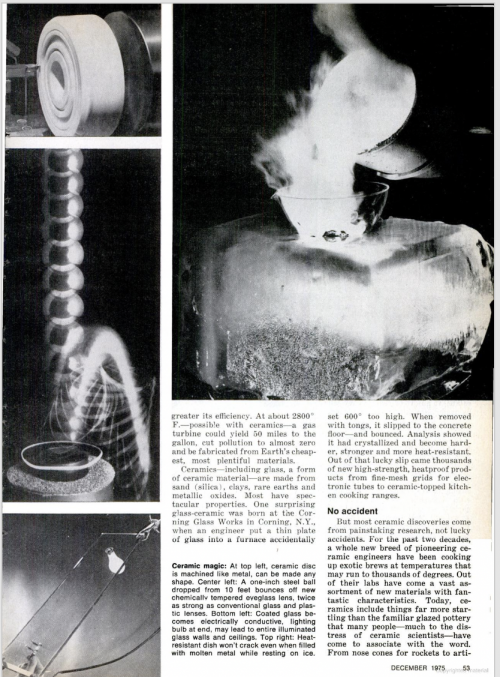
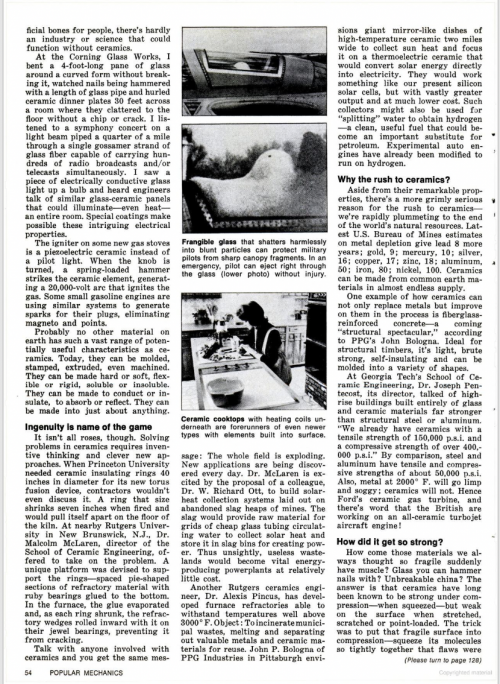
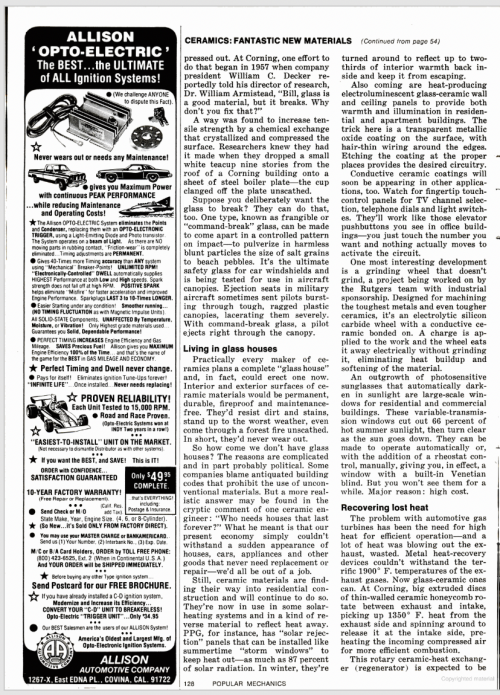
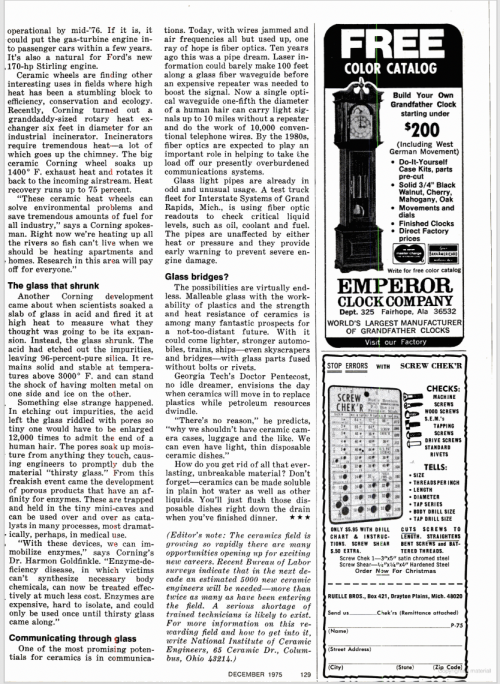
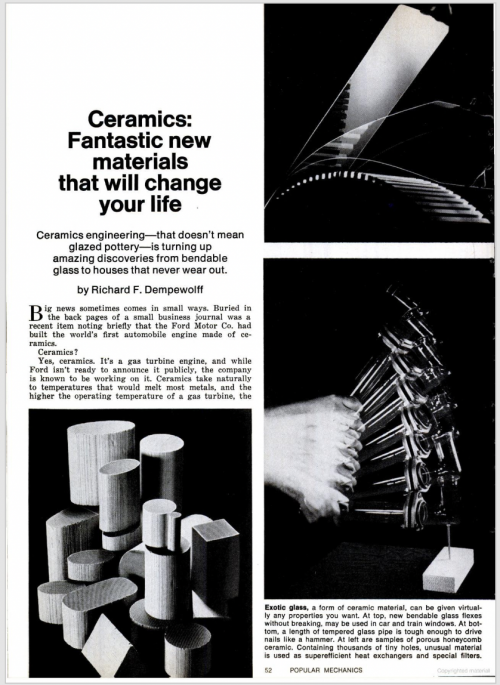
This article from the December 1975 Popular Mechanics outlines some wild ideas from the last time there was a great dash of optimism around ceramics including houses, skyscrapers, bridges, and even disposable ceramic dishes. Some of the things did come to pass, most notably fiber optic communication, as well as cooktops and jet engines (though they couldn't get that to work for automotive turbines. Screenshot 2025-06-21 at 3.49.39 PM.png Screenshot 2025-06-21 at 3.49.45 PM.png Screenshot 2025-06-21 at 3.49.52 PM.png Screenshot 2025-06-21 at 3.50.03 PM.png Screenshot 2025-06-21 at 3.50.10 PM.png
 
Another important application: heat shields. If you remember, one of the Space Shuttle's biggest problems was the beating that the ceramic heat shield took on reentry, requiring months of repair between launches.
 
Ceramics aren't just extremely resistant to heat, they are also virtually immune to corrosion. That would open up a host of new applications for supercritical water which can easily break down rocks for the extraction of oil (it can also upgrade the oil in situ, reducing the need for refining), neutralize all manner of toxic waste, and more efficiently transfer heat in steam power plants
 
Ceramics aren't just extremely resistant to heat, they are also virtually immune to corrosion. That would open up a host of new applications for supercritical water which can easily break down rocks for the extraction of oil (it can also upgrade the oil in situ, reducing the need for refining), neutralize all manner of toxic waste, and more efficiently transfer heat in steam power plants

Modern steam power plans are allready using supercritical water, since decates. I think the same is true for oil extraction from rocks.
 
It only makes sense for slate rock oil, not for anything which needs to be pumped up. If it is large scale or not depends on definition, large in term percentage of slate rock oil or oil in generel?

BTW, Ceramics in construction of briges and building is standard since thousands of years. There is even a ceramic which can be cast in liquid state and form can form a cupola when it dries. The Romans already invented it...
 

Similar threads

Back
Top Bottom