I think they're going with satellite constellations for AMTI now.


View: https://x.com/AirPowerNEW1/status/1932921298365436161
 
Last edited:
While looking for something else at the weekend I came across a 1999 magazine article about the original Boeing AEW&C proposal to the RAAF that jogged my memory. I'd forgotten how long ago the E-7 programme started.
I'm not implying that the E-7 is obsolete tech, rather that the USAF missed the bus in replacing the E-3 and now finds itself between a rock and a hard place. Waiting for space-based tech that may or may not deliver in the next 10-15 years seems a folly to me.
Obviously the E-2D is seen as the cheapest off-the-shelf solution at this moment. Given how the USAF hates buying USN kit, I'm sure this wasn't an easy or popular decision.

I don't really buy the 'austere' airfield thing, I mean if they wanted austere then something like Crowsnest would be even more austere!
Also interesting that the AEW UAV seems out of the picture, I would have thought the USAF would have reached for that before choosing the E-2D. Which implies they still want to keep a human in the loop at the scene of the action. Which then raises why space-based would be better than that?
 
A bit of a misunderstanding. I was thinking same thing would happen to P-8 as it did with E-7.

We have the same theater (Pacific) and the same airframe (B737). USAF says airframe is not survivable in that theatre and for the Navy it magically is?

I think the primary argument Hegseth has against the E-7 is budgetary. I am making the survivability argument. But in any case P-8 is already in service and there is nothing else in service to replace it anyway.
 
(from the link above)

Yes it does. It can't go as high as a jet powered aircraft, hence see as far above topographic heights. That's why USAF traded their Connies for E-3.
Then it's a bold move and that is remarkable.

Why would anyone want to station AEW&C aircraft further forward anyway. That reasoning they gave doesn't make much sense to me tbh.
 
Why would anyone want to station AEW&C aircraft further forward anyway. That reasoning they gave doesn't make much sense to me tbh.

The reasoning was that it will get shot down, it was gold plated and not needed because well..space...And here are 9 E-2D's to compensate for the capability..and they will be forward deployed and somehow survive even though you will need to have more of them to cover similar area for similar time and need them to be closer etc. Most other arguments are people working backwards and trying to justify the decision. Its cope for the most part :).

OSD is willing to accept the risk of loss of AEWC capability and is bullish on space. Perhaps that optimism is because they've upped investments in space in their request and see the freeing up of resources allowing them to accelerate certain space based efforts. In which case, I'm sure they'll articulate that as they discuss this decision in the coming weeks.

We will see if Congress will let E-3's retire and be replaced by handful of E-2Ds. Also, apparently the E-7 Mid Tier Acquisition development program is still funded so Boeing is still working towards developing a USAF configured E-7 and delivering initial prototypes in 2027

 

That Twitterer seems to be conflating NGAD-the-fighter with NGAD-system-of-systems.

When the E-7 was selected in 2023 the USAF was intent on delivering space-based surveillance within a decade but still said the E-7 would be the “principal airborne sensor for detecting, identifying, tracking, and reporting all airborne activity to Joint Force commanders."

NGAD as an overall program has been running since 2014. The E-7 was, as far as I can tell, part of it.
 
That Twitterer seems to be conflating NGAD-the-fighter with NGAD-system-of-systems.
The NGAD FoS and SoS is called out in my tweet there. And by that, I mean the broader effort and not the PCA platform. AF has included AMTI capability in that NGAD SoS and broader portfolio with several references to that over the years in public documents. It is safe to assume that the NGAD portfolio is investing in AMTI technologies and capabilities. Which makes sense given how important that is going to be to the broader AD effort.

Of course E-7 approval was in keeping with that and the capabilities were expected to be synergistic and complementary (It had to be, it was conceived and launched once NGAD was well into development). We’ve just moved away to that and now appear to be willing to take that risk of airborne AMTI loss with E-3's being retired with a small number of E-2D's replacing that capability which is insufficient from a capability or capacity stand point. The concerning bit here is that this push is OSD and not USAF driven. I would love for Congress to get a panel of experts to testify around the pros and cons of this decision to help them decide their position instead of just rubber stamping the SecDef because their districts may get E-2d's now to replace the E-3s.
 
Last edited:
That Twitterer seems to be conflating NGAD-the-fighter with NGAD-system-of-systems.

When the E-7 was selected in 2023 the USAF was intent on delivering space-based surveillance within a decade but still said the E-7 would be the “principal airborne sensor for detecting, identifying, tracking, and reporting all airborne activity to Joint Force commanders."

NGAD as an overall program has been running since 2014. The E-7 was, as far as I can tell, part of it.
Last I heard, sapce-based hypersonic detection (full coverage) and tracking this year, GMTI (full coverage) 2026, AMTi (full coverage) 2029. Some assets for the latter are already up there though, as mentioned in the article I linked.
 
While looking for something else at the weekend I came across a 1999 magazine article about the original Boeing AEW&C proposal to the RAAF that jogged my memory. I'd forgotten how long ago the E-7 programme started.
I'm not implying that the E-7 is obsolete tech, rather that the USAF missed the bus in replacing the E-3 and now finds itself between a rock and a hard place.
Not only that, there's the whole E-10 saga to fit in before you even get to the E-7!
 
Last I heard, sapce-based hypersonic detection (full coverage) and tracking this year, GMTI (full coverage) 2026, AMTi (full coverage) 2029. Some assets for the latter are already up there though, as mentioned in the article I linked.

I am aware of the SDA proliferated constellation handling coms and IR LEO tracking (delayed to summer with a years worth of launches scheduled, so not operational this year). What constellation(s) handle GMTI? Presumably NROs proliferated constellation?
 
Hello folks, if not mentioned before, I highly recommended to read the following report “The Department of the Air Force in 2050” by Frank Kendall, who served as the 26th Secretary of the Air Force during the former administration. The Pentagon and the new administration appears to reflect many of his views. The premise suggests that enablers such as tankers and AWACS may not be survivable in the Indo-Pacific region.
Frank Kendall said:
[...]The Department of the Air Force (DAF) has already begun the transition from reliance on Air Force systems like Airborne Warning and Control System (AWACS) and Joint Surveillance Target Attack Radar System (JSTARS) to space-based surveillance sensors for direct operational support, especially surface and air moving target tracking and targeting. [...]
Source (PDF):
 
Hello folks, if not mentioned before, I highly recommended to read the following report “The Department of the Air Force in 2050” by Frank Kendall, who served as the 26th Secretary of the Air Force during the former administration. The Pentagon and the new administration appears to reflect many of his views. The premise suggests that enablers such as tankers and AWACS may not be survivable in the Indo-Pacific region.

Source (PDF):

I simply have an exceptional hard time to understand the push for space based systems, which are virtually undefendable and incredibly vulnerable. In any hot war these are gone within hours or days, and then what, will the USAF be blind at long ranges? Putting all eggs in one basket was never clever, neither was throwing billions at perceived super weapons. Truly, some people haven't learned from SDI whatsoever.

The US Military appears incredibly schizophrenic right now, across all branches.
 
The reasoning was that it will get shot down, it was gold plated and not needed because well..space...And here are 9 E-2D's to compensate for the capability..and they will be forward deployed and somehow survive even though you will need to have more of them to cover similar area for similar time and need them to be closer etc. Most other arguments are people working backwards and trying to justify the decision. Its cope for the most part :).

OSD is willing to accept the risk of loss of AEWC capability and is bullish on space. Perhaps that optimism is because they've upped investments in space in their request and see the freeing up of resources allowing them to accelerate certain space based efforts. In which case, I'm sure they'll articulate that as they discuss this decision in the coming weeks.

We will see if Congress will let E-3's retire and be replaced by handful of E-2Ds. Also, apparently the E-7 Mid Tier Acquisition development program is still funded so Boeing is still working towards developing a USAF configured E-7 and delivering initial prototypes in 2027
Purely budget driven. Hegseth said the E-7 is vulnerable. So they replace it with a system with less range, less endurance, and with a radar that has less capability.

I'd like to blame it on appointing someone as SecDef whose main qualification was that he was a host on Fox and Friends. Or that his main military experience was being in the Minnesota National Guard and servicing in a Civil Affairs unit in Iraq. But I think there are larger issues at play.
 
I simply have an exceptional hard time to understand the push for space based systems, which are virtually undefendable and incredibly vulnerable. In any hot war these are gone within hours or days, and then what, will the USAF be blind at long ranges? Putting all eggs in one basket was never clever, neither was throwing billions at perceived super weapons. Truly, some people haven't learned from SDI whatsoever.
There's a difference between having a handful of satellites that are doing the job and having a couple hundred of satellites doing the job.
 
And Falcon 9 can put up a lot of satellites in a hurry. ;)

Modern space-launch capability is not like even early 2000s space-launch capability... much less 1990s etc.
 
And Falcon 9 can put up a lot of satellites in a hurry. ;)

Modern space-launch capability is not like even early 2000s space-launch capability... much less 1990s etc.
Not if someone takes out your launch facility with an HGV* full of Kamikaze drones. Or just straight up plasters it with HGVs**.
*Heavy Goods Vehicle
**Hypersonic Glide Vehicle
Same acronym but very different things!
 
Right now SpaceX is launching from Vandenberg AFB on the California Coast and from Cape Canaveral on the Florida coast... and is preparing a launch facility in Texas (near the coast of the Gulf of Wherever).

Cruise missiles from subs are a definite possibility. ;)
 
Right now SpaceX is launching from Vandenberg AFB on the California Coast and from Cape Canaveral on the Florida coast... and is preparing a launch facility in Texas
Hmmm...interesting. Space-based AEW, cancelled Wedgies, HaHaHawkeyes. Wonder if there is some ever so slight connection...

Chris
 
Not if someone takes out your launch facility with an HGV* full of Kamikaze drones. Or just straight up plasters it with HGVs**.
*Heavy Goods Vehicle
**Hypersonic Glide Vehicle
Same acronym but very different things!
That just stops the US from replacing destroyed constellations. If the constellation is already up you're down to maybe being able to poke holes into it for a short time.

You drop an HGV on the US and it's going to be on like Donkey Kong. If you're lucky it won't result in your country ceasing to exist and instead you're just going to get the "country leadership change team" deployed on you. Marines, 82nd Airborne, and whoever else is up in rotation for immediate deployment.
 
That just stops the US from replacing destroyed constellations. If the constellation is already up you're down to maybe being able to poke holes into it for a short time.

You drop an HGV on the US and it's going to be on like Donkey Kong. If you're lucky it won't result in your country ceasing to exist and instead you're just going to get the "country leadership change team" deployed on you. Marines, 82nd Airborne, and whoever else is up in rotation for immediate deployment.
Maybe some other random middle east country, but defeating China conventionally is just a wet dream. China launching sustained strike on CONUS in an all-out war is quite a realistic scenario especially with H-20 coming online
 
That just stops the US from replacing destroyed constellations. If the constellation is already up you're down to maybe being able to poke holes into it for a short time.

You drop an HGV on the US and it's going to be on like Donkey Kong. If you're lucky it won't result in your country ceasing to exist and instead you're just going to get the "country leadership change team" deployed on you. Marines, 82nd Airborne, and whoever else is up in rotation for immediate deployment.

You don't need that level of nihilism to defend a country. Launch sites infrastructures are built to be rapidly erected after being blasted by a launch failure...
Think Chain Home antenna paragdym during BoB.

Regarding the road HGV (excellent, @Hood !), Cap Canaveral is the panacea of defense in that regard.
 
Maybe some other random middle east country, but defeating China conventionally is just a wet dream. China launching sustained strike on CONUS in an all-out war is quite a realistic scenario especially with H-20 coming online

ICBM HGVs and locally sourced UAVs are options, but H-20 will not have anything like that combat radius. B-52s do not have that endurance.
 
ICBM HGVs ally sourced UAVs are options, but H-20 will not have anything like that combat radius. B-52s do not have that endurance.
Off topic, but H-20 currently from consensus in the PLA watching circle could potentially be a Tu-160 MTOW cruise missile carrier with enough range with a single refueling to hit CONUS via air launched cruise missile or ballistic missile. B-52J with new engines and refueling could strike China mainland taking off from CONUS as well. H-20 purely for strike within second island chain as of right now seems mostly redundant with J-36/H-6 and JH-XX, IMO it is more likely that H-20 would end up being a larger than B-2 flying wing with intercontinental range. Which rounds back to the question why would USAF kill the E-7 program which would give early warning against strikes like this.
 
Off topic, but H-20 currently from consensus in the PLA watching circle could potentially be a Tu-160 MTOW cruise missile carrier with enough range with a single refueling to hit CONUS via air launched cruise missile or ballistic missile. B-52J with new engines and refueling could strike China mainland taking off from CONUS as well. H-20 purely for strike within second island chain as of right now seems mostly redundant with J-36/H-6 and JH-XX, IMO it is more likely that H-20 would end up being a larger than B-2 flying wing with intercontinental range. Which rounds back to the question why would USAF kill the E-7 program which would give early warning against strikes like this.

I personally doubt that but we shall see. So far H-20 is theoretical. In any case, I do not think it is relevant - the goal of a space based system would be to put up so many assets that there was heavy overlap in coverage. Kinetically engaging a constellation of hundreds to thousands of platforms would be impossible for most countries and the debris fields would threaten everyone’s satellites, including China’s.

The bigger problem I see is whether such a satellite system could truly be effective in the first place…it would be working over great distances and very high speed with very low dwell time per platform.
 
I think everyone is missing the fact that wing folding would allow the E-2D to be accommodated in a hardened aircraft shelter, making it significantly less vulnerable to a novel drone threat, such as covertly launched, short ranged FPV drones. There is no real way to protect an airliner sized platform with a hardened structure, at least not in the near term. I’d argue that the E-2D opens up a number of other interesting possibilities, such as attaching your AEW platform directly to fighter squadrons and wings, the USAF employing naval aviators and naval training streams, perhaps even having the USAF use older airframes with plenty of remaining flight hours but a limited or expired number of remaining carrier landings. I see an element of genius in this proposal.

As much as we hate to admit it, the E-7 has been overtaken by events in Russia and Iran. It’s a workable AWACS replacement alternative but you just can’t guarantee protection from drones when it’s on the ground. And as a high value asset with a large crew, how is it less vulnerable against a novel long range missile threat than the Russian’s A-50? The E-2D seems to be the optimal solution until the space based platforms are fully up and running in coming years. And even then, I could see USAF E-2Ds being useful for unexpected expeditionary warfare scenarios.
 
I think everyone is missing the fact that wing folding would allow the E-2D to be accommodated in a hardened aircraft shelter, making it significantly less vulnerable to a novel drone threat, such as covertly launched, short ranged FPV drones. There is no real way to protect an airliner sized platform with a hardened structure, at least not in the near term.

Why not? The US has looked at hardened aircraft shelters for strategic bombers before, and if you can design something for a B-52, then you can design something for a 737-derived AWACS. Could even look at the types of hangers that China has built for their Pacific Island bases, although those aren't strictly hardened aircraft shelters, they will keep out FPVs.
 
There is probably even room at Anderson for airliner/bomber sized shelters, though that probably would not protect against direct hits from ballistic missile RVs.
 
Why not? The US has looked at hardened aircraft shelters for strategic bombers before, and if you can design something for a B-52, then you can design something for a 737-derived AWACS. Could even look at the types of hangers that China has built for their Pacific Island bases, although those aren't strictly hardened aircraft shelters, they will keep out FPVs.
Money, E-7 is already considered a money sink and you want them to spend even more money on extremely expensive hardened shelters. Bruh
 
I want to say in fact Pentagon FY26 budget did consist E-7's part,they didn't cancel it
How much procurement funding did they include in the budget for E-7's? Looks like $0. They requested RDTE funds though but about $100 Million less than what the program expected to spend.
 
There's a difference between having a handful of satellites that are doing the job and having a couple hundred of satellites doing the job.

I don't see how sheer number somewhat alleviates the glaring vulnerabilities, especially with all peers already deploying anti-satellite weapons. And anti-satellite weapons and strategies would simply evolve and adapt to counter such a threat posed by the US. An aircraft can react to a threat more proactively/dynamically and doesn't have several penalties imposed on it like satellites.

I'm sure at one point space warfare will get to a point where something like this is viable. But opening yourself up to a capability gap right now, at a time where China for example is expanding their AEW&C fleet seems incredibly optimistic in my eyes, or incredibly misguided.

Technology progressed since the failure of SDI, yes. But many issues remain firmly in place.

Redundancy is a sacred virtue for any military. And I would argue the E-2Ds cannot provide true redundancy due to their increased vulnerability as they need to be deployed further forward in any real threat environment.
 
I think cancellation of E-7 is a mistake, but I think a case could be made for purchasing E-2s for forward basing in the Pacific.

Also I do not understand why the U.S. is not building hardened shelters everywhere. They do not need to be two meter thick types, just a hard shell with a spall liner. Ideally you would want to be able to stop UAVs, cluster bomblet, or thermite charges, which might take something a little more elaborate or layered, but not 2 m of concrete level.

The Israeli attacks along with Spiderweb make it clear where this is going…indeed we have arrived.
 
<Cope>I like the idea of E-2D's for forward basing. We need three to four more such types that are scaled based on how forward they can be (or not). The largest being a 747 or A380 based system and the smallest being something that fits on CCA. And even better still, we need the flying wing AWACS as Quellish shows. Just one forward based E-2D is so lame. Look at what China is doing etc etc. Each comes standard with an inflatable HAS that they can fly around and park. </Cope>

The E-2D play is laughable..when you couldn't afford the primary AEWC and battle management solution but now created a new set of niche needs and are fulfilling it with what's left over from a funding seemingly at the expense of the primary solution needed for a larger swath of need. But that's where we are with all this. Hopefully, this gets restored or they are able to make a better case for why they are pivoting away to a completely unrelated solution at the 11th hour.
 
Last edited:
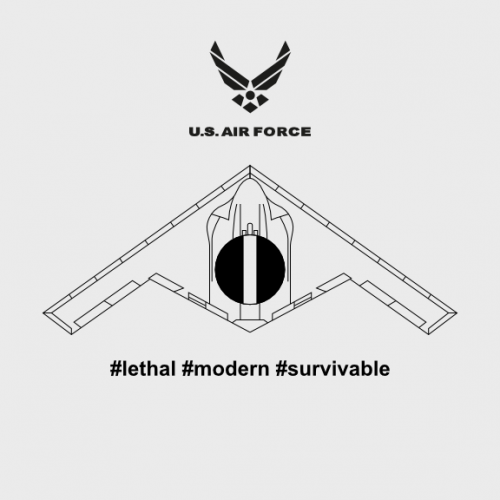
Well, I guess I can post this now that the cat is out of the bag....

View attachment 773934
Put a conformal radar around the wing edges and then maybe you have something. That said the detection range for modern stealth aircraft vs radar from the frontal aspect is likely very low, from above probably signifgicantly higher. ;)
 
Wedgetail has its survivability issues, no doubt, but some of them can be mitigated with thoughtful use and basing changes.

USAF should continue with the E-7 AND integrate Joint E-2D operations, but we gotta pay for $45bn in ICE detention facilities expansion somehow.
 

Similar threads

Back
Top Bottom