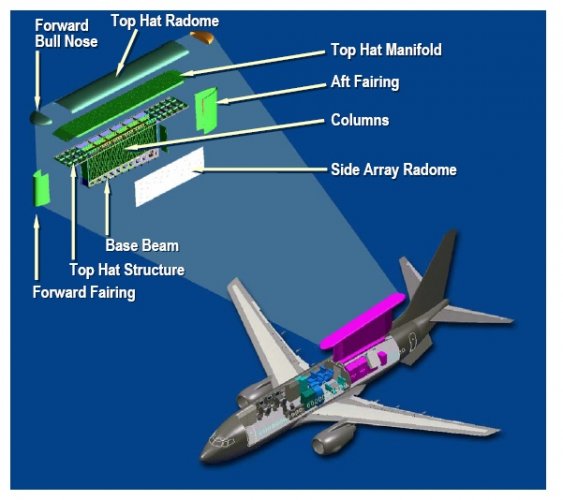
Does anyone have information detailing the E-7A MESA radar architecture/performance? @GARGEAN pointed out in another forum that the "tophat" array in the front and back will be working with less area (therefore smaller aperture) and will have a substantially lower range and resolution than the side arrays. I find it hard to believe frankly, I don't think the USAF would walk itself into an AWACS aircraft that doesn't have full 360° coverage. What do the others think?
Quite a late reply, but the Tophat is not arranged "in the front and back". It is literally arranged the way it's named, atop the main structure. It's an endfire array. It has a smaller array size than the main array for sure, but much bigger than any of the solution that tries to mount a separate for- and aft arrays
 
Last edited:
Maybe this will help clarify:

737_AEW&C_MESA_Radar_Media_Kit 6.jpg

Now the question arises as to why the Tophat emits through small arrays in the fore / aft Bullnoses instead of using arrays in the much larger volume of the Forward / Aft vertical fairings. Cooling, waveguides, structural loads? I don't know.

Screenshot_20250519-112131_1.png
 
Now the question arises as to why the Tophat emits through small arrays in the fore / aft Bullnoses instead of using arrays in the much larger volume of the Forward / Aft vertical fairings. Cooling, waveguides, structural loads? I don't know.
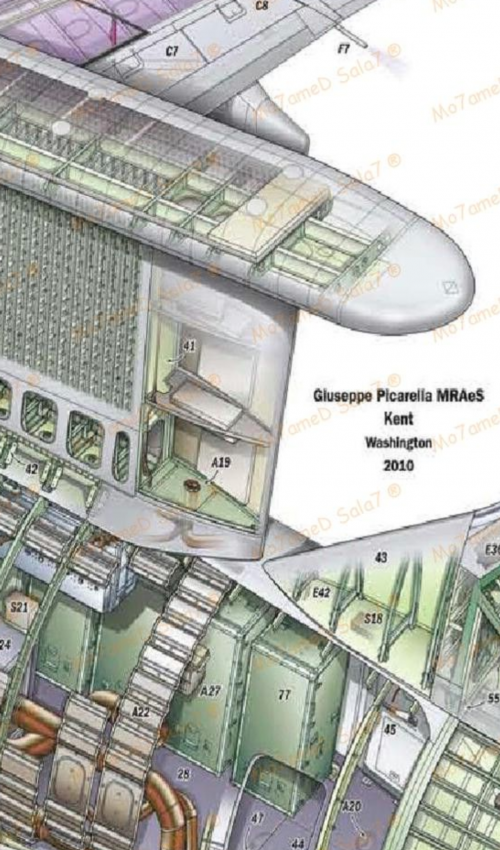
The vertical fairings are all blocked by aircraft structure.

Look at a picture of an E-7 in flight, the tophat array is held horizontal, and the front of the array is just barely above the top of the cockpit.
1024px-%EA%B3%B5%EC%A4%91%EC%A1%B0%EA%B8%B0%EA%B2%BD%EB%B3%B4%ED%86%B5%EC%A0%9C%EA%B8%B0_%287445565660%29.jpg
 
I wonder if this decision will have any effects on the NATO Airborne Early Warning and Control Force stationed here at AFB Geilenkirchen, Germany. Maybe at the next NATO meeting, we will get more information from the US administration, if they want to shorten the US partnership in the NATO Airborne Early Warning and Control Force, and also if they still support the fleet change from Boeing E-3 to Boeing E-7.
 
The E-2D’s turboprop performance, robust landing gear, and arrested landing capabilities mean it can be pushed far forward to very austere operating locations with limited runway length. And it can do this without sacrificing the quality of the data it collects or the efficacy of its use as a battle manager.
(from the link above)

Yes it does. It can't go as high as a jet powered aircraft, hence see as far above topographic heights. That's why USAF traded their Connies for E-3.
Then it's a bold move and that is remarkable.
 
Whilst I appreciate the USAF had its reasons for specifying a bespoke E-7 configuration, which seems to have been a catastrophe, it does seem odd that the FMS-baseline E-7 wasn't considered as an interim option.

The E-7 despite all the delays in getting to a USAF configuration and architecture (a valuable upfront investment for a planned fleet size of two dozen aircraft) was still going to deliver in 2027 or less than two years from now. This cut has more to do about sending a message and severely scaling back the airborne AEW&C investment as opposed to delays on the E-7 itself. If you are planning to spend a third to a fifth of what you planned, then buying a third to a fifth E-7's probably does not make sense.

If you are going to under-invest in your air force as a matter of choice, which is the message here then the service will have to take risk. Here the risk is in the medium term and hoping that the space based AMTI capability actually delivers as designed on time and on cost. The hedge is a severely limited capability relative to the more capable E-7 which the USAF wanted to actually improve once it began fielding in quantity.

The USAF has gone from " we'll field a USAF variant of E-7 and then enhance it over time to meet future threats and needs'' to "cancel E-7 and buy limited number of relatively less capable E-2D's with probably minimal change from whatever the Navy has configured them as. This is an OSD directed decision. It will be interesting to see if Congress will let them retire E-3s as E-2's are brought in. Not that those E-3's have much left in them from a readiness perspective but you are really not getting a lot of battle management out of naval E-2D's no matter how much the SecDef spins this.
 
Last edited:
There was no need for an interim option and the USAF specific enhancements were very much needed. E-7 AEWC was a sizable investment for the Air Force. 20+ aircraft. It was not an attempt to put a program together to buy 4-5 AWACS quickly off the shelf and then move on. For a fleet size that large, it made sense for the AF to have US specific equipment installed and in keeping with its other acquisition programs of same timeframe (F-15EX, T-7, NGAD etc) expect it to possess open mission systems architecture so that upgrades and sustainment could be competed and efficiently acquired and performed.

Hegseth did not chop E-7 because he did not like the E-7 MTA (something that was originally conceived in the Trump 1.0 administration under WIll Roper). He choped it because he did not want to fund it. It was the bill payer for other capability with some of it probably used to accelerate more enduring space based capability. When you don't intend on spending more on defense but want a few dozen billions of annual priorities that did not previously exist in the budget, you have to kill things to pay for them. There's no real way around that predicament. E-7 and FA/XX are just two notable aerospace programs that fit that bill well. There will be others that will be killed as we'll learn once the budget docs are actually made public. Congress can perhaps step in and call for at least a very public and transparent discussion on these rash decisions. But that may be asking for a bit too much.
 
Last edited:
What was actually said at yesterday's House Appropriations Committee Oversight hearing for the Department of Defense. Video is available here: https://appropriations.house.gov/schedule/hearings/oversight-hearing-department-defense

I had the video transcribed at my own expense.

[00:51:12] Hegseth: Well, I appreciate the question, Mr. Chairman. Uh, and priorities and decisions are what we're in the business of on the budget side, on the capabilities side. And I think President Trump has charged us with making the big difficult decisions after a lot of deferred maintenance and deferred decisions, to ignore parochial priorities in large part, and focus on what the department needs and where it needs it and when it needs it, and that that means some tough calls. And there are platforms we've supported as a result, and there's some platforms and systems that we won't support going forward because the services have requested it or we've identified those are systems and platforms that don't orient toward a future threat. And we've learned a lot of things, a lot, a lot from what happened in Ukraine. We've learned a lot from what China is attempting to do and the systems they're building. So if we have systems and platforms that are not survivable in the modern battlefield, or they don't give us an advantage in a future fight, we have to make the tough decisions right now. That's my job. That's the chairman's job. And it's our job to fund those new systems and make tough calls. So the E-7 is an example of that. Um, we're going to exit. We're going to fund existing platforms that are there more robustly and make sure they're modernized. But we believe most of the ISR or a great deal of the ISR in the future will be space based and not in a scientific space based. We hope we'll get there, but in a. We're funding capabilities that will surpass some of those airborne capabilities. So we're willing to continue to review things like the E-7. But from our view, investments in existing systems that carry forward that capability alongside even bigger investments in space based ISR, gives us the kind of advantages we need on a future battlefield.

[00:52:59] Speaker Cole: I think that's a fair point. I will point out I've been on this committee a long time. I watched the US Army waste $29 billion on the future combat system because it was going to be so great, and it didn't, and we wasted a ton of money. We got a platform here that works. Space is great. It's unknown. It's undeveloped. And I would just urge you to look at this pretty carefully as you make the decision. We certainly will as a committee. Um, I don't know how much time I've got left because the clock's not running.

[00:53:32] Speaker1: You're the chairman, so.

And at today's Senate Appropriations Committees hearing "A Review of the President’s Fiscal Year 2026 Budget Request for the Department of Defense". Video available here: https://www.appropriations.senate.g...-budget-request-for-the-department-of-defense

Again, I had this transcribed at my own expense.

[02:29:56] Murkowski: Well, I appreciate that. And, um, appreciate the continued focus. Uh, there's a lot of focus on the INDOPACOM should be. But just remember, we sit right on top of it. We're connected. We're part of that. Um, I'm running out of time. I. I have been concerned. Um, we have E-3 capability, um, up north, of course, but, uh, we were all counting on the E-7 Wedgetail, uh, coming, coming our way. Um, we're kind of limping along up north right now, which is unfortunate. And the budget proposes terminating the program. Um, again, the the E-3 fleet barely operational now. And, um, I understand the intent to shift towards the space based. You call it the air moving target indicators. Um, but my concern is, is that you've got a, you've got a situation where you're not going to be able to to use more duct tape to hold things together until you put this system in place. And so how how we maintain that level of, of, of operational readiness and coverage. I'm not sure how you make it. Speaker4: General Caine?

[02:31:15] General Caine: uh, well, ma'am, thank you for the question. You know, the E-3 and E-3 community have been, uh, really important to us for for a long, long time. And, uh, I'll defer to the comptroller, but but I, you know, the department has a bridging strategy through investing in some additional airborne platforms, uh, in order to gap fill while the space based capabilities come online.

[02:31:40] DoD Comptroller: Yes, sir. Thank you. Uh, ma'am, we do have in the budget 150 $150 million in FY 26 for a joint Expeditionary E-2D unit with five dedicated E-2Ds, and the budget also funds four additional E-2Ds to fill the near-term gap at $1.4 billion.

[02:31:57] Murkowski: And can you tell me how that will will have will that have implications for what we're seeing up north in Alaska?

[02:32:05] DoD Comptroller: I would defer to the Secretary and the chairman on that question, ma'am.

[02:32:11] Hegseth: The answer is yes. I would um, I would file this entire discussion under difficult choices that we have to make. But, you know, the E-7 in particular was sort of late, uh, more expensive and gold plated. And so filling the gap and then shifting to space based ISR is a portion of how we think we can do it best. Uh, considering all the challenges.

 
In February, as part of SECNAV Phelan's confirmation hearings he responded to Advance Policy Questions from congress, including:

The Navy is investing in extending the E-2D Advanced Hawkeye into the 2040s as part of its naval battle management function. What is the Navy’s approach to air battle management command and control and how do the Navy and Air Force intend to execute joint air battle management in a high-end fight?

I understand the Navy, in conjunction with the Air Force, Joint Staff and the combatant commanders, is beginning an Office of Secretary of Defense’s (OSD) Cost Assessment and Program Evaluation (CAPE)-directed study to define the requirements for joint air battle management in a high-end fight. The results of this study will inform me, if confirmed, and the rest of the Navy leadership as to any potential investments needed in airborne command and control capabilities.

Given the new capabilities the E-2D Advanced Hawkeye will bring to the battlespace, and the new tactics and concepts of operation it will enable, does the Navy perceive a need for expeditionary squadrons of E-2Ds? Why or why not?

The E-2D Advanced Hawkeye is designed to operate as part of the carrier air wing (CVW), and it is the airborne centerpiece of the Carrier Strike Group air warfare and surface warfare missions. I understand that in conjunction with the Air Force, the Joint Staff and the Combatant Commanders, the Navy is beginning a study to define the requirements for employment of expeditionary joint air battle management capabilities. The results of this study, to include the concepts of operations, basing options, training, materiel, and doctrine, will inform me, if confirmed, and the rest of the Navy leadership as to any potential investments needed in expeditionary airborne command and control capabilities.

Aviation Week reported that the comments included a potential land-based role for the E-2D Joint Expeditionary element:


As far as I am able to tell, those specific comments were not part of any of Phelan's documented testimony, comments, or answers.
 
Worth noting that the PLA is taking a different approach. The PLA fields some 40-60 AEW&Cs of various types currently (I am not a seasoned PLA watcher so I cannot give a more accurate estimate). They continue to prototype, build, buy, and field them. They also have other projects, as we know, such as high-altitude balloons. Perhaps these Chinese AEW&Cs would be vulnerable targets, but the same could be said for USAF satellites in low-earth orbit. The USAF would certainly stand to lose more than the PLA if LEO were to be taken out via orbital nuclear detonations and/or Kessler syndrome.
 
The USAF would certainly stand to lose more than the PLA if LEO were to be taken out via orbital nuclear detonations and/or Kessler syndrome.
AMTI won't be cheap. They won't fly terribly high, too, if you still want high frequency track.
They're a good, worthy target even if you intercept them with direct ascent weapons.

No need for Kessler, probably no need for even multi-kill vehicles. Just wait for them to overfly hostile area.

I am frankly sceptical of them buying into this dream. There are more survivable/defendable options, but they still put entire atmospheric fight in jeopardy, should anything go wrong. And those aren't easily replenishable either.
 
Worth noting that the PLA is taking a different approach. The PLA fields some 40-60 AEW&Cs of various types currently (I am not a seasoned PLA watcher so I cannot give a more accurate estimate). They continue to prototype, build, buy, and field them. They also have other projects, as we know, such as high-altitude balloons. Perhaps these Chinese AEW&Cs would be vulnerable targets, but the same could be said for USAF satellites in low-earth orbit. The USAF would certainly stand to lose more than the PLA if LEO were to be taken out via orbital nuclear detonations and/or Kessler syndrome.

The PLA has different priorities. Most of its ground based defenses are on the coast, with the interior generally only protected in built up areas with economic or military relevance (Beijing, wuhan, etc). So a lot of their AWACs fleet in wartime would actually be engaged in territorial missions, where as the U.S. need not worry about H-6s over the CONUS, or likely even H-20s.

Not sure how I feel about this. Clearly there are rather horrible range and altitude compromises with this, as well as a couple operator seats (E-2D can use its copilot seat as a director officer technically but I wonder how that works practically). On the other hand, Israel used to take advantage of the fokding wings by putting E-2s in HAS shelters that were fighter sized, and the E-2 would be vastly more forward deployable in every way. It’s worth noting that the APY-9 is, at least up until the KJ-3000, the only airborne UHF radar I am aware of, so it might have an increased capability vs 5th gen aircraft as well. And then there’s the obvious advantage of being built on a hot line currently.


ETA: PLAAF and PLAN probably have closer to 80+ AEW.
 
Last edited:
AMTI won't be cheap. They won't fly terribly high, too, if you still want high frequency track.
They're a good, worthy target even if you intercept them with direct ascent weapons.

No need for Kessler, probably no need for even multi-kill vehicles. Just wait for them to overfly hostile area.

I am frankly sceptical of them buying into this dream. There are more survivable/defendable options, but they still put entire atmospheric fight in jeopardy, should anything go wrong. And those aren't easily replenishable either.

I would presume that some or all parts of the NGAD system would provide passive and active sensor coverage and that all of this data would be stitched together to attempt to provide wide area coverage without dependence on a single high value platform. So that is probably also part of this puzzle that was left unspoken.

The more I think about it, the more I’m left with the feeling that E-7 does not really bring anything to the table in the pacific anyway - where are you going to fly it out of and how would you possibly hide or harden it on the ground? The Spider-Man attacks indicate that huge aircraft that do not fit into almost any hangar or HAS are probably a pointless investment. E-2 has a huge latent advantage in folding wings, even for land based storage.

The more I think about it, the more I am warming to the idea. It may not be optimal in range/altitude but there would be huge advantages in basing and interoperability.

I wonder how hard it would be to make boom compatible version? But also the KC-46 fleet could accommodate this force easily.
 
Not liking this.

Buyers remorse? :)

Actually the more I think about it, the more E-2D is a better fit for ACE operations. The compromises probably need to be made to have any kind of AEW survivability in the Pacific.
 
I would presume that some or all parts of the NGAD system would provide passive and active sensor coverage and that all of this data would be stitched together to attempt to provide wide area coverage without dependence on a single high value platform. So that is probably also part of this puzzle that was left unspoken.
I am a bit skeptical if fighters can replace large aperture, wide FoV c/s band.
We're entering era of thousands of drones, and they're honestly terrifying.
It’s worth noting that the APY-9 is, at least up until the KJ-3000, the only airborne UHF radar I am aware of, so it might have an increased capability vs 5th gen aircraft as well. And then there’s the obvious advantage of being built on a hot line currently.
I think that was part of the goal (as well as simply making narrow array with limited power useful).
On the opposite side, how it'll perform against actual small targets overland?

I understand that US and Russia got cold feet for big AWACS, but what to do otherwise. Swamp Pacific with acoustic buoys?
 
Last edited:
I am a bit skeptical if fighters can replace large aperture, wide FoV c/s band.
We're entering era of thousands of drones, and they're honestly terrifying.

I am confident they cannot, but on the other hand if the choice is aggregate ESM/IR sensors on UAVs supported by active radar from manned fighters is probably superior to a n already shot down AEW. My impression of the J-36 is that it is also an attempt to solve that problem.

I think that was part of the goal (as well as simply making narrow array with limited power useful).
On the opposite side, how it'll perform against actual small targets overland?

I understand that US and Russia got cold feet for big AWACS, but what to do otherwise. Swamp Pacific with acoustic buoys?

I suspect E-2 usage would be predominantly over sea even in USAF use. At the very least, attacking Japan or the PI will involve an over water approach. Not sure how well that radar will work against small UAVs but it should actually be a step up against stealth fighters with vertical surfaces.

I am absolutely certain the WestPac is already swamped with passive sensors, though they are focused on ship targets and probably not buoys, at least in the traditional sense.

I think part of the NGAD project will include huge numbers of ESM/IR sensors on relatively expendable UAVs (see the air launched UTAP-22) along side dedicated MALE/HALE higher end platforms.
 
And has there been consideration that actions to degrade those satellites will be in the Gray Zone, as opposed to the Red Zone of hitting a manned AWACS?

That seems like a minor concern. It’s not like the PRC does not have a similar dependence on satellites…in fact I would argue, more so.

I would be much more worried about the entire ambitious concept being functional in the first place.
 
I think it’s pretty smart move. Could shortcomings be overcomed by simply having a larger number of aircraft?

Agree on the concern of relying too much on satellites. They’re fine now, but that might change in the future (we already have cases of “harassments” in geostationary orbit).

A bit off topic: following this logic, can we expect the same thing to happen to P-8 Poseidon?
 
That seems like a minor concern. It’s not like the PRC does not have a similar dependence on satellites…in fact I would argue, more so.

I would be much more worried about the entire ambitious concept being functional in the first place.
Yeah but that goes back to a diversified fleet of IRS. If china take the risk of mutual degradation of space based IRS they can fall back on their increasing numbers of AWACS alongside fielding J-36 that blends IRS and EMS with kinetics and stealth to stay survivable, whereas for us we putting all our eggs into one basket. The f-47 seems to be closer to the size of the j-50 rather than j-36 (given what they saying about it being affordable), meaning less real estate for large arrays. In fact, China would be incentivized to degrade our space based IRS if they know we got nothing else to fall back on while they do. This is an open invitation to your enemy to checkmate you.

This whole thing reeks of hegseth coming in with an ideological objective to be an agent of radical change and the increasing number of yes men he surrounds himself with (refer to the recent mass firing of his staff).
 
Yeah but that goes back to a diversified fleet of IRS. If china take the risk of mutual degradation of space based IRS they can fall back on their increasing numbers of AWACS alongside fielding J-36 that blends IRS and EMS with kinetics and stealth to stay survivable, whereas for us we putting all our eggs into one basket. The f-47 seems to be closer to the size of the j-50 rather than j-36 (given what they saying about it being affordable), meaning less real estate for large arrays. In fact, China would be incentivized to degrade our space based IRS if they know we got nothing else to fall back on while they do. This is an open invitation to your enemy to checkmate you.

This whole thing reeks of hegseth coming in with an ideological objective to be an agent of radical change and the increasing number of yes men he surrounds himself with (refer to the recent mass firing of his staff).

I generally agree with the above, but I think the increased deployment options of the E-2 might represent a stopped watch being right twice a day.

As for PRC AEW…I doubt that is much more survivable than US examples. Why would that ever be the case? Just because in open source it seems like the PL-15/17 has a range advantage over AIM-120, somehow PRC platforms are immune?

You could put a folded wing E-2 practically anywhere - HAS, tent, aircraft weather shelter, warehouse adjacent to an air strip, thermo camo tent off a dirt strip…while I do think that the decision is being made for simplistic budget reasons, the more I think about it, it could be accidentally quite useful.
 
You could put a folded wing E-2 practically anywhere - HAS, tent, aircraft weather shelter, warehouse adjacent to an air strip, thermo camo tent off a dirt strip…while I do think that the decision is being made for simplistic budget reasons, the more I think about it, it could be accidentally quite useful.
Not to mention if they actually integrate enough with the newer air force assets, they might also have greater integration with the navy.
 
A bit off topic: following this logic, can we expect the same thing to happen to P-8 Poseidon?
Sure. You bet.
As soon as you can drop sonobouys and torpedoes from LEO. And reload after you RTB.
 
How and why? What USAF role would it fill?
A bit of a misunderstanding. I was thinking same thing would happen to P-8 as it did with E-7.

We have the same theater (Pacific) and the same airframe (B737). USAF says airframe is not survivable in that theatre and for the Navy it magically is?
 
Sure. You bet.
As soon as you can drop sonobouys and torpedoes from LEO. And reload after you RTB.

Insert a drone similar to X-47B instead of a jet…or use B-21 (it has the range to stay safe)

Sorry for the off-topic.
 
Last edited:
I wonder if the E-7 is being cut because President Trump has said Golden Dome will be operational at the end of his current presidency, and being that it will be the most powerful air/space defence system in the world, why would such old tech like full-up AEW&C aircraft be needed in any numbers?
 
The efforts the Ukrainians have made to eliminate Russian Mainstays suggests that full-capability battlespace management platforms are still relevant.

A couple of questions for the Hawkeye pushers (including myself, big fan, but there is a limit)

1) Can it refuel from A330 MRTT/KC-135 and KC-46 i.e. jet tankers?
2) Does it have a crew rest area/galley/toilet to allow the longer endurance operations the USAF will probably want?

Back on the late 60s and again in the 70s and finally in the 80s, the RAF concluded the answer to both question was 'No'.

More fast and break things. Including the USAF apparently.

Chris
 
More info on why this is a huge capability loss:
View: https://x.com/Flankerchan/status/1933057553774330265

"Selection of that frequency and platform size constraint tho means that E-2 cant do heightfinding the same way as typical air defense radar do. Instead it relies on Multipath heightfinding where target height information is gleaned from reflection of target that bounced back from the ground. Might works good on ocean as it's basically like mirror but overland.. it's messy as soils have different electrical properties, vegetations and of course urban.

E-3 operates in S-band in some 3-4 GHz, antenna is so much bigger, beamwidth is narrower and more elements can be provided which allow heightfinding by steering the beam on the vertical direction. Thus making it essentially independent from surface electrical properties"
E-3 also larger and have more rooms. Crew can rest, essentially 11 hours or more could be achieved. E-2 is limited to 6-7 hours.
 
Last edited:
It’s worth noting that the APY-9 is, at least up until the KJ-3000, the only airborne UHF radar I am aware of, so it might have an increased capability vs 5th gen aircraft as well. And then there’s the obvious advantage of being built on a hot line currently.


ETA: PLAAF and PLAN probably have closer to 80+ AEW.
If I'm not wrong PLAAF has WZ-9 AEW drones that carry a UHF anti-stealth radar, it was more recently spotted last year but has been flying ever since 2015. These should be able to integrate into PLAAF's AEWC command structure as autonomous sensor nodes.
 
The question is why not go directly with a boosted EC-130V? If folded wings was really the only need, LM would have probably dug an old related study or launched a rapid design effort.
Hercule will be everywhere expeditionary can be done at scale, has the supporting infrastructure, the volume, the refueling receptacle etc...

images
 
Last edited:

Similar threads

Back
Top Bottom