- Joined
- 3 June 2011
- Messages
- 21,094
- Reaction score
- 19,524
And give them some real weapons.Arguably the USs greatest weapon system technological [still] advantage. I’d have SSNs & SSBNs/SSGNs rolling off the assembly line like sausage.

And give them some real weapons.Arguably the USs greatest weapon system technological [still] advantage. I’d have SSNs & SSBNs/SSGNs rolling off the assembly line like sausage.
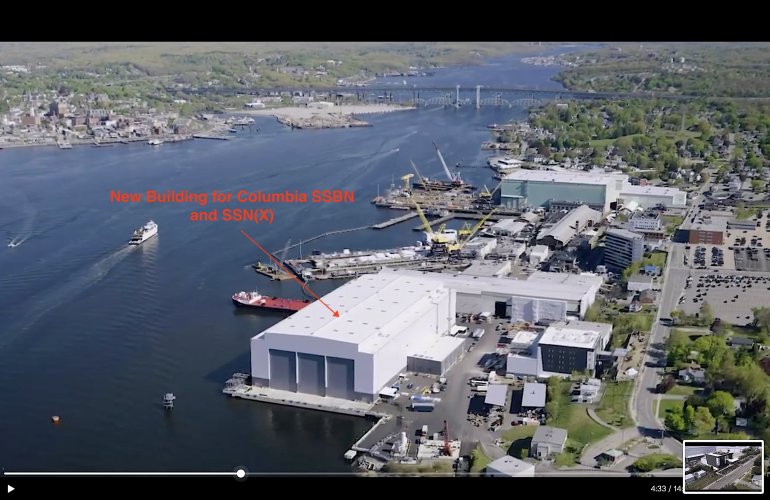
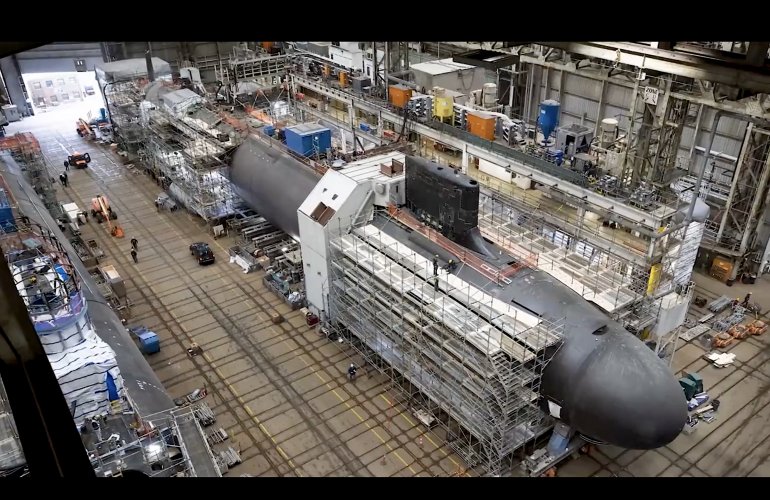
Electric Boat has been expanding its facilities in both Groton, Connecticut and Quonset Point, Rhode Island. In Groton, a new land level facility for the Columbia class SSBNS was built next to the old South Yard sheds (which were originally open, inclined building ways. Many of the early nuclear submarines were built there (Nautilus, Seawolf, Skipjacks, Skates). These were covered over in the 1960's to shield form satellite reconnaissance and subsequently converted to storage sheds. The big green building was the land level facility for the Ohio SSBNs and now the Virginia class SSNs. Not visible are two sheds on the other side of the large green building were two smaller, covered sheds for the LA class SSNs. Those were not land level, but inclined ways. The subs were launched by sliding down the ways into the Thames River (I was there for the USS Hartford SSN "slide"). Land level facilities use mobile carts on rails to move the components during assembly, and then subsequently out to a floating deck that can submerge to place the submarine in the water. The rails can be seen in the Virginia class building photo.Arguably the USs greatest weapon system technological [still] advantage. I’d have SSNs & SSBNs/SSGNs rolling off the assembly line like sausage.
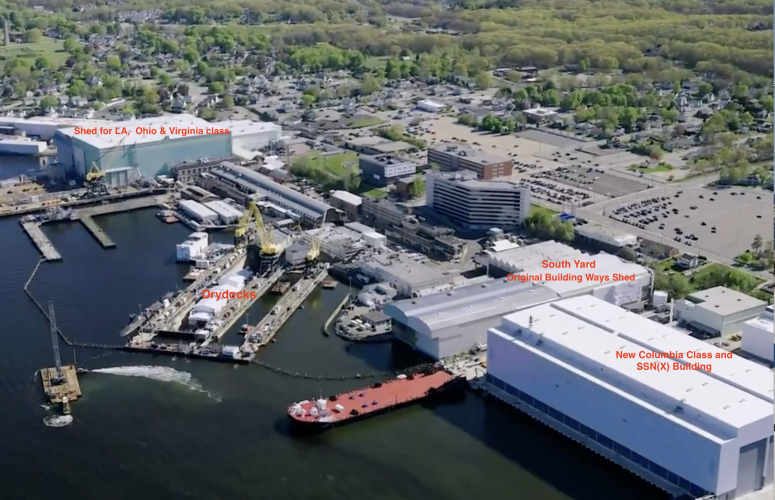

Yeah, I mentioned in another thread that good people are always going to be your real bottleneck:Electric Boat has been expanding its facilities in both Groton, Connecticut and Quonset Point, Rhode Island. In Groton, a new land level facility for the Columbia class SSBNS was built next to the old South Yard sheds (which were originally open, inclined building ways. Many of the early nuclear submarines were built there (Nautilus, Seawolf, Skipjacks, Skates). These were covered over in the 1960's to shield form satellite reconnaissance and subsequently converted to storage sheds. The big green building was the land level facility for the Ohio SSBNs and now the Virginia class SSNs. Not visible are two sheds on the other side of the large green building were two smaller, covered sheds for the LA class SSNs. Those were not land level, but inclined ways. The subs were launched by sliding down the ways into the Thames River (I was there for the USS Hartford SSN "slide"). Land level facilities use mobile carts on rails to move the components during assembly, and then subsequently out to a floating deck that can submerge to place the submarine in the water. The rails can be seen in the Virginia class building photo.
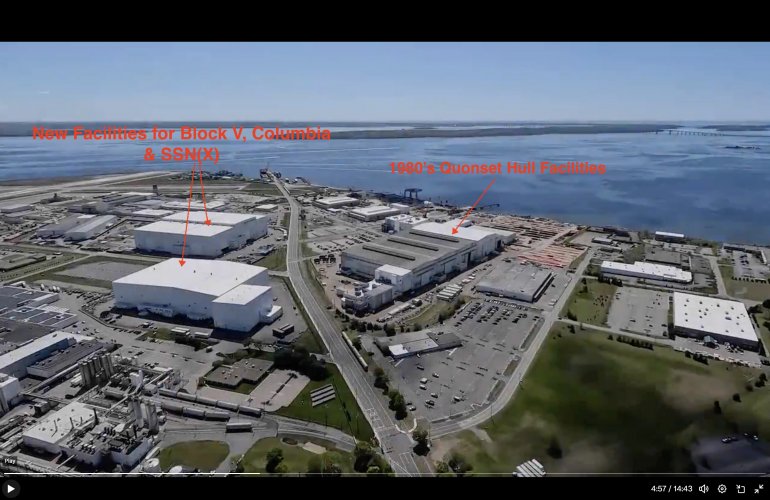
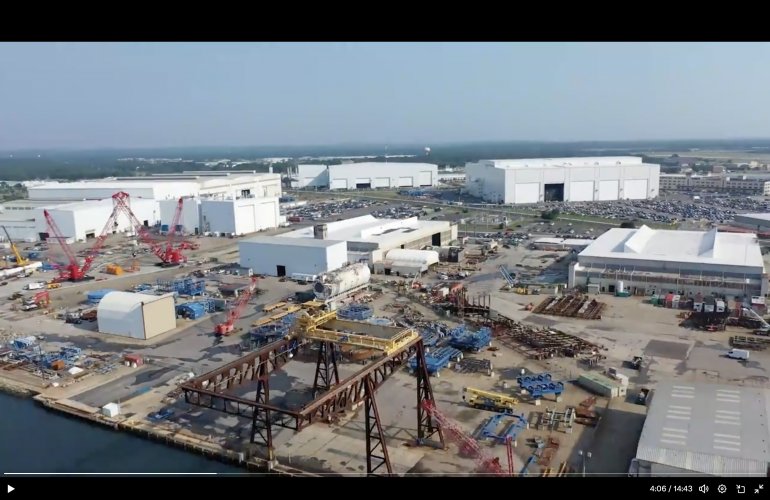
The Quonset Point facility has added two new buildings (shown in attached photos). These are used for hull section fabrication and partial outfitting of interior components. The hull sections are shipped by barge to the Electric Boat Groton site (or Newport News) for final integration and outfitting into the completed submarine.
I work in a technical capacity in defence, my wife works in financial services. We are both very good at what we do and recognised as such. My wife gets paid twice what I do, then gets bonuses that have never been less than 10% of my salary and have been more than my salary. She has also had share grants and share options.Yeah, I mentioned in another thread that good people are always going to be your real bottleneck:
https://www.secretprojects.co.uk/th...as-collins-class-submarines.22752/post-768917
We're making strides in getting talented young people into the industry--but time will tell if they're put in an environment where they can learn and thrive. I imagine the powers that be will devise a schedule that's far too aggressive and they'll end up behind the eight ball.
We'll see how it goes, though--these things are notoriously hard to predict.
They sorta are, but there's been some congestion in the upstream pipelines.Arguably the USs greatest weapon system technological [still] advantage. I’d have SSNs & SSBNs/SSGNs rolling off the assembly line like sausage.
They have one of the best torpedoes in the world, and what is probably the best subsonic cruise missile in the world available as weapons.And give them some real weapons.


Funnily enough, that does seem to be more or less the goal: “Our 2024 annual production rate of Virginia-class submarines per year was 1.13 compared to our need of 2.0,” [RADM Rucker] pointed out.Still an area the US holds significant technological overmatch. I’d be doubling submarine production. Yes it will take years might as well start today.
Honestly, that contract package looks like it's mostly going to a bunch of supply management/logistics chuckleheads so I'm not too confident it'll move the needle in any meaningful way.https://thedefensepost.com/2025/06/04/pentagon-virginia-sub-contract/Still an area the US holds significant technological overmatch. I’d be doubling submarine production. Yes it will take years might as well start today.
I remember the story of a nuclear engineer trying to order a replacement part for some reactor system. Without it, submarine cannot go to sea, and they need to leave within a couple of days. No parts remaining in the Navy stock system. He calls up the manufacturer, gets an elderly-sounding lady on the phone.There's a lot of really smart people putting a heck of a lot of effort into improving submarine production - so while it may not make sense on the surface, I have high confidence there's a valid reason directly tied to improving the industrial base. Of note, many of the issues with submarine construction and maintenance trace to random small vendors that make some critical widget.
Well, that was one of my primary concerns. I don't think any of the mentioned companies actually build anything, most of them provide the ever-vague "engineering and logistics services." It triggers my grifter Spidey sense.Of note, many of the issues with submarine construction and maintenance trace to random small vendors that make some critical widget.
11 months since the launch of the previous Virginia hull (SSN 799)... so very far from the minimum build rate of 2/year.


The U.S. Navy’s Fiscal Year 2026 shipbuilding plan calls for the procurement of six new vessels, including two Virginia-class nuclear-powered fast attack submarines. These submarines—anticipated to be named USS Potomac and USS Norfolk—will initiate production of Block VI. Their delivery is projected for the mid-2030s.While the hull numbers have not been officially assigned in the FY2026 budget, SSN-814 and SSN-815 are the most likely designations, following the April 2025 award of SSN-813—named USS Atlanta.
In this video, Defense Updates analyzes what more Block VI Virginia class brings to the table compared to Block V ?
#defenseupdates #virginiaclass #usnavy
Problem is, as virtually every other area has shown, we tend to piss those away out of stupidity and/or corruption. We're actually giving the green light for Nvidia to start selling AI chips to China again.https://thedefensepost.com/2025/06/04/pentagon-virginia-sub-contract/Still an area the US holds significant technological overmatch. I’d be doubling submarine production. Yes it will take years might as well start today.
It's amazing that the Navy continues to stand by this goal of 2.3 SSNs/year, when the current delivery plan only reaches 2 SSNs/year by 2030-35... and there's no guarantee that this acceleration will even be achieved.The GAO Jun. '25 Weapon Systems Assessment reports Virginia '24 build rate fell to 1.15 submarines per year, the Navy has a goal to deliver 2.3 submarines per year by the early 2030s.
The Block VI boats also with VPM, first three of five? SSN814, 815 & 816, Navy awarded a $1.9 billion contract late June to the General Dynamics Electric Boat for long-lead items, first should be delivered and commissioned in 2034 or 2035. As Navy extending Virginia builds to Blocks VII and VIII, assuming five per block that may be why the build of the SSN(X) pushed back to the 2040s.
My first question is what's the plan to expand the trained workforce? Until there's a plan for that it's all talk. They can wish all they want but it won't magic ships into being.It's amazing that the Navy continues to stand by this goal of 2.3 SSNs/year, when the current delivery plan only reaches 2 SSNs/year by 2030-35... and there's no guarantee that this acceleration will even be achieved.
The 10 year plan (2025-2034) includes only 17 SSNs deliveries, versus the retirement of 15 SSNs + all 4 big Ohio class SSGNs. That's a net loss in capability, starting from an already undersized fleet which has shrunk by 4 SSNs in the last 5 years. The potential loss of another 2 SSNs to Australia in 2032/35 also has to be considered.
...so if anyone's wondering what the AUKUS review is looking at (and where it may land), this is the hard math that no one can ignore.

This is just AI slop I'm afraid.Defense Updates has put out a video concerning the Block VI version of the Virginia-class SSN:
As I understand it, increasing shipyard salaries to make it more attractive compared to Oil Patch work.My first question is what's the plan to expand the trained workforce? Until there's a plan for that it's all talk. They can wish all they want but it won't magic ships into being.
Just following on from my earlier chart on this subject, which is also included here for completeness. Same data sources, new presentations.
Regarding the outlier that is SSN-811 on the first chart: the FY'21 estimates, issued February 2020, record the contracted delivery dates for SSNs 802 through 810 and those are explicitly noted and bounded as such. The FY'21 estimates also extend beyond those contracted boats, with SSN-811 then estimated to be delivered in February 2030, extending a regular Feb-August delivery cadence then estimated to be running for several years by that point. A contract modification to fund SSN-811 was issued March 2021. The FY'22 estimates released shortly thereafter, in May 2021, would've been the preferred source for the contracted delivery date for SSN-811, but unfortunately that document only lists boats up to SSN-809.
SSN-811 subsequently reappears in the FY'23 estimates with an estimated delivery date of July 2032, though it is unclear if that is the original contracted delivery date or represents a slippage from that original, undisclosed date. In the latest FY'26 estimates, the estimated delivery date for SSN-811 has been revised to December 2032. Hence, only five months of slippage, from July to December 2032, between FY'23 and FY'26 estimates. If one were to use the earlier date from the FY'21 estimates (February 2030) as the baseline for comparison instead, that number would look rather different, however I don't really want to get into the business of using dates issued from before boats were actually contracted as the baseline for comparison. For what it's worth, the estimated delivery dates for most future SSNs slipped significantly between FY'22 and FY'23: SSN-810 went from May 2029 to October 2031.
"This deal is getting worse all the time."


These things take timeI've attached two of the papers here, unfortunately the December 2001 Naval Surface Warfare Center Carderock Division Technical Digest is too large to upload here.
 . At least 25+ yrs of US research and 65+ by the Soviets and who knows who else.
Navy, Palantir unveil ShipOS in a bid to boost nuclear sub production
https://breakingdefense.com/2025/12...pos-in-a-bid-to-boost-nuclear-sub-production/

Don't worry. New australian facility will help to increase the production rate....11 months since the launch of the previous Virginia hull (SSN 799)... so very far from the minimum build rate of 2/year.
Still waiting for any tangible signs of production acceleration?
BlueSky thread on the Advanced Sail:
Array length and tow cable length are different, the multiple kilometre lengths for towed array systems that are reported combine array length and tow cable length. An 800 metre array is very large by towed array standards, longer than the British Type 2031Z 663 metre array (with 1,830 metre tow cable) which was expected to perform the same wide area surveillance roles as the USN's SURTASS, although not as long as the 2.3km and later 1,280 metre long arrays proposed for the abortive Types 2038 and 2057 (allegedly Type 2076 uses a 1.2km array,)L3Harris have won contracts for the TB-29C long-range thin line towed-array passive sonar to detect quiet enemy submarines at long range to replace the TB-29A, mention made towed arrays can be miles long, but TB-29C is quoted as only 825 meters and 3.8 cm diameter.
Plus the TB-34A fat-line towed-array passive sonar system to replace the TB-16 for tactical use in littoral shallow coastal waters is only 75 meters by 75 cm diameter.
First time have seen length and diameter of passive towed arrays quoted
https://www.militaryaerospace.com/s...-array-sonar-to-detect-quiet-enemy-submarines
https://www.militaryaerospace.com/s...sive-sonar-systems-for-fast-attack-submarines
Small error, the TB-34A is 7.5 cm in diameter, not 75 cm. The latter would be a really fat line cable!L3Harris have won contracts for the TB-29C long-range thin line towed-array passive sonar to detect quiet enemy submarines at long range to replace the TB-29A, mention made towed arrays can be miles long, but TB-29C is quoted as only 825 meters and 3.8 cm diameter. It's designed to keep the array's sensors away from tow vessel noise to improve its signal-to-noise ratio and its ability to detect and track faint contacts like quiet nuclear and diesel-powered submarines and seismic signals, Lockheed gets a mention in article.
Plus the TB-34A fat-line towed-array passive sonar system to replace the TB-16 for tactical use in littoral shallow coastal waters is only 75 meters by 75 cm diameter.
First time have seen length and diameter of passive towed arrays quoted
https://www.militaryaerospace.com/s...-array-sonar-to-detect-quiet-enemy-submarines
https://www.militaryaerospace.com/s...sive-sonar-systems-for-fast-attack-submarines

OK, fess up. WHO left the ruddy sink unplugged again?.......View attachment 776507
View attachment 776508
Some photos from the Groton -> Oyster Point Ferry last week.