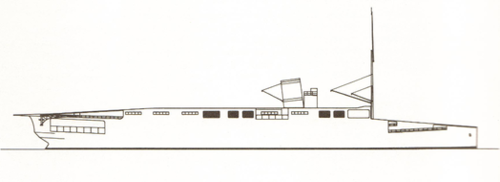
I - WWI German Aircraft Carrier Project

Airborne2001

ACCESS: Secret
Joined
19 June 2020
Messages
377
Reaction score
541
NOTE: Not to be confused with the 1942 German aircraft carrier project.
(My main source is... Wikipedia... Sorry, but it is the only website that actually provides a lot of info.)


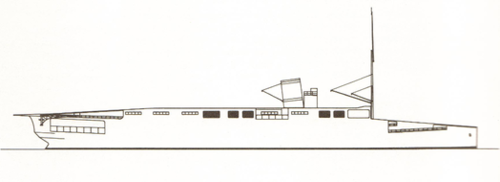
In the mid-1910's, Germany was building an ocean liner, the Ausonia, for Italy. During this time, some people in Germany were interested in the idea of ships that could carry aircraft. Most of these that would appear in the German Navy, the seaplane tenders, were not fast enough for the High Seas Fleet (Though in 1915, the only active seaplane carrier of any kind was the Friedrich Carl.) In 1915, it was decided that the incomplete hull should be converted into an aircraft carrier. The "I" designation was only preliminary; had it been finished it would have been given an official name. The design work was completed by 1918, though the funds in Germany at the time were very strained. Due to the unrestricted submarine warfare of the time, most naval funds were being poured into submarines. As a result, the design was shelved. In 1920, with the order surprisingly still intact, Italy had then cancelled its order for the Ausonia due to the extreme inflation in the Weimar republic of the time causing the ocean liner to be far too expensive.

General characteristics
Type:aircraft carrier
Displacement:12,585 metric tons
Length:158 m (518 ft)
Beam:18.8 m (62 ft)
Draft:7.43 m (24.4 ft)
Propulsion:
  • 2-shaft Blohm & Voss geared turbines
  • 14,000 shp
  • 1,500 tons of coal
Speed:20 knots
Aircraft carried:
  • 13 or 19 seaplanes
  • 10 wheeled aircraft
Aviation facilities:3 hangars

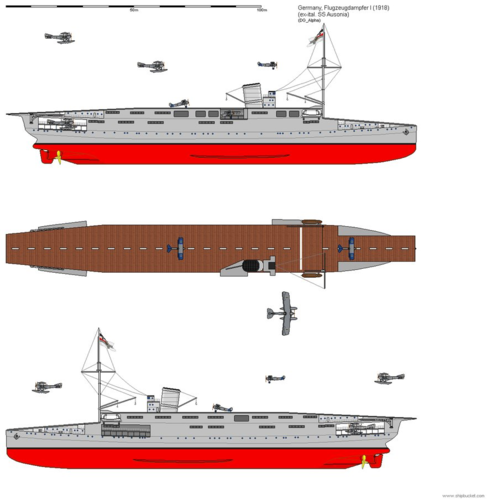
1598223524817.png
1598223832580.png
Something I will need help with:
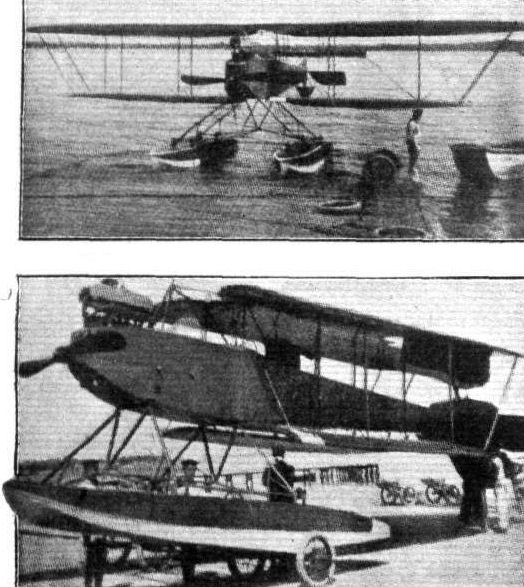
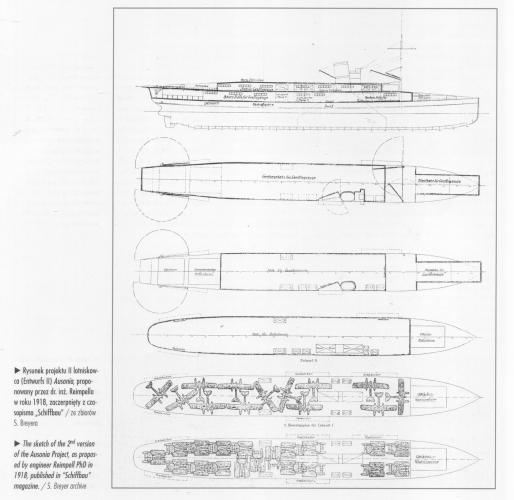
Does anyone have any idea of what aircraft the carrier was intended to use? The second pictures assumes the Fokker D.VII and what I am assuming is a Friedrichshafen FF.33, FF.41, or FF.49 as the main complement of aircraft. It would have used a combination of fighters, bombers, and torpedo bombers.
 

Attachments

  • 1598223820583.png
    1598223820583.png
    83.4 KB · Views: 74
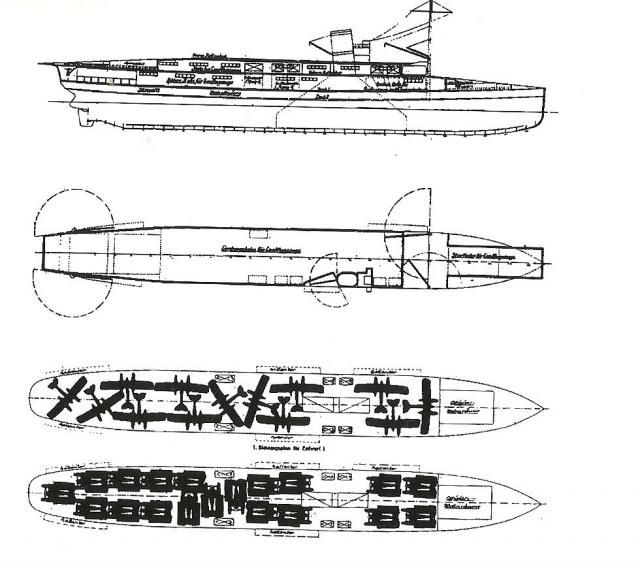
This drawing shows in more detail the hanger storahe and aircraft arrangements:
007350e86dc37d261e86b9857380114c.jpg
 
I think these were not folded wings just they were removed and stored next to the fuselage like many floatplanes during ww2
 
Some modellers choose these aircraft:
LVG C.VI
Fokker DVII
Albatros D.III
Hansa-Brandenburg W.12
Hansa-Brandenburg W.33
 
Some modellers choose these aircraft:
LVG C.VI
Fokker DVII
Albatros D.III
Hansa-Brandenburg W.12
Hansa-Brandenburg W.33
Those needs some tail hooks then and some other modifications i guess to operate from a carrier.
 
These aircraft were quite slow and light, they can land on shorter ships as well, also we are talking 1918 here, carrier aviation is still new and new technologies and ideas had to be tried out.
 
Last edited:
These aircraft were quite slow and light, they can land on shorter ships as well, also we are talking 1918 here, carrier aviation is still new and new technologies and ideas had to be tried out.
Well at least it looks like a carrier we know that it would be.
 
These aircraft were quite slow and light, they can land on shorter ships as well, also we are talking 1918 here, carrier aviation is still new and new technologies and ideas had to be tried out.
Well at least it looks like a carrier we know that it would be.

The double deck concept made its way in such ships like the HMS Furious or early Akagi and Kaga. Akagi_draw_03.gif
 
These aircraft were quite slow and light, they can land on shorter ships as well, also we are talking 1918 here, carrier aviation is still new and new technologies and ideas had to be tried out.
Well at least it looks like a carrier we know that it would be.

The double deck concept made its way in such ships like the HMS Furious or early Akagi and Kaga.View attachment 640012
Seems the German carrier is the little brother of them then.
 
I think these were not folded wings just they were removed and stored next to the fuselage like many floatplanes during ww2

Folding wings were not uncommon in this period, many large biplanes had folding wings for easier storage, even land-based ones.
For example the Short Brothers had a patented system in early1913 and using that produced the Shorts Folder seaplane, the first of which was used on trials on the converted cruiser HMS Hermes. This type even became the first torpedo-bomber too in 1914 thanks to the intervention of Churchill.
 
Indeed! I was thinking exactly the same when I read Tzoli's comment earlier, only to see you had beaten me to it (by a mere five years).

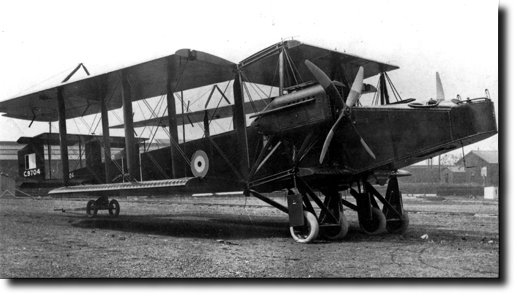
Anyway, here's a picture of a British WWI Handley Page 0400 bomber with wings folded...
 

Attachments

  • bomber0400.jpg
    bomber0400.jpg
    92.1 KB · Views: 29
From what i can tell, they use shorter flight deck for take-off, while above are for landing and planes are retrieved into the hangars via by those large lifting cranes (otherwise why would the plan highlight those massive cranes angle for?)
 
or that the lower hangar is for seaplanes with 13 stored as wings deployed and 19 with wings folded. They are launched by lowering to the sea via the stern cranes and picked up the same way.

The wheeled aircraft are launched from the bow and after they land on the upper deck they are lowered to the hangar by the crane aft the funnel. There is a hatch between hangar level inboard of the funnel.
 
No lifts, just inclined ramps to roll planes & cranes to haul them.
What is the large rectangle marked at the aft end of the flight deck, just ahead of the semi-circle for the reach of the cranes? Possibly a lift?
 
What is the large rectangle marked at the aft end of the flight deck, just ahead of the semi-circle for the reach of the cranes? Possibly a lift?
Looks more like a ramp, covered by deck hatch. See how the hangar deck aft curved upward to connect with flight deck? I think, the idea was that when hatch is opened, the plane could be just rolled out of hangar right on flight deck.
 
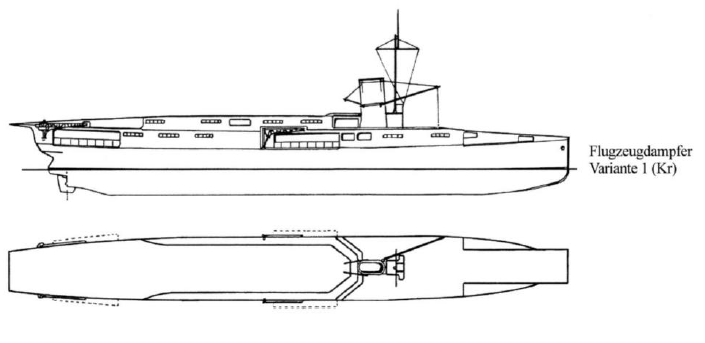
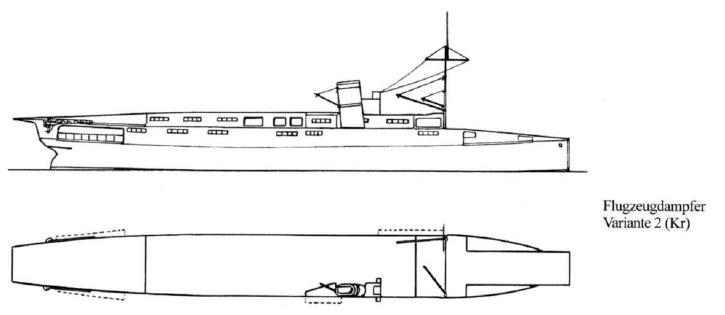
In the new edition of "Die deutschen Kriegsschiffe 1815-1945 Bd-1" it's explicitely mentioned, that there were no lifts, and that bringing down into the hangar should be accomplished by the cranes through hatches on the sides. That rectangular may indicate something below, but not in the flight deck, and it isn't shown in the drawings in the mentioned book. It's further mentioned, that catapults should be developed for such ships, but still weren't incorporated into this design ... and that the problem of decelerating landing aircraft still wasn't solved.
In that book actually three variants are shown, one with the bridge and funnel still in the middle of the ship, the one, we had above, and another one with the flight deck elongated over the fly-off deck on the bow.

1749124574526.png

1749124602964.png

1749124636014.png
 
Some modellers choose these aircraft:
LVG C.VI
Fokker DVII
Albatros D.III
Hansa-Brandenburg W.12
Hansa-Brandenburg W.33

The drawings match the silhouette of a Friedrichshafen type. These were by far the most widely used seaplane types, especially in the north, and were used right up until the end of the war. So, a folding wing derivative would seem most plausible (e.g. Friedrichshafen FF64).

What documentation is there regarding wheeled types? Is this just inferred from the existence of a flight deck (apparently for recovery)?
 
That rectangular may indicate something below, but not in the flight deck, and it isn't shown in the drawings in the mentioned book
Based on couple shipbucket arts and a 3d printed model i saw, those rectangular shapes are mostly depicted as overhang platforms on the open hangars.
 
interesting is how german labeled this carrier, Flugzeugdampfer = Aircraft-steamer

would it simplified the nomenclature between WW1 and WW2 hardware, if we label those WW1 ships as Aircraft-steamer ?
 
In the new edition of "Die deutschen Kriegsschiffe 1815-1945 Bd-1" it's explicitely mentioned, that there were no lifts, and that bringing down into the hangar should be accomplished by the cranes through hatches on the sides. That rectangular may indicate something below, but not in the flight deck, and it isn't shown in the drawings in the mentioned book. It's further mentioned, that catapults should be developed for such ships, but still weren't incorporated into this design ... and that the problem of decelerating landing aircraft still wasn't solved.
In that book actually three variants are shown, one with the bridge and funnel still in the middle of the ship, the one, we had above, and another one with the flight deck elongated over the fly-off deck on the bow.

View attachment 772438

View attachment 772439

View attachment 772440
Incredible. Thank you for sharing.
 

Similar threads

Back
Top Bottom