While the RUR-5 had either a Mk-46 12.75" torpedo or a nuclear depth-charge with a 10KT W44 warhead the RUM-139 only had the Mk-46 (And later on the Mk-54) torpedo. So what I was wondering the VLA was being developed in the early 1980s was any thought given to it also having a nuclear depth-charge too? I could see it using some variant of the W81 SM-2 warhead design.

You are using an out of date browser. It may not display this or other websites correctly.
You should upgrade or use an alternative browser.
You should upgrade or use an alternative browser.
RUR-5 ASROC and RUM-139 VL-ASROC (VLA)
Scott Kenny
ACCESS: USAP
- Joined
- 15 May 2023
- Messages
- 19,515
- Reaction score
- 27,962
Well, ASROC (and SUBROC!) was supposed to be replaced by UUM/RUM-125 Sea Lance, not VLA. And Sea Lance would have had a 200kt W89 warhead (same as SRAM2). But the ship-launched version was given up on as too complex (or not enough commonality left) by 1983, with the US developing VL-ASROC as a stop-gap instead.While the RUR-5 had either a Mk-46 12.75" torpedo or a nuclear depth-charge with a 10KT W44 warhead the RUM-139 only had the Mk-46 (And later on the Mk-54) torpedo. So what I was wondering the VLA was being developed in the early 1980s was any thought given to it also having a nuclear depth-charge too? I could see it using some variant of the W81 SM-2 warhead design.

dy031101
ACCESS: Restricted
- Joined
- 13 September 2008
- Messages
- 37
- Reaction score
- 54
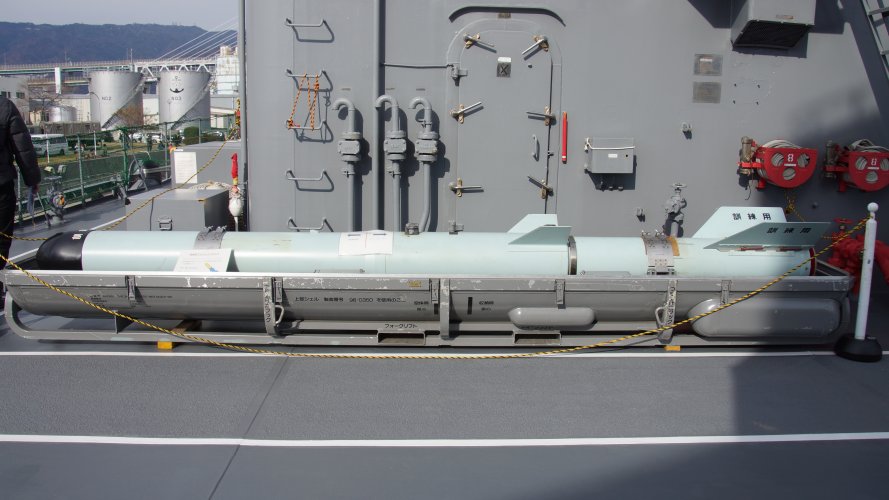
I remember seeing a Mk.26-compatible version of the RUM-139 was displayed in a past defense exhibition in Taiwan (for the Keelung class destroyers).
I made the mistake of not saving an image of it while it was still online and am just kicking myself for it now.
Does anyone have any information on this, such as any change made outside of the launcher interface? Thanks in advance.
I made the mistake of not saving an image of it while it was still online and am just kicking myself for it now.
Does anyone have any information on this, such as any change made outside of the launcher interface? Thanks in advance.
Last edited:


Odysseus1980
I really should change my personal text
- Joined
- 30 July 2014
- Messages
- 126
- Reaction score
- 146
The Mk26 could launch RUR-5, Harpoon amd SM-2MR.

- Joined
- 16 April 2008
- Messages
- 10,588
- Reaction score
- 18,127
The Mk26 could launch RUR-5, Harpoon amd SM-2MR.
Harpoon was never operationally fielded in the Mk26 launcher. You see Harpoon in the manufacturer's schematic but never in real life.
Does anyone know if the Booster on the RUR-5 was the NOTS 401-A rocket motor ?
Dave
I don't believe so. According to the Encyclopedia Astronautica, the NOTS 401A is 0.5 m wide, while ASROC is only 0.34 m wide.
http://www.astronautix.com/n/nots401a.html
Hmm . . .I don't believe so. According to the Encyclopedia Astronautica, the NOTS 401A is 0.5 m wide, while ASROC is only 0.34 m wide.
Do you know the motor designation for the ASROC Booster ?
Last edited:
It's already in this thread.
So, the Booster is a "MK 37" . . .
I "lost" it among all of the other "MK" references referring to torpedoes.
Last edited:
Scott Kenny
ACCESS: USAP
- Joined
- 15 May 2023
- Messages
- 19,515
- Reaction score
- 27,962
Curse of the USN.So, the Booster is a "MK 37" . . .
I "lost" it among all of the other "MK" references referring to torpedoes.
Curse of the USN.
LOL !
Odysseus1980
I really should change my personal text
- Joined
- 30 July 2014
- Messages
- 126
- Reaction score
- 146
Exactly this I remember, information from the manufacturer of the Mk26 and from Friedman Naval Systems.
I found info on the MK 37.
It indicates that "MK 37" is the designation for the torpedo, but NOT the ASROC rocket booster.
https://maritime.org/doc/jolie/part2.php

Torpedo Mk 37 is a two-speed, electrically-driven, active/passive acoustichoming torpedo. The main developers of the Mk 37 were Westinghouse ElectricCorp., Sharon, Pa.; the Harvard Underwater Sound Laboratory, Cambridge, Mass.;and the Ordnance Research Laboratory of Pennsylvania State University.Engineering development of Torpedo Mk 37 began in 1946 but work had started in1942 on the Project 4 panel (an echo-ranging, Doppler-enabled, acoustic homingsystem), which was incorporated into the Mk 37. The Mk 37 torpedo wasproduced in quantity by the Naval Ordnance Plant, Forest Park, Ill., and wasthe standard U.S. Navy submarine-launched, antisubmarine weapon for about 20years. All Torpedoes Mk 37 Mod 0 have been withdrawn from the Fleet,refurbished, updated, and reissued to the Fleet as the Mod 3. Since the Mk 37torpedo is available for foreign countries under the Military AssistanceProgram, however, some countries still maintain the Mod 0 version.
CHARACTERISTICS
107
Torpedo Mk 37 (Mods 1 and 2) was a follow-on development of Torpedo Mk 37Mod 0. This submarine-launched, antisubmarine weapon was developed by theNaval Underwater Ordnance Station, Newport, R.I., and the Vitro Co., SilverSprings, Md. The principal modification to the Mod 0 was the addition of awire guidance capability. This wire guidance feature lengthened the torpedoby 26 inches and increased the weight by 260 pounds. In addition to thechange to the torpedo, submarine fire control systems and torpedo tubes werealso modified to provide the wire guidance capability. Torpedoes Mk 37 Mod 1,manufactured by the Naval Ordnance Plant, Forest Park, Ill., were refurbishedand reissued to the Fleet as Mk 37 Mod 2 torpedoes. Under the MilitaryAssistance Program, the Mod 1 version has been sold to foreign governments;only the Mod 2 version is still in use by the U.S. Navy.
CHARACTERISTICS
108
It indicates that "MK 37" is the designation for the torpedo, but NOT the ASROC rocket booster.
https://maritime.org/doc/jolie/part2.php
| Torpedo Mk37 Mods 0 and 3 | DEVELOPMENT DATE: 1946 APPROXIMATE IN-SERVICE DATES: 1956 TO PRESENT |

Torpedo Mk 37 is a two-speed, electrically-driven, active/passive acoustichoming torpedo. The main developers of the Mk 37 were Westinghouse ElectricCorp., Sharon, Pa.; the Harvard Underwater Sound Laboratory, Cambridge, Mass.;and the Ordnance Research Laboratory of Pennsylvania State University.Engineering development of Torpedo Mk 37 began in 1946 but work had started in1942 on the Project 4 panel (an echo-ranging, Doppler-enabled, acoustic homingsystem), which was incorporated into the Mk 37. The Mk 37 torpedo wasproduced in quantity by the Naval Ordnance Plant, Forest Park, Ill., and wasthe standard U.S. Navy submarine-launched, antisubmarine weapon for about 20years. All Torpedoes Mk 37 Mod 0 have been withdrawn from the Fleet,refurbished, updated, and reissued to the Fleet as the Mod 3. Since the Mk 37torpedo is available for foreign countries under the Military AssistanceProgram, however, some countries still maintain the Mod 0 version.
CHARACTERISTICS
|
|
107
| Torpedo Mk37 Mods 1 and 2 | DEVELOPMENT DATE: 1959 APPROXIMATE IN-SERVICE DATES: 1960 TO PRESENT |

Torpedo Mk 37 (Mods 1 and 2) was a follow-on development of Torpedo Mk 37Mod 0. This submarine-launched, antisubmarine weapon was developed by theNaval Underwater Ordnance Station, Newport, R.I., and the Vitro Co., SilverSprings, Md. The principal modification to the Mod 0 was the addition of awire guidance capability. This wire guidance feature lengthened the torpedoby 26 inches and increased the weight by 260 pounds. In addition to thechange to the torpedo, submarine fire control systems and torpedo tubes werealso modified to provide the wire guidance capability. Torpedoes Mk 37 Mod 1,manufactured by the Naval Ordnance Plant, Forest Park, Ill., were refurbishedand reissued to the Fleet as Mk 37 Mod 2 torpedoes. Under the MilitaryAssistance Program, the Mod 1 version has been sold to foreign governments;only the Mod 2 version is still in use by the U.S. Navy.
CHARACTERISTICS
|
|
108
- Joined
- 16 April 2008
- Messages
- 10,588
- Reaction score
- 18,127
I found info on the MK 37.
It indicates that "MK 37" is the designation for the torpedo, but NOT the ASROC rocket booster.
https://maritime.org/doc/jolie/part2.php
Torpedo
Mk37
Mods 0 and 3
1946
APPROXIMATE IN-SERVICE DATES:
1956 TO PRESENT
Torpedo Mk 37 is a two-speed, electrically-driven, active/passive acoustichoming torpedo. The main developers of the Mk 37 were Westinghouse ElectricCorp., Sharon, Pa.; the Harvard Underwater Sound Laboratory, Cambridge, Mass.;and the Ordnance Research Laboratory of Pennsylvania State University.Engineering development of Torpedo Mk 37 began in 1946 but work had started in1942 on the Project 4 panel (an echo-ranging, Doppler-enabled, acoustic homingsystem), which was incorporated into the Mk 37. The Mk 37 torpedo wasproduced in quantity by the Naval Ordnance Plant, Forest Park, Ill., and wasthe standard U.S. Navy submarine-launched, antisubmarine weapon for about 20years. All Torpedoes Mk 37 Mod 0 have been withdrawn from the Fleet,refurbished, updated, and reissued to the Fleet as the Mod 3. Since the Mk 37torpedo is available for foreign countries under the Military AssistanceProgram, however, some countries still maintain the Mod 0 version.
CHARACTERISTICS
Length 135 inches Diameter 19 inches (21-
inch guide
rails)Weight 1430 pounds Propulsion Electric motor Enabling Range 300-95000 yards Guidance Gyro Homing Active, passive,
combinationFC Settings Electrical Warhead Mk 37 Mod 0
330 pounds HBX-3Exploder Mk 19 type
Contact
Speed (knots) Classified Range (yards) Classified
107
Torpedo
Mk37
Mods 1 and 2
1959
APPROXIMATE IN-SERVICE DATES:
1960 TO PRESENT
Torpedo Mk 37 (Mods 1 and 2) was a follow-on development of Torpedo Mk 37Mod 0. This submarine-launched, antisubmarine weapon was developed by theNaval Underwater Ordnance Station, Newport, R.I., and the Vitro Co., SilverSprings, Md. The principal modification to the Mod 0 was the addition of awire guidance capability. This wire guidance feature lengthened the torpedoby 26 inches and increased the weight by 260 pounds. In addition to thechange to the torpedo, submarine fire control systems and torpedo tubes werealso modified to provide the wire guidance capability. Torpedoes Mk 37 Mod 1,manufactured by the Naval Ordnance Plant, Forest Park, Ill., were refurbishedand reissued to the Fleet as Mk 37 Mod 2 torpedoes. Under the MilitaryAssistance Program, the Mod 1 version has been sold to foreign governments;only the Mod 2 version is still in use by the U.S. Navy.
CHARACTERISTICS
Length 161 inches Diameter 19 inches (21-
inch guide
rails)Weight 1690 pounds Propulsion Electric motor Enabling Range 300-95000 yards Guidance Gyro-wire Homing Active, passive,
combinationFC Settings Electrical Warhead Mk 37 Mod 0
330 pounds HBX-3Exploder Mk 19 Mod 1
Contact
Speed (knots) Classified Range (yards) Classified
108
No, you're getting confused because the Navy uses the same Mark numbers across many different types of equipment.
So, what you found is the Torpedo, Mark 37 a heavyweight ASW torpedo. This was far too large to ever been incorporated into ASROC.
The Rocket Motor, Mark 37 is a completely different thing.
Do you know of any links for info on the Mark 37 rocket motor ?No, you're getting confused because the Navy uses the same Mark numbers across many different types of equipment.
So, what you found is the Torpedo, Mark 37 a heavyweight ASW torpedo. This was far too large to ever been incorporated into ASROC.
The Rocket Motor, Mark 37 is a completely different thing.
WIth all of that confusion, I bet that the "logistics" of supply was a real nightmare . . . It the same problem occurring today ?The USN reuses the ‘mk’ designation repeatedly. Its kinda like how in World War Two there was an M1 rifle, and M1carbine, and an M1flame thrower.

tychosis
ACCESS: Secret
- Joined
- 16 March 2025
- Messages
- 209
- Reaction score
- 639
Well, per MIL-STD-1661 the mark and mod are only part of the type designator and should always be preceded by the item name.WIth all of that confusion, I bet that the "logistics" of supply was a real nightmare . . . It the same problem occurring today ?
- Joined
- 16 April 2008
- Messages
- 10,588
- Reaction score
- 18,127
WIth all of that confusion, I bet that the "logistics" of supply was a real nightmare . . . It the same problem occurring today ?
Logistics ordering today is done by NSN (NATO Stock Number), which should eliminate most of the confusion.
Logistics ordering today is done by NSN (NATO Stock Number), which should eliminate most of the confusion.
In the "pre-computer era", I bet some bizarre things happened . . .
- Joined
- 16 April 2008
- Messages
- 10,588
- Reaction score
- 18,127
Do you know of any links for info on the Mark 37 rocket motor ?
That PDF linked earlier has a remarkable amount of info.
Agreed . . . I'm just trying to see what else may be available.That PDF linked earlier has a remarkable amount of info.
I'm curious, for example" who actually manufactured the motor . . . Was it Honeywell or, perhaps, Thiokol, Aerojet, or another entity ?
So far, I believe that Aerojet made them.
Last edited:
Scott Kenny
ACCESS: USAP
- Joined
- 15 May 2023
- Messages
- 19,515
- Reaction score
- 27,962
A different problem. Things are ordered by NSN (I was taught National Stock Number, but whatever it stands for), and a single digit off can get you something very different. A two digit transposition can get you 155mm gun barrels instead of M4 handguards.WIth all of that confusion, I bet that the "logistics" of supply was a real nightmare . . . It the same problem occurring today ?
Worse, there are NSNs for everything. Leather flying jackets. AH-1W Cobra helicopter, complete. HAWK missile battery with all vehicles. Jack Daniels whiskey. Beer. Morphine. Cocaine. All exist in the NSN system.
You're supposed to fill out the requests for things by NSN and item description, but the idiots at the supply depots only look at the NSN.
A different problem. Things are ordered by NSN (I was taught National Stock Number, but whatever it stands for), and a single digit off can get you something very different. A two digit transposition can get you 155mm gun barrels instead of M4 handguards.
Worse, there are NSNs for everything. Leather flying jackets. AH-1W Cobra helicopter, complete. HAWK missile battery with all vehicles. Jack Daniels whiskey. Beer. Morphine. Cocaine. All exist in the NSN system.
You're supposed to fill out the requests for things by NSN and item description, but the idiots at the supply depots only look at the NSN.
Sounds like a real problem . . .
- Joined
- 16 April 2008
- Messages
- 10,588
- Reaction score
- 18,127
Agreed . . . I'm just trying to see what else may be available.
I'm curious, for example" who actually manufactured the motor . . . Was it Honeywell or, perhaps, Thiokol, Aerojet, or another entity ?
So far, I believe that Aerojet made them.
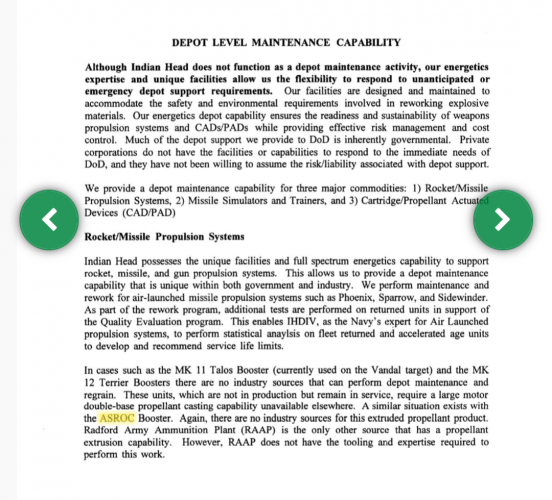
I'm fairly certain it wasn't Aerojet or any industry company still in business. By the 1993 BRAC, NSWC Indian Head was the only source for reworked ASROC booster motors; there was no industrial supplier. Whether it was a small company that later folded, a Honeywell subsidiary that got eliminated, or if Indian Head was the original supplier, I don't know.
https://digital.library.unt.edu/ark:/67531/metadc26730/m1/6/?q=Asroc
Attachments
I'm fairly certain it wasn't Aerojet or any industry company still in business. By the 1993 BRAC, NSWC Indian Head was the only source for reworked ASROC booster motors; there was no industrial supplier. Whether it was a small company that later folded, a Honeywell subsidiary that got eliminated, or if Indian Head was the original supplier, I don't know.
My line of thinking is based on this :
https://tinyurl.com/3r78ctmt
QUOTE :
The term "ASROC" refers to the Anti-Submarine Rocket, initially designated the RUR-5A, a stand-off anti-submarine weapon system developed by the United States Navy. Aerojet played a key role in the development and production of this system.
Here's how they are connected:
- RUR-5A ASROC: This refers to the original variant of the ASROC system, designed to be launched from surface ships equipped with the Mark 112 "Matchbox" launcher.
- Aerojet's Role: Aerojet supplied the powerful solid-propellant rocket motor that propelled the ASROC missile. This allowed for the standoff capability of the system, launching the torpedo or depth charge to a considerable distance from the ship.
END QUOTE :
Dave
Last edited:
- Joined
- 16 April 2008
- Messages
- 10,588
- Reaction score
- 18,127
Aerojet's Role: Aerojet supplied the powerful solid-propellant rocket motor that propelled the ASROC missile. This allowed for the standoff capability of the system, launching the torpedo or depth charge to a considerable distance from the ship.
And this is why you never, ever trust the AI summary. It has incorrectly mashed together some information from multiple sources. Because AI does not understand context at all.
If you track back the AI "sourcing" link for this factoid, it takes you to this page:
https://www.worldnavalships.com/forums/thread.php?threadid=11965
Problem is, the only reference of Aerojet on that page is related to Regulus, not ASROC.
The Regulus was 34' 3.75" long and 4' 2" in diameter with a wingspan of 21'. Weighing 13,485 lbs. the missile was powered by an Allison J33 turbojet with 4600 lbs of thrust. Launch was aided by two Aerojet 2KS boosters with 16,500 lbs of thrust each.
AI is particularly inaccurate if you try to ask it any questions about military systems, because it learns from trash data and random fan boi posts online. If you’re lucky it sources Wikipedia, which begs the question, why not just Wikipedia. But do not trust AI with any military technology question; literally wiki would be more accurate.
- Joined
- 16 April 2008
- Messages
- 10,588
- Reaction score
- 18,127
AI is particularly inaccurate if you try to ask it any questions about military systems, because it learns from trash data and random fan boi posts online. If you’re lucky it sources Wikipedia, which begs the question, why not just Wikipedia. But do not trust AI with any military technology question; literally wiki would be more accurate.
I suspect generative AI is particularly inaccurate about any topic you know particularly well.
I suspect generative AI is particularly inaccurate about any topic you know particularly well.
Fair enough; I can only comment with any authority on that topic and my specific search attempts on it. General knowledge does seem more its thing: more material, less nuance.
Scott Kenny
ACCESS: USAP
- Joined
- 15 May 2023
- Messages
- 19,515
- Reaction score
- 27,962
My best description of AI summaries is that it hallucinates.I suspect generative AI is particularly inaccurate about any topic you know particularly well.
I'd give my left nut for an effective AI research assistant that could effectively summarize and cite sources!
Defense Updates has just uploaded a video concerning the VLA:
The Vertical Launch Anti-Submarine Rocket (VL-ASROC) is one of the least publicly discussed yet most critical weapons in the U.S. Navy’s layered anti-submarine warfare (ASW) architecture. While the naval community focuses heavily on long-range missiles, Aegis surface combatants rely on VL-ASROC for a very different mission—rapid, precise engagement of hostile submarines at standoff ranges.
As submarines become quieter, harder to detect, and armed with long-range anti-ship missiles, the ability to project an immediate anti-submarine warfare response at distance has become essential. VL-ASROC fills that requirement. It is a vertical-launched, rocket-delivered lightweight torpedo, designed to strike underwater threats that would otherwise remain out of reach for shipborne torpedoes and too close for aircraft intervention.
In this video, Defense Updates analyzes why little publicized VL-ASROC is an impressive weapon for US Navy?
#defenseupdates #VL_ASROC #usmilitary
Similar threads
-

-
-

-
 Lepanto-class guided missile battleship
- Started by Dilandu
- Replies: 25
-
 US Navy Diesel Submarine Concept
- Started by covert_shores
- Replies: 20