
Well here you go...And Hellyer's erstwhile mentor, Northrop's T.V. Jones, had always wanted the F-5 to be a light carrier fighter
: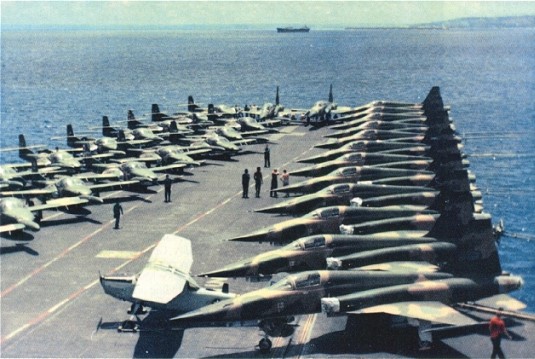

Well here you go...And Hellyer's erstwhile mentor, Northrop's T.V. Jones, had always wanted the F-5 to be a light carrier fighter
:


Not given by any sources i have, but the nose on the scale mockup is smaller than the JA 37s, so they probably proposed some american radar unit.Is there any information on what radar was planned to be used? To take advantage of the AIM-54 something powerful would be required. I don' believe the improved radar used by the JA-37 interceptor had entered service by that time and even then, I also doubt that had the range of F-14's AWG-9 due to simple size/power limits.
The new intake was on behalf of the Aussies iirc. The JA 37 was capable of mach 2 but it couldn't achieve such speeds on the regular. The oblique intakes would supposedly help it reach and perform better at such speeds. It was noted however that the Aussies asked for a lot which from a Swedish POV was seen as unnecessary.The plan to redesign the intakes seems odd since the JA-37 is supposedly already capable of going over Mach 2 and how much speed you could get beyond that probably won't matter very much, since the Viggen isn't carrying some exceptional amount of fuel.


Facebook group
Any source? (edit: im not disputing, but u know were this came from?)First photo on thread shows a built 'What-if' 72 scale model kit in SPECULATIVE colour scheme and NOT an official model :/
This is just a copypaste of my OP..
Thanks for the summary.They were kind enough to digitalize both documents and make them available as PDFs in their site:
https://flygvapenmuseum.welib.se/#/search?s=Aircraft%20Saab%2037AU%20%3A%20specification.&f=%7B%7D&so=%26sort%3Dscore%20desc&p=0&pp=10
Hi apparition,Thanks for the summary.
I can't seem to get at the pdfs from this computer. Are there any illustrations of the variable ramp intakes developed in conjunction with Grumman*?
More broadly, I'm surprised that the mission radius requirement was only 250 miles. Given the size of Australia I would have thought longer ranges would have been desired.
*I hadn't heard this before. I find it interesting to now know that Grumman was involved with two aircraft I quite like, the Viggen and the Lavi, although significantly more in the latter case than just the intake ramps with the 37AU.

Doesn't seem to work in NZ.They were kind enough to digitalize both documents and make them available as PDFs in their site:
https://flygvapenmuseum.welib.se/#/search?s=Aircraft%20Saab%2037AU%20%3A%20specification.&f=%7B%7D&so=%26sort%3Dscore%20desc&p=0&pp=10
Same here in Swedistan.Doesn't seem to work in NZ.

I'm very late sorry, but may I ask, where did you get that mockup picture? Awesome job researching this thing btw.In early 1970, the Aussies sent a request to Saab that they wanted to procure the in-development fighter variant of the Saab 37 Viggen (JA 37) as a replacement for their aging Mirage III. Saab got green light for export and sent classified preliminary documentation in December 1970. Swedish standards were seen as unfavourable, despite noting good track record. Requirement specs came at the end of 1971, aiming for a 1976 delivery.
In March 1972 specs were done for the planned Saab 37AU, which was supplemented with a proposal for collaborate license production to revive the dying Australian aviation industry. During the same period the design competed against the Mirage F1 and the Northrop Cobra. On May 11 1973, a formal offer for 27, 67 or 127 aircraft was made and the Australian aviation industry was invited to become part of the projects development, including future plans, as well as green lighting license production of the engine, spare parts and electronics. It was given the preliminary serial designation A21.
View attachment 706544
Saab 37AU mockup. Of note: what appears to be AIM-54 Phoenix missiles on the intake pylons, the aerial refueling probe on the nose, the A21-002 serial designation on the tail, the redesigned nose which appears smaller than the nose of Swedish Viggens.
The Saab 37AU was relatively different from the Swedish JA 37 base in several aspects, such as requirements for increased speed, increased lifespan and different armament etc. Saab, in collaboration with Grumman, spent lots of money into the development of oblique intakes to handle Mach 2+ flight. The project came to a stop however with the 1975 Australian constitutional crisis, with only a full scale mockup of the intakes being done.
In 1976, procurement restarted. The new government found the Saab 37AU too expencive and inquired the costs of 72 AJ 37 or JA 37 aircraft. At this phase, however, the inquiry was also sent out to all other possible aircraft suppliers. Saab 37 was examined by Australian politician and diplomat Lance Barnard, the Australian ambassador to Sweden at the time (possibly after his term). American aircraft was however favorised, and in 1981 Australia ordered 75 F/A-18 Hornet strike fighters, with deliveries in 1985, ten years later than originally planned for the Saab 37AU. The A21 serial designation went over to the F/A-18 instead.
According to one source (an overall good one but not perfect), the Aussies interest in Viggen started with the Australian defence minister, who was a former ambassador to Sweden. During his time in Sweden he had observed the Swedish aviation industry and cracked a plan to use it to rebuild the dying Australian aviation industry. No name appears and no defence minister was a Swedish ambassador before that post. Neither can i find anyone who fits into this story in the slightest, except possibly Lance Barnard, who was an ambassador post 1976 which actually inspected the Viggen (although what appears to be post 1979, at which point the project was effectively dead).

I'm very late sorry, but may I ask, where did you get that mockup picture? Awesome job researching this thing btw.
yeah right! sounds very plausibleI'd be interested in the photo origin too. (However, that is a model not a "mockup" - I suspect it is the old Esci/Airfix 1/48 kit with Hornet serials (and ARDU decals) applied.
yeah right! sounds very plausible
sorry, english isn't my first language. Didn't realize until now that it sounded ironic in text. What I meant was: Yeah, right. The photo origin is indeed interesting. And that you said about the model 1/48 etc etc is a very plausible explanation. Sorry if it came out weirdCare to clarify?
Answered prior. Facebook group.I'm very late sorry, but may I ask, where did you get that mockup picture? Awesome job researching this thing btw.
Has anyone had any luck with this?I check the link and the PDFs are not listed anymore. But, if you reach out to them, they will probably share the PDF with you.
They were purely fictionalThe SAAB 37 two-seaters in those what-if Aussie liveries are markedly different from the actual two-seaters (Sk 37). Is there anything else on that proposed configuration?


