USN Interwar gun designs

Tzoli

ACCESS: Top Secret
Senior Member
Joined
1 February 2011
Messages
3,347
Reaction score
5,035
Norman Friedman mentions 2 guns for the USN in a number of his books in the 1920-30 timeframe.

First is a 37mm Machine Cannon intended as a primary light AA gun for the 1920's warship designs (Heavy Cruisers and Battleships) I don't know if any development was done or was it used for developing other weapons (1,1" or the 37mm M1? )

The second is the 5,3" DP-gun which was developed into the famous 5"/38 Mark 12 gun, the 1928/29 Battleship studies shows this as their primary DP-AA weapon in twin mountings. But I could not find any other mention of them.

Does anybody know anything about these?
 
First is a 37mm Machine Cannon intended as a primary light AA gun for the 1920's warship designs (Heavy Cruisers and Battleships) I don't know if any development was done or was it used for developing other weapons (1,1" or the 37mm M1? )

Friedman goes into a little more detail in Naval Anti-Aircraft Guns and Gunnery. He says there was an October 1928 request from Admiral Leahy of BuOrd to look at the Army/Colt 37mm cannon (which I think eventually became the M1). BuOrd liked it for the 1-lb shell, which had a nominal velocity of 2800 fps. (The finished M1 for the Army has a heavier HE shell and lower velocity) The Navy asked for two test examples, with right and left-hand clip feed, with the goal to design a six-gun mount. But the Navy's ultimate desire was to design a 25mm version with longer shells of similar weight but better ballistics, possibly belt fed. It looks like Colt was unwilling to commit the engineering for that and it eventually came to nothing. Then the Navy went forward with its own 1.1-inch design and the rest, as they say, is history. (In 1930, the Navy also designed its own 37mm round and started work on its own 37mm gun, but abandoned it pretty quickly.)

(Oddly, in 1936 the Navy apparently received an offer from Rheinmetall for single and twin 3.7cm automatic guns, as well as Soluthern 2cm guns.)

The second is the 5,3" DP-gun which was developed into the famous 5"/38 Mark 12 gun,

Friedman mentions a 5.4"/40 design from BuOrd in this timeframe. This had a 75-lb shell with a separate case. It had a manually loaded ROF of 12 rpm on large ships (much less on small ones, probably). This was a bit too heavy to maintain the RoF, especially at high angles, so they went down to 5"/40 with a 54-lb shell weight. During development, they cut the barrel down a couple of calibers and we got the iconic 5"/38. There is some more info in the footnotes regarding mount weight and so forth that I'm too lazy to transcribe right now.
 
Friedman goes into a little more detail in Naval Anti-Aircraft Guns and Gunnery. He says there was an October 1928 request from Admiral Leahy of BuOrd to look at the Army/Colt 37mm cannon (which I think eventually became the M1). BuOrd liked it for the 1-lb shell, which had a nominal velocity of 2800 fps. (The finished M1 for the Army has a heavier HE shell and lower velocity) The Navy asked for two test examples, with right and left-hand clip feed, with the goal to design a six-gun mount. But the Navy's ultimate desire was to design a 25mm version with longer shells of similar weight but better ballistics, possibly belt fed. It looks like Colt was unwilling to commit the engineering for that and it eventually came to nothing. Then the Navy went forward with its own 1.1-inch design and the rest, as they say, is history. (In 1930, the Navy also designed its own 37mm round and started work on its own 37mm gun, but abandoned it pretty quickly.)
Too bad the 1.1" ended up being a total dog.
 
Thank you! Any other info on the 5,3/5,4" gun? Muzzle Velocity, turret shape?
 
Thank you! Any other info on the 5,3/5,4" gun? Muzzle Velocity, turret shape?

It would have been a twin mount but there are no sketches. It would have been powered in train and elevation, as well as loading (but still requiring manhandling from hoist to feed tray). The intent was for new battleships to have 18 5.4"/40 guns (9 twin mounts) in place of 8 5"/25 and 12 5"/51 in older ships.

Velocity was 2,600 ft/sec with a range of 20,000 yards and a ceiling of 40,000 feet.
 
Actually 8 twin mounts were envisioned for the 1928 series of battleship designs. But reading Friedman's description on these is quite difficult....

Is there an MV value for the 5"/40 direct predecessor of the/38 gun?
Any designation mentions? Say Mark A or Mark F etc?
 
Actually 8 twin mounts were envisioned for the 1928 series of battleship designs. But reading Friedman's description on these is quite difficult....

Quite possibly this is the difference between BuOrd's idea based on the weights of the various mounts and BuShips' ideas of what they could actually arrange on the ship. That ninth twin mount would have to be on centerline, which was in short supply on those designs, IIRC.

Is there an MV value for the 5"/40 direct predecessor of the/38 gun?
Any designation mentions? Say Mark A or Mark F etc?

Nothing on designation, and the velocity was the same, at 2,600 ft/sec from a new gun. Probably that's why the barrel got shorter--they realized that the 40-caliber tube was excessive for the chosen powder charge and they could use a 38-caliber tube for the same performance.
 
Last edited:
Interesting!
Thanks, in the end the 5"/38 Mark 12 mostly fired 55,18lbs (25kg) or 54lbs (24,5kg) shells at 2600ft/s (792m/s)
 
Interesting!
Thanks, in the end the 5"/38 Mark 12 mostly fired 55,18lbs (25kg) or 54lbs (24,5kg) shells at 2600ft/s (792m/s)

Yep, the 5"/38 and 5"/40 had the same ammo and charge. That 2-caliber barrel reduction was almost cosmetic, though I expect losing 10 inches off the working circle was helpful to BuShips.
 
It would have been a twin mount but there are no sketches. It would have been powered in train and elevation, as well as loading (but still requiring manhandling from hoist to feed tray). The intent was for new battleships to have 18 5.4"/40 guns (9 twin mounts) in place of 8 5"/25 and 12 5"/51 in older ships.

Velocity was 2,600 ft/sec with a range of 20,000 yards and a ceiling of 40,000 feet.
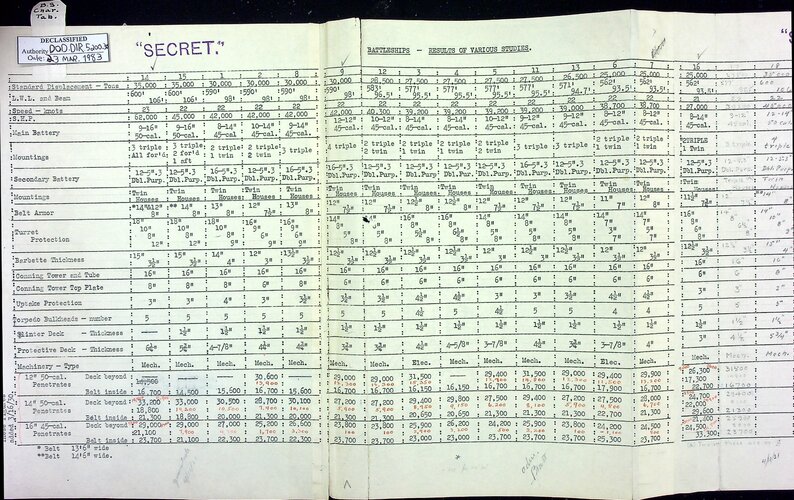
I have a very positive update to this: look what I just found in a Miscellaneous design box at NARA! Not just twins, but TRIPLES!
 

Attachments

  • 20241210_151621[1].jpg
    20241210_151621[1].jpg
    3.2 MB · Views: 264
  • 20241210_151408[1].jpg
    20241210_151408[1].jpg
    4.1 MB · Views: 279
Friedman goes into a little more detail in Naval Anti-Aircraft Guns and Gunnery. He says there was an October 1928 request from Admiral Leahy of BuOrd to look at the Army/Colt 37mm cannon (which I think eventually became the M1). BuOrd liked it for the 1-lb shell, which had a nominal velocity of 2800 fps. (The finished M1 for the Army has a heavier HE shell and lower velocity) The Navy asked for two test examples, with right and left-hand clip feed, with the goal to design a six-gun mount. But the Navy's ultimate desire was to design a 25mm version with longer shells of similar weight but better ballistics, possibly belt fed. It looks like Colt was unwilling to commit the engineering for that and it eventually came to nothing. Then the Navy went forward with its own 1.1-inch design and the rest, as they say, is history. (In 1930, the Navy also designed its own 37mm round and started work on its own 37mm gun, but abandoned it pretty quickly.)

(Oddly, in 1936 the Navy apparently received an offer from Rheinmetall for single and twin 3.7cm automatic guns, as well as Soluthern 2cm guns.)


Friedman mentions a 5.4"/40 design from BuOrd in this timeframe. This had a 75-lb shell with a separate case. It had a manually loaded ROF of 12 rpm on large ships (much less on small ones, probably). This was a bit too heavy to maintain the RoF, especially at high angles, so they went down to 5"/40 with a 54-lb shell weight. During development, they cut the barrel down a couple of calibers and we got the iconic 5"/38. There is some more info in the footnotes regarding mount weight and so forth that I'm too lazy to transcribe right now.
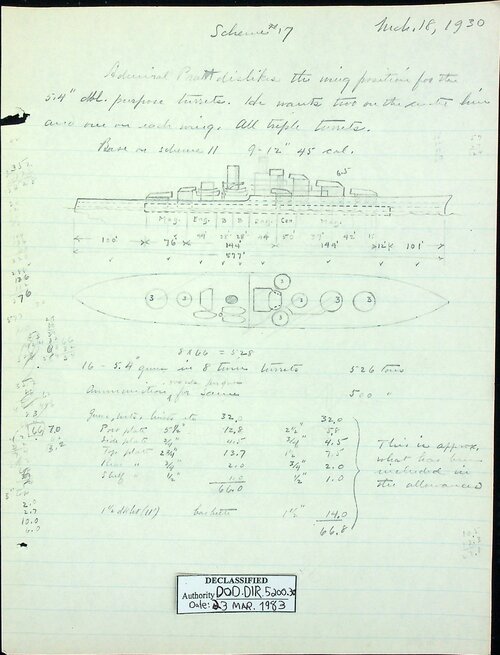
I am fairly confident that the 5.3" and 5.4" are the same gun, my guess would be 136mm which would explain the rounding errors. This BB sketch No. 17 from the London Naval Conference just a couple months after the turret sketch's date explicitly says 5.4", but the table says 5.3" triples. I would assume it's a single gun rather than a 135 and 137mm being designed at the same time for the same purpose.

(And for what it's worth, the USNI article on the 5"/38 also calls it a 5.4"/40 https://www.usni.org/magazines/nava...armaments-and-innovations-ubiquitous-5-inch38 )
 

Attachments

  • IMG_0056.jpg
    IMG_0056.jpg
    574.5 KB · Views: 169
  • IMG_0068.jpg
    IMG_0068.jpg
    2.1 MB · Views: 211
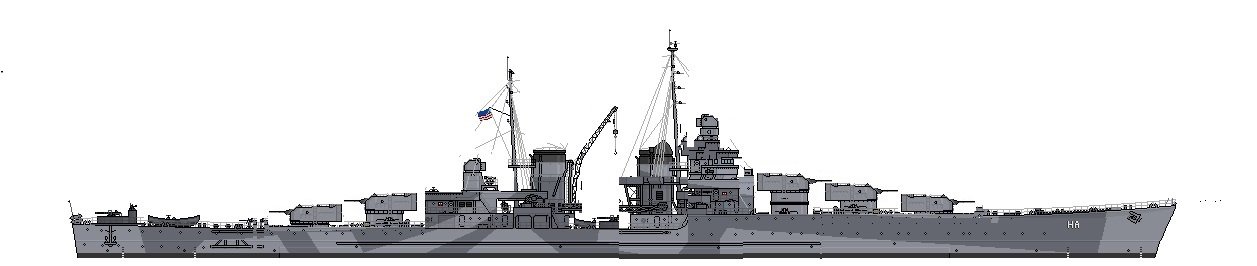
And now I can’t stop thinking about what a CLAA with 5 of these triples would look like….
I think they'd look pretty much like the Brooklyn class at first glance, and would like result in the two classes often being mistaken for one another. But there would just be "something off about them" to the casual observer.
 
Not to cause a distraction but I cobbled this from another drawing.

I already have the 5.4" triple turret modeled and molded in 1/1200 for the Scheme 17 BB. I may take a stab at making this too.
 

Attachments

  • US CLAA 5_4inchDG.jpg
    US CLAA 5_4inchDG.jpg
    59.7 KB · Views: 145
I have a very positive update to this: look what I just found in a Miscellaneous design box at NARA! Not just twins, but TRIPLES!
Hey @awhalen61 !
Did you visited NARA since then? Or found any document relating to the development of the 6" DP gun/turret?
 
5.4/5.3 are oddball, nontraditional calibers and their metric conversions are even more peculiar (137.16mm/134.62mm respectively). Does anyone know what the rationale was or could have been in selecting these measurements? This program seems to have been a paper exercise for at least half a decade, so some thought seems to have gone into the decision.
 
5.4/5.3 are oddball, nontraditional calibers and their metric conversions are even more peculiar (137.16mm/134.62mm respectively). Does anyone know what the rationale was or could have been in selecting these measurements? This program seems to have been a paper exercise for at least half a decade, so some thought seems to have gone into the decision.
Shell weight for a given shell form would be my guess.
 
5.4/5.3 are oddball, nontraditional calibers and their metric conversions are even more peculiar (137.16mm/134.62mm respectively). Does anyone know what the rationale was or could have been in selecting these measurements? This program seems to have been a paper exercise for at least half a decade, so some thought seems to have gone into the decision.
Probably an effort to reach the maximum shell weight possible while still being able to manually work the gun.
 
The French used a gun caliber that was about 5.4" (138mm IIRC) on some of their destroyer classes. On the last of their large destroyers these gave a very powerful anti-surface battery but as I understand it they never got all the issues worked out before the war occured.

Navweaps makes mention of a longer 5.4"/48 caliber gun which was considered during a later timeframe as an armament for CLAAs and replacement for the 5"/38 on battleships and other large combatants. It was rejected in favor of the 5"/54. The site also mentions an "uprated 5"/38" considered as an option but no more details on that.
 
5.4/5.3 are oddball, nontraditional calibers and their metric conversions are even more peculiar (137.16mm/134.62mm respectively). Does anyone know what the rationale was or could have been in selecting these measurements? This program seems to have been a paper exercise for at least half a decade, so some thought seems to have gone into the decision.
If you consider other common contemporary calibres, then there is the French 138.6mm which converts to 5.456". While we'd normally round that to 5.5", 5.5" was already commonly used for 140mm, so maybe they rounded down, not up to keep the distinction from the British 5.5" (ETA: and the Japanese 5.5" 3rd Year Type)
 
The Italians also had a 135mm naval gun (usually called 5.3" in English sources) which they used on light cruisers and a secondary armament on some battleships.

I'd have to assume the USN gun would have been precisely 5.4" as opposed to the ones used by the Metric navies.

I'd say the real oddball caliber award goes to the French gun which doesn't seem to fit nicely in either measurement system. Their navy seemed to have quite a few such calibers.
 
The Italians also had a 135mm naval gun (usually called 5.3" in English sources) which they used on light cruisers and a secondary armament on some battleships.

I'd have to assume the USN gun would have been precisely 5.4" as opposed to the ones used by the Metric navies.

I'd say the real oddball caliber award goes to the French gun which doesn't seem to fit nicely in either measurement system. Their navy seemed to have quite a few such calibers.
Though I have not found a definitive source on this, the French used 14cm, 138.6mm and 138mm for the same "caliber". It seems that 14 cm was used for the barrel inside of the rifling grooves, 138.6 mm as the real caliber at the rifling, and 138 mm as a new naming system eg "the number of millimeters rounded down to the mm".

So it may be that the design caliber was originally chosen with the oldest naming system and the name then changed.
 

Similar threads

Back
Top Bottom