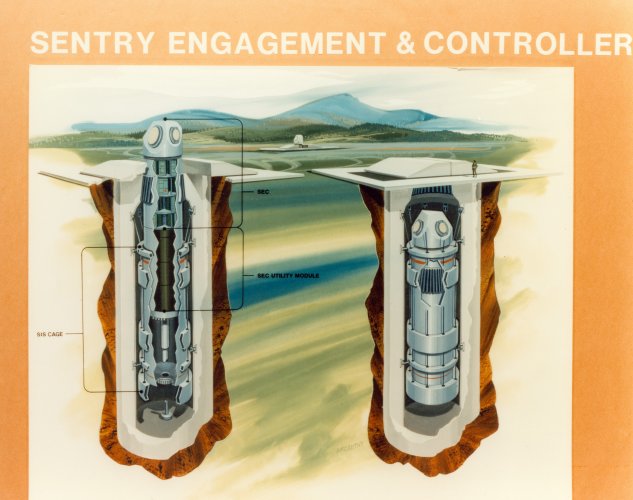
Something I've always wondered, why didn't the technology of the Sprint motor ever turn up elsewhere? I understand that the speeds it produced could be characterized as...excessive due to the whole issue of plasma communications interference, but it feels like a missile that can do zero to Mach 10 in five seconds should have some applications other than reentry vehicle interception. Scary-fast SAM/AAM? Some kind of SRAM replacement? I don't know, it just seems like there has to be some application for that.
 
I understand that the speeds it produced could be characterized as...excessive due to the whole issue of plasma communications interference,

By all accounts they'd found a way to deal with the command uplink problems caused by the plasma-sheath and those techniques are IIRC still classified.
 
Something I've always wondered, why didn't the technology of the Sprint motor ever turn up elsewhere?
The price for the speed was mass - Sprint was silo launched 3400kg missile with more or less 40km range. Sprint need such speed to catch RV coming at 2-3 kms before nuclear detonation will be triggered. The question what else need such speed, that justify the mass. And technologically nothing really changed - take a look how big is ARRW.
 
The price for the speed was mass - Sprint was silo launched 3400kg missile with more or less 40km range. Sprint need such speed to catch RV coming at 2-3 kms before nuclear detonation will be triggered. The question what else need such speed, that justify the mass. And technologically nothing really changed - take a look how big is ARRW.
I’d like to accelerate a large ALBM to high Mach number carrying a 1000 lbs warhead on a HGV.
 
Something I've always wondered, why didn't the technology of the Sprint motor ever turn up elsewhere? I understand that the speeds it produced could be characterized as...excessive due to the whole issue of plasma communications interference, but it feels like a missile that can do zero to Mach 10 in five seconds should have some applications other than reentry vehicle interception. Scary-fast SAM/AAM? Some kind of SRAM replacement? I don't know, it just seems like there has to be some application for that.
The sheer speed is really only applicable against things with nuclear warheads. You need something fast to get to the incoming nuke to defeat it before it goes boom.

IIRC most of the Sprint was simply a crapton of fuel burning really fast. Nothing particularly exotic, about like a CRV7 engine.

I believe that now the only two missions for Sprint tech is ABMs and anti-hypersonics.
 
Last edited:
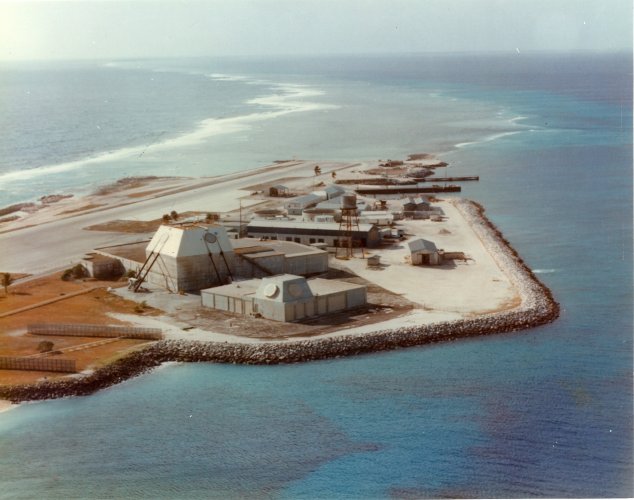
The Site Defense Radar, as described in this post by Ryan Crierie, was actually built in Kwajalein.

1000008670.jpg
After the Nike-X/Sentinel/Safeguard era, the Army continued developing ABM technologies and testing them at Meck Island in the Kwajalein Atoll. In this image we see the recently completed Site Defense Radar (SDR) system in the foreground, which was built on the reclaimed land that can be seen as the lighter color area on the right half of the image.

SDR was basically an updated version of the Missile Site Radar (MSR), the larger building to its left. The much smaller building size demonstrates the improvements in radar and computer technology made over the ten years since the MSR was built in the late 1960s. The two fences seen on the lower right were radar reflectors that prevented stray rays from the MSR being reflected off nearby islands to the north. These "clutter fences" were common in earlier systems. The metal rails running up the sides of the MSR building are supports for a maintenance platform and were removed sometime after this photo was taken.

The Site Defense Program was part of ongoing studies to provide a last-ditch defence against attacks on the US Air Force's Minuteman missile silos. SDP sites would be equipped with an SDR and a number of Sprint II missiles positioned near the Minuteman silos. They would watch attacking warheads until the last possible second and only shoot at those that could be seen approaching a silo close enough to damage it. Others that could be seen falling outside the lethal radius would be ignored, allowing a small number of Sprints to deal with the warheads from a large number of ICBMs.
 
SAFEGUARD scored several kills during OIF...in a way.


My initial contact with the Patriot system was in the late 1970s. I was fresh out of graduate school with a PhD in psychology but had some experience with predecessor air defense systems, such as Nike Hercules and Hawk, as an air defense officer in the early 1970s. Patriot was a somewhat different experience. The system has two operating modes: semi-automatic and automatic. Patriot in semi-automatic mode is slightly more automated than its immediate predecessor the Hawk system, but still on that I would term the “main line” of evolutionary development for air defense systems of its class. That is, the system provides more computer-based engagement support than its predecessors, but Patriot in semi-automatic mode is still very much an operator-in-the-loop system. Patriot in automatic mode represented a significant jump in capability. In that sense, there was a discontinuity between Patriot in semi-automatic mode and Patriot as it could be used in automatic mode.

Patriot’s automatic mode is quite different. So different, in fact, that I once asked one of the prime contractor’s systems engineers where they got the engagement-control algorithms used in the system’s automatic mode. He replied that they had been adapted from the engagement control logic of the Safeguard system. Safeguard was the first operational U.S. anti-ballistic missile (ABM) system. The system was deployed briefly beginning in the early 1970s and then traded away as part of one of the first treaties limiting U.S. and Soviet ABM systems. Remnants of the old Safeguard system still exist at Ft. Bliss, Texas, and at isolated sites in Montana and North Dakota.

Safeguard was a near-autonomous system. Get a green light to initiate the missile engagement process, and the system mostly took over from there. The computer fought the air battle. That was a reasonable choice, given Safeguard’s mission and operational context: Fight the first salvo of the Battle of Armageddon at the edge of space. However, that level of automation was not an appropriate operating mode for Patriot’s mission and operating environment. Patriot operates in the more cluttered and ambiguous lower-tier region of the air defense operational environment. The potential for track classification and identification mistakes is considerably greater for Patriot than it was for Safeguard. The Army did not fully grasp the impact of these differences, and to some extent still does not. The major problem with Patriot is that the system’s automatic feature is mostly an all-or-none operating mode. In automatic mode, there are few “decision leverage points” that allow the operators to influence the system’s engagement logic and exercise real-time supervisory control over a mostly automated engagement process.

Beginning in the late 1970s and continuing through Patriot’s initial fielding in January 1984, I was involved in a series of system development studies for Patriot. During that time, there was a school of thought in Army circles that using Patriot in automatic mode would be a preferred operating concept. Our early work lent support to the argument that automatic was not a suitable operating mode for Patriot against conventional air threats. Patriot’s engagement algorithms were too “brittle” for the system’s engagement context. Used in this context, “brittle” refers to the machine’s inability to handle unusual or ambiguous tactical situations reliably. The term is now commonly used to describe automation limitations.

The basic issue with brittleness is that computer-based algorithms operate in a black-and-white world; they have a little capacity to handle gray or ambiguous situations. That task falls to human operators, if they have the time and expertise to do so. When Patriot was initially fielded, tactical usage guidance directed that the system not be employed in automatic mode. The automatic mode was included with Patriot because it was available from Safeguard, and there were potential Cold War-related situations in which a mostly automated air defense system might prove useful. Safeguard was intended to be used in a nuclear war context in which all bets are off, so to speak, and risk tolerance is very high. That was not the case for Patriot.

...

One of the more interesting aspects of Patriot tactical operations after the first OIF fratricide incident (the British Tornado) was a decision to have fire units drop their launchers to standby mode.

That way, the system could remain in automatic engagement mode but not actually engage a track until one or more launchers were returned to ready status. Commanders apparently wanted a “second look” before permitting the system to engage.

The second OIF fratricide (the Navy F-18) took place under this modified operating regimen. The system reported a false ballistic missile track later attributable to radar electromagnetic interference. The tactical director at the battalion command and control node gave the order, “Bring your launchers to ready.”

That directive was tantamount to an order to engage. But that was not what the tactical director intended; he simply wanted to get ready to engage by bringing fire unit launchers to ready status.

The subordinate battery fire units were in tactical ballistic missile automatic mode.

The tactical director either did not know that, or he did not remember in the heat of impending action that returning launchers to ready status would result in an automatic engagement by the first available launcher. The F-18 was engaged and destroyed.

...

Army “big missile” air defense units such as Patriot function under the operational control of the Air Force. After the second fratricide, the Air Force denied Patriot units any engagement authority, even in self-defense.

The Tornado incident was a permissible self-defense engagement against what the system classified as an anti-radiation missile. Under the new rules of engagement, Patriot could engage only when specifically authorized by the Air Force controlling authority.

Tactical ballistic missile engagement timelines are often too short for that to be a practical course of action. In essence, that decision took Patriot out of the fight, so to speak.

There were no further Patriot launches during OIF, and, luckily, there were no more ballistic missiles to shoot.

Similar engagement restrictions on Patriot operations are still in place: the Air Force retains engagement authority for any Patriot shots.

...

There are situations in which a high level of automation and near-autonomous operations clearly are required. One such situation involves defending against large numbers of incoming ballistic missiles, what analysts refer to as a saturation attack. Human operators performing in-the-loop or too closely on-the-loop in such situations could be overwhelmed and not able to cope effectively with performance demands. Too closely on-the-loop refers to a situation in which operators under-trust the automation and do not permit the system the control latitude the engagement situation demands. This is the flip side of the automation over-trust issue mentioned previously.

In a sense, this requirement led to the development of Patriot’s automatic mode of operation more than 35 years ago. Recall that Patriot’s automatic mode was adapted from the Safeguard system’s automatic mode.

That mode of operation was entirely appropriate for Safeguard’s mission objectives and operating environment. Problems arose when the automatic mode was incorporated into Patriot without a critical consideration of differences between Patriot and Safeguard. That led to imprudent use of Patriot during OIF and contributed to the fratricide incidents.
 
SAFEGUARD scored several kills during OIF...in a way.

It'd be interesting to hear how Aegis automatic logic works in comparison.

Wonder if anyone can actually describe it in sufficiently-general terms without NDAs flaring, though...
 
Congressional Record; HOUSE 4605 - February 26, 1969

[From the Los Angeles (Calif.) Times. Feb. 21, 1969]

ANTIMISSILE FUNDS SOUGHT BY AIR FORCE (By Ted Sell)

WASHINGTON. The Air Force is lobbying behind the scenes to get money for its own antiballistic missile system, perhaps in competition with the Army.

The Army has been assigned responsibility for developing and deploying, as well as operating, the controversial Sentinel ABM.

But the Air Force would like to get some of the action, too, partly out of concern that continued Army work on ABMs would in time put the Air Force out of the space-defense business it was assigned after it became a separate service.

Air Force officers are seeking about $15 million to test out their ideas that discarded Minuteman intercontinental ballistic missiles can be modified into ABMs.

APPROACH LEGISLATORS

Air Force officials have privately approached key legislators on the project. The action has the effect of encouraging delays in going ahead with Sentinel on grounds the Air Force may be in the process of developing a better and cheaper substitute. How successful the Air Force effort will be on Capitol Hill is open to question. The current dispute in Congress is over whether the Army's Sentinel will work and whether it will be worth the $5 billion to $10 bill1on estimated cost. The Air Force already had started to acquire the expertise it might need to operate an ABM. At Eglin Air Force Base, Fla., it built a $62 million one-of-a-kind advanced radar installation in 1967. Since then the Air Force has trained technicians to operate the unit in excess of the needs for simply one such radar, while admitting it did not plan to build others.

The Eglin radar is of a type called phased-array, an advanced system far beyond those now needed by the Air Force but similar in principle to those to be used in the Army's Sentinel system. One of the advantages the Air Force sees in its proposal is that it would use hundreds of Minuteman 1 missiles which otherwise will become surplus as the new, multiwarhead Minuteman 3 missiles are produced.

APPROVED IN 1957

The Minuteman program was approved in 1957 as the first project to use solid-fuel missiles as ICBMs instead of the earlier liquid-fueled Atlas and Titan missiles. Solid-fueled missiles can be stored longer and fired much faster than missiles which have to be fueled with the toxic and corrosive liquid fuels immediately before firing. By 1963, the Air Force had 800 Minuteman 1 missiles. The figure is down to 600, with the other 400 missiles in the 1,000-rocket force being later model Minuteman 2. Each of the Minuteman 1 models cost on the order of $7 million to $8 million.

The Air Force sees an ABM system based on these weapons as saving much of the cost otherwise involved in buying new Spartan and Sprint missiles. The major modification involved in the Air Force plan would be to convert guidance systems from the offensive mission -- directing the Minuteman in an upward path that would put it on course to plunge onto within about a quarter mile of a target in Russia to a defensive one. The defensive mission would involve placing the Minuteman warhead within a close enough distance of an incoming Russian missile to destroy it either with blast effect or a shower of radiation to neutralize the nuclear warhead.

Significantly, the Air Force thinks the guidance might be made accurate enough to get away from a nuclear warhead for the ABM -- that conventional explosives might do the job.
 
Congressional Record; HOUSE 4605 - February 26, 1969

[From the Washington (D.C.) Evening Star, Feb.19, 1969)

PENTAGON EYES SENTINEL AS SUB MISSILE SHIELD
(By Orr Kelly)

The Defense Department is considering a significant new use for an anti-missile system -- protection against a possible Soviet submarine missile attack in its current review of the Sentinel defense system. Defense Secretary Melvin R. Laird raised the possibility that the components of the Sentinel system might be arranged to provide protection against Soviet submarine-launched missiles for the first time yesterday in a Pentagon press conference.

"I believe . . . the technology that is ready now for deployment and could be deployed if we were to go along with the Johnson-Clifford budget proposal or a modification of the Johnson-Clifford budget proposal, would have certain side-defense capabilities as far as Soviet-launched weapons from submarines or from space platforms, or false launches," Laird said.

Although Defense officials are convinced an effective defense against the Soviet force of nearly 1,000 land-based missiles is impractical now, it was learned that they are considering the possibility that a high degree of protection could be provided against submarine-launched missiles through much of the 1970s. Defense experts, working under the direction of deputy defense secretary David Packard, are considering about 10 possibilities in their review of the Sentinel system, developed under the Johnson administration.

The possibilities being considered include continued research and development, with no deployment at the present time, plus the number of different ways of deploying the radars and missiles of the Sentinel system.

Not under consideration is the so-called "thick" system designed to protect this country against a full-scale Soviet attack, according to Pentagon sources. But an effective defense against submarine-launched missiles is considered a possibility. As presently planned, the Sentinel system would have only limited capability to shoot down submarine-launched missiles because it is designed to detect and destroy missiles coming in from the north. But it could be redesigned to look seaward as well, probably at a significant increase in cost.

The Russians now have about 45 submarine-based missile launchers, compared with 656 launchers on American polaris nuclear submarines.

The Soviet Union deployed its first boat comparable to the early Polaris-type American submarines last year and is now estimated to be building from one to two new ballistic submarines a year. Each is capable of carrying 16 missiles. At this rate of production the Russians could have about 237 launchers on submarines by the mid-1970's, of which about half might be deployed at any one time. If, in the event of war, two or three subs could be destroyed before they launched their missiles, an American missile defense system might well be able to intercept most, if not all of those remaining.

Whether the cost of checkmating the Soviet ballistic missile submarine effort through much of the next decade would be worthwhile when the Russians would still have enough land-based missiles to destroy this country, is debatable.

But American defense planners consider the 41 U.S. Polaris submarines this country's most important means of preventing a nuclear war and would be greatly concerned if the Russians found some way to nullify this force. They could thus decide it would be worth a great deal to prevent a similar Soviet force from becoming an effective threat.
 
Congressional Record; HOUSE 4605 - February 26, 1969

February 15, 1969, Armed Forces Journal

SENTINEL ADVANCES
(By Walter Andrews)

The Army now is evaluating Sentinel ABM intercept improvements that, if proven feasible, would permit the use of lower-yield nuclear warheads and possibly even the eventual use of conventional warheads.

Industry studies for greatly improving the accuracy of the Sentinel system's Spartan long-range, ICBM intercept missile are presently being evaluated by the Army's ABMDA (Anti-Ballistic Missile Defense Agency).

The studies are referred to as SIPS (Spartan Improved Performance Study) and center on the high performance third stage. ABMDA is part of the Army's Office of Research & Development (OCRD), and provides long range R&D for the Sentinel system. Nothing is officially firm on when the improved Spartan missile would be incorporated in the Sentinel system.

However, indications exist that the Army would like to have the improved missile in the Sentinel system sometime during 1974. As presently conceived, the Sentinel is slated for operation in 1971.

The proposed improvements would give the Sentinel a new deployment flexibility, which could conceivably mitigate the effect of recent objections to the location of nuclear ABMs near cities.

Officials pointed out to the JOURNAL, however, that a "massive change" would not be involved.

SIPS AND LOITER

SIPS, if proven, would give the Spartan an in-flight "loiter" or "wait" capability, which could possibly be measured in minutes or seconds. It would permit the Spartan to be redirected in fiight, with all that capability implies in terms of improved accuracy.

With a "loiter" capability, the Sentinel would not have to commit a Spartan to intercept until time had been allowed for the atmosphere to separate the real warheads from decoys.

JANUARY PROPOSALS

Since the middle of January, ABMDA has been evaluating studies by Boeing, McDonnell Douglas and Martin Marietta on the feasibility of developing a new third, "loiter" stage for the three-stage Spartan missile.

These funded efforts studied the feasibility of a new, third stage utilizing solid-propellant. A previous McDonnell Douglas effort considered the possibility of developing a new third stage utilizing liquid rocket technology.

SOLID VERSUS LIQUID

The usual advantage of liquid propulsion over solid is that thrust and missile attitude can be controlled and varied more. Once ignited, it is difficult to control the burning and vary the thrust of a solid rocket. This is done in liquid rocket motors by controlling the flow of fuel or oxidizers. Solid motors, however, have the strategic advantage of readiness. The Army therefore is studying methods to vary the pulse and attitude of solid motors.

RFP'S SOON

In the near future, it will request industry proposals for the best method of building such a controllable solid motor. The industry "answer" could involve a near term solution of clustered motors or the development of a new type of solid motor control nozzle.

Officials also told the Journal that technology has been postulated by industry (LTV was mentioned as being in the forefront) of "near-zero miss distances."

In its evaluation of technology the Army would take into consideration work done by the Air Force on satellite intercept by rocket.

The R & D job facing DoD and the Army's ABMDA right now involves feasibility evaluation of these postulated capabilities.

CONVENTIONAL WARHEAD?

Officials said that a successful SIPS effort would permit the utilization of a much lower yield nuclear warhead. They added that the attainment of accuracies sufficient enough to permit the utilization of conventional pellet or steel rod type warheads "is still farther down the road."

"The people in DoD are as eager as anyone to develop a non-nuclear warhead. It's a goal we are shooting for -- unfortunately it's not easy. The probabilities involve distances of a few feet."

SPARTAN AND SPARTANS

In ABM developmental language, officials told the Journal "the proposed improved third stage would let you wait until the atmosphere has sorted out the ballistic coefficients of all the things involved."

The 1967 approval of the Sentinel system was predicated on the development of a new, longer-range, "exoatmospheric" Spartan missile.

This missile will use the radiation from a high-yield nuclear warhead exploded outside the atmosphere -- the so-called "big bang effect" -- to intercept and disarm incoming ICBM warheads.

A NEW MISSILE?

Prior to the go-ahead for the Sentinel system, the Spartan was called the Extended Range Zeus (DM15X2), which was developed by McDonnell Douglas.

Except for the public relations/political rationale for renaming the Extended Zeus the Spartan, there would be a good possibility of the improved Spartan being given a new name.

Officials said that such a missile would be combined with the exoatmospheric Spartan for the area defense of the country. Presumably, the shorter range Sprint ABM interceptor also would find a place in the new scheme.

REMOTE SPRINT

Consideration also has been given to a "Remote Sprint" Sentinel configuration, in which the Sprint missiles would be placed away from the detecting Perimeter Acquisition Radars (PAR) and the tracking Missile Site Radars (MSR). The benefit here would be that such a Sprint configuration would better utilize the "reach" of the longer range radars.

When positioned close to the radars, the short range Sprint missiles only utilize a fraction of the radar's range.

Officials told the JOURNAL that Remote Sprint is considered a potential improvement. However, no decision. has been made as yet, they said. The obvious trade-offs are the cost of new site acquisition and additional command and control installations.

In a possible new Sentinel configuration, the exoatmospheric Spartan missiles containing the high-yield nuclear warheads could be positioned away from cities.

The SIPS version of the Spartan could be emplaced nearer the cities for the "area defense" of the population centers.

The Sprints, remote or otherwise, could be used for the defense of radar sites and possibly ICBM installations.
----

SABMIS AND SENTINEL

"Proven technically feasible" are the words used by officials to describe the present status of the Navy's Seaborne Anti-Ballistic Missile Intercept System (SABMIS).

Officials told the Journal that concept formulation of the system is "completed right now" as far as the technical feasibility of the system is concerned.

A SAMBIS would be a good system for intercepting enemy ICBMs in the boost and mid-course phase, officials said. As such it would complement the Army's Sentinel system.

SABMIS presently is funded at a low level, officials said, but a lot depends on DoD decisions made during the next month.

Industry feasibility studies on SABMIS were completed last year.

Companies participating were: Hughes, PRC, General Electric, Northrop Nortronics, Sperry, Boeing, McDonnell Douglas, Martin Marietta and Raytheon.
 
Congressional Record
Extension of Remarks 20 Sep 1976, 31434

"The Merits of a Limited Ballistic Missile Defense," originally from the October 1970 issue of "Astronautics and Aeronautics"

THE MERITS OF A LIMITED BALLISTIC MISSILE DEFENSE
(By Patrick J. Friel)

How should the U.S. respond to the development of the ICBM-delivered thermonuclear weapon by the Chinese People's Republic (CPR) or any limited-resource nation? I believe that the most reasonable response is the deployment of an "area type" ballistic missile defense (BMD) system.

This article discusses an area BMD system. It also covers the possible response of the Soviet Union to the deployment of Safeguard; the value of a limited BMD as an alternate (other than a massive retaliatory strike by our strategic offensive forces) U.S. response to a small ac- cidental attack ·by the Soviet Union; the role of the Safeguard system in protecting our strategic forces and thus limiting their size; and some technical approaches to arms control.

U.S. Response to the CPR Nuclear Threat:

The U.S. has at least three options in responding to the deployment of ballistic missiles by the Chinese People's Republic or, for that matter, any limited-resource nation.

1. A massive-retaliation deterrent (the so-called "assured destruction" policy).

2. Preparations to destroy a potential attacker's missile forces themselves at some level of provocation (the "counter force" policy).

3. A limited ballistic-missile defense.

There is a fourth alternative, i.e., a policy of doing nothing, which may be tantamount to forcing the U.S. into a formal assured-destruction policy.

An assured-destruction policy with respect to the CPR could well involve the destruction of upwards to 200-million people, if we apply the same criteria as we have to the Soviet Union (25% to 30% fatalities) -- an incredible holocaust.

Even so, it is not clear that the Chinese would be deterred by the existence of such forces, since they have publicly stated that they believe that thermonuclear weapons are "paper tigers." (This, of course, is one reason for admitting the CPR into the United Nations. Presumably, they could learn and hopefully understand the disaster of a thermonuclear exchange.)
For credibility, it would be necessarry for the President or the Secretary of Defense to announce formally the massive-retaliation policy with respect to the CPR or other nuclear-armed limited-resource nation. This would mean that a rich, powerful, Western, and predominantly white nation would threaten to destroy an Eastern poor, non-white nation in the event of a limited thermonuclear attack. Even if such a policy is justified from the U.S. viewpoint, its very existence could heighten the tensions between whites and non-whites in the world.

The second option would be to develop the ability to destroy any missile force developed by the CPR. If this were our only response to the potential Chinese threait, then the U.S. would be put in the position of being the aggressor, even though the target would be "inanimate" missiles.

The U.S. attack would have to occur at some unpredictable level of provocation -- a very difficult, if not impossible, policy to implement. In fact, this policy might even require a willingness to absorb damage from a few missiles before destroying the remainder of the CPR forces.

The third option, a limited BMD, prevents reliably blackmailing the U.S. into some untenable position with a threat to destroy a few of our cities and some 5-20-million Americans. Its principal disadvantages include the cost --i t would consume national resources that could go to other and possibly more pressing problems -- and the possiblllty that it would push another spiral in the arms race with the Soviet Union.

I think that it has been shown quite clearly that it is not technically feasible to build a ballistic-missile defense, within any cost, that would provide adequate protection against a determined attack on our urban centers by a nation with the resources of the USSR.

A simple calculation would show that an effective terminal urban defense against even 10,000 missiles (both the Soviet Union and the U.S. now have about 1000 groundbased missiles) would fail if the opponent built only a few hundred more and casualties could still be in excess of 100 million, even assuming a defense effective against sophisticated penetration aids.

Thus, within the state of our technology, an urban defense against a nation with large technical and material resources does not seem to be practical, and therefore, an assured-destruction policy with respect to the Soviet Union ts the only reasonable response.

(I might add that the limiting technology appears to be the traffic-handling ability of radars, and more basically, the fact that an interceptor missile must be used to destroy the attacking missile. As long as a "flying machine" must be used as a defensive weapon, the defense will always be "saturated" at some attack level. A vast change in our technology -- e.g., the introduction of some sort of radiation weapon-would be required to change this fundamental technical fact.)

However, a limited defense system aimed at defending ourselves against a Chinese attack (or an attack by any limited-resource nation) would escalate the cost of developing an effective force on the part of the Chinese to prohibitive values beyond their resources.

In fact, the possession of a limited defense by the Soviets and ourselves would make an entrance into the "thermonuclear club" too expensive for almost all the nations of the world. Thus, the temptation on the part of any nation to invest their resources in the development of thermonuclear weapons would be substantially reduced and the effectiveness of any small missile force alone would be essentially nil.

The fourth possibllity, to do nothing, I would repeat, means implementing an assured-destruction policy with respect to the CPR.

I think we should realize that many of those who are on principle opposed to any form of ballistic-missile defense are in fact the architects of our present assured-destruction policy with respect to the Soviet Union.

It is not certain that the extension of this policy to the Chinese and any other limited-resource nation will be as effective as it has been with respect to the Soviet Union.

Safeguard Against a Small Attack:

Thus I see compelling reasons for deploying a limited BMD. The proposed Safeguard program will include, of course, the long-range Spartan missile, designed to make an interception outside the atmoshpere.

An important technical variation on the basic Spartan design will also be deployed and will substantially increase its range, by redesign of only its upper stage -- a change which has been in development for some time.

The greater range will enable one Spartan battery to assist another in the event of a concentrated attack of many tons of missiles on one urban area. Thus, if the Chinese should target all of their small force in one metropolitan area, it should be possible to bring to bear more than one battery in the defense of that area.

The improved missile wlll also have the ability to counter a threat from sea-launched ballistic missiles or a fractional orbital bombardment system (FOBS).

The performance characteristics of this modified Spartan will also make it possible to counter some the elementary penetration aids which the Chinese may introduce, such as balloons and chaff.

In addition, the Safeguard system wlll be designed to accommodate any reasonable radar-blackout attack which could be mounted by the potential Chinese forces. The frequency of Safeguard acquisition radar has been chosen to minimize such effects. Moreover, the system will be "• • •" to permit one perimeter radar to assist the other in the initial acquisition and tracking of the threat in a "blackout" attack.

With this limited-area BMD system, the President would not be forced into untenable negotiations with the Chinese or any limited-resource nation with a small number of missiles.

Thus, the area-defense part of the proposed Safeguard with the improved Spartan will provide a significant capability against the limited Chinese forces, even if they should employ elementary penetration aids wtth a small blackout attack or should concentrate their entire force on one section of the country.

I should emphasize that larger forces and technical sophistication would eventually allow the Chinese to penetrate the Safeguard system. If, however, the CPR constructs such a large force -- substantially larger than our projections (a few tons of missiles in a few years) -- we would have no alternative but to formally turn to massive retaliation through the development of an overwhelming assured-destruction capability with respect to the Chinese mainland.

Hopefully, in the interim, the CPR will see the folly of entering into an ever-escalating thermonuclear arms race with the U.S. or, for that matter, the Soviet Union.

Therefore, by creating the area-defense portion of the Safeguard system, we will not be placed in the position of publicly implementing an assured-destruction policy with respect to the Chinese upon the appearance of a few ballistic-missile systems on the mainland of China, or, in any hostile limited-resource nation.

 
It’s shocking to read what we were doing 60+ years ago. Now we have trouble building a ICBM (amongst other systems)

The advancements in aerospace tech from 1945-65 compared to 66-25 is somewhat depressing.

There was legislation passed in 2018 IIRC called the right to try. Terminally ill people could try experimental drugs that hadn’t passed the rigorous testing of other medical treatments/pharmaceuticals.

We should have a national defense “right to try” and start trying to do the incredible again without fear or punishment that seems to come with RDT&E.
 
I could see Sprint technology for in-space use perhaps.

Starship can't quite get to an Earth Trojan on its own--but could perhaps release a similar solid to bridge the gap.
 
I apologize about bringing back politics. There was a Bulletin of the Atomic Scientists article from I think 2004 that goes into the adding on effect an ABM system creates. It draws more fire down on it to make sure it’s overwhelmed. The Bulletin is very peacinik-y but they have the best detailed articles. They‘ve put their archive behind a paywall now but I think I have it somewhere printed out. If I can find it, I’ll post pics. It compares 2 nuke targeting plans against Moscow. 1 from 1968, 1 from 1989. About double the amount of warheads targeted by 1989.
What a shame they put it behind a paywall. That would be something great to see.
I also own the BB Briggs book on strategic defense. And yeah, I think ABMs are both effective AND if not destabilizing, they further arms races. Now if your opponent can’t afford a large nuclear arsensal & you can, a small ABM system gives you some maneuvering room.
I would say even a limited shield like the system used around Moscow (ABM-1/4) would still be useful even if it wasn't a perfect shield.

Looking at this the power-output would be extremely high to generate such a beam and it would be something that seems fairly fixed in directionality. One would easily just use mobile missiles and the effectiveness would go down to zero (and China, North-Korea, and Russia all have mobile ICBM's).
 
I could see Sprint technology for in-space use perhaps.

Starship can't quite get to an Earth Trojan on its own--but could perhaps release a similar solid to bridge the gap.
No, the high acceleration has no use.
 
NORTH AMERICAN AIR DEFENSE COMMAND and
CONTINENTAL AIR DEFENSE COMMAND
HISTORICAL SUMMARY
JULY-DECEMBER 1962

In September [1962], NORAD learned that the Army had issued contract awards of $375,000 each to Douglas, Lockheed, Martin, and North American Aviation for a study to define a SPRINT AICBM missile development program.

The study was to be completed in 120 days.

The requirements were for ICBM destruction up to 108,000 feet, with engagement time of 10.5 seconds, to include system reaction time after a decision was generated, and 4.5 seconds to 20,000 feet. A 48-missile complex was to be considered with a capability of launching 12 missiles simultaneously every ten seconds. If possible, the missile was not to exceed 150 G axial acceleration.

SPRINT was to protect sites hardened to 100 psi. For urban application, 15 psi at ground zero was the maximum acceptable level.
 
December 3, 1964

MEMORANDUM FOR THE PRESIDENT

SUBJECT: Recommended FY 1966-1970 Programs for Strategic Offensive Forces, Continental Air and Missile Defense Forces, and Civil Defense (U)

5. The Production and Deployment of the NIKE X Anti-Missile System

During the past year, we have greatly expanded our knowledge of anti-missile defense with regard to both the cost and effectiveness of alternative deployments and the technical aspects of the system. The Army has developed three basic systems configurations which differ primarily in the number and kind of radars utilized:

a. The so called HI-MAR configuration which includes one high cost Multifunction Array Radar (MAR) and about two single-face low cost Missile Site Radar (MSR) for each urban area defended. This configuration provides the most effective defense against a large, technologically sophisticated attack per urban area defended, but it is the most costly for a given number of areas.

b. The LO-MAR configuration which includes, on the average, one MAR for every three urban areas and one double-face MSR and two single-face MSR for each urban area defended. For a given level of expenditures, recent Army studies indicate that the LO-MAR configuration would possibly maximize survivors against a moderately sophisticated attack and would be clearly superior to a HI-MAR configuration against a smaller or less sophisticated attack.

c. The NO-MAR configuration which includes only MSR radars in the same combination as the LO-MAR configuration. This would be the lowest cost configuration per urban area defended but it would not be effective against a large, sophisticated attack.

I found this in the Bell Labs ABM document regarding the MSR in Nike-X:

"The MSR could track targets at relatively short range and look behind nuclear fireballs that obscured MAR coverage. Also, it could either look behind or permit triangulation on jammers, and generate additional tracks when required by traffic levels."

I also dug more into Bell Labs Document and found this:

The L-band MAR-II of the NIKE-X System was specially designed for long-range search and acquisition and high-data-rate coverage for discrimination. Plans were established for installing a prototype model on Kwajalein (see artist's view in Figure 1-34), while the MSR was to be located on Meck Island some 25 miles away. The high-power requirements for MAR (100 MW peak and 2 to 3 MW average per transmitter face) dictated separate transmitter and receiver array faces.

I once did a deep dive onto PILLBOX [DON-2N] and the similarities I'm finding between MAR-II and DON-2N are a lot.
 
Last edited:

ICBM Site Defense Studied
AVIATION WEEK and SPACE TECHNOLOGY, August 27, 1962​

New series of parallel advanced studies aimed at developing a terminal ballistic missile defense system possibly built around an extremely high-acceleration version of Nike Zeus, called Nike Sprint (solid propellant rocket intercept) for the purpose of point defense of the nation’s ICBM bases. are being conducted separately by the Army Ordnance Missile Command and Advanced Research Projects Agency.

Three-part contract for a system study known as Hardpoint, currently is being negotiated with three aerospace companies by ARPA. The three are American Machine & Foundry. Hughes Aircraft Co. and Maxson Electronics.

Proposal requests for a study of a high-acceleration Zeus defense missile, which is expected to be capable of bettering the already high-acceleration of the Army's Nike Zeus anti-missile missile by a factor or five or six, are due to be issued by AOMC momentarily. This will be conducted under a program called Hardsite.

Essential idea behind both Hardsite and Hardpoint is to give the Air Force’s hardened Atlas, Titan and Minuteman ICBM sites additional defense against ballistic missile attack with their own anti-missile missile system. Hence, the name Hardsite defense, or Hardpoint defense as it was known in original studies conducted nearly two years ago by many aerospace companies working under Air Force’s Study Requirement 79813.

Under Hardsite or Hardpoint concepts, a small volume or corridor, which hostile missiles would have to penetrate in an assault against a hardened missile site, would be calculated and protected by detection and acquisition radar systems and special Nike Sprint sites. The intention would be to defend only the hardened sites or “hard points.”

Against enemy warheads coming in through this narrow corridor, an extremely simplified guidance system could be used for Sprint missile compared with that required for Nike Zeus. The missiles would be designed to make an intercept 4-5 sec. after launch at an altitude above 50.000 ft., where explosion of a multi-megaton warhead would not produce sufficient overpressure to damage U. S. hardened missile sites. The Nike Sprint probably would not employ a nuclear warhead.

The Hardpoint studies began about two years ago as an outgrowth of SR 79813 which concerned hardened site equipment and its vulnerability. A series of studies, several of them funded, were conducted for Rome Air Development Center by a number of aerospace companies including Martin Marietta, United Aircraft, Hughes, Raytheon, General Dynamics and Republic Aviation. These efforts, then known as Hark (Hardened Re-entry Kill), were completed in 1961 and taken away from USAF on the ground that terminal ballistic missile defense is Army’s responsibility.
 

ARPA Briefs Industry on HIBEX
Aviation Week & Space Technology, March 25, 1963​

Washington—Missile and propulsion companies were briefed earlier this month on the Advanced Research Projects Agency's (ARPA) HIBEX (high impulse booster experiments) program. The program aims to advance the technology of extremely high-acceleration rocket boosters for missile defense and other potential uses.

ARPA hopes through its Project Defender to develop technology that will provide advanced anti-ICBM missiles capable of reaching altitudes of several miles in less than a second. This would allow low-altitude intercepts with maximum use of atmospheric filtering to discriminate between decoys and warheads. From this program will come technology for improved models of the Sprint missile for Nike X (see story) and for possible use in defending hardened missile sites and control centers.

Proposals from industry on the HIBEX program are due in May, with a target date of July for selecting one or more contractors. Companies that attended the recent briefing included Aerojet-General, Boeing, Douglas, General Dynamics/Astronautics, General Electric, Hercules Powder Co., Hughes Aircraft, Lockheed Missiles and Lockheed Propulsion, Martin, Rocketdyne, Thiokol, and United Technology Center (UTC).

UTC last week won an ARPA contract for studies on a solid-propellant, anti-ICBM missile booster with acceleration rates of 10 to 100 times those of conventional solid-propellant rockets. Several other firms are conducting similar studies.

---- --- ---

Martin Co. Will Develop Sprint Missile for New Nike X System
Aviation Week & Space Technology, March 25, 1963​

Washington—Martin Co. last week won the three-company competition to develop the Sprint missile, a relatively low-cost, high-acceleration missile to be used in the new Army Nike X ballistic missile defense system.

Nike X system, which will use atmospheric filtering to discriminate between decoys and warheads, requires a missile that can be launched, reach intercept altitude of 20-30 mi., and kill the target within 10 sec. (AW Feb. 11, p. 36).

Martin becomes a major subcontractor to Bell Telephone Laboratories (BTL), which is responsible for Nike X system design and development, a role it also performs on the Nike Zeus for the Army Missile Command. Initial contract, expected to total approximately $55 million, is being negotiated.

Douglas Aircraft Co., which was selected last fall along with Martin and North American Aviation to conduct 120-day paid studies on the Sprint missile, was the subcontractor for the Nike Zeus missile. Failure to get the Sprint program may result in a number of layoffs at Douglas, although Zeus improvement work is continuing, particularly for possible anti-satellite use.

Sprint development will be carried out at Martin’s Orlando Div. Project director will be Sidney Stark, former project director for the Army-Martin Pershing missile.

Announcement of Martin’s selection roughly two weeks before the Apr. 1 target date originally set for selecting the Sprint contractor reflects the high priority attached to the program by Defense Dept. officials. Defense Secretary Robert McNamara told the House Armed Services Committee recently that “we propose to proceed with the greatest urgency in the development of the Nike X system. . . .”

The new system, with its high-acceleration Sprint missiles, also appears suitable for use against submarine-launched ballistic missiles, where the warning time is considerably less than for an ICBM. McNamara called such a defense “second only in importance to defense against ICBM attack.” Also, because the Nike X missile should be less expensive than Nike Zeus, and fewer radars will be needed, widespread coastal installations could cost far less.

Martin Co. proposed to use Hercules Powder Co. as its propellant subcontractor. The latter makes the propellant for the Minuteman third-stage, a Class 9 double-base type which can be detonated but gives extremely rapid burning and vehicle acceleration. Backup propellant contractor might be chosen.

Sprint, intended to intercept at altitudes of 20-30 mi., is expected to use a single-stage booster. Nike Zeus uses a two-stage rocket which produces a range of about 70-100 mi. The single-stage configuration, coupled with simplified guidance and control, is expected to give Sprint a weight of several thousand pounds, perhaps half that of the Zeus. Where the Zeus is powered by a 450,000-lb. thrust first stage, improvements in propellants since the Zeus was first designed are expected to permit a 50% increase in thrust for the Sprint booster. The combination should give the missile extremely rapid acceleration characteristics.
 
Jack P. Ruina Oral History Interview – JFK#1, 11/08/1971

And it was at that time that I give myself credit for inventing the, what is the Nike-Zeus system now. Not that I handed it in from scratch because a lot of the technology which Nike-Zeus contained was already in the air. Answer had been working on phased array radars and better interceptors, and so on. And I made up again -- I had a little talking paper like this for Harold Brown’s staff meeting -- where I presented the alternatives that we had. And I gave it to both Harold and later to the President’s Science Advisory Committee. And I listed -- I think I can find it on paper too -- the alternatives we had.

And one was to continue with Nike-Zeus as is. And nobody found that satisfactory.

The other is to continue with Nike-Zeus but to modify it so that we had bad phased array radars instead of the, instead of the old radars that they had.

The second option was to have phased array radars and also work on a new interceptor which would be short ranged and snappier and faster and they’d all phase in.

And the third option, which I called Nike-X -- just because, you know, I didn’t know what to call it; and that’s how the name originated -- it started on that piece of paper, Nike-X, I call it N-X, was to say what if we started from scratch?

You know, if we started from scratch, how would it differ from the other, from the things that we were talking about.

On my outline, I had a little table outlining each of these things. And then the program was sort of pushed up to the higher authorities and it stayed Nike-X and then the… When it was approved it was called… It stayed Nike-X in all the internal papers and then when it was approved the Army and Bell Labs changed its name to Nike-Phoenix.

And they found within a few weeks that they couldn’t use the word “phoenix” because another program had the name “phoenix” somewheres and it would be confusion.

So they said, “Well, let’s go back to Nike-X until we find a better name.”

And then they just never found a better name. And so, the one mark that I made in history that I can point to is I’ve named Nike-X, Nike-X.
 

Attachments

  • JFKOH-JKR-01-TR_NIKE_Phoenix.pdf
    2.4 MB · Views: 22
APPENDICES: Commission on the ORGANIZATION of the government FOR the conduct of FOREIGN POLICY June,1975 (IN SEVEN VOLUMES) VOLUME 4 APPENDIX K: Adequacy of Current Organization: Defense and Arms Control

According to Alain Enthoven: "A part of the Army's strategy for asserting its right to the ABM defense mission was to give all its defensive missile systems the same or similar names.

Thus, its surface-to-air missiles were called NIKE-AJAX and NIKEHERCULES. The Army wanted to call the new ABM system NIKE- ZEUS to stress the continuity with the existing program.

The Administration, wanting a new name to distinguish the new weapon system, asked the Army to come up with a new name,and used 'NIKE-X' until the Army did so." The Army then proposed calling the system NIKE-PHOENIX, but the Navy already had an air-to-air missile by that name. The Army retracted its suggestion and NIKE-X stuck.

John Newhouse completes the story: "Ironically, it was the dovish wife of one official - a woman strongly opposed to the war in Vietnam, ABM's, and most things military - who hit upon the name SENTINEL at a dinner party in Washington where the problem was being aired conversationally. " This inspiration did not occur until 1967, so NIKE-X remained the system's name for five years. (Indeed "NIKE-X" underwent modifications throughout the period. “SENTINEL" applied only to the particular NIKE-X configuration authorized for deployment in 1967.)
 

Attachments

  • Appendices_ABM.pdf
    550.6 KB · Views: 20
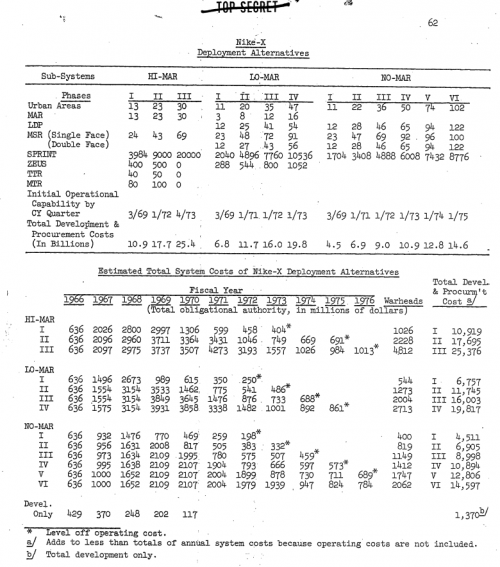
From McNamara Memorandum "Recommended FY 1966-1970 Programs for Strategic Offensive Forces, Continental Air and Missile Defense Forces, and Civil Defense" to POTUS, dated 3 December 1964, showing us the Phase I Nike-X (Pre-SPARTAN) deployment concepts the Army had at the time.

I want 20,000 SPRINTs. :D

EDIT: I think LDP = Local Data Processing

At the point of this report [1964] computers were so big that if you went with cheaper MSRs, you had to build computers for ABM.

Over time [1965-1966] the LDPs disappeared from the system as the MSRs absorbed local data processing into the MSRs themselves; along with getting more radar power as computers got better, cheaper, faster
 

Attachments

  • SPRINT-X.png
    SPRINT-X.png
    119.2 KB · Views: 74
Last edited:
I think I know why Spartan: "DM-15X2" and Improved Spartan "DM-15X3" have that designation.

It's a sequential designation applied to NIKE-X funded missiles.

The "missing link" X1 is actually the first NIKE-X missile funded -- SPRINT.

X2 was the second, and X3 is the third.
 
From Ballistic Missile Defense Radars -- IEEE spectrum MARCH 1970:

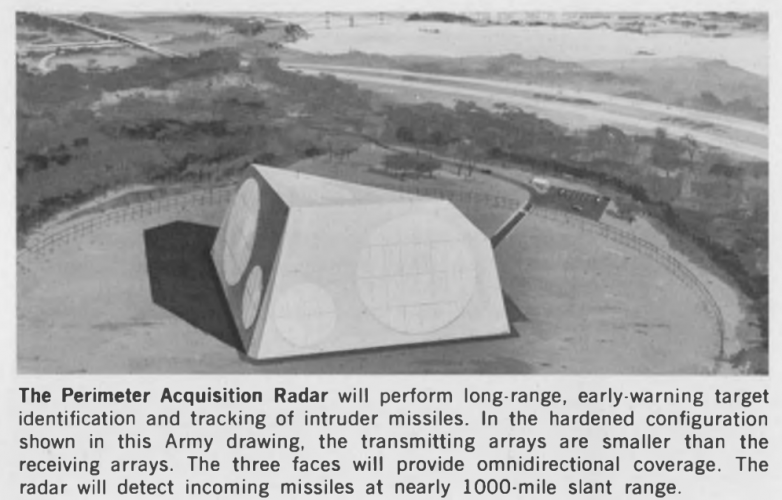
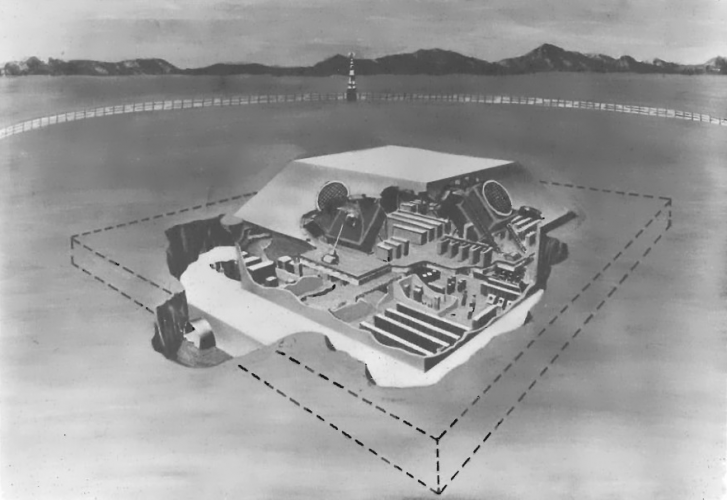
The PAR design was originally conceived as a VHF phased array with two apertures, one for transmit and one for receive. In this original design, the receive aperture was about 30.5 meters in diameter, but the transmit aperture was much smaller. The PAR is now being developed in the UHF region and only one aperture, common for both transmit and receive, is used.

Briefly, the reasons for these changes are as follows. The PAR searches for, and tracks, exoatmospheric ICBM targets. The radar beam must penetrate the ionosphere and, consequently, it is subject to the refractive and attenuative effects of both natural ionization phenomenons, such as aurora, and nuclear-induced ionization phenomenons, such as beta blackout. Generally speaking, the intensity of these high-altitude ionization effects decreases with v2, where v is the radar operating frequency. Thus, the shift from VHF to UHF significantly reduces the effects of these ionization phenomenons on PAR performance.

The switch to a single aperture occurred because of the increased track capacity that could be achieved with a larger transmit aperture, and the cost reduction that could be achieved from the smaller building resulting from combining both the transmit and receive functions into one aperture.

...

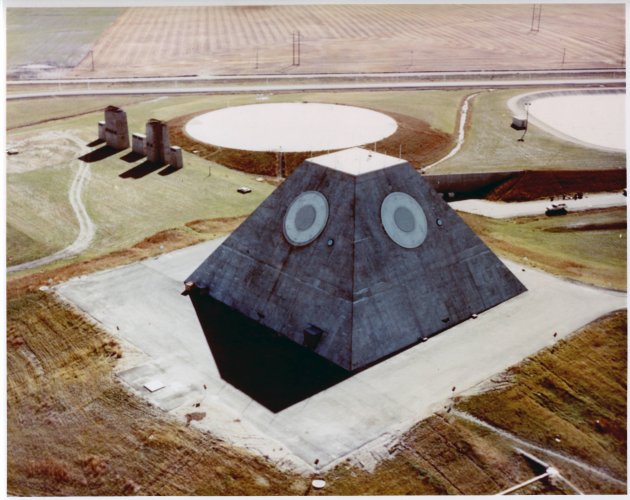
Missile site radar

Missile site radar is primarily a precision target-tracking and interceptor-guidance radar and is optimized to operate in a high-traffic environment (see Fig. 8). Secondarily, the MSR is also capable of autonomous search and target acquisition. It operates in the S-band region and has a range capability of several hundred kilometers against typical RVs. The MSR is of phased-array design with a 4.1-meter-diameter aperture. This single aperture serves for both transmitting and receiving. The MSR is generally configured as a four-faced radar to provide complete 360-degree azimuthal coverage.

...

The following examples will give a general feel of how this data-processing hardware can handle the BMD problem:

1. When the PAR makes a track measurement on an object, it uses this measurement to update and refine the predicted trajectory of the object. Each such calculation requires very many operations in the data processor. However, the data-processor speed is such that a single processor unit can perform the entire calculation in about 1 or 2 milliseconds. Because the radars were designed to give high-accuracy measurements on each track pulse, only of the order of 100 pulse hits per target are needed, and these can be spread over several minutes of the target’s trajectory. Therefore, the average time required of a processor is less than a millisecond per object per second. Thus, a single processor unit may perform trajectory predictions for over 1000 objects simultaneously. Since a massive attack would last for minutes and not all objects would appear simultaneously, a processor unit would build up to this rate. As it finished with a particular track, it would drop the object and start on a new object. Thus if, just as an example, an attack lasted for 30 minutes with several hundred objects entering coverage per minute, a processor unit could handle several thousand objects over the duration of the attack.

2. Spartan and Sprint guidance calculations take longer time per calculation and are made at a higher average rate. However, the number of defensive missiles that must be in guidance simultaneously from one MSR is small compared with the total objects (reentry vehicle plus junk) a PAR must handle.

These two examples are discussed since, in the peak-load situation, they are the most demanding of data-processor time at the two different sites. The actual number of processor units required for each defense site is selected based on the postulated threat. Additional processor units are added to handle all of the other functions required to support these basic functions and to supply the necessary number of spare processors to meet availability requirements.

...

At the present time, our PARs and MSRs are estimated to cost between $150 million and $200 million each when all costs, from site activation to final check-out as an operational system, are included (investment cost). The cost for major parts of these radars is listed in Table I.

In addition to the costs that have been designated as investment costs, there is an operating and maintenance cost for these radars that amounts to about 5 percent of the initial investment per year.
 
wait a minute, if traffic capacity is a function of aperture size; then MSR could easily be plugged to handle higher traffic as needed; per Bell Labs ABM Study:

During the latter part of 1968, when design of the tactical system was well along, consideration was given to increasing the range of the MSR by increasing the diameter of the antenna face. This proposed redesign, known as the Improved MSR (IMSR), was associated with system capabilities that might be required at some time in the future. Studies were made to define the building modifications and antenna support structure that would be required to retrofit a tactical MSR system to the larger diameter antenna. These studies continued until the early part of 1970. The building was then modified so that the larger antenna could be installed. This redesign incorporated a permanently larger antenna-to-feed horn enclosure which could be used with either size antenna, thus eliminating the need for future retrofit. The smaller antenna, as installed at North Dakota (see Figure 7-2), is actually inside a larger annulus which can be removed if the larger antenna is ever needed.
 

Attachments

  • MSR.jpg
    MSR.jpg
    1.1 MB · Views: 58
I just noticed this in the Bell ABM Report (References)

SAFEGUARD System — Basic Deployment — MSR Data Processor Sizing — Case 27950-1600 (U), R. T. Herbst, Bell Laboratories MFF, October 8, 1971. (SECRET)

Provides the basis for the recommendation that the MSR DPS sizing for the basic SAFEGUARD deployment be 10 Processor Units, 12 Program Stores, and 14 Variable Stores, and that the basic deployment, 2 PARS and 4 MSRs, preserve the option to install more than 10 Processors at each MSR site.

Hold up a moment.

We know that Phase I was to be Grand Forks and Malmstrom; the 2 PARs makes sense; but FOUR MSRs? That implies each site would have had 2 x MSRs.

Given an average cost of $175M per radar; cutting each Phase I site from 2 MSRs to 1 MSR each saves a cool $350M in 1970 dollars....or $2.8B~ in 2025 dollars.

This also helps explain why Bell was increasingly wanting to get out of SAFEGUARD -- because the system kept getting cut down and castrated to save money....The original NIKE-X concepts was for each MAR/TACMAR to be paired with several MSRs; which would enable the MSRs to triangulate to defeat jammers as well as "peek" around NUDETs.

EDIT, also I just noticed -- "preserve the option to install more than 10 Processors at each MSR site."

EDIT II: Wait a minute.... wouldn't those two "extra" MSRs also have their own co-located "Extra" Sprint RML Farms?
 
Last edited:
My dear OBB,

I ran across this blogpost by you from 2022:


Recently sold on eBay was a display model for a vehicle labeled “SIPS.” No other data was available. However, this appears to be an upper stage modification for the LIM-49 Spartan surface-to-air anti-missile missile. Which suggests that the first “S” in “SIPS” standard for “Spartan.” Perhaps something like “Spartan Integral Propulsion System” or some such. However, this seems to appear to be a complete vehicle…. the very large first and second stage motors, as well as the warhead section, *appear* to have been replaced with a new, small booster with fins. Perhaps this was meant to test the third stage of the Spartan… or perhaps it was meant to be a way to find some use for the Spartan third stage after program cancellation, as some sort of scientific test vehicle.

SIPS = Spartan Improved Performance Studies -- also known as DM-15X3 Improved Spartan, Code 20, Advanced Spartan, etc etc.
 

Attachments

  • PAR_Early_VHF.png
    PAR_Early_VHF.png
    207.1 KB · Views: 47
  • MSR_Early.png
    MSR_Early.png
    225.6 KB · Views: 48
REPORT OF THE DEFENSE SCIENCE BOARD
February 1967
Report of the Task Group on Independent Research and Development

RAYTHEON SUBMISSION OF PAYOFFS IN IR&D

[...]

Space-Fed Phased Array Antennas

By 1962 it became clear that the next-generation radars would use phased array antennas.

A study in that year examined the tradeoff considerations among corporate-fed, series-fed and space-fed phased arrays. Practical experience in that time period was largely with corporate-fed techniques, and the resulting antennas, though flexible and allowing many simultaneous beams, were costly and had pattern and interaction problems. The tradeoff study aimed somewhat at cost, maintenance and interaction problems concluded that the space-fed approach showed the most promise. To gain experience and understand the technical risks of this choice, a one-hundred-element array, beam steering computer, feed collimation correction program were undertaken in the 1963 IR&D program.

Toward mid-1963, the NIKE-X program became serious about a Missile Site Radar (MSR)—a lower cost agile beam radar—and issued RFP’s to industry in October 1963 to be returned November 15, 1963.

The IR&D program, which by that had illuminated many of the seen and unseen problems of the space-fed approach, provided the technical base against which to make a competent response in the six weeks allotted.

In fact, the hard technical data and the depth with which the risks and their solutions were understood, allowed Bell Labs to make a decision on this program in December 1963, just six weeks after proposal submission. Work started January 2, 1964.

Not only did the program start promptly, but the resulting radar will require less maintenance and logistic support in the field and will cost several million dollars less than one built around corporate-fed techniques.

It is likely that space-fed techniques for MSR would have evolved without the IR&D program, but it is generally agreed that the time saving to this program is of the order of one year as a result of the IR&D effort.
 
STATEMENT OF SECRETARY OF DEFENSE ROBERT S. McNAMARA BEFORE A JOINT SESSION OF THE SENATE ARMED SERVICES COMMITTEE AND THE SENATE SUBCOMMITTEE ON DEPARTMENT OF DEFENSE APPROPRIATIONS ON THE FISCAL YEAR 1966-70 DEFENSE PROGRAM AND 1966 DEFENSE BUDGET (Classified Version)


Page 47

Pervading the entire Damage Limiting problem is the factor of uncertainty of which there are at least three major types -- technical, operational, and strategic. Technical uncertainties stem from the question of whether a given system can be developed with the performance characteristics specified. Operational uncertainties stem from the question of whether a given system will actually perform as planned in the operational environment.

The third type, strategic uncertainty, is perhaps the most troublesome since it stems from the question of what our opponent or opponents will actually do -- what kind of force they will actually build, what kind of attack they will actually launch, and how effective their weapons will actually be. What may be an optimum defense against one kind of attack may not be an optimum defense against a different kind of attack. For example, within a given budget, a NIKE X defense optimized for an attack by 200 ICBMs would defend more cities with fewer interceptor missiles than a defense optimized for an attack by 600 ICBMs. Similarly, a NIKE X defense optimized against an attack by ICBMs with simple penetration aids would have fewer high cost radars than one optimized against an attack by ICBMs with more advanced penetration aids. Thus, for a given cost, the efficiency of our defense depends upon the correctness of the assumptions we make during the design of these defenses and about the size and character of enemy attack.

In the same way, the effectiveness of our strategic offensive forces in the Damage Limiting role would be critically dependent on the timing of a Soviet attack on U.S. urban targets. Our missile forces would be most effective against the Soviet bombers and ICBMs if the attack on our urban centers were withheld for an hour or more -- an unlikely contingency. Our manned bomber forces would be effective in the Damage Limiting role only if the Soviet attack on our urban centers were withheld for eight hours or more.

Page 81-86

c. NIKE X

The major issue in the ballistic missile defense program concerns the production and deployment of the NIKE X system. In my appearance before this Committee last year, I described the NIKE X system and its problems in considerable detail. Since that time, we have greatly expanded our knowledge of anti-missile defense with regard to both the relative costs and effectiveness of alternative deployments and the technical aspects of the system.

One of the most significant developments of the past year has been the highly encouraging progress being made in the development of the missile site radar (MSR). This radar was originally conceived as an adjunct to the large central multi-function array radar (MAR) to serve as a transmitter of guidance commands to the SPRINT missile and to perform limited target tracking. We have found that by adding separate data processing equipment and improved tracking capability to the MSR, it can serve as the primary sensor in certain deployments and at a much lower cost than the MAR. The MSR, of course, would have only a fraction of the capability of the MAR, but it would cost only about a tenth as much -- $40 million per site compared with $400 million for the MAR.

The MSR in combination with the MAR would make possible a number of alternative NIKE X deployments. Three basic systems configurations would be possible differing primarily in the number and kind of radars utilized:

1. a so-called HI-MAR configuration which would include one high cost MAR and two or three single face low cost MSRs for each urban area defended. This configuration would provide the most effective defense against a large, technologically sophisticated attack but it would be the most costly if any sizeable number of cities were to be defended;
2. a LO-MAR configuration which would include one MAR for about every three urban areas and one double face MSR and two single face MSRs for each urban area defended. Recent studies indicate that for a given level of expenditures, the LO-MAR configuration would probably be more effective in saving lives in a moderately sophisticated attack and would be clearly superior to a HI-MAR configuration against a smaller or less sophisticated attack. This is so because for the same expenditure more cities can be defended; and
3. a NO-MAR configuration which would include only MSR radars in about the same combination as the LO-MAR configuration. This would be the lowest cost configuration per urban area defended but would be much less effective against a large sophisticated attack.
[DELETED SEVERAL PARAGRAPHS]

Although the NIKE X development is progressing satisfactorily,

[PARAGRAPH DELETED]

But over and above the technical problems there are still greater uncertainties concerning the preferred concept of deployment, the relationship of the NIKE X system to other elements of a balanced damage limiting effort, the timing of the attainment of an effective nation-wide fallout shelter system and the nature and effect of a possible Soviet reaction to our NIKE X deployment.

Accordingly, we propose to continue the development of the NIKE X system on an urgent basis and a total of $407 million has been included in the FY 1966 budget for that purpose. Of the $407 million, $20 million will be required to support the test and evaluation program at Kwajalein, which involves the simulated interception of missiles with various re-entry payloads launched from Vandenberg AFB; $17 million will be required for additional NIKE X facilities at Kwajalein, and $10 million would be used for some preliminary production engineering.

We plan to re-examine the question of production and deployment of the NIKE X system again next year. Deferral of this decision to the FY 1967 budget would still permit an initial operational capability by the summer of 1970. Considering the vast amount of development, test and evaluation work still to be accomplished, I do not believe we could improve on this IOC date by many months even if we were to start production in FY 1966.

Note the cost for MAR -- $400M in 1966 would be $4B in 2025 (!!!)

MAR was hideously expensive because it was supposed to include a 30~ million instructions per second supercomputer attached to it.
 

Similar threads

Back
Top Bottom