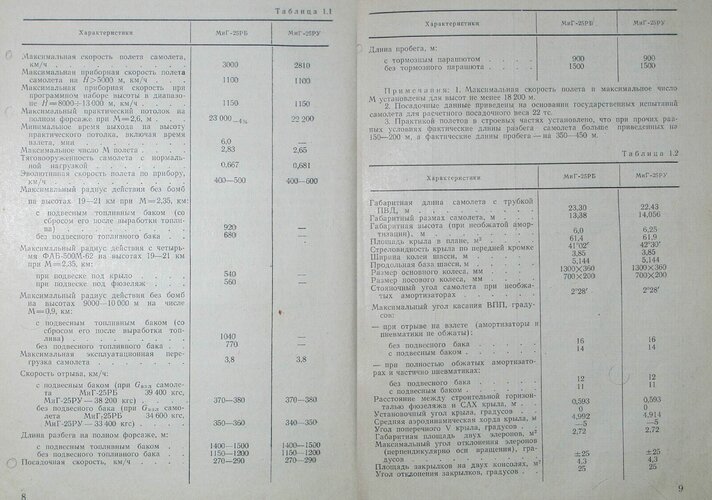
Not all modifications are listed there. And the safe maximum speed of the first instances is indicated there. Then the maximum speed increased. The maximum that squeezed out of the MiG-25 is 3600km/h over the Sinai Peninsula in 1972. By the way, your pilots themselves accelerated the MiG-25 hijacked by the traitor Belenko to 3400km/h. The question here is not in the power of the engines, but in the ability of the hull to withstand heating and air pressure, so that the pilot in the cockpit is not baked.Don't invent something that isn't there. There are official documents where everything is described in detail
Didn't that wreck the engines?The maximum that squeezed out of the MiG-25 is 3600km/h over the Sinai Peninsula in 1972.
Don't invent something that isn't there. There are official documents where everything is described in detail
I've just been musing about a titanium built MiG-25/31 after reading some other what-if topic on the net.
So just as a very rough theoretical exercise, it seems using titanium instead of steel on the MiG-25 would have reduced the empty weight from 20 tons to something like 13,5 tons!
I was discussing this - in a different context - with a structural engineering colleague last week. Very often, and especially in lightweight structures, the thickness of material is governed by something other than strength. As a result, stronger or lighter materials don't always save weight.Actually the MiG‑25’s structure weighed less than 10 tons. It would have weighed about the same if it had been made of aluminium. I don’t think it’s possible to reduce its weight by 6.5 tons using titanium — that is, to achieve a weight of less than 3.5 tons. That’s not realistic. Perhaps you’d gain 300–500 kg in weight.