uk 75

ACCESS: Above Top Secret
Senior Member
Joined
27 September 2006
Messages
6,555
Reaction score
7,327
The Royal Navy started receiving Phalanx CIWS too late for the 1982 Falklands War.

It would be interesting to know what the impact of the following would have been:

Phalanx fitted on T42 and Fearless/Intrepid as it was later in the 80s.

Replacement of Seacat by Phalanx on a one for one basis on all or some destroyers (County) and frigates (Amazon, Leander and Rothesay).
 
I once thought of developing an improved STAAG called Wicketkeeper* which would have been more reliable & required less maintenance than the STAAG Mk II that it replaced. I hoped that it would weigh the same & consume the same space as a Sea Cat launcher to allow a one-to-one substitution and (for example) Fearless & Intrepid would have been completed with 4 Wicketkeepers instead of 4 Sea Cat systems.

Would that have been an improvement on Sea Cat?

*And yes it is called Wicketkeeper because the Dutch called their CIWS Goalkeeper.
 
The Royal Navy started receiving Phalanx CIWS too late for the 1982 Falklands War.

It would be interesting to know what the impact of the following would have been:

Phalanx fitted on T42 and Fearless/Intrepid as it was later in the 80s.

Replacement of Seacat by Phalanx on a one for one basis on all or some destroyers (County) and frigates (Amazon, Leander and Rothesay).
Was Sea Cat the point defense missile or the local area defense missile?

Because Phalanx is very much a point defense system, it only engages things coming directly at the Phalanx.
 
Was Sea Cat the point defense missile or the local area defense missile?

Because Phalanx is very much a point defense system, it only engages things coming directly at the Phalanx.
The first paragraph of the Wikipedia entry puts it better than I can.
Seacat was a British short-range surface-to-air missile system intended to replace the ubiquitous Bofors 40 mm gun aboard warships of all sizes. It was the world's first operational shipboard point-defence missile system, and was designed so that the Bofors guns could be replaced with minimum modification to the recipient vessel and (originally) using existing fire-control systems. A mobile land-based version of the system was known as Tigercat.
 
The first paragraph of the Wikipedia entry puts it better than I can.
I asked because one of the missile systems was found to be absolutely terrible at engaging crossing targets and I could not remember which one it was.

Several of the escorts attempted to do their escort job but the missiles they had were not up to the job.
 
*And yes it is called Wicketkeeper because the Dutch called their CIWS Goalkeeper.
I would point out that a wicket-keeper is stationed to catch the ball after it has already missed, and use it to defeat the original target. It's probably a better name for a system intended to allow missiles seduced by soft-kill measures to reattack!
 
I asked because one of the missile systems was found to be absolutely terrible at engaging crossing targets and I could not remember which one it was.

Several of the escorts attempted to do their escort job but the missiles they had were not up to the job.
Short range missiles have terrible performance against crossing targets as they hace short ranges and the bearings change too fast. Probably you’re thinking of Sea Wolf, whose software did not allow the system to engage crossing targets. Seacat was designed to engage targets flying towards the ships and, due to its guidance system had no capability against crossing targets at all
 
I once thought of developing an improved STAAG called Wicketkeeper* which would have been more reliable & required less maintenance than the STAAG Mk II that it replaced. I hoped that it would weigh the same & consume the same space as a Sea Cat launcher to allow a one-to-one substitution and (for example) Fearless & Intrepid would have been completed with 4 Wicketkeepers instead of 4 Sea Cat systems.

Would that have been an improvement on Sea Cat?

*And yes it is called Wicketkeeper because the Dutch called their CIWS Goalkeeper.

How were you going to make it more reliable, reduce the maintenance and make it light enough for a one-to-one substitution?
 
Last edited:
What exactly constitutes a head-on and crossing target? While Phalanx mightn't great at engaging targets flying by out at ~1km I can't imagine that Phalanx couldn't engage a target that will fly by at ~100m. Surely it would have an engagement envelope of maybe 10 degrees either side of directly ahead.

In the case of the Falklands there were often many ships operating very close together, a plane would have to fly almost toward one to get to the one nearby behind it. If the Phalanx has a bit of an engagement 'cone', and its radar etc works in an inshore, cluttered, environment then it should pick up a couple of kills during the air Battle of San Carlos.
 
Hard to say, would it be any better... not that Phalanx have an outstanding combat record. And replacing the inefficient but well-known Sea Cat with Phalanx on RN ships just before the war could quite easily result in bugged and ureliable system rushed into action.
During the run up to Canadian Navy's deployment during the Persian excursion as it became known as,in 1991 One of the warships snaffeled what turned out to be the first Phalanx purchased .
It had been used for testing purposes and well used didn't quite describe it . Perhaps tested to near destruction might be a better choice of words.
But the Gunnery department were quite pleased by the fact they'd been able to acquire and install it far sooner than the rest of the task group.
Unfortunately it spent a large amount time down for minor repairs and maintenance.
So while the other warship in the TG had a sign on it Phalanx console that read " If it flies, it dies. " The first ship mentioned had one that read .
" No ! The #-&$#- thing still doesn't work ."
 
I think Tony Williams had an interesting point that the RN lost an opportunity by not developing a single barrel 3"70 mount.
Come to think of I haven't seen him for quite some while either here or the other fora he used to inhabit. I hope he's alright .
 
During the run up to Canadian Navy's deployment during the Persian excursion as it became known as,in 1991 One of the warships snaffeled what turned out to be the first Phalanx purchased .
It had been used for testing purposes and well used didn't quite describe it . Perhaps tested to near destruction might be a better choice of words.
But the Gunnery department were quite pleased by the fact they'd been able to acquire and install it far sooner than the rest of the task group.
Unfortunately it spent a large amount time down for minor repairs and maintenance.
So while the other warship in the TG had a sign on it Phalanx console that read " If it flies, it dies. " The first ship mentioned had one that read .
" No ! The #-&$#- thing still doesn't work ."

In the 2010s the RAN put a brand new one into the non-serial-tracked FMS repair pipeline. They got a fully serviceable unit at the latest spec from the repair pipeline, made in 1983! Jeez did they whinge about that! Yet they weren't willing to wait for their new one to go through the serial-tracked repair pipeline, so you get what you get.
 
What exactly constitutes a head-on and crossing target? While Phalanx mightn't great at engaging targets flying by out at ~1km I can't imagine that Phalanx couldn't engage a target that will fly by at ~100m. Surely it would have an engagement envelope of maybe 10 degrees either side of directly ahead.
In reality there's going to be an engagement envelope for any system. Most systems can cope with a 'crossing' target that flies obligingly in slow circles around the weapon system at its favoured range. And at the other end, even a highly capable area air defence system can't defend an area much larger than its own footprint against a really high performance hypersonic threat.
 
What exactly constitutes a head-on and crossing target?
Head on: Something coming to kill you personally. Technically, constant bearing, decreasing range.
Crossing Target: Something trying to kill your friends on another ship over there. (edit) Technically, changing bearing, decreasing range (up to a point, then range starts increasing again)


While Phalanx mightn't great at engaging targets flying by out at ~1km I can't imagine that Phalanx couldn't engage a target that will fly by at ~100m.
The 100m target is rather difficult, as that gives you a target that may be moving faster than the mount can turn to point the gun it.


Surely it would have an engagement envelope of maybe 10 degrees either side of directly ahead.
Because of how little ammunition it keeps in the drum, in AA mode it's limited to targets coming directly at the ship it's mounted on.

In surface mode the person holding the control stick has about 6 seconds to sign their name into the target.


In the case of the Falklands there were often many ships operating very close together, a plane would have to fly almost toward one to get to the one nearby behind it. If the Phalanx has a bit of an engagement 'cone', and its radar etc works in an inshore, cluttered, environment then it should pick up a couple of kills during the air Battle of San Carlos.
Maybe. It'd certainly alert that there were incoming. If the Argies were very close to overflying the ship with Phalanx on it, they'd definitely draw fire.
 
Last edited:
The reality is, the Royal Navy for far too long neglected the replacement of the Sea Cat PDSAM system and when it did derive a replacement, in the form of the Sea Wolf PDSAM system, it was heavier, more costly and complex than originally envisaged and hence not utilised as a full fledged replacement for the Sea Cat system.

Maybe, the Royal Navy could have simply installed a greater number of simple 30mm turreted systems like the EMERLEC-30 twin 30mm mounts. Or at minimum more basic single 20-30mm mounts. Granted, such light cannons might not been as effective against the likes of Argentinian Exocet missiles, but they sure could have contributed to chewing up many Argentinian Mirage III/Dagger/Skyhawks, which attacked spectacularly with dumb bombs.

Regards
Pioneer
 
Come to think of I haven't seen him for quite some while either here or the other fora he used to inhabit. I hope he's alright .

I had a similar thought recently. Hope all is well at his end.
 
Short range missiles have terrible performance against crossing targets as they hace short ranges and the bearings change too fast. Probably you’re thinking of Sea Wolf, whose software did not allow the system to engage crossing targets. Seacat was designed to engage targets flying towards the ships and, due to its guidance system had no capability against crossing targets at all

Sea Cat, Sea Wolf, Rapier, Blowpipe....all had that issue as they just weren't designed to do that.
 
How were you going to make it more reliable, reduce the maintenance and make it light enough for a one-to-one substitution?

Wasn't one of the issues with STAAG its valve based electronics getting shaken to bits when it fired? If so that's one easy change you could make that would reduce weight, power and improve reliability.
 
I had a similar thought recently. Hope all is well at his end.

I know he retired from management of the Military Guns Delphi group a few years ago. There are folks there still on touch with him, I think, so I'd hope we would hear any serious news from them. (But I dropped that group from my regular reads as it took a weirdly pro-Russian turn for a while).
 
IIUC the Phalanx tracks a target and evaluates if it can manoeuvre to hit the target, however I don't know if it will engage a target that can manoeuvre to hit or not.

For example, the Phalanx tracks an aircraft 5km out that will pass by at 1km out it won't engage even though the target might be within range of its gun. However, if it tracks a target 5km and calculates that will pass by at 100m, might it engage the aircraft at 1km out because the aircraft could manoeuvre onto the target?
 
IIUC the Phalanx tracks a target and evaluates if it can manoeuvre to hit the target, however I don't know if it will engage a target that can manoeuvre to hit or not.

For example, the Phalanx tracks an aircraft 5km out that will pass by at 1km out it won't engage even though the target might be within range of its gun. However, if it tracks a target 5km and calculates that will pass by at 100m, might it engage the aircraft at 1km out because the aircraft could manoeuvre onto the target?
I don't know, but I suspect so.

There's videos of a Phalanx aiming at (civilian) aircraft that are overflying the ship it's fitted to, and the Sailors on deck are saying "no, no no..." expecting it to open fire. Then when the plane finally starts flying away from the ship, the gun mount actually sounds sad that it could not engage!

But anyone who did know would not be able to say so.
 
I don't know, but I suspect so.

There's videos of a Phalanx aiming at (civilian) aircraft that are overflying the ship it's fitted to, and the Sailors on deck are saying "no, no no..." expecting it to open fire. Then when the plane finally starts flying away from the ship, the gun mount actually sounds sad that it could not engage!

But anyone who did know would not be able to say so.

In air manual mode, Phalanx will track but will not fire unless the operator pushes the button. That's public knowledge, nothing sensitive.
 
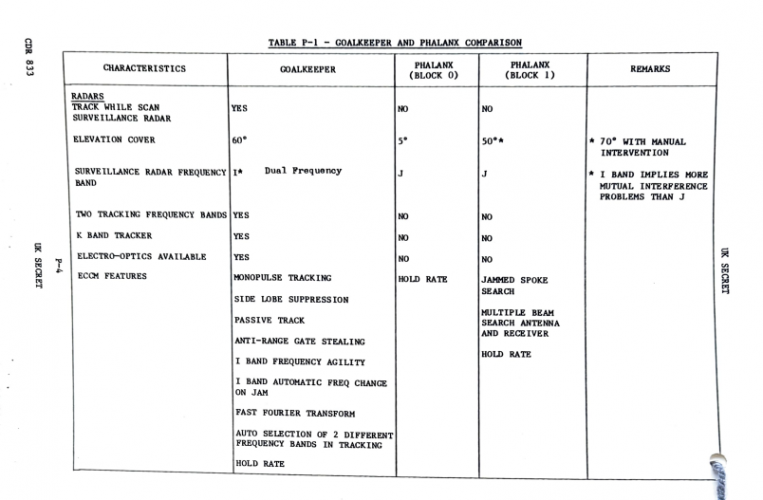
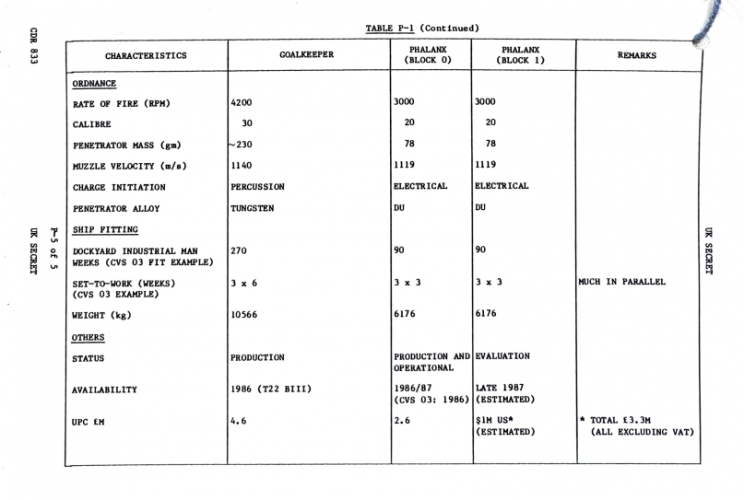
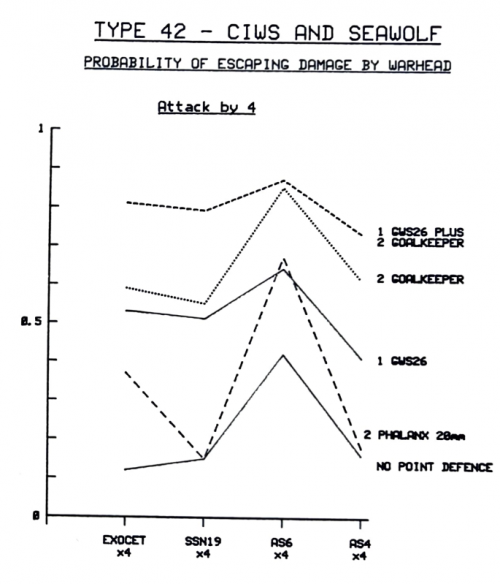
Anyone know of any comparisons of Goalkeeper/Phalanx/Dalek?

Chris
Some discussion of it here in relation to the CIWS 2000/Phalanx Block II programme.

Seems like Goalkeeper was bigger, heavier, more expensive and less effective against supersonic targets.
 
Some discussion of it here in relation to the CIWS 2000/Phalanx Block II programme.

Seems like Goalkeeper was bigger, heavier, more expensive and less effective against supersonic targets.
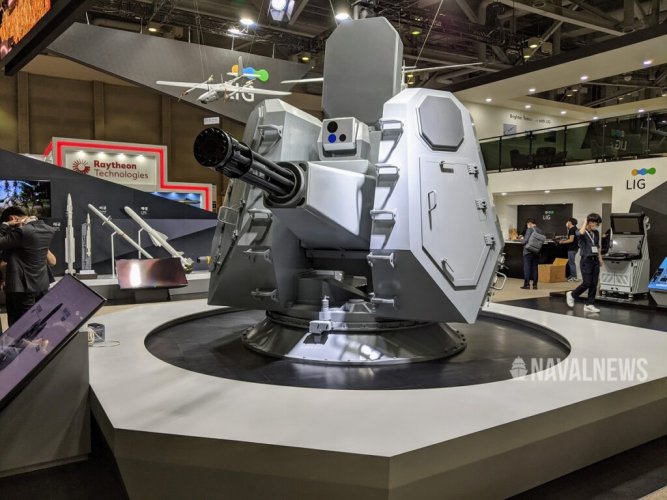
The South Koreans are spending KRW 320 billions, approx $230 million, on developing a Mk II Goalkeeper, CIWS II, with new AESA radar and EOTS, for its future fleet, it seems in preference lasers.
 

Attachments

  • CIWS_II_LIG_Nex1_AESA_EOTS.jpeg
    CIWS_II_LIG_Nex1_AESA_EOTS.jpeg
    170.4 KB · Views: 30
I know he retired from management of the Military Guns Delphi group a few years ago. There are folks there still on touch with him, I think, so I'd hope we would hear any serious news from them. (But I dropped that group from my regular reads as it took a weirdly pro-Russian turn for a while).
Tony Williams
Joined 10 January 2013
Last seen 21 January 2024
 
It had been used for testing purposes and well used didn't quite describe it . Perhaps tested to near destruction might be a better choice of words.
That does raise the interesting question of how much blame for it not working you apportion to: being first generation, it being shagged out, crew unfamiliarity with a new system.

Even with the added complications of adding an extra type of ammunition required of the task force and supplying power to them, which if from generators requires fuel like Rapier, I can't see them causing drawbacks enough to outweigh potential benefits. Considering that they're mostly self-contained wonder how they might have done welding one to some of the STUFT.
 
That does raise the interesting question of how much blame for it not working you apportion to: being first generation, it being shagged out, crew unfamiliarity with a new system.

Even with the added complications of adding an extra type of ammunition required of the task force and supplying power to them, which if from generators requires fuel like Rapier, I can't see them causing drawbacks enough to outweigh potential benefits. Considering that they're mostly self-contained wonder how they might have done welding one to some of the STUFT.
IIRC all the CIWS needs is electrical power and some source of cooling water run to it, along with a ~10x10'/3x3m clear square of deck space on the weather deck. You could install one on a fresh platform just aft of the stack on most ships. Not sure I'd want to use potable water for cooling, but you could definitely hook the water return line into the hot water delivery system of the ship if you needed to.
 
The thing that could be much better than retaining Seacat was, to my mind, proceeding with 1950s plans to use Bofors 40/70 guns. Being not as capable as Phalanx, they were probably the best gun-based AD solution until advent of CIWS systems and replacing Seacat with something akin to Breda-Bofors type 64 mount would make situation at San Carlos a bit better.
40/70 have some amount of usability if power supply is cut off or director is disabled. It still has very decent local power drive (95 degrees/second train and elevation for Type 106 and 107 mounts, bit less for lated 64 and 564 - IIRC no other AA gun mount had such aim speeds until advent of CIWS mounts) and a fine local sight (SRS-5). And in event of all systems going down, it still can be trained and elevated with simple hand drive. And, since early 1970s, it has PFHE ammo.
Moreover, israelis used Bofors 40/70 to great effect during Arab-Israeli wars and had quite a number of confirmed kills with them, including KSR-2 and P-15 missiles. Part of said kills, according to CIA reports, were done with Breda-Bofors Type 107 aboard Saar-class boats (which were controlled by Galileo OG R/7 directors).

To sum it up: much more efficient solution would be not rushing probably a bit raw Phalanx, but replacing clearly inadequate Seacat with 40/70 mounts. Having power drive and coupled to MRS director it, to my mind, would be able to offer credible defence against attacking aircraft, speedboats and bolster missile defence (and later CIWS) when dealing with missile threat. Moreover, it would be a credible weapon up to advent of Mk.4 in 2010s.
And, I think, it would be much better than using Oerlikon 30mm and especially Emerlec proposed earlier in this thread (only large scale user of Emerlec - ROK navy - had really bad experience with it, primarily on reliability and efficiency grounds).

 
By the 1945 it was felt that 40 mm was almost useless to knock down Kamikaizes. And the only reason according to according least to one report to keep the 20 mm was for purposes of morale ( it gave you something to do! )
The most effective weapon was the 5"38 cal. equipment equipped with the VT fuse.
That why the the 3"50 cal. was being brought forward.
If you're facing Aircraft strikes guns including larger caliber are still viable.
 
By the 1945 it was felt that 40 mm was almost useless...

Maybe so but the Bofors still had some game. The Mark IXs on HMS Fearless and HMS Intrepid shared in taking a wing off of a Argentinian A-4B on 27 May 1982. That said, there was also a world of difference between the WW2-era Bofors L/60 and the postwar L/70.

The 40mm L/70 had a higher RoF (240-300 rpm vs 120-140) and - importantly for low-level Falkland engagements - a greater horizontal range (12,500 m vs 9,000 m). The latter was the result of the L/70's longer barrel giving a higher muzzle velocity.

The L/70 was also available during the panic British build-up in April 1982 (at least in its land-based LAA form) since the British Army had just phased out their Bofors in 1979 (replacing the L/70s with Rapier missiles). Likely adapting a land-based LAA carriage to shipboard use would be less than optimal ... but at least it was stand-alone system.
 
The CIWS and Bofors/Sea Cat do different jobs despite both being labelled 'point' defence weapons. CIWS only shoots at things coming directly for it, whereas Bofors/Sea Cat can shoot at anything in the general vicinity within its engagement envelope. The Phalanx and others were originally designed to shoot down AShMs, for which 20-30mm is fine, indeed such small guns allow their widespread fitment, but of course such guns are also useful against tactical aircraft.

If used in the Falklands, the Phalanx's primary role would be guarding against the many Exocets in Argentina's inventory. However, in the event they would also be used against aircraft and likely would have had some success.

An interesting thought experiment would be if the RN fitted the mid 80s twin 30mm GCM-A032 mounts to ships from the 70s rather than the single 20mm Oerlikon L70s. That should put a lot more, and more powerful light AA guns into the theatre for Argentine planes to fly into.
 
Back
Top Bottom