
You are using an out of date browser. It may not display this or other websites correctly.
You should upgrade or use an alternative browser.
You should upgrade or use an alternative browser.
Enzian ground-to-air rocket-propelled winged missiles
- Thread starter moin1900
- Start date
Re: Enzian Variants and Warheads
Hi everybody
I have found some
http://www.walter-rockets.i12.com/missiles/enzian.htm
http://www.ausairpower.net/DT-MS-1006.pdf (about Enzian etc)
http://www.ww2aircraft.net/forum/aviation/b-29s-over-germany-4013-11.html
http://one72guy.awardspace.com/Missiles_Germany_WW2_1_72.html (some Plastic Models)
Many greetings
Hi everybody
I have found some
http://www.walter-rockets.i12.com/missiles/enzian.htm
http://www.ausairpower.net/DT-MS-1006.pdf (about Enzian etc)
http://www.ww2aircraft.net/forum/aviation/b-29s-over-germany-4013-11.html
http://one72guy.awardspace.com/Missiles_Germany_WW2_1_72.html (some Plastic Models)
Many greetings
Re: Enzian Variants and Warheads
Hi everybody
Any news about the Enzian E-4 warhead that contained 550 rockets ?
I have read that there was a drawing in the book
"German Explosive Ordnance".
Maybe someone knows more ?
Many greetings
Hi everybody
Any news about the Enzian E-4 warhead that contained 550 rockets ?
I have read that there was a drawing in the book
"German Explosive Ordnance".
Maybe someone knows more ?
Many greetings
Re: Enzian Variants and Warheads
Hi everybody
Enzian warhead with 550 little rockets
To answer my own question
There is not a picture or sketch !
But there is a little text on page 232
(SEE SKETCH BELOW)
But where is this sketch ?
Maybe someone can help ?
Here the document
http://www.lexpev.nl/manuals/index.html
http://www.lexpev.nl/downloads/tm919852germanbombfuzesmines1953.pdf
Here the Pfeilraketen
http://www.secretprojects.co.uk/forum/index.php/topic,6806.0.html
Thanks for every reply
Hi everybody
Enzian warhead with 550 little rockets
To answer my own question
There is not a picture or sketch !
But there is a little text on page 232
(SEE SKETCH BELOW)
But where is this sketch ?
Maybe someone can help ?
Here the document
http://www.lexpev.nl/manuals/index.html
http://www.lexpev.nl/downloads/tm919852germanbombfuzesmines1953.pdf
Here the Pfeilraketen
http://www.secretprojects.co.uk/forum/index.php/topic,6806.0.html
Thanks for every reply

- Joined
- 25 June 2009
- Messages
- 15,515
- Reaction score
- 9,444
Re: Enzian Variants and Warheads
Source: Technical Intelligence Supplement, May 1946
ENZIAN
This is the third AA rocket sponsored by GL Flak E5. It was designed by Dr. Wurster, chief test pilot of Messerschmitt and holder of the 1936 world's speed record in the Me-109. The development was begun in November, 1943. Work was interrupted by the destruction of the Messerschmitt plant at Augsburg in February, 1944.
The project was moved to Sonthofen and later to Schlosswirtschaft Linderhof near Oberammergau. A document dated 22 January 1945, said that 23 missiles had been launched, all without control, and that 14 were failures.
On 24 February 1945, the aerodynamics man Neuschutz wrote in an internal memorandum, "for the further work a clear leadership must be created with definition of responsibility. Dr. Wurster, Dr. Thiel. Dr. Thun, and Mr. Muhlberg now have some authoritative influence without a plan of organization and without a leader. The previous lack of success does not lie in the technical sector but is solely in question of leadership.
"No information on aerodynamic and flight performance has been obtained from the test firings because the firings were marred by explosions, failures of launching rockets. etc."
The work was ordered stopped on 17 January 1945. Messerschmitt intervened and took the matter to Hitler himself but the work was finally stopped about the middle of March.
There were several designs of Enzian. The subsonic version was similar in design to the Me-163 airplane which has no horizontal tail surface. It was 90 cm in diameter, 365 cm long, starting weight 1600 kg, final weight 690 kg with pay load of 300 kg of explosive. Its maximum speed was about 270 m/ sec, maximum altitude 13.8 km, range 25.3 km.
In the tests a conventional radio control was used. It was intended to use an acoustic homing device or an infrared homing device.
A larger supersonic version with pay load of500 kg was also designed.
Source: Technical Intelligence Supplement, May 1946
- Joined
- 25 June 2009
- Messages
- 15,515
- Reaction score
- 9,444
Re: Enzian Variants and Warheads
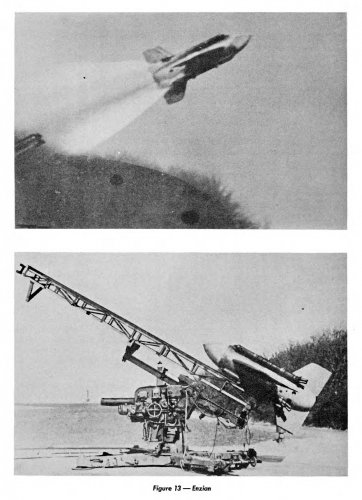
Photos from Guidance and Homing of Missiles and Pilotless Aircraft, May 1946:
Photos from Guidance and Homing of Missiles and Pilotless Aircraft, May 1946:
Attachments

T. A. Gardner
ACCESS: Top Secret
- Joined
- 18 February 2021
- Messages
- 2,021
- Reaction score
- 3,576
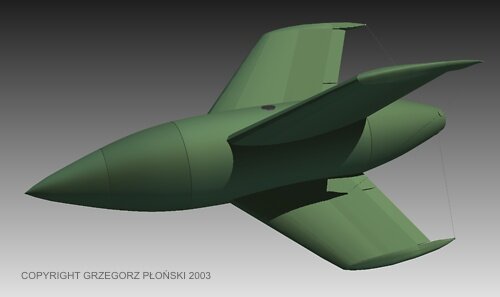
Does anyone have or know of any specifications or drawings of the Enzian E-5 proposed supersonic version of this missile?


Grzesio
ACCESS: Secret
From nearly 20 years ago: https://web.archive.org/web/2004081...ystok.pl/~hess/r_ppk_messerschmitt_enzian.htmDoes anyone have or know of any specifications or drawings of the Enzian E-5 proposed supersonic version of this missile?
Length 4600 mm,
Wingspan 2450 mm,
Fuselage diameter 876 mm,
Launch weight 1900 [2000?] kg,
Fuel weight 600 kg,
HE weight 225 kg,
Max thrust 2500 kG,
Max. speed 1800-2340 km/h,
Ceiling 15 000 m,
Range 30 000 m.
Generally it was to be a tailless design with four swept wings spaced evenly around the fuselage in the X fashion.
Attachments
Last edited:
Enzian Projects
- E-4 warhead with 550 small rockets [1]
https://www.secretprojects.co.uk/threads/planet-projekt.6806/post-57941
- E-1 Vorschlag Primitiv-Einsatz [3]
March 22, 1945
Letter from Messerschmitt to Speer.
Messerschmitt proposes the use of the already-built Enzian E-1 anti-aircraft missile. The missile is to be deployed against enemy bombers in a so-called "primitive" operation using the simplest of means.
The payload of the Enzian E-1 is to consist of a 350 kg warhead, either with 3,500 incendiary fragments and 58 kg of explosives, or "shotgun" rocket projectiles.
- Proposal: "Manned Enzian" [2]
Notes regarding the inspection of anti-aircraft missiles in Karlshagen by the Reichsmarschall on October 30, 1944
"We can also put a man in the front. This is possible in terms of space and weight. The man would then have to descend by parachute."
Enzian Development History
https://www.secretprojects.co.uk/threads/no-german-v-2.48092/post-815589
Enzian (Original Drawings)
https://www.secretprojects.co.uk/th...pment-politics-by-dan-sharp.40062/post-711599
Source:
[1] German Explosive Ordnance Vol.1
OP 1666, June 1946, Page: 232
[2] Bundesarchiv Signatur: RL 3/2586; Page: 255
[3] Bundesarchiv Signatur: R 3/1749; Page: 229-234
- E-4 warhead with 550 small rockets [1]
https://www.secretprojects.co.uk/threads/planet-projekt.6806/post-57941
- E-1 Vorschlag Primitiv-Einsatz [3]
March 22, 1945
Letter from Messerschmitt to Speer.
Messerschmitt proposes the use of the already-built Enzian E-1 anti-aircraft missile. The missile is to be deployed against enemy bombers in a so-called "primitive" operation using the simplest of means.
The payload of the Enzian E-1 is to consist of a 350 kg warhead, either with 3,500 incendiary fragments and 58 kg of explosives, or "shotgun" rocket projectiles.
- Proposal: "Manned Enzian" [2]
Notes regarding the inspection of anti-aircraft missiles in Karlshagen by the Reichsmarschall on October 30, 1944
"We can also put a man in the front. This is possible in terms of space and weight. The man would then have to descend by parachute."
Enzian Development History
https://www.secretprojects.co.uk/threads/no-german-v-2.48092/post-815589
Enzian (Original Drawings)
https://www.secretprojects.co.uk/th...pment-politics-by-dan-sharp.40062/post-711599
Source:
[1] German Explosive Ordnance Vol.1
OP 1666, June 1946, Page: 232
[2] Bundesarchiv Signatur: RL 3/2586; Page: 255
[3] Bundesarchiv Signatur: R 3/1749; Page: 229-234

Dilandu
I'm dissatisfied, which means, I exist.
Typical for WW2 Germans. When they realized that the main problem of guided missile is exactly guidance, they have no better idea than "erm... let's put a pilot inside, so we don't need to dig into this spooky electronic stuff".We can also put a man in the front. This is possible in terms of space and weight. The man would then have to descend by parachute."
Scott Kenny
ACCESS: USAP
- Joined
- 15 May 2023
- Messages
- 19,676
- Reaction score
- 28,160
I mean, they have all those Hitlerjugend, brainwashed and totally willing to die for the Fatherland, so...Typical for WW2 Germans. When they realized that the main problem of guided missile is exactly guidance, they have no better idea than "erm... let's put a pilot inside, so we don't need to dig into this spooky electronic stuff".
Would a 'manned Enzian' not be a Me.163 Komet ?
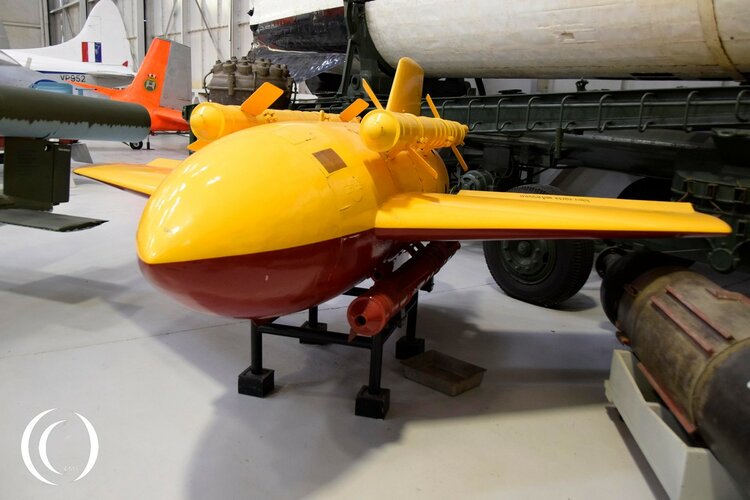
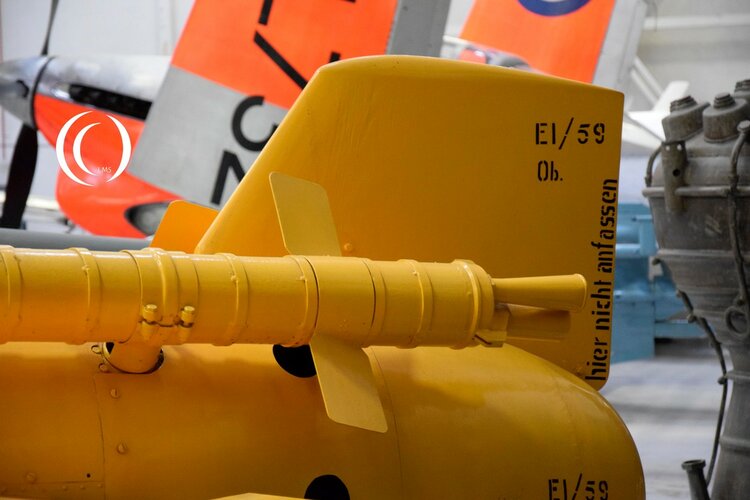
Looking at one of the original test missiles when it was at RAFM. Cosford I can't see how it could fit a pilot (even a small one) unless dimensionally increased in size ?
There is just no space or weight capacity in the airframe
Looking at one of the original test missiles when it was at RAFM. Cosford I can't see how it could fit a pilot (even a small one) unless dimensionally increased in size ?
There is just no space or weight capacity in the airframe
T. A. Gardner
ACCESS: Top Secret
- Joined
- 18 February 2021
- Messages
- 2,021
- Reaction score
- 3,576
Not exactly. By the end of 1943 it was clearly apparent that they--Germany--had fallen far behind the US and Britain in the development of electronics. Their available radars were barely adequate as part of a missile guidance system. They (they didn't know about this set yet) had nothing like the SCR 584 that could be locked onto a target, automatically track it, and compute a firing solution. Their proposed MCLOS systems were nearly worthless as practical guidance systems.Typical for WW2 Germans. When they realized that the main problem of guided missile is exactly guidance, they have no better idea than "erm... let's put a pilot inside, so we don't need to dig into this spooky electronic stuff".
Because their electronics industry couldn't even come close to meeting their current needs, there was little room for R&D on any sort of large scale and no capacity to build the guidance systems even if they could design one that worked. An automatically guided missile was not going to happen for them anytime soon.
The alternative was a manned SAM. Werner v. Braun and Walter Dornberger proposed just that as early as the end of 1941 but got turned down hard by the Luftwaffe. Erich Bachem made the same proposal in 1944 and was initially turned down. It took Himmler's intervention to get his proposal authorized. This resulted in the Ba 349 Natter. This was for all intents, a manned surface-to-air missile. The pilot was needed for terminal guidance and attack of the target in lieu of an adequate guidance system with sufficient accuracy to get the missile there and the lack of a proximity fuze to kill the target. The system was sufficient to get the Natter to the vicinity of the target automatically where the pilot would then take over and make the final attack. Because it wasn't to be a suicide weapon, there were minimal provisions to save the pilot and rocket motor in the face of increasing scarcity of resources.
I have little doubt that if the Japanese had been shown the Natter and had gotten plans for one, they would have enthusiastically adopted it as a suicide weapon.
As for Messerschmitt and the Enzian, it's very likely that if it were proposed as a disposable manned interceptor, it would have been turned down just like every other such proposal was. As for the proposal itself, I could see Messerschmitt overselling it, particularly if he knew some rival in the industry was proposing one. But given that the Enzian had major, unresolved, issues with its engine, I can't see a manned one being a realistic solution to the SAM problem.
I would say, a more immediate problem the Germans had, and likely hadn't fully recognized, was their lack of any alternative in solid fuel to double base nitrocellulose (dyglicol). Of course, given the shortage of oil and rubber in Germany, this was probably a self-inflicted failing based on those industries.
Dilandu
I'm dissatisfied, which means, I exist.
I'm rather not sure. Japanese worked on their own surface-to-air missiles & pilotless interceptors near the end of the war - and it seems that they very clearly understood that their main advantage is that they are pilotless. It just seems that Japanese, having more experience with actual suicide crafts, recognised better than Germans the limitations of poorly trained pilots - and came to conclusion that piloted SAM make no sence, because untrained pilot would not be able to guide it efficiently, and trained pilot would be far too costly.I have little doubt that if the Japanese had been shown the Natter and had gotten plans for one, they would have enthusiastically adopted it as a suicide weapon.
T. A. Gardner
ACCESS: Top Secret
- Joined
- 18 February 2021
- Messages
- 2,021
- Reaction score
- 3,576
With Natter, all the pilot had to do was be able to fly the missile--plane--in more or less level flight towards the target and at the correct distance, release the R4M rockets in the nose to pepper it. Once that occurred, the pilot could put the Natter in a shallow dive and when at about 1000 meters altitude, give or take, jettison the canopy and bail out. The engine and pilot were the only valuable parts of the system so their recovery would make it much cheaper to operate. From launch to nose-over, the Natter was flown on automatic 3-axis pilot from the ground by radio link with a radar tracking the plane.I'm rather not sure. Japanese worked on their own surface-to-air missiles & pilotless interceptors near the end of the war - and it seems that they very clearly understood that their main advantage is that they are pilotless. It just seems that Japanese, having more experience with actual suicide crafts, recognised better than Germans the limitations of poorly trained pilots - and came to conclusion that piloted SAM make no sence, because untrained pilot would not be able to guide it efficiently, and trained pilot would be far too costly.
Similar threads
-

-
New book - Sonderwaffen - Experimental guns, rockets and missiles used by the Luftwaffe during World War Two.
- Started by Justo Miranda
- Replies: 36
-
-
 Brazilian missile/rocket projects
- Started by batigol
- Replies: 29
-
 "Big Bill" and "Big Marc" Missiles.
- Started by klem
- Replies: 1