
You are using an out of date browser. It may not display this or other websites correctly.
You should upgrade or use an alternative browser.
You should upgrade or use an alternative browser.
Bratukhin VTOL Aircraft
- Thread starter Stingray
- Start date


- Joined
- 26 May 2006
- Messages
- 38,285
- Reaction score
- 20,424


ILikeTanks
ACCESS: Confidential
- Joined
- 16 January 2023
- Messages
- 77
- Reaction score
- 47
What is the purpose of the aircraft?Bratukhin's quad-rotor VTOL aircraft project from 1954.

pedrospe
ACCESS: Secret
- Joined
- 9 February 2010
- Messages
- 413
- Reaction score
- 272
Provably a demonstration aircraft for VTOL technology.What is the purpose of the aircraft?
- Joined
- 26 May 2006
- Messages
- 38,285
- Reaction score
- 20,424
Attachments

Motocar
I really should change my personal text
- Joined
- 16 May 2014
- Messages
- 1,335
- Reaction score
- 1,664
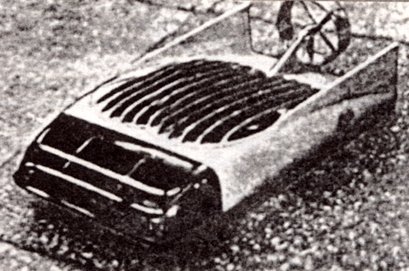
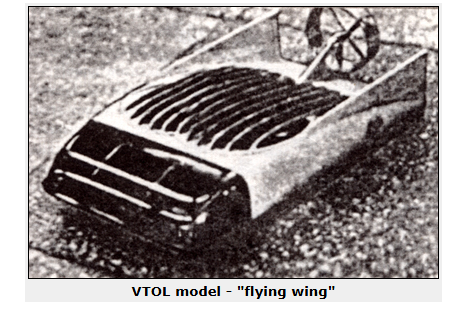
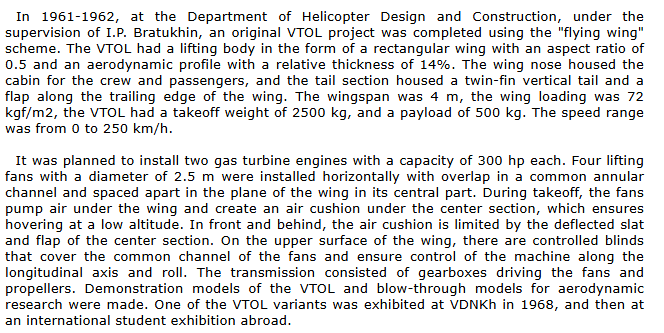
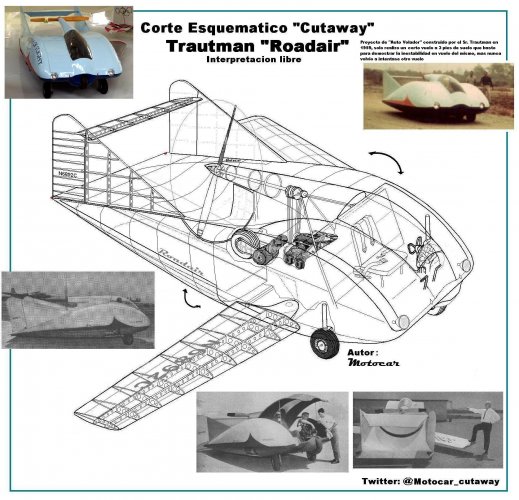
This model resembles the 1959/60 Trautman Roadair, although it is not a copy. The differences are noticeable, including a ducted propeller/fan and long slots along the rear fuselage. The poor quality of the photography doesn't help much to appreciate the relevant details of this design. The Roadair already has a schematic cutaway in the thread I'm running on the forum. Regards. Motocar
Motocar
I really should change my personal text
- Joined
- 16 May 2014
- Messages
- 1,335
- Reaction score
- 1,664
Repost Cutaway Tratman Roadair just as a complement to my previous comment, shared from thread:
https://www.secretprojects.co.uk/threads/flying-cars-and-roadable-aircraft.3556/page-8#post-233245
https://www.secretprojects.co.uk/threads/flying-cars-and-roadable-aircraft.3556/page-8#post-233245
Attachments
- Joined
- 26 May 2006
- Messages
- 38,285
- Reaction score
- 20,424
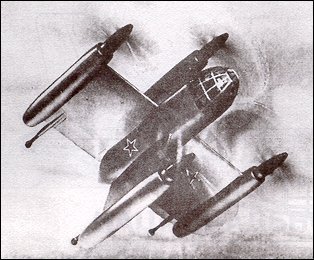
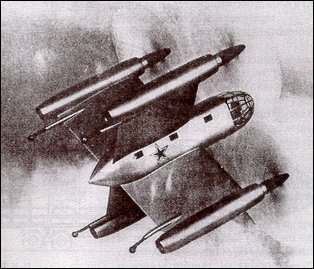
Bratukhin's quad-rotor VTOL aircraft project from 1954.
In 1954, a design group was organized at the Department of Helicopter Design and Construction at the Moscow Aviation Institute to develop a VTOL airborne transport aircraft. The project was carried out under the leadership of Academician B.N. Yuryev and I.P. Bratukhin together with the All-Union Electrotechnical Institute, where Academician A.G. Iosifyants was the director at the time.
For this purpose, the VTOL aircraft chose a power plant consisting of four NK-12MV turboprop engines with a capacity of 12,000 hp, which were also installed on the Tu-95. It was planned that the engines would drive coaxial propellers with a diameter of 6 meters.
The designers proposed an original VTOL layout with a vertically positioned fuselage for takeoff and landing. Four turboprop engines were located in nacelles at the ends of a low aspect ratio cruciform wing (the angle between the consoles was 90 degrees). The fuselage had a rectangular cross-section. In its nose section was a two-seat crew cabin, and behind it were three cargo compartments. The seats were to be installed on hinges with a lock to ensure comfort for the crew and paratroopers when changing the position of the fuselage during takeoff and landing.
The estimated takeoff weight of the VTOL aircraft was 50-60 tons depending on the flight conditions, and the maximum takeoff thrust of the four coaxial propellers was 90 tons. The aircraft performed vertical takeoff and landing, having a thrust-to-weight ratio sufficient for gaining altitude (1.2 - 1.5), and then had to switch to horizontal flight.
The project of this VTOL aircraft was distinguished by the originality of its layout and the novelty of the proposed technical solutions. Some of them were patented. The most important feature of this development was the electrical transmission circuit, which replaced the traditional mechanical one - with gearboxes, shafts and couplings.
For this purpose, the VTOL aircraft chose a power plant consisting of four NK-12MV turboprop engines with a capacity of 12,000 hp, which were also installed on the Tu-95. It was planned that the engines would drive coaxial propellers with a diameter of 6 meters.
The designers proposed an original VTOL layout with a vertically positioned fuselage for takeoff and landing. Four turboprop engines were located in nacelles at the ends of a low aspect ratio cruciform wing (the angle between the consoles was 90 degrees). The fuselage had a rectangular cross-section. In its nose section was a two-seat crew cabin, and behind it were three cargo compartments. The seats were to be installed on hinges with a lock to ensure comfort for the crew and paratroopers when changing the position of the fuselage during takeoff and landing.
The estimated takeoff weight of the VTOL aircraft was 50-60 tons depending on the flight conditions, and the maximum takeoff thrust of the four coaxial propellers was 90 tons. The aircraft performed vertical takeoff and landing, having a thrust-to-weight ratio sufficient for gaining altitude (1.2 - 1.5), and then had to switch to horizontal flight.
The project of this VTOL aircraft was distinguished by the originality of its layout and the novelty of the proposed technical solutions. Some of them were patented. The most important feature of this development was the electrical transmission circuit, which replaced the traditional mechanical one - with gearboxes, shafts and couplings.
|
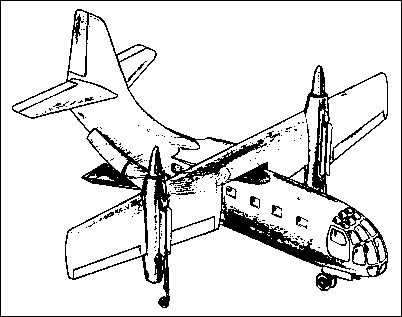
In 1955-1956, again under the leadership of I.P. Bratukhin, research was conducted at BNTI TsAGI on VTOL transport aircraft with propellers to determine the possibilities of creating such vehicles. To ensure vertical takeoff and landing in combination with high cruising speed, a VTOL design with coaxial propellers driven by turbojet engines was proposed. During takeoff and landing, they were to rotate 90 degrees together with the wing. This allowed the fuselage to remain horizontal, facilitating the placement and transportation of cargo.
The VTOL design was typical for that time. The rotating wing was chosen to have a low aspect ratio so that its entire surface was located in the flow from the propellers. This reduced the possibility of flow stall at high angles of attack, which is especially important in transient conditions. The power plant consisted of two NK-12MV turbojet engines with a capacity of 12,000 hp each. This ensured the transportation of a 5-ton load at a cruising speed of 700 km/h and a range of 1,250 km. The estimated takeoff weight of the VTOL aircraft was 30 tons.
The project of this VTOL aircraft was distinguished by the originality of its layout and the novelty of the proposed technical solutions. Some of them were patented. The most important feature of this development was the electrical transmission circuit, which replaced the traditional mechanical one - with gearboxes, shafts and couplings.
In 1955-1956, again under the leadership of I.P. Bratukhin, research was conducted at BNTI TsAGI on VTOL transport aircraft with propellers to determine the possibilities of creating such vehicles. To ensure vertical takeoff and landing in combination with high cruising speed, a VTOL design with coaxial propellers driven by turbojet engines was proposed. During takeoff and landing, they were to rotate 90 degrees together with the wing. This allowed the fuselage to remain horizontal, facilitating the placement and transportation of cargo.
The VTOL design was typical for that time. The rotating wing was chosen to have a low aspect ratio so that its entire surface was located in the flow from the propellers. This reduced the possibility of flow stall at high angles of attack, which is especially important in transient conditions. The power plant consisted of two NK-12MV turbojet engines with a capacity of 12,000 hp each. This ensured the transportation of a 5-ton load at a cruising speed of 700 km/h and a range of 1,250 km. The estimated takeoff weight of the VTOL aircraft was 30 tons.
https://web.archive.org/web/20090618130402/http://vtol.boom.ru/rus/Bratuhin/index.html
The VTOL design was typical for that time. The rotating wing was chosen to have a low aspect ratio so that its entire surface was located in the flow from the propellers. This reduced the possibility of flow stall at high angles of attack, which is especially important in transient conditions. The power plant consisted of two NK-12MV turbojet engines with a capacity of 12,000 hp each. This ensured the transportation of a 5-ton load at a cruising speed of 700 km/h and a range of 1,250 km. The estimated takeoff weight of the VTOL aircraft was 30 tons.
The project of this VTOL aircraft was distinguished by the originality of its layout and the novelty of the proposed technical solutions. Some of them were patented. The most important feature of this development was the electrical transmission circuit, which replaced the traditional mechanical one - with gearboxes, shafts and couplings.
In 1955-1956, again under the leadership of I.P. Bratukhin, research was conducted at BNTI TsAGI on VTOL transport aircraft with propellers to determine the possibilities of creating such vehicles. To ensure vertical takeoff and landing in combination with high cruising speed, a VTOL design with coaxial propellers driven by turbojet engines was proposed. During takeoff and landing, they were to rotate 90 degrees together with the wing. This allowed the fuselage to remain horizontal, facilitating the placement and transportation of cargo.
The VTOL design was typical for that time. The rotating wing was chosen to have a low aspect ratio so that its entire surface was located in the flow from the propellers. This reduced the possibility of flow stall at high angles of attack, which is especially important in transient conditions. The power plant consisted of two NK-12MV turbojet engines with a capacity of 12,000 hp each. This ensured the transportation of a 5-ton load at a cruising speed of 700 km/h and a range of 1,250 km. The estimated takeoff weight of the VTOL aircraft was 30 tons.
https://web.archive.org/web/20090618130402/http://vtol.boom.ru/rus/Bratuhin/index.html
Similar threads
-
Yakovlev « Albatros » tilt-rotor UAV
- Started by Trident
- Replies: 10
-
 Bratukhin helicopters... built and unbuilt
- Started by Stargazer
- Replies: 16
-
 Raoul Hafner VTOL Aircraft & Helicopter Projects
- Started by hesham
- Replies: 16
-
-
York XHC-22 Yorkopter VTOL Aircraft of 1956 ?
- Started by hesham
- Replies: 5