
You are using an out of date browser. It may not display this or other websites correctly.
You should upgrade or use an alternative browser.
You should upgrade or use an alternative browser.
Various Hungarian & Austrian Lesser Known Designers,Airplanes and Projects
- Thread starter hesham
- Start date


bunnystar211
ACCESS: Restricted
- Joined
- 22 April 2019
- Messages
- 34
- Reaction score
- 48
have anything more information about WM.23? or some information about M.W.G built Bf109?

- Joined
- 25 July 2007
- Messages
- 4,916
- Reaction score
- 5,538
have anything more information about WM.23? or some information about M.W.G built Bf109?
Weiss Manfréd WM-23 "Ezüst Nyíl' "Silver Arrow"
-- https://www.secretprojects.co.uk/threads/weiss-manfréd-wm-23-ezüst-nyíl-silver-arrow.3916/
The Magyar Wagon- és Gépgyar built Gusztáv fighters seem to be referred to as 'Me-109s' in Hungarian sources. But German designations applied to MWG-produced aircraft added an 'a' (for Ausland).
Some 40 x Bf 109Ga-4s and 460 x Bf 109Ga-6s were built at Györ. There were also Hungarian-built Bf 109Ga-10s and Bf 109Ga-14s ... but I'm not sure if those were produced by MWG Györ.
bunnystar211
ACCESS: Restricted
- Joined
- 22 April 2019
- Messages
- 34
- Reaction score
- 48
thanks !!!Weiss Manfréd WM-23 "Ezüst Nyíl' "Silver Arrow"
-- https://www.secretprojects.co.uk/threads/weiss-manfréd-wm-23-ezüst-nyíl-silver-arrow.3916/
The Magyar Wagon- és Gépgyar built Gusztáv fighters seem to be referred to as 'Me-109s' in Hungarian sources. But German designations applied to MWG-produced aircraft added an 'a' (for Ausland).
Some 40 x Bf 109Ga-4s and 460 x Bf 109Ga-6s were built at Györ. There were also Hungarian-built Bf 109Ga-10s and Bf 109Ga-14s ... but I'm not sure if those were produced by MWG Györ.

- Joined
- 26 May 2006
- Messages
- 38,288
- Reaction score
- 20,425
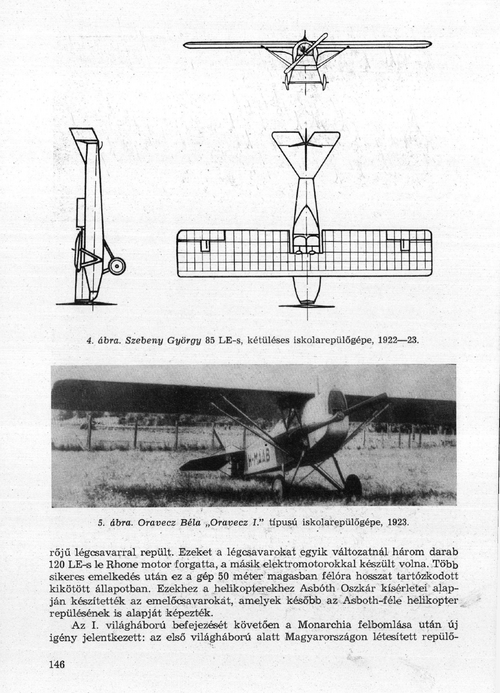
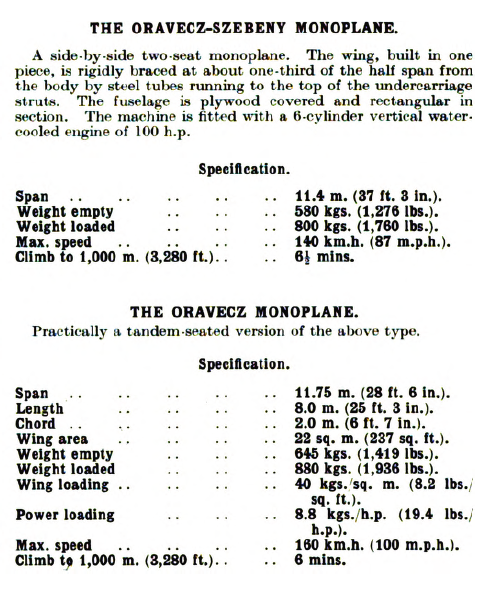
Hi,
the Nieuschloss-Sichtig Aerplane Works and its designers,Mr. Bela Oravecs and
Mr. George Szebeny,created two airplanes,one was side-by-side two-seat and the
other was tandem two-seat,both were a monoplanes and intended for training,
that was done in 1923.
https://hu.wikipedia.org/wiki/Szebeny_György
From this site,
https://library.hungaricana.hu/hu/view/ORSZ_KOZL_TechnTortSzle_04/?pg=147&layout=s
Attachments
- Joined
- 26 May 2006
- Messages
- 38,288
- Reaction score
- 20,425
Mr. Lampich left the company and went to Austria;
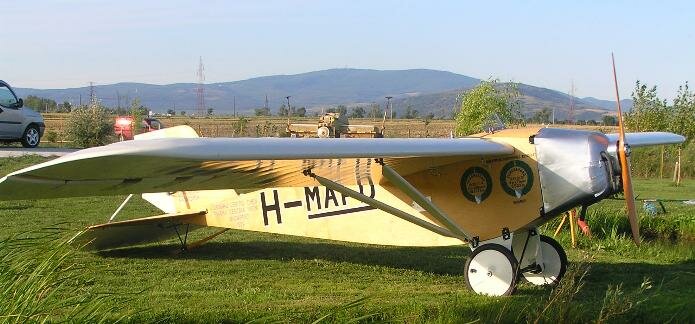
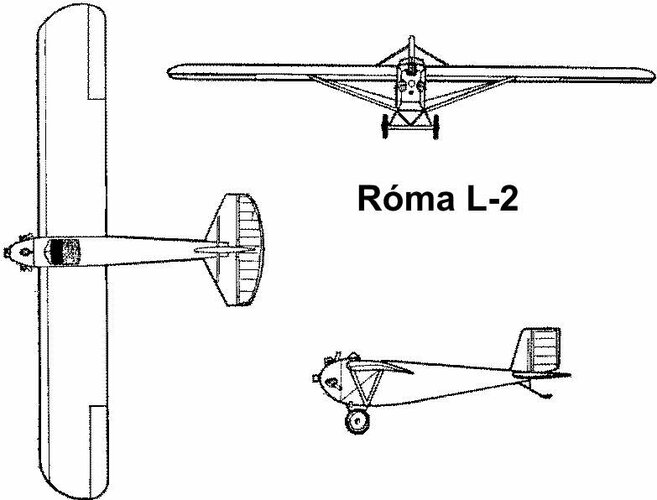
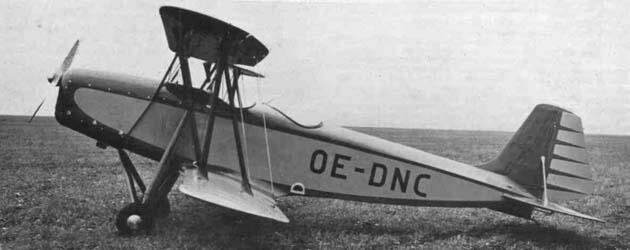
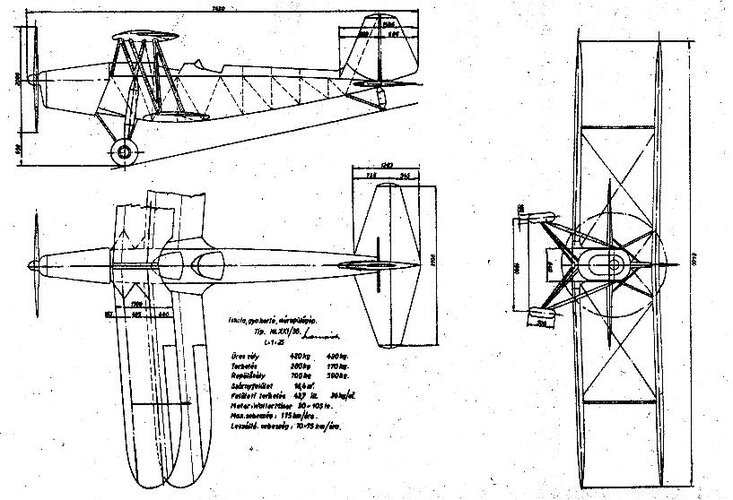
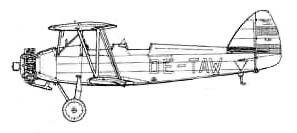
The first aircraft in the framework of the MSRE was L1 Mama's favorite, designed by Árpád Lampich, and the 12 HP engine by Péter Thorotzkai. The next aircraft, the L2 Rome, flew three world records in its category. After Rome, L4 Bohóc was built. This biplane, made of wood, was also suitable for aerobatics. Árpád Lampich, the talented and successful designer, took part in the design and production of the BL 5 and BL 6 aircraft, but then he continued to work in Austria, where, e.g. he designed the LN-XXI and LN-XXII types of sleek biplanes. Lajos Rotter, who started with MSRE, but started an independent business, founded FEIRO with the Feigl brothers. By 1924, the small passenger plane FEIRO I was ready, a significant innovation was a solution suitable for equalizing the steering force. In the next step, a more powerful engine was built into the aircraft, thus the FEIRO Crane was born. The FEIRO Dongó two-person training aircraft did not receive a government order due to its relatively weak engine. With this, the activities of the company FEIRO ceased. Lajos Rotter reappeared with the glider named Karakán (1933), with this plane they flew for the first time in Hungary over a distance of more than 50 km. He designed the next glider together with Zoltán Janka - it became the Vándor. The glider named Nemere was completed in 1936, with which Lajos Rotter won the Olympic championship with a world record flight in Berlin.
https://mek.oszk.hu/02100/02185/html/812.html
For LN XXI and XXII,
https://www.histaviation.com/lampich_nl_21.htmlhttps://www.histaviation.com/lampich_nl_22.html
Attachments
- Joined
- 26 May 2006
- Messages
- 38,288
- Reaction score
- 20,425
Hi,
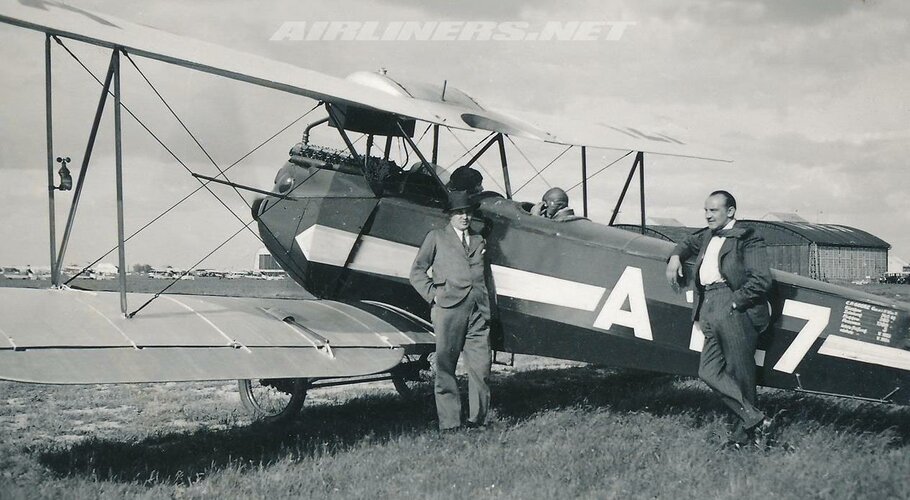
the Bauer Bz II was a three seat mail carrier biplane,powered by one
Daimler engine.
https://www.histaviation.com/bauer_bz_2.html
the Bauer Bz II was a three seat mail carrier biplane,powered by one
Daimler engine.
https://www.histaviation.com/bauer_bz_2.html
Attachments
- Joined
- 26 May 2006
- Messages
- 38,288
- Reaction score
- 20,425
Attachments
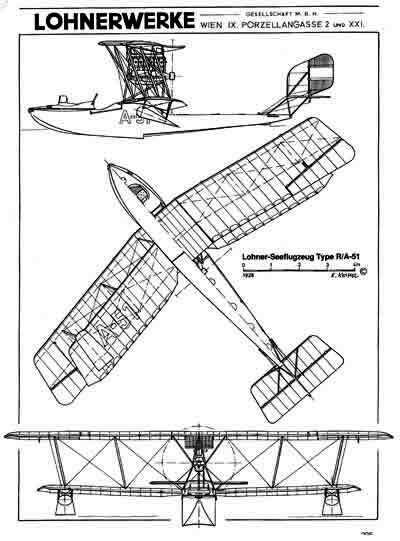
- Joined
- 26 May 2006
- Messages
- 38,288
- Reaction score
- 20,425
Attachments
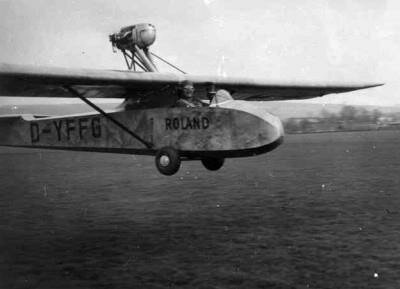
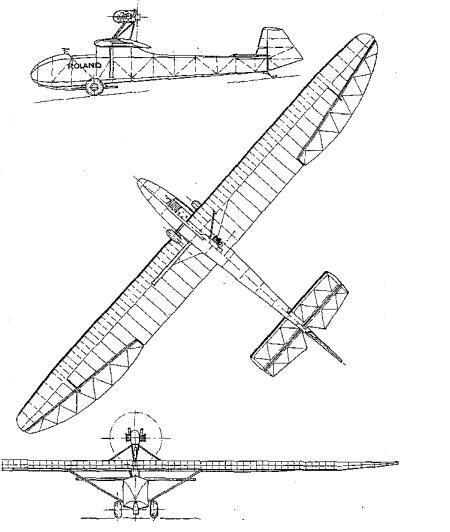
- Joined
- 26 May 2006
- Messages
- 38,288
- Reaction score
- 20,425
By the way,that firm had a series of aircraft and gliders,
https://www.secretprojects.co.uk/threads/akaflieg-graz-g-23-flying-egg.16953/
- Joined
- 26 May 2006
- Messages
- 38,288
- Reaction score
- 20,425
Attachments
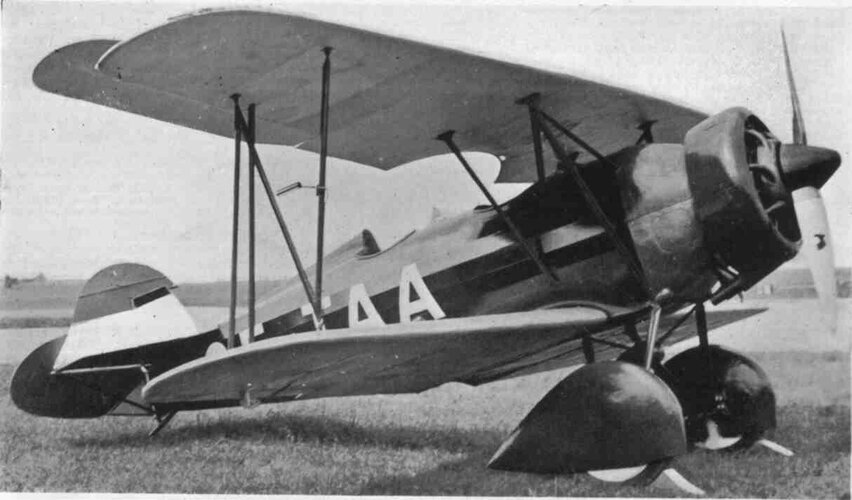


- Joined
- 25 July 2007
- Messages
- 4,916
- Reaction score
- 5,538
By the way,that firm had a series of aircraft and gliders,
https://www.secretprojects.co.uk/threads/akaflieg-graz-g-23-flying-egg.16953/
Never a "firm" ... akaflieg is a contraction of Akademische Fliegergruppe. In other words, akafliegs are student flying organisations (usually attached to engineering schools or departments). And that was/is the case for Akaflieg Graz.
Akaflieg Graz is a flying club (originally a gliding club) attached to the Technische Universität Graz ... not a manufacturing company.
- Joined
- 26 May 2006
- Messages
- 38,288
- Reaction score
- 20,425
How to get all Austrian "A" series for air force as I think ?.
I meant the "A" series,such as,
Fokker F.III = A-5
Fokker F.V = A-7
Avis BS.I = A-10
and go on ?.
- Joined
- 26 May 2006
- Messages
- 38,288
- Reaction score
- 20,425
But A series is different from 1933,also it's nothing to do with Meindle concepts,This so-called A-series is nothing more than the registration of civil aircraft in the Austrian aviation register. I believe OE-xxx was introduced as a civil registration in 1933.
https://www.secretprojects.co.uk/threads/meindl-aircraft-from-austria.24167/
- Joined
- 26 May 2006
- Messages
- 38,288
- Reaction score
- 20,425
I meant the "A" series,such as,
Fokker F.III = A-5
Fokker F.V = A-7
Avis BS.I = A-10
and go on ?.
I need to know all of this series,from A-1 to A-xx,that's all.
- Joined
- 25 July 2007
- Messages
- 4,916
- Reaction score
- 5,538
I need to know all of this series,from A-1 to A-xx,that's all.
And @Maveric has already provided the answer - the series of A registrations for Austrian civilian aircraft (prior to adoption of the OE- series). I'm not clear on how or why those Meindl-van Nees designations got caught up in all of this?
The registrations for two of three examples you listed match that second A series - A-5 (2nd use; Fokker F III c/n 1606) and A-10 (Avis BS I; crashed 30 July 1924). But, your A-7 for a Fokker F V doesn't match either A series.
In the first A series, A-7 was a Brandenburg B I (or C I) belonging to Franz Zuzmann at Aspern. In the second A series, A-7 belonged to a Phönix D I in police use.
-- http://www.airhistory.org.uk/gy/reg_A-.html
_____________________
[1] The sale of the sole Fokker F V prototype to Austria was facilitated by the same Avis Flugzeug- und Autowerke which built your BS 1. However, in that, Avis was acting as the Vienna agent for a small Hungarian airline - Ungarischen Luftverkehrs AG.
- Joined
- 25 July 2007
- Messages
- 4,916
- Reaction score
- 5,538
... and who was Magdlener (A-13) ?.
The Österreichisches Luftfahrt-Archiv lists the Franz Magdlener aircraft A-13 as the Magdlener I. That designation may be a later back-formation from the Magdlener II (A-23). The latter ended up flying for the Österreichische Fliegerschule (before being written-off in an accident on 06 June 1927). BTW, both aircraft were designed for Franz Magdlener by ex-Lohner ing Leopold Bauer. [1]
-- http://www.luftfahrt-archiv.at/flug-informationen.htm
_______________________________________
[1] Leopold Bauer later designed two aircraft for Franz Zuzmann - the Bauer BZ I and BZ II. Air History lists the BZ I for as the first A-20 (later re-reg. as the first OE-DEZ) and the BZ II - which went to C.P. Goerz GmbH of Vienna - as A-127 (later re-reg. as the first OE-DFZ, then exported as D-EDFZ). Note that these designations will also be seen as simply Z I and Z II or with 'Bz' prefixes (perhaps confusing BZ with the wartime abbreviation for Benz motors?).
Air History also lists the 1925 Bauer-Eger (aka BAEG, after designer Leopold Bauer and its builder, Max Eger) as A-20.
-- https://www.secretprojects.co.uk/th...strian-designer-engineer-leopold-bauer.18812/
- Joined
- 26 May 2006
- Messages
- 38,288
- Reaction score
- 20,425
That site show the Avis Flugzeugwerke und Autowerke GmbH aircraft,it included,
BS.I,BS.II,BS.III,BGV.I & BV.I,there was also BS.IV project.
- Joined
- 25 July 2007
- Messages
- 4,916
- Reaction score
- 5,538
That site show the Avis Flugzeugwerke und Autowerke GmbH aircraft,it included,
BS.I,BS.II,BS.III,BGV.I & BV.I,there was also BS.IV project.
It does. The 'B' in the AVIS aircraft designs came from their designer, Dipl Ing Julius von Berg (formerly of Aviatik). The 'BS' series were intended as AVIS flying school trainers (so, 'BS' was probably for 'Berg Schulflugzeug' or similar). I suspect that 'BV' was for 'Berg Verkehr' (Berg Transport) and 'BGV' for 'Berg Großer Verkehr' (Berg Heavy Transport).
The corporate history goes something like this:
1922-1924: Technische Werkstätten Ges.mbH in Wien made small cars and dabbled in aircraft in Vienna
- 1922(?): AVIS repair facilities opened in Vienna- Währing, Canongasse 12
1924-1931: Became AVIS Flugzeug- und Autowerke Ges.mbH; [1] HQ in Vienna (Freyung 3)
- 1924: Land acquired in Brunn am Gebirge for AVIS factory; aerodrome was at Aspern
-- AVIS flight school established while offering aerial photography and sightseeing junkets
-- Original AVIS aircraft design begun under Dipl Ing Julius von Berg
- 1928 : Aviation activities at AVIS Flugzeug- und Autowerke Ges.mbH come to an end
- 1931 : AVIS Flugzeug- und Autowerke Ges.mbH assets completely liquidated
AVIS Aircraft Types and Designations went as follows:
AVIS BS I - 1924 tandem 2-seat parasol-wing trainer; x 1
- AVIS BS I : Strut-braced, semi-cantilever parasol wing
- AVIS BS I : 1 x 100 hp (??) 6-cyl. inline; span 10.40 m
-- Constr. ply-covered wood wings; steel-tube fuselage
- AVIS BS I : Civil reg. A-10; offered export military use
-- BS I crashed 30 July 1924 on demonstration in Sofia*
-- * Bulgarian AF pilot attempted aerobatic manoeuvres
AVIS BS II - 1924 tandem 2-seat parasol-wing trainer; x 1
- AVIS BS II : Evol. of BS I w/ continuous cockpit opening
- AVIS BS II : 1 x 100 hp (??) 6-cyl. inline; span 10.40 m
-- Constr. as BS I; Fokker-style wood/welded steel-tube
- AVIS BS II : Civil reg. A-16; to Schmidgruber & Schmid
AVIS BS III - 1925 tandem 2-seat parasol-wing trainer; x 1
- AVIS BS III: As per BS II; distinguished by wheel covers
- AVIS BS III: 1 x 100 hp (??) 6-cyl. inline; span 10.40 m
- AVIS BS III: Austria civilian registration was A-15
-- Demonstrated to Austrian military; Graz Thalerhof, 1930
AVIS BS IV - 1925 tandem 2-seat parasol-wing trainer; x 1
- AVIS BS IV: As per BS II; distinguished by wheel covers
- AVIS BS IV: 1 x 80 hp Siemens-Halske Sh 5; span 10.40 m
- AVIS BS IV: Apparently, no Austrian civilian registration
-- Going by Flight drawings; BS IV had thinner profile wings
-- https://aviadejavu.ru/Images6/FT/FT1925/04/227-1.jpg
- AVIS BS IV: Fate unconfimed; reported crashed in 1925
AVIS BGV I - 1924 trimotor passenger carrier biplane; x 1
- AVIS BGV I: 2+6; cabin under wings; cockpit set far aft
- AVIS BGV I: 1 x 235 hp + 2 x 100 hp;* span 19.00 m
- AVIS BGV I: Constr. resembles both BS & BV I types
-- A-11; intended as operational basis for an AVIS airline
-- * Some sources claim that 235 hp was an AVIS design
-- * Some sources list Mercedes 100 hp; others 120 hp
AVIS BV I - 1925 cabin passenger parasol monoplane; x 1
- AVIS BV I: 1+3; cabin under wings; cockpit set far aft
- AVIS BV I: 1 x 100 hp (??) 6-cyl. inline; span 14.20 m
- AVIS BV I: Conceptually, airliner deriv. of the BS series
-- Very deep central fuselage to accommodate the 3 x pax
- AVIS BV I : A-12; fate unconf.; reported crashed in 1925
Similar threads
-
 Romanian Lesser Known Airplanes and Designers
- Started by hesham
- Replies: 91
-
Sikorsky Lesser Known Aircraft,non-Aircraft and Projects
- Started by hesham
- Replies: 19
-

-
-