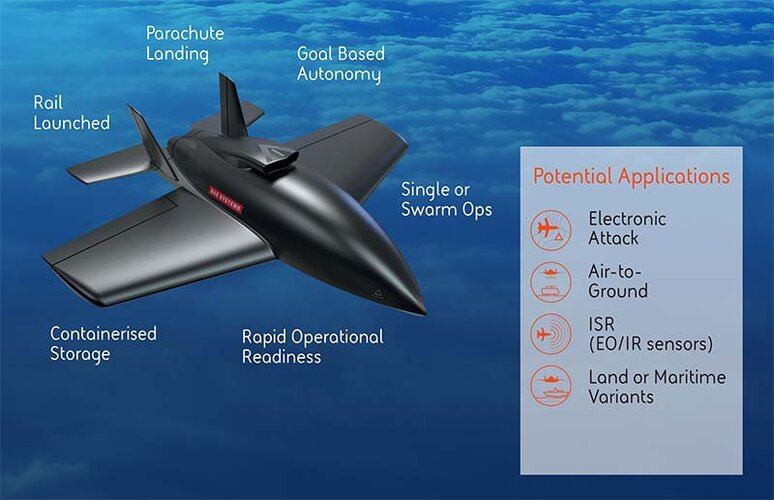
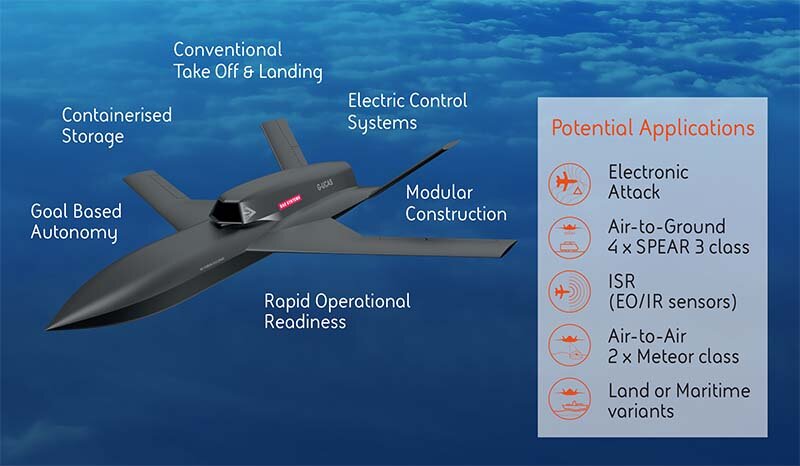
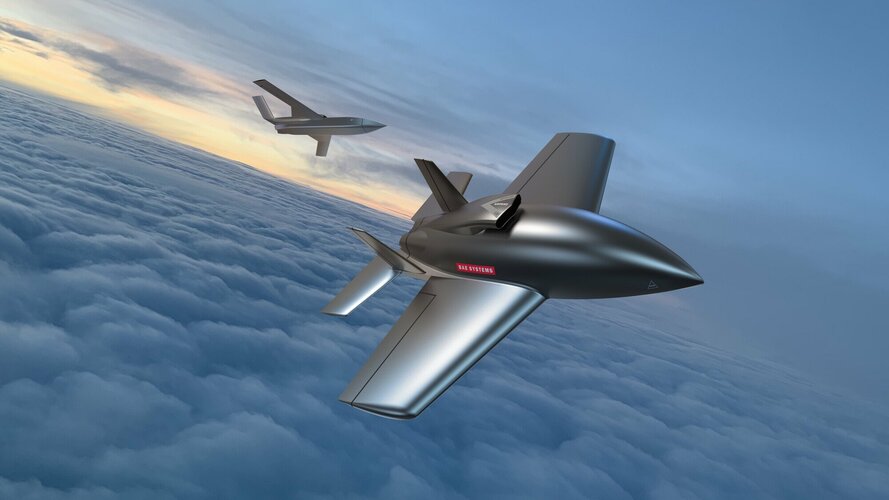
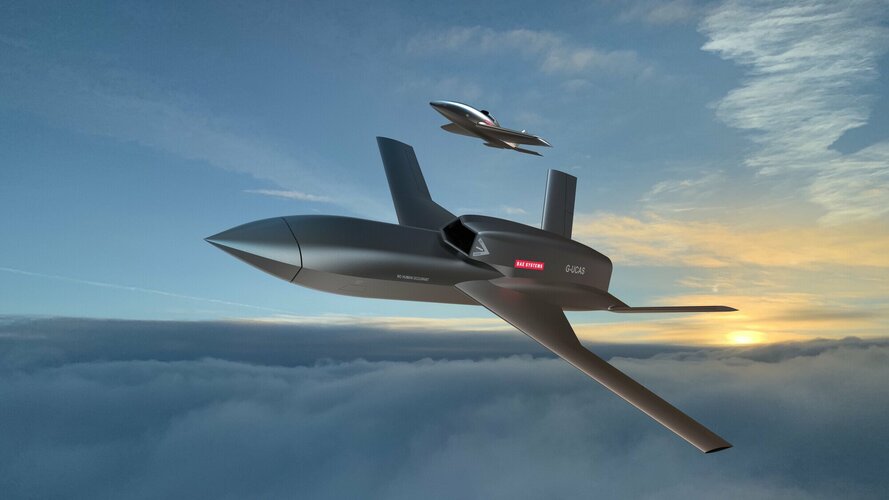
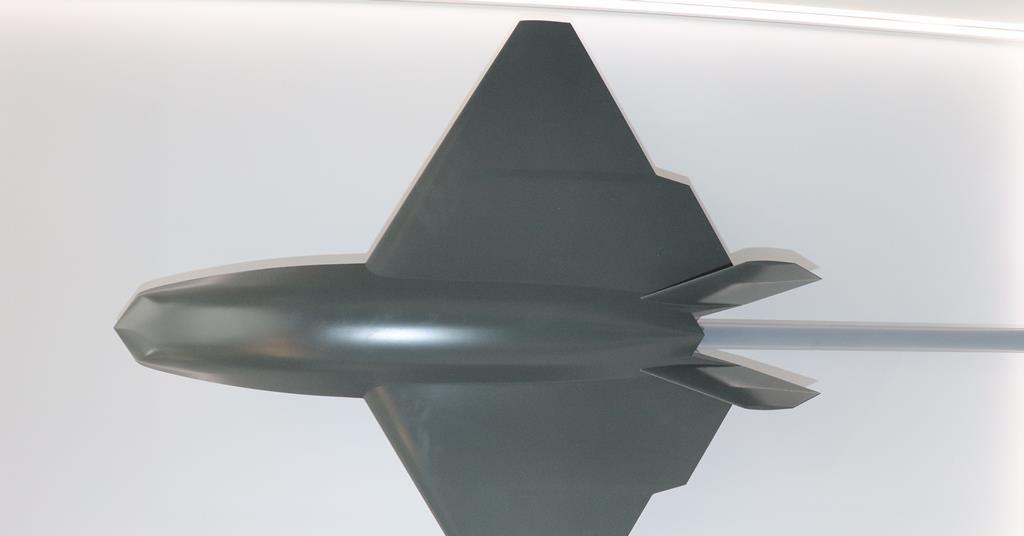
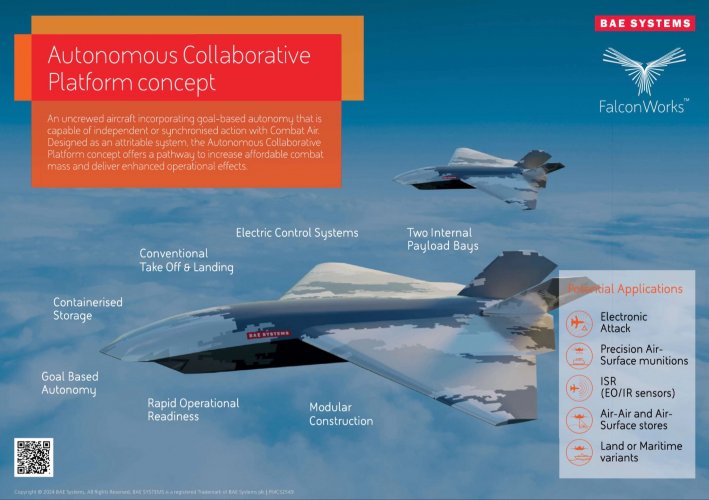
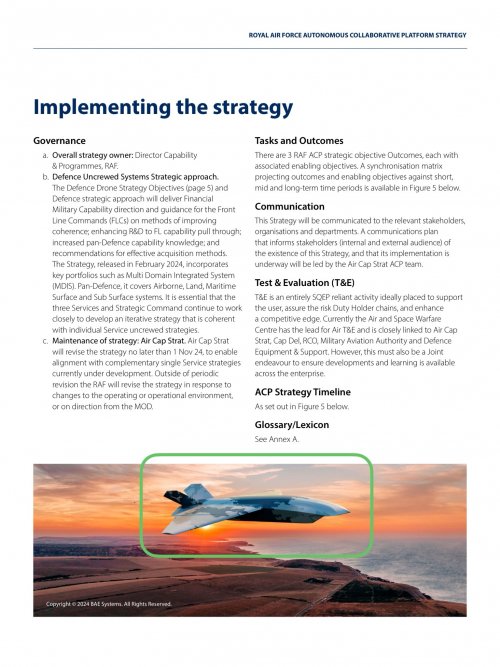
"UAS Concepts being developed within our Air sector offer the potential to enhance the operational effect of current and future crewed platforms, by augmenting the force mix through affordable combat power. "
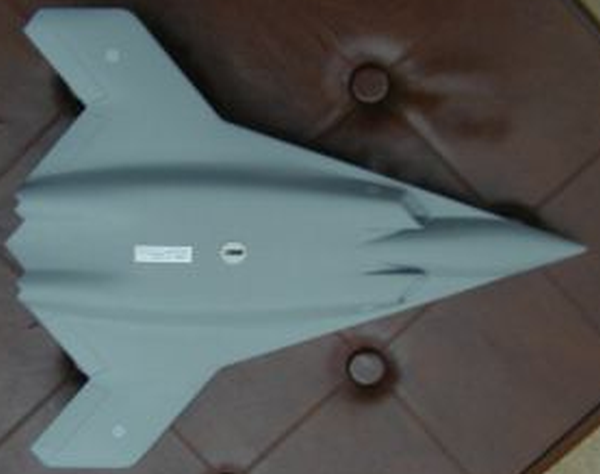
Pretty much all the configurations proposed are similar apart from Ghost Bat. BAES are just a few years late in making their plastic model. They had zero to do with the one at previous RIAT.
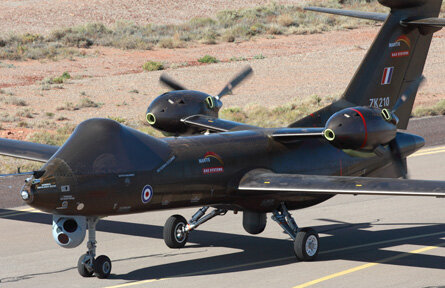
That MALE UAS isnt Mantis - no stub wing for the engines
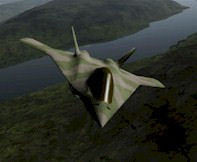
Given the absence of Replica's silhouette, I'm more inclined to think that the unknown one might be Nightjar rather than FOAS. But it's just an hunch, since we know very little of the program.
Edit:
a bit more on why I think this might be Nightjar.
The graphic is suggestive of the evolution from the capability of a multirole combat aircraft like the Typhoon, passing through several BAE systems UAS and finally culminating into the Tempest at the end.
The line from the Typhoon to the Tempest diverges into several lines, possibly as a nod to the distributed nature of the Future Combat Air System (of which Tempest is just the manned part).
So there would be no need to depict Replica or FOAS, or any other aircraft not involved in the FCAS concept, thus confirming that the graphic is not meant to showcase the various projects BAE has worked on from the Typhoon onwards.
The silhouettes of the various aircraft are more or less chronologically lined up (HERTI 2004-2007, Mantis 2009, Taranis 2010, the unknown one, PHASA-35 2018-2020, UAS 1 2022, UAS 2 2022, Tempest 2035), Around the same time Taranis was being developed, Nightjar was under study as well.
I always thought that Nightjar / Nightjar-2 were risk reduction programs that didn't include actual full-scale flight vehicles. Moreover, they preceeded Taranis (if we keep on timeline chart theory).
I always thought that Nightjar / Nightjar-2 were risk reduction programs that didn't include actual full-scale flight vehicles. Moreover, they preceeded Taranis (if we keep on timeline chart theory).
You are correct. I should have said a "Nightjar" spawn, rather than Nightjar proper.
The aim of the Nightjar programme was to explore the integration of new airframe features, which could be critical for the future of air vehicle design. The programme provided stepped increases in valuable data on issues surrounding design, aerodynamics, manufacturing and in-service performance limits.
Given the scope of the program, with a focus on future aircraft designs, and its sensitive nature, I think something might have been flown to test those features. Taranis might have been the white world version of the test program.
But it's only speculation on my part, so not worth much.
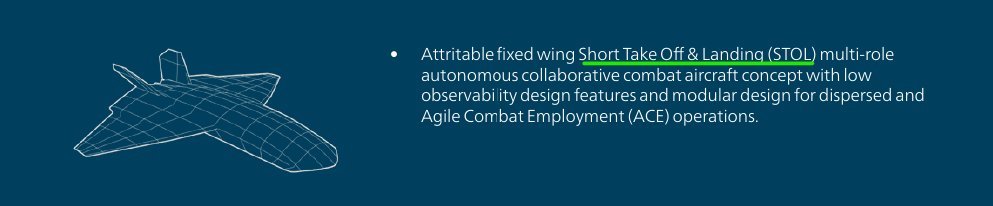
STOL capability detailed for BAE's class 2 ACP (diamond wing).
Given no other class 2 ACP has advertised STOL capability (that I've seen) + it's BAE, it would seem a front runner for the Royal Navy's Project Vanquish. GAs Gambit is CATOBAR ("small" catapult requirement) at least shown so far.
BAE FalconWorks Product Portfolio Overview 2025, on the class 2 ACP -
"Attritable fixed wing Short Take Off & Landing (STOL) multi-role autonomous collaborative combat aircraft concept with low observability design features and modular design for dispersed and Agile Combat Employment (ACE) operations" https://www.baesystems.com/dam/jcr:08f6568e-f3a4-46e6-ae23-02070fe84946 (links direct to PDF file)
Oct 2025 - "RFI INDUSTRY - VANQUISH Technical Demonstration
Description
As part of the route to the Royal Navy's Hybrid Air Wing, Project VANQUISH seeks to deliver a technical demonstration at sea of an attritable (Tier 2) Fixed Wing Short Take Off and Landing Autonomous Collaborative Platform (FW STOL ACP)"
Dec 2025 - 1st Sea Lord -
“We will get a demonstrator for our fast jet fighter capability off the carrier next year … we’re working closely with the Air Force to make sure that we can develop together...”
General Sir Gwyn Jenkins KCB OBE ADC RM, First Sea Lord, gave a speech at the Sea Power Conference.
www.gov.uk
Other related:
Feb 2024 - Flight global article details BAE class 2 ACP aiming for first flight "within two years" (as detailed above in this thread)
"BAE Systems has revealed the design of an autonomous collaborative platform (ACP) demonstrator which it aims to fly within the next two years."
“We have a programme laid out until it gets to first flight within two years. To take the programme much further, we are going to need a partner to help us develop the programme, and develop it in the right direction.
The Royal Air Force's (RAF’s) intent for use of Autonomous Collaborative Platforms (ACP) in the Air domain.
www.gov.uk
Sept 2025:
"BAE Systems and QinetiQ have successfully completed synthetic trials to show how uncrewed aircraft can operate alongside existing crewed aircraft like Typhoon to provide a more cost-effective and flexible concentration of combat air power. "
I do wonder if it is possible to harden the landing gear enough on these things, to allow an electric motor powering the wheels, to boost acceleration on take-off. Thus allowing shorter runways, or heavier "ACPs"
I do wonder if it is possible to harden the landing gear enough on these things, to allow an electric motor powering the wheels, to boost acceleration on take-off. Thus allowing shorter runways, or heavier "ACPs"
STOL capability suggests a very low landing and take off speed, how will that be achieved?
If its going to be Hawk sized and capable of a breaking stop on the carrier, then it must be coming over the round down at 50 knots, certainly no more.
I cant really see how this can be achieved safety without a reconfigured deck with an angled runway.
Having something hawk sized, malfunctioning or battle damaged, careering down the center line doesn't seem like a great idea!
You need an angled deck that might also allow higher speed F35B Rolling vertical landings too....
whatever they're doing they seem to have a lot of faith in it. However, angled deck landings means less parking space on deck, I wonder how the airwing ratio will turn out
I strongly suspect that the air wing will not be a problem for the foreseeable future. Having MUCH faith in OUR dear bleaders either way. Besides, having a cake and eating it seems to apply. You cannot have landing space and parking space in the same location.
With its chiselled beak (somewhat like the fictional Firefox) and diamond shaped wing, the BAE Systems autonomous collaborative platform (ACP) concept revealed at WDS2024 is an extremely interestin…
hushkit.net
"The BAE Systems UCAV has a diamond shaped YF-23-like planform but with a relatively short forebody. The wing leading edge appears to be rounded, rather than sharp, and this, coupled with the geometry of the forebody and wing, suggests a modest design mach number around 1.4. "
"None of the surfaces of the aircraft feature any indication of moveable controls, and while this may be an example of artistic licence, it does raise the possibility that this uncrewed concept may draw on the BAE Magma demonstrator of 2019. Magma demonstrated the ability to use circulation control at the trailing edge of the wing, coupled with fluidic thrust vectoring of the exhaust, to successfully fly a UAV with no moving control surfaces. The tail fins on the UCAV appear quite small, and one wonders whether circulation control in yaw might be being used, because of the high lift coefficients that are achievable."
This site uses cookies to help personalise content, tailor your experience and to keep you logged in if you register.
By continuing to use this site, you are consenting to our use of cookies.