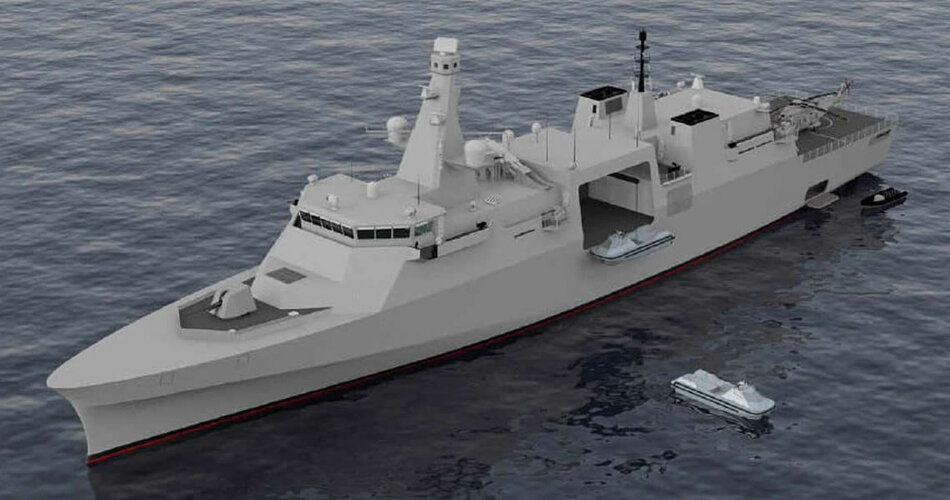
Type 31 GPFF Design Studies and Development

Hmmmm....so the Bofors 40mm returns to the RN....

It's sad to see the CTAS 40mm fail here, but not surprising. Having funded development to then not spread the capability as widely as possible puts off possible customers.

The clear hope is funding for 3P ammunition.
But in theory it also keeps open the door to future guided rounds and allows for cheaper basic 40mm as well.

I see it's to provide both CIWS, anti-FAC and GP capability.
It also undermines the need for 57mm and frankly makes 76mm main guns a bit pointless.
 
I see it's to provide both CIWS, anti-FAC and GP capability.
It also undermines the need for 57mm and frankly makes 76mm main guns a bit pointless.
The extra range of the 57mm will help push engagements out, and be more useful for an indirect fire role.
 
I see it's to provide both CIWS, anti-FAC and GP capability.
It also undermines the need for 57mm and frankly makes 76mm main guns a bit pointless.
The extra range of the 57mm will help push engagements out, and be more useful for an indirect fire role.
But is it worth it?
Might as well leave defence to 40mm and FLAADS.
 
I see it's to provide both CIWS, anti-FAC and GP capability.
It also undermines the need for 57mm and frankly makes 76mm main guns a bit pointless.
The extra range of the 57mm will help push engagements out, and be more useful for an indirect fire role.
But is it worth it?
Might as well leave defence to 40mm and FLAADS.
It certainly might appear that there is considerable overlap between 40mm and 57mm in anti-aircraft roles. But dropping 57mm in favor of missiles leaves quite a gap in the surface engagement solution.

That is, 57mm offers roughly 50% more engagement range than 40mm against surface targets. This, combined with the increases potential for guided rounds in the larger shell (ORCA and ALaMO, for example), suggests a clear benefit to having a bigger gun in the 57-76mm range for surface engagements. This isn't a new observation -- the RN adoption of the OTO 76mm gun on the Peacock OPVs back in the 1980s reflects the limitations of 40mm in "junk bashing" roles.

Having opted for 57mm, the next question is whether the choice of 40mm for secondary gun is better or worse than the alternatives. Those would appear to be either 35mm or 30mm firing air-bursting/AHEAD type rounds instead of 40mm with 3P proximity rounds. The choice between 35mm and 40mm seems to be a toss-up to me. Millennium is fast-firing but not much lighter and the ammo isn't that much smaller either. Going to 30mm might allow three rather than two mounts but complicates arrangements so you might not have more guns that can point in any given direction. And you sacrifice range against all sorts of targets.
 
Last edited:
https://www.navyrecognition.com/ind...plans-to-introduce-five-type-32-frigates.html
According to a report published by the UK’s House of Commons Defense Committee on December 7, 2021, the British Royal Navy is planning to introduce five Type 32 frigates, which would increase the escort fleet (frigates and destroyers) from 19 to 24.

During the DSEI, British defense exhibition in September 2021, British company Babcock International revealed it was pitching its Arrowhead 140 design, used by the Type 31 frigate, as the base design for the Type 32.

According to information from the UK’s Minister for Defense Procurement Jeremy Quin, the new Type 32 frigate will be a platform for autonomous systems, adding to the British Navy’s capabilities for missions such as anti-submarine warfare and mine countermeasures.

Citing British navy military experts, the Type 32 will offer an ability to host MMCM modules in addition to supporting littoral operations by the Royal Marines. Initiated in 2012 under a cooperation agreement between France and the United Kingdom, the MMCM program develops a prototype autonomous system for detection and neutralization of sea mines and underwater improvised explosive devices (UWIEDs).
 
I'm not convinced that a frigate is the most cost effective MCM mothership, but it wouldn't be hard to imagine a Type 31 with those four bays loaded with USVs and a light armament of CAMM and a 57mm gun. It would still be beefier than a River II, which can only be good.

ASW capability sounds good, lets hope it doesn't herald some MoD/Treasury bean counters to cancel some of the Batch 2 Type 26s though.
 
ASW capability is likely USV based, as the costs of redesign and building a quietened version is prohibitive. Couple this with Proteus UAV-H

Arguably a AAW variant is much easier.
 
I would also assume that the Type 32s with autonomous systems will help replace the minehunters that are currently in service with the Royal Navy, as these are slated to be replaced by remotely piloted vehicles instead.

Also, what is the present weapons outfit for the Type 31?
 
I would also assume that the Type 32s with autonomous systems will help replace the minehunters that are currently in service with the Royal Navy, as these are slated to be replaced by remotely piloted vehicles instead.

No-one really knows. I agree with previous posters that a Frigate design is not the best platform. It's more likely that the RN will go with a commercial style hull. A development of an Oil and Gas Offshore Support Vessel would appear to be the likely direction. Lots of growth margin as well, which a Frigate design will not have. BMT got the design's right years ago with Venator 90 for a more warlike posture and Venari 85 for more peacable areas...

Current weapons outfit for Type 31 is 1 x 57mm, 2 x 40mm Bofors, 12 Sea Ceptor (number is not fully confirmed but thats all that have been seen positively in images, still some hope for 24, even if its FFBNW). Nothing else has been confirmed, that includes the AShM fitout and any possibility of Torpedo Tubes.
 
Last edited:
Current weapons outfit for Type 31 is 1 x 57mm, 2 x 40mm Bofors, 12 Sea Ceptor (not confirmed but thats all that have been seen positively in images). Nothing else has been confirmed, that includes the AShM fitout and any possibility of Torpedo Tubes.
Which isn't exactly earth-shattering kaboom firepower, a 1980s FAC probably packed just as much firepower...

It's more likely that the RN will go with a commercial style hull. A development of an Oil and Gas Offshore Support Vessel would appear to be the likely direction.
Sounds possible, although the RN seems to want something that will tag along with the Littoral Group so presumably they are looking at some kind of self-defensive armament given its going to be loitering fairly close to shore.

Feels like Type 32 might become a Type 31 Batch 2 (which Admiral Radakin was recently quoted as saying might happen), - a T31 with minehunting USVs and dedicated datalinks and control space. Though those items are likely to be roll-on roll-off modules so the question is why not future proof Type 31 by being compatible with this kind of modular kit now?

A little more info on the Type 31's 40mm gun: https://www.navylookout.com/in-focus-the-bofors-40mm-mk-4-gun-that-will-equip-the-type-31-frigates/
 
The Type 31 due to the nature of its a procurement will be a fitted for not with to begin with. The price cap on the unit price has lead to an austere fit initially and until all five ships are completed I think they will stay that way till the first refit. The Type 32 design will get the stuff they would like of the Type 31, and some of this will be back fitted onto 31s once the RN get a new Anti-ship missile.

The 57mm has been used by the Canadian Halifax class, and has been selected for the new USN Frigate, but with the 40mm in the CIWS role, and the GP nature of the Type 31 it would make more senses to fit the 5in as per the Type 26 so they can be used for NGS, then fit the 57mm onto River II class
 
The Type 31 due to the nature of its a procurement will be a fitted for not with to begin with. The price cap on the unit price has lead to an austere fit initially and until all five ships are completed I think they will stay that way till the first refit. The Type 32 design will get the stuff they would like of the Type 31, and some of this will be back fitted onto 31s once the RN get a new Anti-ship missile.

The 57mm has been used by the Canadian Halifax class, and has been selected for the new USN Frigate, but with the 40mm in the CIWS role, and the GP nature of the Type 31 it would make more senses to fit the 5in as per the Type 26 so they can be used for NGS, then fit the 57mm onto River II class
Agreed.
Funding additional 5 sets of Higher end kit is going to be cheaper once Type 32 funding is secured for the initial 5 sets.
It also opens up a long term sell off of low end Type 31 and repeat orders for Type 32 keeping shipyards open.
 
The 57mm has been used by the Canadian Halifax class, and has been selected for the new USN Frigate, but with the 40mm in the CIWS role, and the GP nature of the Type 31 it would make more senses to fit the 5in as per the Type 26 so they can be used for NGS, then fit the 57mm onto River II class

Thing is, a 5-inch gun would not be very useful in escort or antipiracy type duties, which seem likely to make up a big chunk of the T31's tasks. It's too slow-firing for the counter-small-boat role, which seem likely to be more important than NGFS. And a ship with only 12 CAMM is probably too vulnerable to send inshore for NGFS in a modern threat environment with armed/suicide drones and coastal-defense missiles. (Think the coast of Yemen, for example.)
 
Will be interesting to see what the actual armament on the Polish version will look like. The MEKO A-300 concept that was circulated is very heavily equipped (5-inch gun, 32 Mk 41, 32 medium-range SAM, 16 SSM, 2 RAM, laser and HPM, helicopter, etc.) That seems almost comically over-stuffed. But the baseline Type 31 design was very understuffed.
 
I see it's to provide both CIWS, anti-FAC and GP capability.
It also undermines the need for 57mm and frankly makes 76mm main guns a bit pointless.
The extra range of the 57mm will help push engagements out, and be more useful for an indirect fire role.
But is it worth it?
Might as well leave defence to 40mm and FLAADS.
It certainly might appear that there is considerable overlap between 40mm and 57mm in anti-aircraft roles. But dropping 57mm in favor of missiles leaves quite a gap in the surface engagement solution.

That is, 57mm offers roughly 50% more engagement range than 40mm against surface targets. This, combined with the increases potential for guided rounds in the larger shell (ORCA and ALaMO, for example), suggests a clear benefit to having a bigger gun in the 57-76mm range for surface engagements. This isn't a new observation -- the RN adoption of the OTO 76mm gun on the Peacock OPVs back in the 1980s reflects the limitations of 40mm in "junk bashing" roles.

Having opted for 57mm, the next question is whether the choice of 40mm for secondary gun is better or worse than the alternatives. Those would appear to be either 35mm or 30mm firing air-bursting/AHEAD type rounds instead of 40mm with 3P proximity rounds. The choice between 35mm and 40mm seems to be a toss-up to me. Millennium is fast-firing but not much lighter and the ammo isn't that much smaller either. Going to 30mm might allow three rather than two mounts but complicates arrangements so you might not have more guns that can point in any given direction. And you sacrifice range against all sorts of targets.
A very (very very) rough analogy of the difference between 57mm and 40mm is think the difference between the 2pdr AT gun and the 6pdr AT gun.
 
The 57mm has been used by the Canadian Halifax class, and has been selected for the new USN Frigate, but with the 40mm in the CIWS role, and the GP nature of the Type 31 it would make more senses to fit the 5in as per the Type 26 so they can be used for NGS, then fit the 57mm onto River II class

Thing is, a 5-inch gun would not be very useful in escort or antipiracy type duties, which seem likely to make up a big chunk of the T31's tasks. It's too slow-firing for the counter-small-boat role, which seem likely to be more important than NGFS. And a ship with only 12 CAMM is probably too vulnerable to send inshore for NGFS in a modern threat environment with armed/suicide drones and coastal-defense missiles. (Think the coast of Yemen, for example.)
The "small boats", meaning Iran's fleet, now have boats sporting a pair of 25km* range (I believe Sea Skua might be a good analogue) missiles. 127mm or 76mm with terminally guided Vulcano have the range to take those boats out before they reach launch range. Additionally the DART anti-air round can also be used for surface engagement of small boats. I think both make more sense than 57mm, which doesn't have the range to attack the boats before they can launch. I don't know how DART compares to 40mm in the CIWS role, but if it's comparable the flexibility of the 76 makes for a better armament fitment.

*Rockets and 14.5mm were interim, I wouldn't be surprised if the next generation of boats carries 100km+ range ASMs.
 
The "small boats", meaning Iran's fleet, now have boats sporting a pair of 25km* range (I believe Sea Skua might be a good analogue) missiles. 127mm or 76mm with terminally guided Vulcano have the range to take those boats out before they reach launch range. Additionally the DART anti-air round can also be used for surface engagement of small boats. I think both make more sense than 57mm, which doesn't have the range to attack the boats before they can launch. I don't know how DART compares to 40mm in the CIWS role, but if it's comparable the flexibility of the 76 makes for a better armament fitment.

I think you missed the bit where I said that 76mm and 57mm are roughly equivalent. Both have guided rounds suitable for small boat engagements.

The use of 127mm Vulcano guided rounds against small boats is more complicated. First, the IR-guided round needed for such engagements appears to not actually exist, though Leonardo says it can be done "easily." Second, I have real doubts about the ability of boats with such long-range weapons to actually employ them effectively. There is a lot of C4ISR needed to back that up. And third, I also have questions about how easy it would be to preemptively engage small boats at very long range in a less than total war scenario. RoE is very unlikely to allow you to shoot at a small boat 25 miles away just because it has missile armament and is headed in your direction. Time-of-flight constraints mean that even if you can open fire as soon as you see some tangible step toward a launch (which literally might be nothing at all until a missile actually leaves its launch tube), the missiles will be gone before your rounds arrive.

So, at that point, the emphasis should be on defending against such missiles, for which 57mm or 76mm are better options. Let your armed helicopter deal with the boats post-launch.
 
Last edited:
A very (very very) rough analogy of the difference between 57mm and 40mm is think the difference between the 2pdr AT gun and the 6pdr AT gun.
Actually, that's pretty close as far as the 57mm/6pdr comparison is concerned. The 2pdr was closer to the 40mm Bofors L/60 rather than the current, more powerful, L/70.
 
There was some speculation that the Type 32 might be another batch of Type 31s, but it seems that the programme's heading in a new and interesting direction.

https://ukdefencejournal.org.uk/type-32-frigate-to-focus-on-operating-drones/
“The Type 32 programme will be the first of a new generation of warships with a focus on hosting and operating autonomous onboard systems that add mass and a cost of complexity upon our adversaries. Many of these autonomous capabilities and other complex systems will be delivered in a modular manner, which offers the potential to simplify the host platform whilst retaining the flexibility to optimise it for a range of specific tasks. It also provides a route to delivering the adaptability that will be essential for all future Royal Navy ships to enable them to outpace evolving threats and capitalise on emerging technology.

Is the type worth a new thread of its own yet?
 

Attachments

  • Royal-Navys-Type-32-Frigate-to-Serve-as-Unmanned-Systems-Mothership.jpg
    Royal-Navys-Type-32-Frigate-to-Serve-as-Unmanned-Systems-Mothership.jpg
    70.9 KB · Views: 140
Agreed, until we know more it might not be worth a dedicated thread.
For me there is nothing that indicates the Type 31 couldn't be used for this role, and indeed the RN has stated it might fill the role.
I would guess the only reason they might not use the Type 31 is if they want a cheaper USV/UUV carrier or if an off the shelf commercial design could do the job just as well.
 
Yes, most likely so. Still, I was intrigued by this emphasis on drones. BAE Systems did come up with the UXV concept for a warship optimised for aerial drones based on a Type 45 hull and I was wondering if Type 32 would be a compact version. The RN is doing work with unmanned surface craft so that is more likely.

https://www.secretprojects.co.uk/threads/bae-stealth-uxv-ucav-carrier-concept.2531/#post-68276
Keep our ears pricked and wait a while until more emerges, I guess.
 
Yes, most likely so. Still, I was intrigued by this emphasis on drones. BAE Systems did come up with the UXV concept for a warship optimised for aerial drones based on a Type 45 hull and I was wondering if Type 32 would be a compact version. The RN is doing work with unmanned surface craft so that is more likely.

If the RN does go this route with the Type 32, I hope they really do their homework and don't try to do too much with one hull like we did with the American LCS program. In the most recent budget for 2023, the USN announced they're early decommissioning all but 6 of the Freedom Class LCS variant and are cancelling the ASW mission module.
 
In the most recent budget for 2023, the USN announced they're early decommissioning all but 6 of the Freedom Class LCS variant
Does that mean that the Independence Class trimaran is considered to be more useful?

The Freedom class has an issue with the combining gear that is very expensive to fix. The decision to decommission most of the class hinges primarily on this. For a ship with limited capability in conventional naval warfare, It’s better to cut the losses and focus on traditional assets ie new Constellation class frigate

The USN is keeping 15 of the independence class active and they will exclusively operate the MCM mission module, replacing the Avenger class. At the end of the day the USN spent an extravagant amount of money on a minesweeper that can go 40 knots
 
Seems odd with respect to a thread speaking about UK ships and the idea of 5" guns coming up. It would seem more appropriate to suggest 4.5" guns in their case.

Its incredible that a 57mm gun is considered adequate to replace 76mm guns. Sounds way too good to be true. Now if they are using Brimstone or Hellfire to engage targets that a 76mm would have been tasked to defeat, it makes perfect sense. But 57mm is a far cry from the 76mm when it comes to raw capabilities. And certainly neither is remotely able to replace a 4.5" main gun. But missiles can do it. It will cost loads of money, but they can do it.
 
Seems odd with respect to a thread speaking about UK ships and the idea of 5" guns coming up. It would seem more appropriate to suggest 4.5" guns in their case.

Its incredible that a 57mm gun is considered adequate to replace 76mm guns. Sounds way too good to be true. Now if they are using Brimstone or Hellfire to engage targets that a 76mm would have been tasked to defeat, it makes perfect sense. But 57mm is a far cry from the 76mm when it comes to raw capabilities. And certainly neither is remotely able to replace a 4.5" main gun. But missiles can do it. It will cost loads of money, but they can do it.

The RN has already specified 127mm (5-inch) guns for the Type 26. The 4.5" suffers from being largely unique to the RN and not having the possibility of benefiting from ammunition developments elsewhere, such as Vulcano.

This idea that 76mm is vastly superior to 57mm just doesn't hold up. Effective gunnery ranges are similar and the higher RoF of the 57mm Mk2 means their "throw weight" is similar. Both have the option of guided rounds.

And the notion that 4.5" is a dramatically better weapon than either is questionable for the T31's missions. Certainly for NGFS (though 127mm is better still), but for either AAW or counter-FIAC (small swarming boats) the 4.5" or 127mm would not be my choice at all.
 
Seems odd with respect to a thread speaking about UK ships and the idea of 5" guns coming up. It would seem more appropriate to suggest 4.5" guns in their case.

Its incredible that a 57mm gun is considered adequate to replace 76mm guns. Sounds way too good to be true. Now if they are using Brimstone or Hellfire to engage targets that a 76mm would have been tasked to defeat, it makes perfect sense. But 57mm is a far cry from the 76mm when it comes to raw capabilities. And certainly neither is remotely able to replace a 4.5" main gun. But missiles can do it. It will cost loads of money, but they can do it.

The new Type 26 is getting a 5” gun, same as on the USN Arleigh Burke class DDG. I always wondered why the RN chose this over their traditional 4.5” gun which has been their standard medium caliber gun predating WW2.

I wish I can remember were I read this but the side by side comparison of the 57mm to 76mm is pretty similar with the 57mm outperforming in many areas due to its high rate of fire.
 
Maybe here: http://www.navweaps.com/Weapons/WNSweden_57-70_mk123.php
Ship Class Used OnMark 1
Sweden: Hugin, Spica I and Spica II classes
Finland: Helsinki class
Mark 2
Sweden: Spica III
Canada: Halifax class
Mark 3
Finland: Squadron 2000 class
Mexico: Oceànica class
United Kingdom: Type 31 Frigate
USCG: Bertholf class (Maritime Security Cutter, Large)
USN: Freedom (LCS-1) and Constellation (FFG-62) classes

Compare to: http://www.navweaps.com/Weapons/WNUS_30mm_BushmasterII.php These 30 mm weapons replaced the 57 mm Bofors guns planned for the USS Zumwalt DDG-1000 class. This weapon can be converted to fire 40 mm rounds with a change of barrels and minor changes to the feeder assembly. This conversion can be performed by the ship's crew.

Ship Class Used OnUSN
San Antonio LPD-17
Freedom LCS-1
Zumwalt DDG-1000
EFV (Armored Fighting Vehicle for the US Marines)
Britain
Type 23 Frigates
 
The new Type 26 is getting a 5” gun, same as on the USN Arleigh Burke class DDG. I always wondered why the RN chose this over their traditional 4.5” gun which has been their standard medium caliber gun predating WW2.
The 4.5" Mark 8 has been getting increasingly long in the tooth and difficult to support, as well as falling behind with ammunition developments because the UK is the only country using that calibre. I believe there are also supply chain issues with 4.5" ammunition.

The RN has wanted to go to a USN 5" gun since the 1950s purely on the supply chain issue, but hasn't been able to for various reasons. With the other factors taken into consideration, a new gun was going to be required anyway, and a 5" was the only logical choice. Leonardo bid against BAE Systems with their own 127mm gun; the 4.5" wasn't even considered.
 
The new Type 26 is getting a 5” gun, same as on the USN Arleigh Burke class DDG. I always wondered why the RN chose this over their traditional 4.5” gun which has been their standard medium caliber gun predating WW2.
The 4.5" Mark 8 has been getting increasingly long in the tooth and difficult to support, as well as falling behind with ammunition developments because the UK is the only country using that calibre. I believe there are also supply chain issues with 4.5" ammunition.

The RN has wanted to go to a USN 5" gun since the 1950s purely on the supply chain issue, but hasn't been able to for various reasons. With the other factors taken into consideration, a new gun was going to be required anyway, and a 5" was the only logical choice. Leonardo bid against BAE Systems with their own 127mm gun; the 4.5" wasn't even considered.

Not sure correct, the RN did invest in a 155mm variant of the 4.5" Mk8 to use the standard NATO artillery 155mm shells, cancelled to save £10 million in aftermath of the 2009 financial crash

Wikipedia - The Ministry of Defence investigated a proposal from BAE Systems to adapt the 4.5 inch system to accept the heavier calibre 155 mm (6.1 inch) gun barrel and breech from the AS-90 self-propelled gun.[8] This "155mm Third Generation Maritime Fire Support" (155 TMF) would introduce a common gun calibre for the British Army and Royal Navy, helping with ammunition logistics, and encouraging joint Army-Navy development of extended range and precision guided shells.[9] A £4m contract was awarded to develop a prototype, and firing trials were scheduled for 2009[10] with delivery in 2014,[4] but the project was cancelled in the cuts implemented following the 2010 Strategic Defence and Security Review.
 
Not sure correct, the RN did invest in a 155mm variant of the 4.5" Mk8 to use the standard NATO artillery 155mm shells, cancelled to save £10 million in aftermath of the 2009 financial crash
The 155mm TMF might have been a candidate system, but it was cancelled before the Global Combat Ship design cycle really got going. By the time definite decisions about the gun were being made, the 155mm was off the table.

Even then, I think 127mm probably has more going for it, commonality with other NATO navies probably being more valuable in practice than commonality with the British Army.
 

Similar threads

Back
Top Bottom