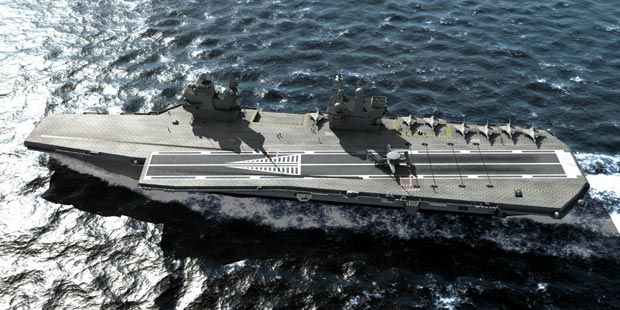
Alternate future French carrier (CdG replacement 2038)

Archibald

ACCESS: USAP
Senior Member
Joined
6 June 2006
Messages
14,956
Reaction score
21,271
Putting that into the "speculative" section rather than "alt-history".

France current plan to replace CdG by 2038:
- 75 000 tons
- submarine nuclear reactors
- EMALS from Uncle Sam
- SCAF on the flight deck

I'm not convinced.
-NOT technically: it is rather logical there: SCAF driving CdG replacement upwards - and still nuclear because CdG.
- FINANCIALLY... I don't like it.

Everybody complains about the RN present (dire) situation (escorts, procurement), but the French Navy also has its own miseries.
It financially going into the wall.

Now or in the close future, that 75 000 tons beast will starve everything else. And 1 carrier is not enough.

More on this later.
 
Now or in the close future, that 75 000 tons beast will starve everything else. And 1 carrier is not enough
I have the same fear. IMHO the size of the carrier is less the issue than the gold platting with complex, expensive systems (nuclear power plant, EMALS, AAG, top notch bespoke combat system)… trying too hard to be the USN.

Except the Marine Nationale isn’t the USN and can’t afford a Gerald Ford.

A large conventional carrier using proven, high reliability systems (such as steam cats, hydraulic brakes for the arrestor wires, and the same combat system as an FDI frigate), would have been a reasonable choice.
 
Last edited:
Here is my own take...

- start from Q.E that is, where France stopped in 2008 (I hate to say those words, but... Sarkozy was right on that point.)

Then... engines & catapults combinations

- Option 1 Q.E + K22 submarine reactors + EMALS
- Option 2 Q.E + K22 submarine reactors + licence-build C-13 catapults
- Option 3 Q.E + non-nuclear + C-13 catapults

The main unknowns
- can K22 nuclear reactors power a Q.E to 27 kt at a minimum ?
-I have no idea if a non-nuclear carrier can use EMALS ? those things need so much electrical power, I wouldn't bet on this.
 
And 1 carrier is not enough
I’m OK with one carrier if it has high availability (at least 60%, preferably 75%) and if the savings get spent on a proper land-based UCAV + A400M-launched cruise missiles that could provide transcontinental deep strike with air refueling support.

When operating together the carrier, UCAV and cruise missiles would be highly complementary. Even if the carrier wasn’t available (or not in the right place), the UCAV + cruise missiles would provide some level of conventional deterrence.
 
- Option 1 Q.E + K22 submarine reactors + EMALS
- Option 2 Q.E + K22 submarine reactors + licence-build C-13 catapults
- Option 3 Q.E + non-nuclear + C-13 catapults

Option 3 is the only one that would deliver significant savings from the current path.
 
Option 1: you fork out big bucks to build a proper aircraft carrier
Option 2: you faff about with F-35Bs on a glorified LHA platform

Any French option 1 is hideously expensive, the $1.5bn for the catapults is just the start, it means designing and building one carrier, adapting the K22 for surface use, developing the SCAF-N to put aboard it (and doubtless an AEW drone too) = mega Euro spend.

France and China are probably the only nations in the world going it alone to get a CVN and a 5th/6th Gen naval fighter concurrently (I'm not counting the USN as the F-35C has a degree of amortisation across the Lightning brand and by the time they get a 6th Gen the Fords will be a tested design).
 
this is what should have happened

3012cc475922048d612463708a1a39fe.jpg
 
France and China are probably the only nations in the world going it alone to get a CVN and a 5th/6th Gen naval fighter concurrently

And France has perhaps 10% or even less, the resources and military budget of China...
That's why I think that thing is unaffordable. Even only ONE. In fact it is a bit more subtle than that.

Option 1: you fork out big bucks to build a proper aircraft carrier

That point, yes. I'm rather confident France (and its Navy) can eventually find the time, money and determination to correctly build and use it: CdG did it, even smaller.
Born in 1982 (May, Falklands climax - how about that !) I grew up in the pre-Internet days of the 1980's - 1990's as Rafale and CdG entry of service was delayed, and delayed and delayed again, by the "peace dividends" after 1989 and the end of Cold War.
It took until 2000, antiquated Crusaders, castrated Rafale F1s, broken propellers and too short a deck for E-2s - but at least the Navy pulled out CdG and it had worked fine since then ...and despite what populists (we have three of them this time: Ciotti and Zemmour and the usual Le Pen, geez) say, 1973-1998 France was in poorer economic shape that nowadays.

The real risk is elsewhere: that the rest of the surface fleet ends trapped between
a) Force de frappe / boomers + attack subs, all three hideous expensive
(the Navy has suffered from the cost burden since the 1960's)
b) the carrier: same story.

Wait, that sounds familiar... the RN has two carriers and nuke subs for deterrent... but the rest of the fleet has greatly suffered, and still suffers, from their cost.

And surely enough, same trend at work for French frigates: not enough FREMM, not enough Horizon, Lafayettes getting old, and patrollers for overseas territories... very antiquated.

Plus the three Mistrals are lucky the CdG did not get a brother, otherwise I can't see where the money would have came from.

Their forerunners the Foudre-class were dumped to foreign navies although they still had plenty of potential.
https://en.wikipedia.org/wiki/Foudre-class_landing_platform_dock
There is a very risk the escort and surface fleet suffers terribly from the carrier expense.
 
Last edited:
I have my doubts steam + conventional arresting gear would be any cheaper than the planned EM + AAG combo. Given the target 2038 date, acquiring either would mean either refurbishing a half-century set from a decommissioned Nimitz, or else a custom, boutique order given the US hasn't made any of either for over ten years and sure as hell isn't going to be making any for themselves between now and 2038.

And custom boutique orders have a tendency to balloon in cost very quickly. Notably, Prince of Wales' conversion would've cost 2 billion pounds, with the obvious caveat of this being a refit job to a ship not designed for them. I'm not surprised the French are going with the in-production option and crossing their fingers for some economy of scale savings.

Now, the combat system, yes, that's a place where the French are reaching and paying more than they need to. Porting over the FDI system is a no-brainer, it's what the US was and is doing with the Fords, with an unfortunate hiccup when the Zumwalts were cancelled and rendered Ford's system an orphan.
 
Bringing this thread back since Spain appears to be potentially in the market for a conventional carrier in the next 10-15 years, and France may also want a 2nd cheaper carrier to complement the hugely expensive PANG.

So... potentially an opportunity for a joint program?


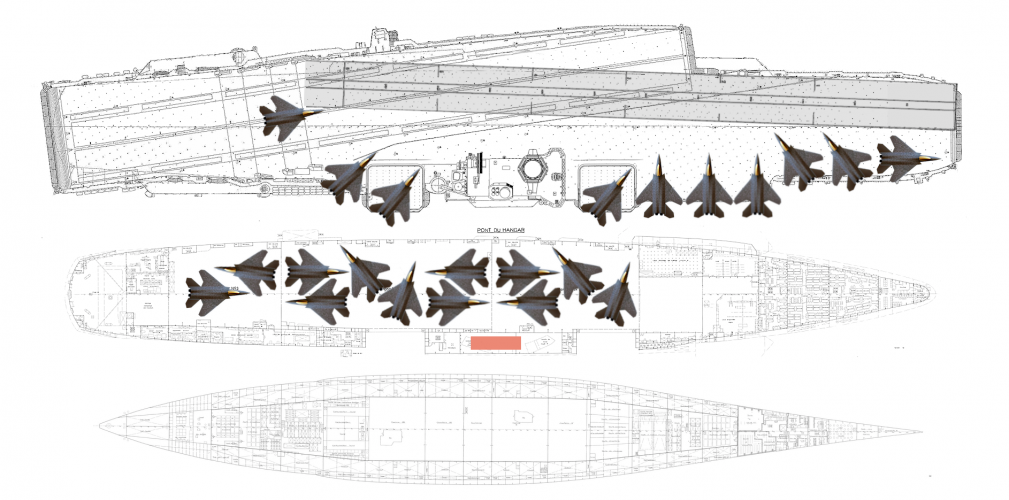
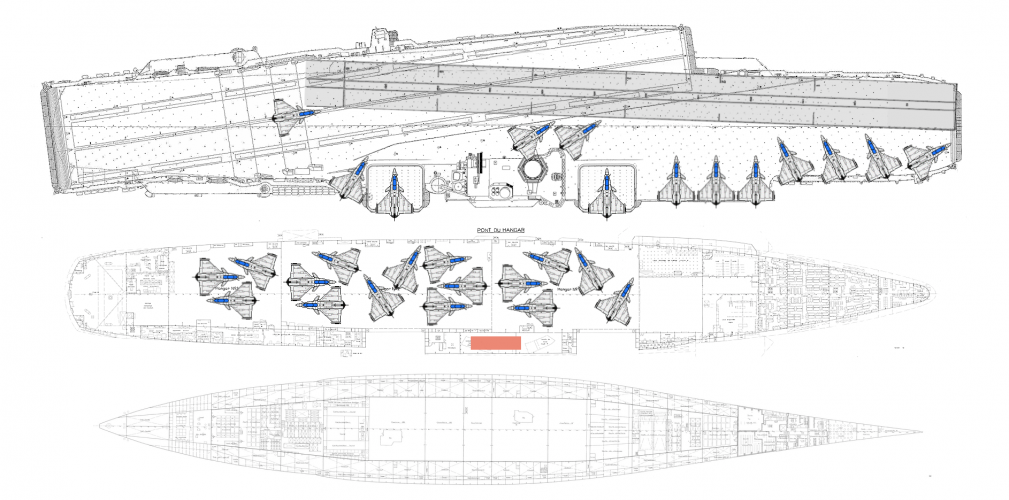
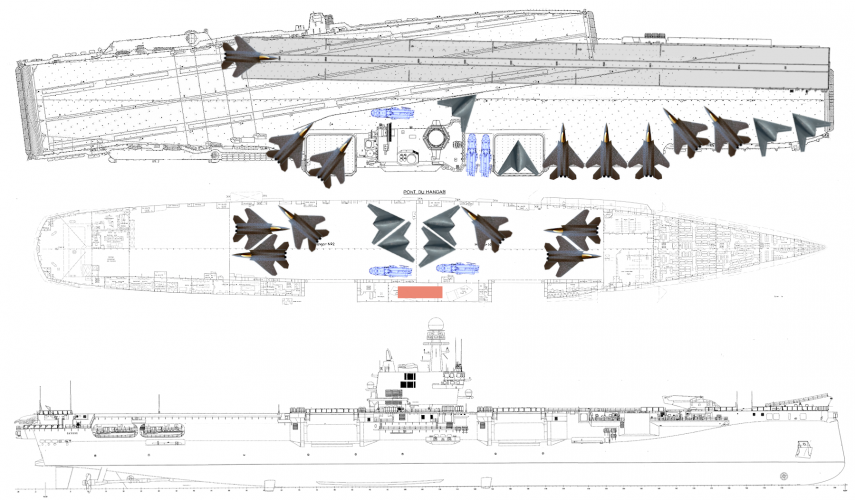
To illustrate my own ideas around what such a Franco-Spanish carrier could look like, here's a STOBAR CV of 30,000-35,000 tonnes capable of carrying 16-18 FCAS/NGF fighters or ~20 Rafales.

There are 21 spots for FCAS/NGF (9 on the flight deck + 12 in the hangar) + 3 helicopter spots. In practice, 16-18 FCAS/NGF + 5-6 helos
CVL Clemenceau mod STOBAR 2px=1ft 18-21x FCAS.png
- Dimensions and flight deck similar to Clemenceau

- Eliminated steam boilers, all steam circuits and catapults (which leads to big gains in available hull volume, personnel requirements, acquisition + maintenance costs)

- Added a ski jump with a ~180m run, and moved the forward elevator to the flight deck edge.

- Simple hydraulic arrestor gear able to stop a ~22t fighter flying at ~135 knots in less than 85 meters (with 20-25 knots of wind on deck, i.e. a wire engagement speed of 110-115 knots). This is ultra reliable technology, available in the UK or the USA, and proven for 70 years. No fancy AAG.

- Compact island with reduced footprint thanks to the choice of propulsion (see below) and an integrated mast (+ long-range rotating radar on a separate mast).

- Propulsion choice is CODAE (diesel + electric) giving a total of ~40MW on 2 shafts allowing for ~25 knots sustained (26-27 knots sprint). Each shaft is connected to a twin reduction gear driven by 1x ~10MW diesel in cruising mode (up to 20 knots) + 1x ~10MW electric propulsion motor for sprints and aviation maneuvers between 21-26 knots. Electricity is provided by a gas turbine generator under the island + some diesel generators to ensure good redundancy. The choice of diesels for the main propulsion reduces fuel consumption, freeing up additional hull volume for aviation fuel.

Basically this is an "envelope" aircraft carrier, which assumes a limited budget and which aims for a good compromise between cost and performance... hence the main architectural choices such as STOBAR, diesel + electric propulsion, the compact island etc.


Alternative air group: 28 spots for Rafale (12 on the flight deck + 16 in the hangar) + 2 helicopter spots. In practice, ~20 Rafale + 5-6 helos
CVL Clemenceau mod STOBAR 2px=1ft 20 Rafale clean.png
 
Last edited:
I don't think lighter carriers are going to make things cheaper.
Instead of fitting an air wing to a carrier hull, it should be the carrier that has fit the airwing the navy needs to carry out its mission.
Let's say we do 2 small ligth carriers instead of one big fleet carrier with each fitting half of the air wing. So both need to be operating in the same carrier group. This reduces the risk of lossing both in a fight (and all aircrafts).
But since there are two ships the total amount of manpower and support will be higher because there's always a minimum baseline manpower for tasks. Even with a smaller number of aircraft you can't reduce that number and it becomes inefficient. While with a larger wing you can saturate & shuffle workload better and keep manpower small.
Also airframes have become larger needing more space so even a light carrier needs to grow now to fit everything
There's also a difference between peacetime and wartime wing size to consider.
Besides imho a carrier that's meant to operate on its own needs at least ~40+ (fighter)aircrafts to do the minimum of 24/7/365 360° CAP + Alert-5's.
 
I don't think lighter carriers are going to make things cheaper. Instead of fitting an air wing to a carrier hull, it should be the carrier that fits the airwing the navy needs to carry out its mission.

Let's say we do 2 small light carriers instead of one big fleet carrier with each fitting half of the air wing. So both need to be operating in the same carrier group. This reduces the risk of losing both in a fight (and all aircraft). But since there are two ships the total amount of manpower and support will be higher because there's always a minimum baseline manpower for tasks. Even with a smaller number of aircraft you can't reduce that number and it becomes inefficient. While with a larger wing you can saturate & shuffle workload better and keep manpower small. Also airframes have become larger needing more space so even a light carrier needs to grow now to fit everything. There's also a difference between peacetime and wartime wing size to consider.

Besides imho a carrier that's meant to operate on its own needs at least ~40+ (fighter) aircraft to do the minimum of 24/7/365 360° CAP + Alert-5's.

You're looking at things from a Tier 1 navy's perspective (like the USN).

For a tier 2 navy like Spain's, the most likely scenario is coalition operations, either embedded within another carrier task force ("dual carrier ops") or as a complement to land-based tactical air. Independent operations will be limited to more manageable threats (e.g. in North Africa) or in the open ocean (e.g. mid Atlantic escort ops).

This is the same for all the small carrier navies (Italy etc). The main goal is to be able to contribute to a USN or NATO-led task force, within a limited budget. And since there is no budget or appetite to buy and operate a large number of naval fighters (40-60 fighters being necessary for the type of independent operations you describe), by definition there is no need for a large carrier. The budget and personnel may only be sufficient to buy a dozen or 2 dozen fighters, and a single small/medium carrier

Which is fine because the ability to bring 12 to 20 fighters to the table will still be valued by allies, as a useful contribution within a larger effort.
 
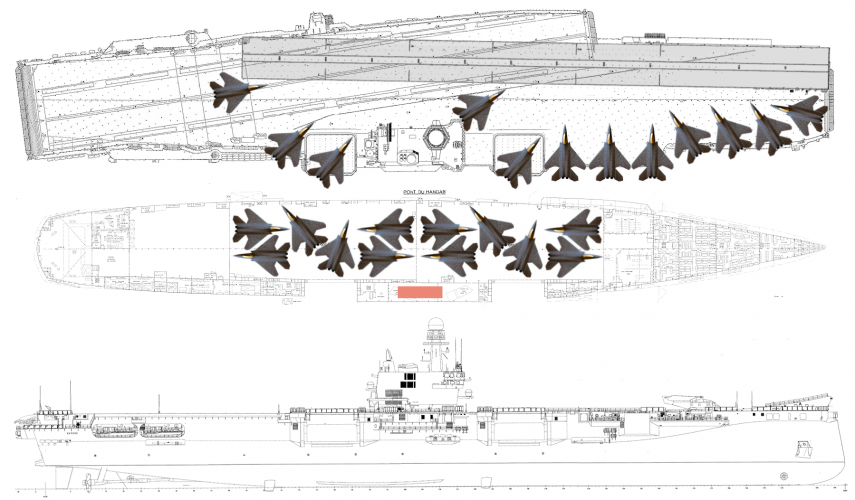
I added a side view of my design and cleaned it up a little by combining elements of Cavour and Clemenceau.

Roughly 35,000t full load with an air group of 18 FCAS + 5 helos. (Showing 23 spots for FCAS... but 18 fighters would be the practical limit from a deck flow perspective)

CVL Clemenceau mod STOBAR 2px=1ft 18-23x FCAS v6.png
 
Last edited:
Now here's the same STOBAR carrier with a hybrid air wing... 14x FCAS fighters + 8 Dassault UCAS + 5 helos.

This would be similar in many ways to a 1960s Royal Navy medium carrier (e.g. HMS Hermes or Victorious), but updated for the 2040s with the flavor of the day being FCAS+UCAS instead of Sea Vixen & Buccaneers!

CVL Clemenceau mod STOBAR 2px=1ft 22x FCAS+UCAS.png
 
Last edited:
I'd strongly push for something roughly Midway-sized. 45ktons light, 60k full load. Different hull shape, though, as the Midways had issues with low freeboard and some odd ship motions that impaired flight ops. But roughly that size and particularly the Coral Sea flight deck layout (~295m long, ~41m wide flight deck).

Use 3x EMALS, 2 on the bow and one on the waist. If I've judged lengths correctly, you'd be able to launch new birds from the starboard bow cat while simultaneously trapping birds. I don't think the Coral Sea's cats were as long as the EMALs are, so the port bow cat would interfere with landing operations.

As to using old school arresting gear versus AAG, the advantage with AAG is the ability to safely land light aircraft like UAVs. Plus, while I'm sure that the US would happily sell you 50+ year old hydraulic arresting gear from a scrapped carrier, the only new build stuff on the market is AAG and has been for over a decade. So if you plan on running a mixed air wing in the future, AAG is strongly recommended. Or you need to make your UAVs heavy enough (~10+tonnes) to survive the forces that old school arresting gear designed to handle 55,000lb airframes will impart.

Granted, if you're running STOL Predators as your AEW airframe, those can probably land just fine without arresting gear. But your attack UCAVs will be limited.
 
With the tight spaces here, it looks troublesome to move aircrafts around especially rotating top stationed ones for below deck ones for maintenance/repair. There's no free space to move them from hangar to hangar without clearing half of them.
 
With the tight spaces here, it looks troublesome to move aircrafts around especially rotating top stationed ones for below deck ones for maintenance/repair. There's no free space to move them from hangar to hangar without clearing half of them.
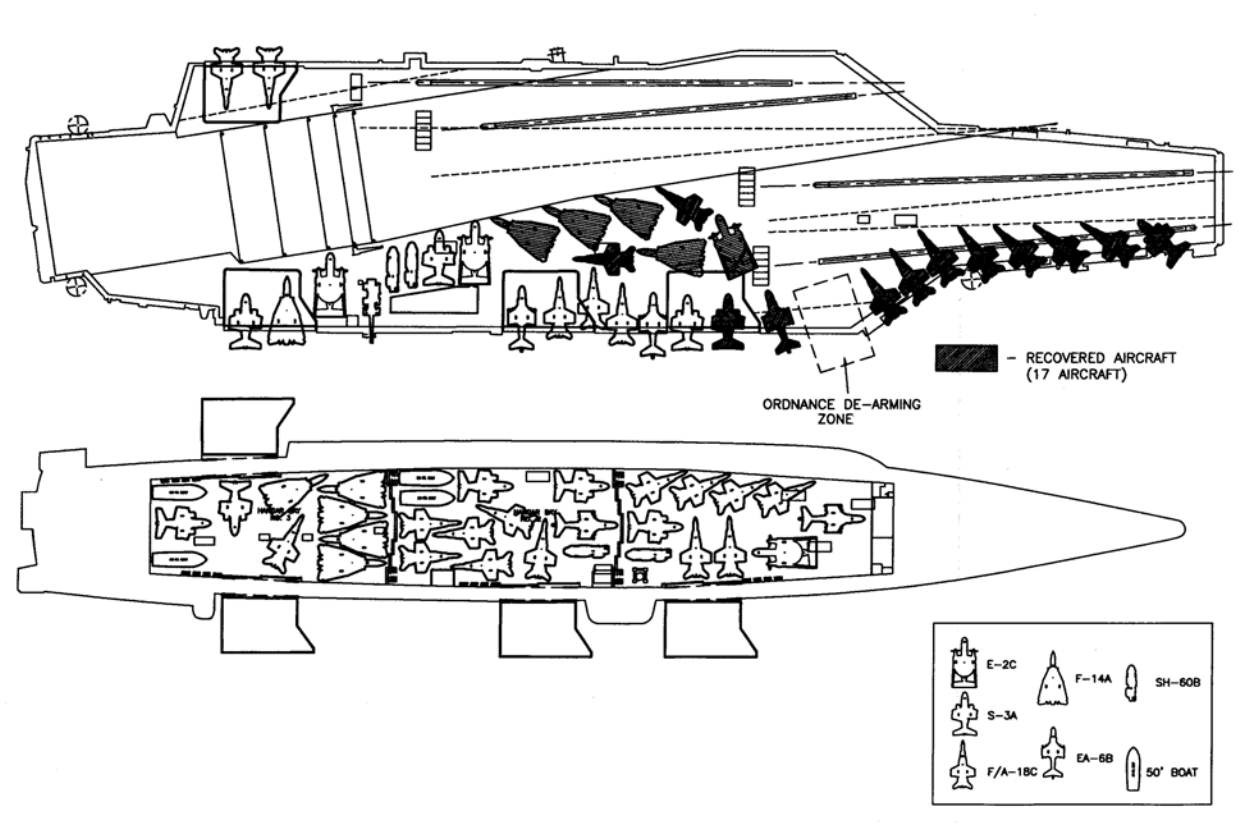
The aircraft density I'm showing here isn't really that high - in fact, it's pretty much standard practice on USN carriers, where the hangar will be full with less than half the airwing, and the flight deck also full.

Space clears up once you start cyclic operations and launch the first 4-6 aircraft from the flight deck. This then allows you to bring up aircraft from the hangar to the flight deck, freeing up the hangar. The next deck load gets launched, you recover the first cycle, and so.

Obviously if you aren't flying cyclic operations with lots of sorties you don't need that many aircraft aboard, and you'd leave more aircraft ashore.

Example of USN deck spotting below... 1st pic is pre-launch, with first 2 cycles on deck and ready to launch.

DeckSpotting.png.8b3d0c4c9f9a4a8c65c424abb55eb842.png


2nd pic is after the 1st cycle is recovered, and 2nd cycle has been launched. At this point the 3rd cycle would be prepared with a mix of aircraft from on the flight deck and brought up from the hangar, freeing up some space.
Gyg2qzobEAAidJx.png:large
 
Back
Top Bottom