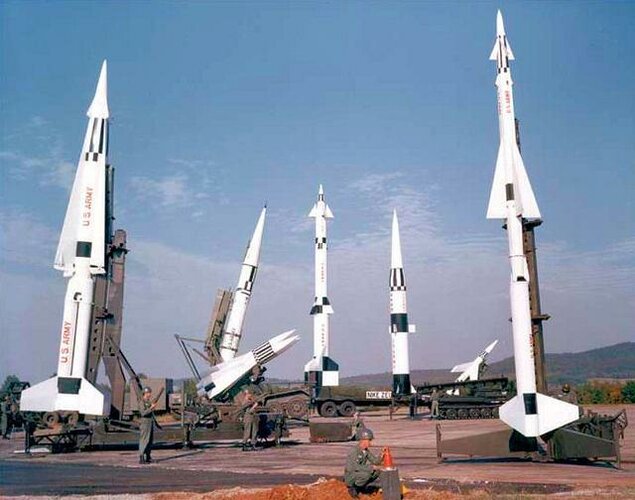
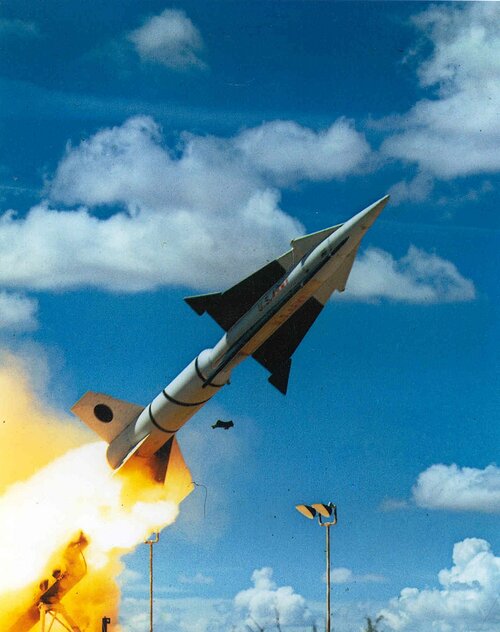
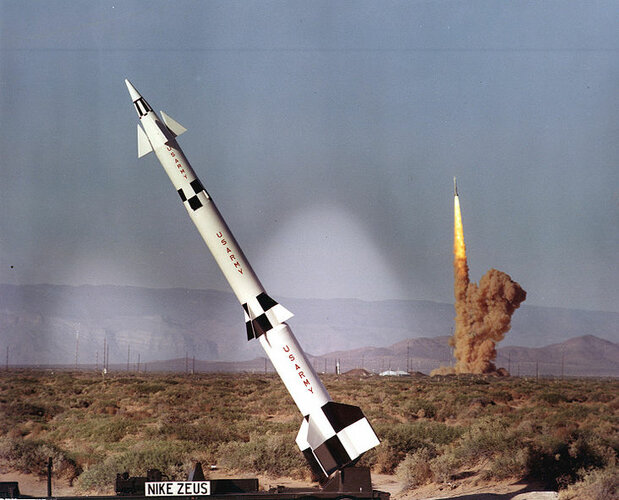
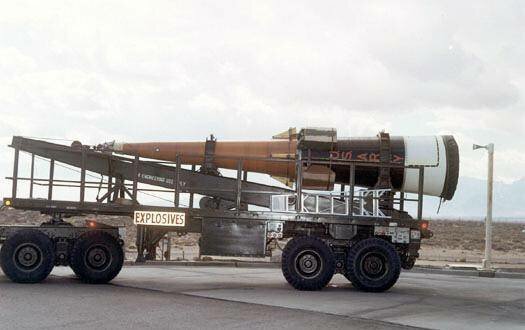
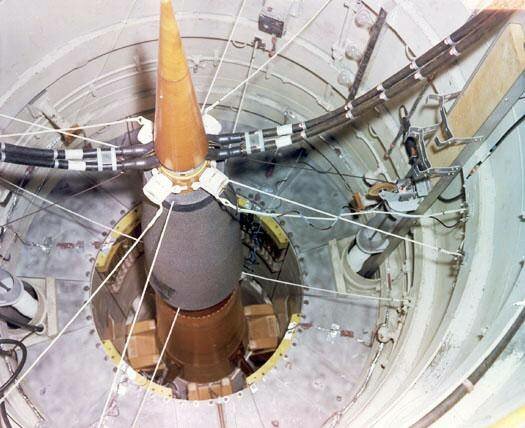
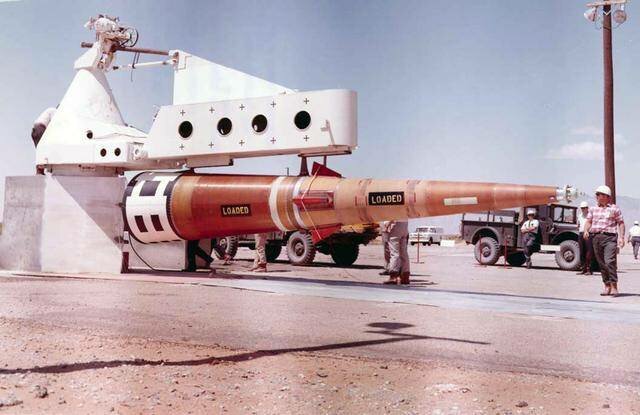
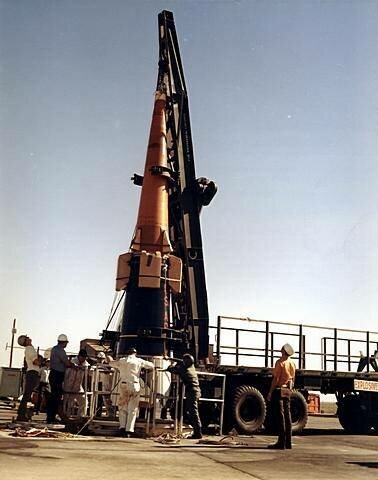
Ara there any (good quality) Nike Zeus family drawings? I had searched on the web, and found nothing useful. Maybe someone knows a drawing coming from a book or an official doc... Thanks.
family together(๑ゝω╹๑)
White sand photo
 

Attachments

  • 1674211037.jpeg
    1674211037.jpeg
    49.6 KB · Views: 239
I think he meant Zeus A, Zeus B, Spartan. That pic is just a Zeus B with a bunch of other random missiles painted black and white.
 
Btw. I think Zeus project ends so rapidly
≥﹏≤. Their son"sentinel"only work 6moths then retired.....
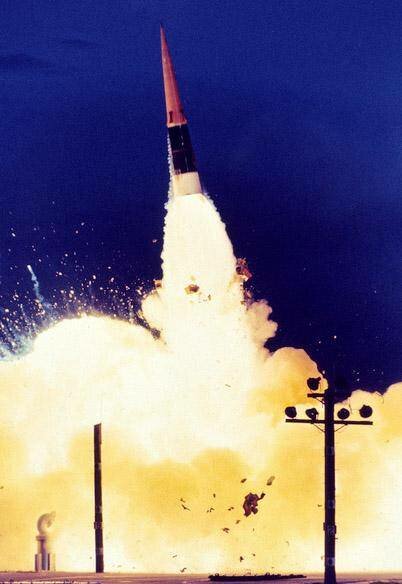
Now only GBI and THAAD(maybe) 40d2d2c08e794bf5a6135058365eae2b.jpeg f3c2c076ea1b48b8b72317120a855184.jpeg dde386e2ae5e49b7bcb867f88e0e8c74.jpeg 5d7f2ab8457244d582a4913f687a6072.jpeg can anty several BM which aiming US homeland(. So why government retired sentinel?
 
Ara there any (good quality) Nike Zeus family drawings? I had searched on the web, and found nothing useful. Maybe someone knows a drawing coming from a book or an official doc... Thanks.
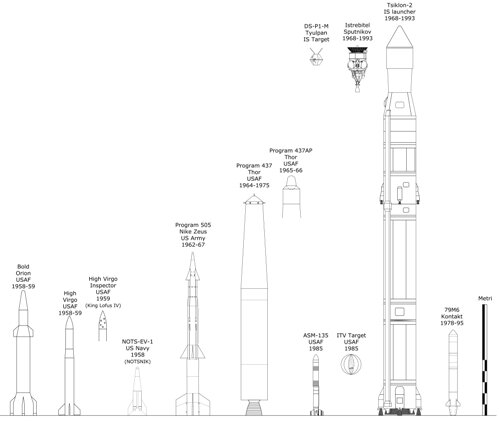
After searching on the web, I found only some pictures of the Nike Zeus (no good drawings), so I created a drawing by myself starting from those pictures, knowing the dimensions of the Zeus. I needed it to compare it with some other ASAT systems of the Cold War for an article I wrote for an Italian magazine, see below (only ASATs that have flown).

ASAT 500px.jpg
 
Ara there any (good quality) Nike Zeus family drawings? I had searched on the web, and found nothing useful. Maybe someone knows a drawing coming from a book or an official doc... Thanks.
After searching on the web, I found only some pictures of the Nike Zeus (no good drawings), so I created a drawing by myself starting from those pictures, knowing the dimensions of the Zeus. I needed it to compare it with some other ASAT systems of the Cold War for an article I wrote for an Italian magazine, see below (only ASATs that have flown).

View attachment 664448
Any chance of getting enough pixels to read?
 
Ara there any (good quality) Nike Zeus family drawings? I had searched on the web, and found nothing useful. Maybe someone knows a drawing coming from a book or an official doc... Thanks.
After searching on the web, I found only some pictures of the Nike Zeus (no good drawings), so I created a drawing by myself starting from those pictures, knowing the dimensions of the Zeus. I needed it to compare it with some other ASAT systems of the Cold War for an article I wrote for an Italian magazine, see below (only ASATs that have flown).

View attachment 664448
Any chance of getting enough pixels to read?
I used a low resolution image for copyright reasons...
From left to right, missiles and targets:

USA ASATs:
Bold Orion, USAF, 1958-59
High Virgo, USAF, 1958-59
High Virgo, Inspector, USAF, 1959 (King Lofus IV)
NOTS-EV-1, US Navy, 1958, (NOTSNIK)
Program 505, Nike Zeus, US Army, 1962-67
Program 437, Thor, USAF, 1964-1975
Program 437AP, Thor, USAF, 1965-66
ASM-135, USAF, 1985
ITV Target, USAF, 1985

URSS ASATs:
DS-P1-M Tyulpan, IS Target
Istrebitel Sputnikov (IS), 1968-1993
Tsiklon-2 IS launcher, 1968-1993
79M6 Kontakt, 1978-95

The paper about the USA ASATs is issued in the September number of Rivista Italiana Difesa, in the next month there will be the second part about the URSS ASATs.
 
Ara there any (good quality) Nike Zeus family drawings? I had searched on the web, and found nothing useful. Maybe someone knows a drawing coming from a book or an official doc... Thanks.
After searching on the web, I found only some pictures of the Nike Zeus (no good drawings), so I created a drawing by myself starting from those pictures, knowing the dimensions of the Zeus. I needed it to compare it with some other ASAT systems of the Cold War for an article I wrote for an Italian magazine, see below (only ASATs that have flown).

View attachment 664448
Any chance of getting enough pixels to read?
I used a low resolution image for copyright reasons...
From left to right, missiles and targets:

USA ASATs:
Bold Orion, USAF, 1958-59
High Virgo, USAF, 1958-59
High Virgo, Inspector, USAF, 1959 (King Lofus IV)
NOTS-EV-1, US Navy, 1958, (NOTSNIK)
Program 505, Nike Zeus, US Army, 1962-67
Program 437, Thor, USAF, 1964-1975
Program 437AP, Thor, USAF, 1965-66
ASM-135, USAF, 1985
ITV Target, USAF, 1985

URSS ASATs:
DS-P1-M Tyulpan, IS Target
Istrebitel Sputnikov (IS), 1968-1993
Tsiklon-2 IS launcher, 1968-1993
79M6 Kontakt, 1978-95

The paper about the USA ASATs is issued in the September number of Rivista Italiana Difesa, in the next month there will be the second part about the URSS ASATs.
Any chance of it in English? Also, looks like you forgot SM-3.

 
Ara there any (good quality) Nike Zeus family drawings? I had searched on the web, and found nothing useful. Maybe someone knows a drawing coming from a book or an official doc... Thanks.
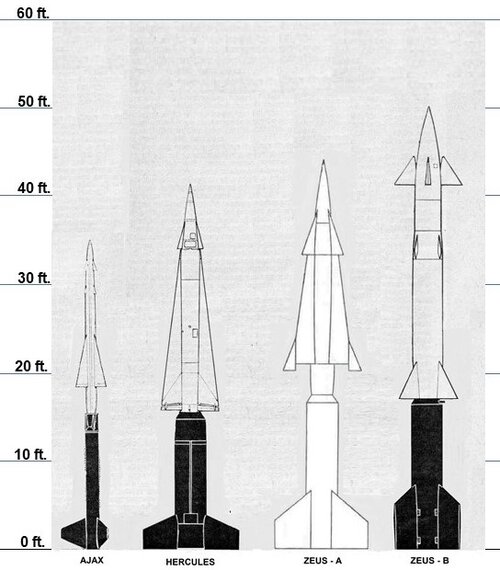
I not sure that this meets your quality criterion, but I put this lineup together using images from the 6 November 1960 issue of Flight and a image of Zeus A found on the Internet. The lengths I have used are:
Ajax - 418", 10.62 m.
Hercules - 492", 12.50m.
Zeus A - 531", 13.49m.
Zeus B - 602", 15.29m.
TX-135 booster used on both Zeus A & B - 196.8", 5.0m.
 

Attachments

  • Douglas Nike family.jpg
    Douglas Nike family.jpg
    104.5 KB · Views: 208
I just stumbled across this Nike Zeus B video on YT:


Development continued, producing Improved Nike Hercules and then Nike Zeus A and B. Zeus, with a new 400,000 lbf thrust solid-fuel booster, was first test launched during August 1959 and demonstrated a top speed of 8,000 mph but had certain deficiencies and was renamed Spartan launched 1967. Production of the Zeus was deferred in 1961 and phased out during 1963 in favor of a specific ABM system initially designated Nike X but later renamed Sentinel.
 
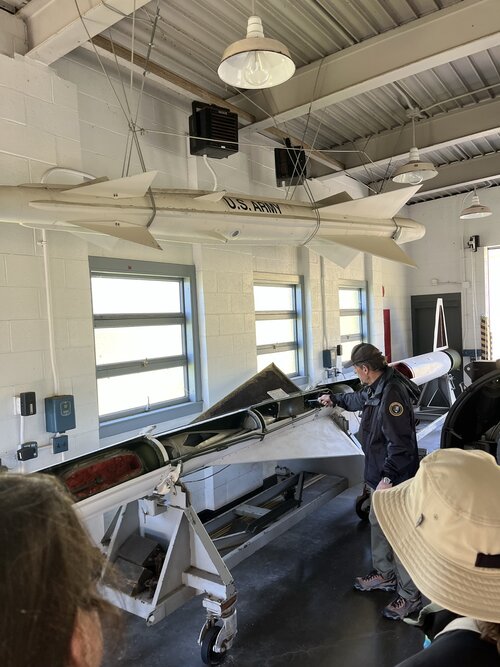
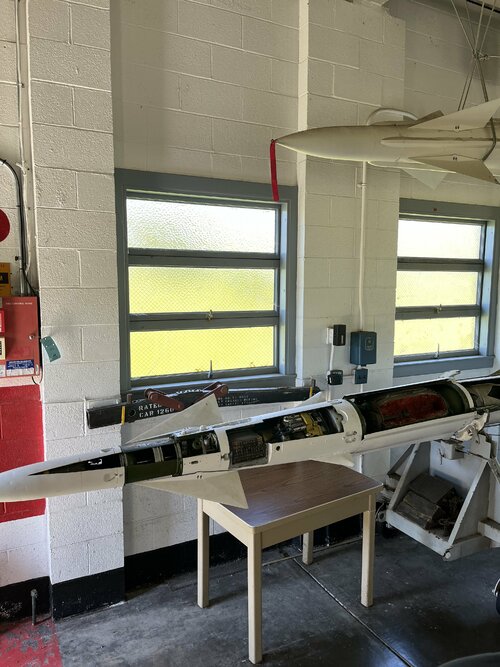
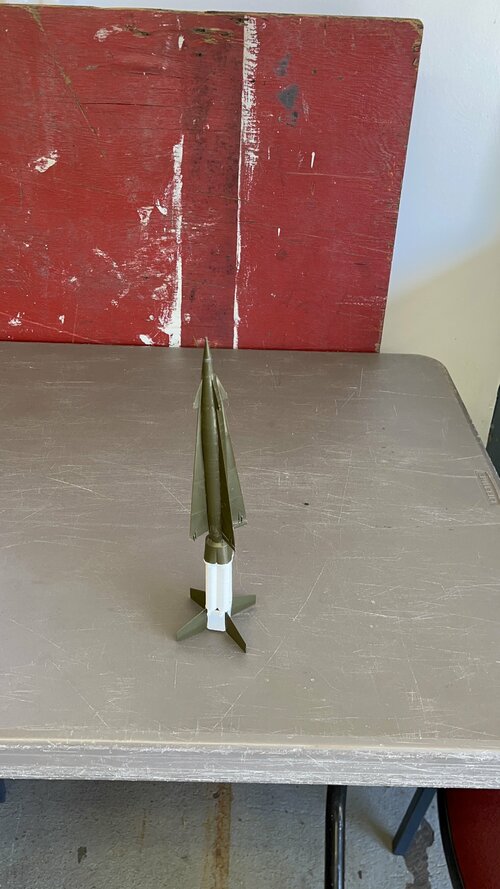
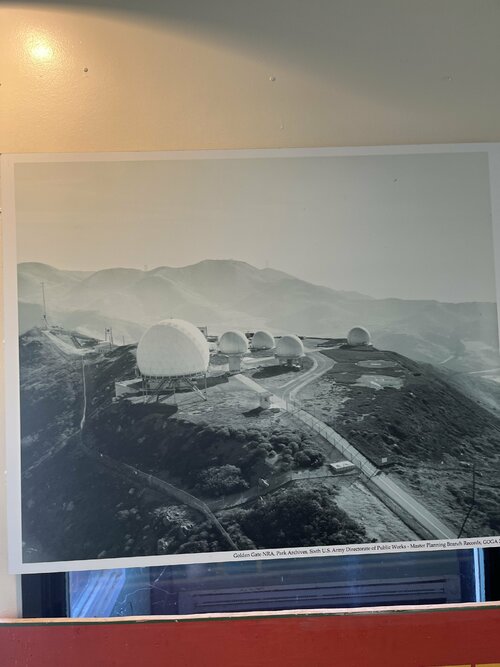
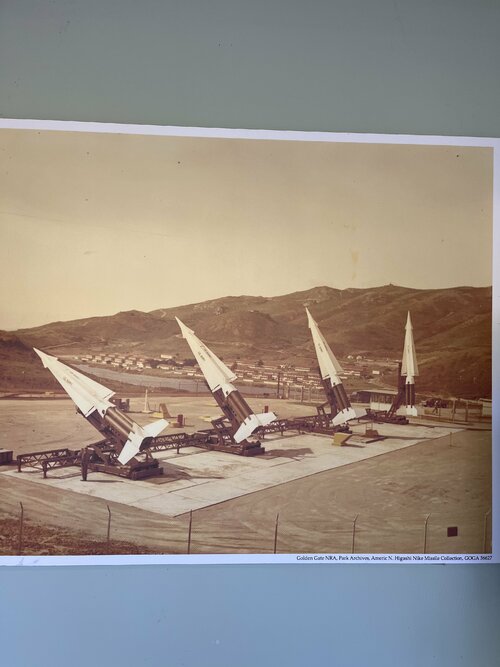
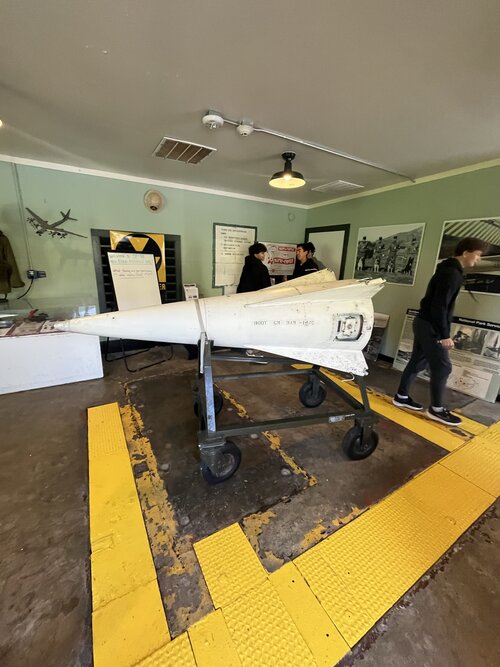
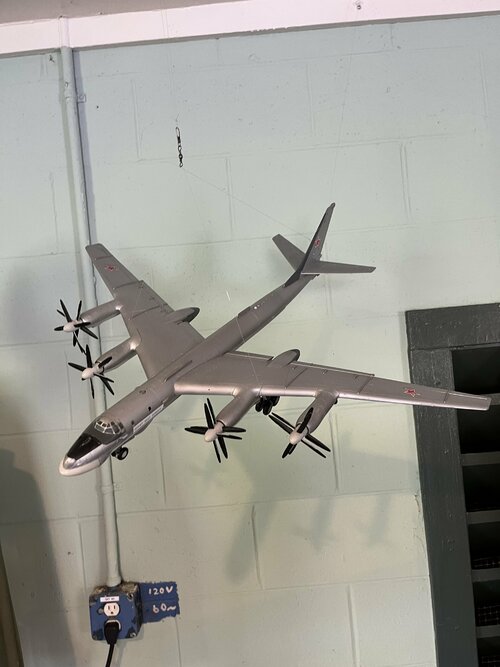
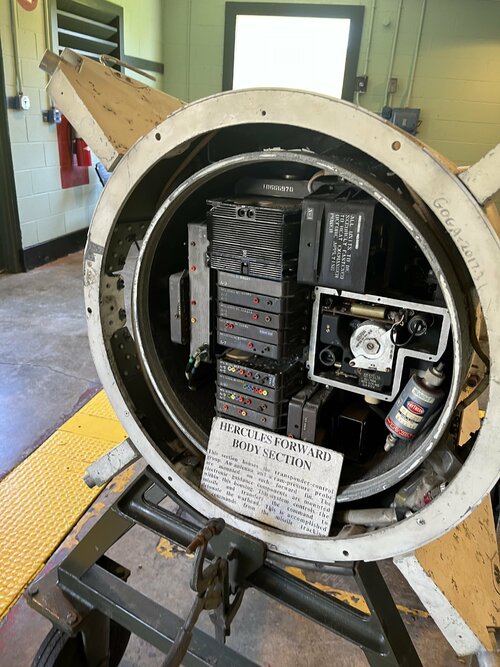
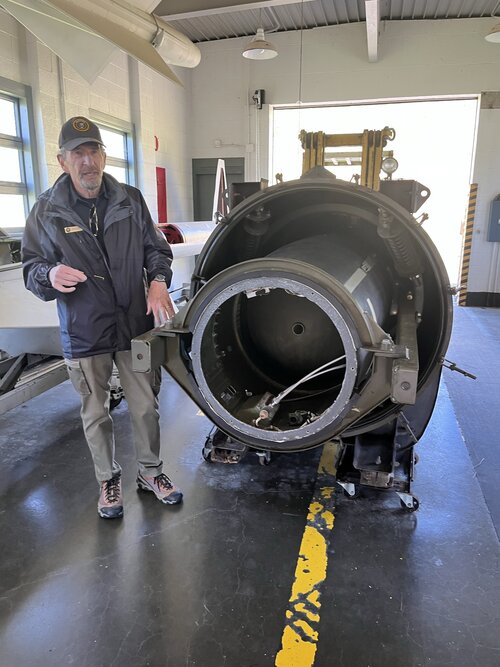
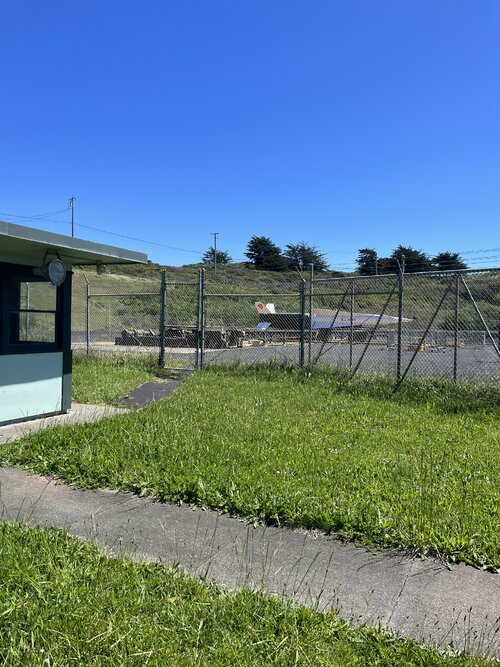
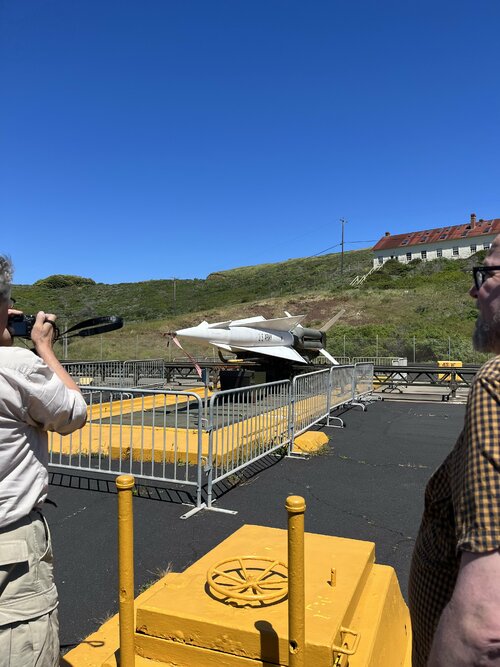
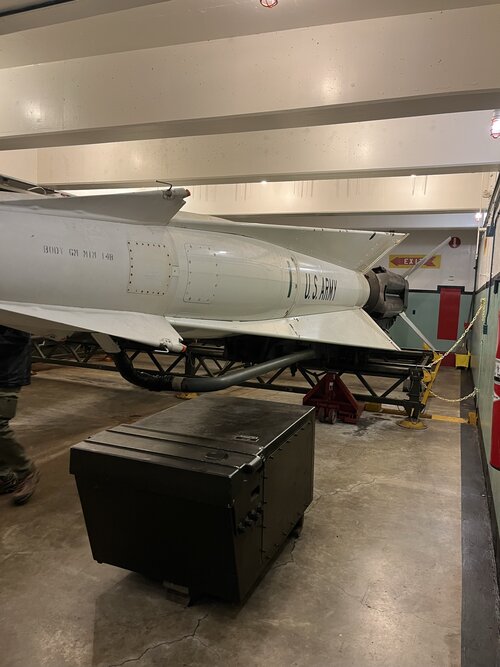
Spent my day yesterday visiting some old installations north of the golden gate and checked out some Nike Hercules missiles, and thought some of you might appreciate this. image 4 is of the Hercules’ warhead container, and images 11 and 12 are cutaways of the Ajax (conventional) variant. I also have a video of the missile being lifted from the underground storage chamber via elevator, which i’ll send a link to aswell. Good day!
 

Attachments

  • 6CA00E8E-C7B9-4727-98AB-8354FD02FEA2.jpeg
    6CA00E8E-C7B9-4727-98AB-8354FD02FEA2.jpeg
    807.2 KB · Views: 73
  • 4170D98D-9401-4E2B-8A6F-8EBA5B81F7FD.jpeg
    4170D98D-9401-4E2B-8A6F-8EBA5B81F7FD.jpeg
    2.2 MB · Views: 74
  • F75D1341-2D6E-440E-B408-20A4496937B2.jpeg
    F75D1341-2D6E-440E-B408-20A4496937B2.jpeg
    1.2 MB · Views: 61
  • 45E6C4B7-DF72-4DC5-9FF2-CEF67CF9E06E.jpeg
    45E6C4B7-DF72-4DC5-9FF2-CEF67CF9E06E.jpeg
    1.4 MB · Views: 59
  • 88650193-D206-499B-8131-244BD472DA82.jpeg
    88650193-D206-499B-8131-244BD472DA82.jpeg
    1.3 MB · Views: 57
  • 6AF59040-2E45-4FE3-9001-ABA078D563B8.jpeg
    6AF59040-2E45-4FE3-9001-ABA078D563B8.jpeg
    854.8 KB · Views: 71
  • ACA9AB2B-9179-433A-BA8B-B0F65D68113C.jpeg
    ACA9AB2B-9179-433A-BA8B-B0F65D68113C.jpeg
    1.6 MB · Views: 60
  • 71E2F3B7-CA4E-4BB4-9E75-3CC49F8B8937.jpeg
    71E2F3B7-CA4E-4BB4-9E75-3CC49F8B8937.jpeg
    1.6 MB · Views: 63
  • FCA976E0-B91C-4AE2-88E8-209E6CB56EF0.jpeg
    FCA976E0-B91C-4AE2-88E8-209E6CB56EF0.jpeg
    798.3 KB · Views: 53
  • 3D13CD96-6F62-4AC9-8384-F27801E2F0AF.jpeg
    3D13CD96-6F62-4AC9-8384-F27801E2F0AF.jpeg
    3.5 MB · Views: 53
  • 663D76B2-EC6F-4DF2-AC49-4207DEC40FE7.jpeg
    663D76B2-EC6F-4DF2-AC49-4207DEC40FE7.jpeg
    1.9 MB · Views: 50
  • CB0C08FA-CD41-411E-837F-15A401FA42A8.jpeg
    CB0C08FA-CD41-411E-837F-15A401FA42A8.jpeg
    702.7 KB · Views: 68
From

NORAD'S QUEST FOR NIKE ZEUS AND A LONG-RANGE INTERCEPTOR
Historical Reference Paper No. 6
1 July 1962
Directorate of Command History
Office of Information
HEADQUARTERS NORAD

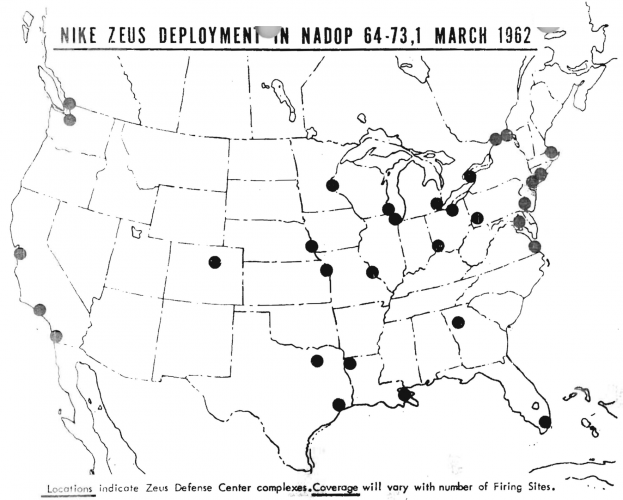
This is my best guess of locations for ZEUS Batteries under NADOP 64-73:

Miami, FL
Maretta, GA (AFP-6) [Limited protection to Atlanta, GA]
New Orleans, LA
Houston, TX
Fort Worth, TX (AFP-4) [Limited Protection to Dallas, TX]
Shreveport, LA (Barksdale AFB)
San Diego, CA
Los Angeles, CA
San Francisco, CA
Seattle, WA
Site North of Seattle (to protect Vancouver?)
Denver, CO
Omaha, NE [Offut AFB / SAC HQ]
Kansas City, MO
St Louis, MO
Minneapolis, MN
Chicago, IL Gary, IN [US Steel Gary Works]
Cincinatti, OH
Detroit, MI
Cleveland, OH
Pittsburgh, PA
Buffalo, NY
Norfolk, VA
Baltimore, MD? [could also be DC? could be both?]
Philadelphia, PA
Newark, NJ [also protects NYC]
Long Island, NY [also protects NYC]
Boston, MA
Upstate NY #A near Fort Covington on Canadian Border
Upstate NY #B near Plattsburgh on Canadian Border

=======================

This was NORAD's "wishlist" of a Zeus Deployment in early (March) 1962.
 

Attachments

  • NORAD_ZEUS-LRIX_1961_Deploy.png
    NORAD_ZEUS-LRIX_1961_Deploy.png
    341.2 KB · Views: 62
Last edited:

Funds Preclude ICBM Defense for Cities
AVIATION WEEK, October 14, 1957

Washington—U. S. cities will not be defended against the Soviet ICBM under present plans of the Department of Defense. Both of the competing anti-missile missile systems currently being developed, Army’s Nike-Zeus and Air Force’s Wizard, are considered too expensive for this.

Administration and USAF planners reportedly have accepted conclusion of a Rand Corp, air defense study that the nation’s missile defenses should be concentrated to defend bases of the Strategic Air Command rather than metropolitan areas because of the financial limitations of present and anticipated defense budgets. Purpose of defending bases is to protect SAC’S status as a deterrent to aggessors.

Major U. S. cities presently arc defended by batteries of Nike-Ajax ground to air missiles. Nike-Ajax has a range of about 20 mi. and is ineffective against even modern jet bombers. Nike-Ajax missile is scheduled to be replaced by the 50-75 mi. Nike-Hercules which can be equipped with a nuclear warhead for increased effectiveness against jets but which is totally ineffective against missiles of the ICBM type.

Rand is a non-profit corporation organized as an extension of USAF’s Air Staff to conduct independent studies and evaluations of strategic and tactical problems in such areas as air defense.

SAC has 37 bases in the continental U.S. now, about a dozen overseas, and is planning to build more. Missile defense systems, however, reportedly are planned only for major bases.

Rand has done an exhaustive analysis of the problems of defense of the U.S. against ICBMS and against IRBMS that could be launched from submarines. Based on the premise that the national defense budget will continue at the same proportionate level, Rand found that the enormous costs of missile defense systems would preclude defense of any significant number of U.S. cities.

This is because both major antimissile missile systems under development, Nike-Zeus and Wizard, must be placed close to target of incoming missile to be effective and can therefore protect only a limited area.

By effective protection of the operational bases of SAC, the Rand proposal would attempt to restore the “pistol to the head” stalemate, where a known aggressor would suffer immediate retaliation.

Problem of this type of defense, however, would be to identify accurately the aggressor should the Soviets decide to “share” their long range missiles with their allies.

Mission of an anti-missile weapon system is to detect, identify, intercept and destroy an incoming enemy missile.

General characteristics of an enemy ICBM would be:

range about 5,000 mi., flight time approaching 30 min, velocity at burnout about Mach 20, altitude at apogee (highest point of its elliptical trajectory) between 600 and 800 mi.

Requirements of the system:

Detection incoming enemy missile must be detected at great enough range to provide time for the tremendously complex missile defense system to track the intruder, compute its trajectory, arm and launch anti-missile missiles. Magnitude of the detection problem can be seen from the fact that an approaching ICBM will have a probable effective radar cross section of about 0.25 square-meters but must be detected between 1,000 and 3,000 mi. away.

Identification inherent part of detection is identification of the intruder as a missile rather than a meteorite or a decoy. An enemy multi-stage ICBM could release several light, simple decoys with the warhead of the final stage. These decoys could provide a better target for the tracking radar than the warhead, so the radar must be capable of distinguishing between them.

Interception problem of computing the trajectory and velocity of an intruding missile once it has been detected and is being tracked requires a computer about the size of an IBM 704. With the present state of the art the only method by which a reasonable probability of interception can be obtained is to launch the anti-missile missile against the intruder on its own trajectory . This requires locating missile defense systems at each target area to be defended.

The anti-missile missile is tracked by a guidance radar from launch, and small corrections in flight path furnished by the computer during initial flight. Constant readiness required of the defense system dictates use of a solid fuel rocket.

Destruction anti-missile missiles will be equipped with nuclear warheads. Present philosophy points toward smaller, more maneuverable missiles with lighter warheads. Because of the relatively low kill probability of such missiles, it may be necessary to fire 10 to 20 anti-missile missiles to kill one intruding ICBM.

Army sponsored anti-missile missile program is Nike-Zeus, an adaptation of Nike-Hercules. Nike-Zeus is the farthest along of any missile defense system. Douglas has produced mockup of the airframe, is working now to increase originally proposed 100-200 mile range. Bell Laboratories is contractor for target acquisition, guidance and computer systems (AW Oct. 7, p. 29).

Army sources say that Nike-Zeus program is lagging far behind in the race to have an operational anti-missile at the time Russia has a production ICBM. Reason, they say, is lack of funds.

Air Force missile defense system is Wizzard, under development by Convair and RCA. Proposed missile has a range of about 1,000 mi., is solid fuel, and is not an adaptation of an existing missile. Air Force program is broad, includes component development of special antennas, electronic antenna steering devices, high power sources, etc. Three Phase I studies of the missile defense problem have been completed under USAF contracts. Contractor teams are: Convair-RCA, Lockheed-Raytheon, and Douglas-Bell (same team as for Army’s Nike-Zeus).

Air Force considers its system much more sophisticated than Army’s Nike-Zeus but is far behind it in development. Wizard system, excluding certain special components, is far from completion of even the planning stage.

A third project, called Plato is scheduled to be canceled. Plato was originally studied competitively by both Cornell Aeronautical Laboratory and Sylvania, but Cornell project, the more sophisticated of the two systems, was canceled last September. Plato has been supported by both Army and Air Force.

Navy is interested in an anti-missile missile system for fleet defense but so far has confined itself to studying systems based on modifications of Talos shipboard to air missile.

Problem in the detection of missiles at very long ranges about which little is known is effect of the aurora borealis or “northern lights” which may reflect radar signals. Aurora is caused by streams of ionized particles from the sun as they encounter the magnetic fields of the earth.

Last week, a joint U. S.-Canadian project was announced to discover the effects of the aurora on radars that will be used for detection of enemy ICBMs. Sponsored by Canada’s Defense Research Board and USAF, project will be manned by Canadian scientists and scientists from MIT’s Lincoln Laboratary. Research station will set up this winter in Northern Saskatchewan.

Ionization of the atmosphere by' an incoming ICBM warhead may be useful for the detection of the warhead during later stages of its flight. Little enthusiasm has been found for this technique, however, because warhead does not cause heavy ionization of the atmosphere until it is within about 100 mi. of its target.
 
Lack of Interest Stalls Missile Defense Programs
AVIATION WEEK, October 7, 1957

Washington—Army s Nike-Zeus and Air Force s Wizard anti-missile missile programs are lagging far behind schedule because of lack of high official interest and consequently lack of funds.

Translation of these “paper missile defense systems” into real defense weapons will take billions of dollars. Presidential policy of limiting information on the status of U. S. and Soviet missile programs has left Congress unprepared for this expenditure. Current status of major U. S. anti-missile missile programs is as follows:

• Nike-Zeus. Farthest advanced. Army’s Nike-Zeus is an adaptation of Nike-Hercules. Contractors arc Douglas for the airframe and Bell Laboratories for control equipment. Nike-Zeus has a presently-proposed range of 100-200 mi., but Douglas is attempting to improve this figure. Bell Laboratories has produced some hardware on the target acquisition, guidance and computer systems but radar being used is company’s own relatively short range version, not the 3,000 mi. radar for missile defense mentioned recently by Gen. Thomas D. White, USAF Chief of Staff (AW September 30, p. 25). Informed sources say that Bell Laboratories for proprietary reasons is resisting switch to long range version. Initial guidance for the Nike-Zeus is provided by guidance radar and computer. System is lagging well behind schedule and is scrimping for funds.

• Wizard. Air Force Wizard system exists only on paper, no significant hardware has been produced. Contractors are Convair for the airframe and RCA for acquisition, guidance and computer. Proposed missile has planned range of about 1,000 mi., is solid fuel, and is not an adaptation of any existing missile. Basic difference from Nike-Zeus is in the different type of radar guidance provided for the missile. Although Air Force considers its system far more sophisticated than the Army’s, program is far behind Nike-Zeus and far from completion of even the paper planning.

• Plato. Scheduled to be canceled as unpromising, Plato was initially studied competitively by Cornell Aeronautical Laboratory, and Sylvania, was given to Sylvania as prime contractor. Small amount of hardware has been produced. Plato has been supported by both Army and Air Force funds.

There have been several other study programs. Lockheed and Raytheon at present have an Air Force contract for an antimissile missile study program. General Electric has worked on a system combining a modified GE early warning radar with a specially developed computer. Informed sources consider the radar lacks required range but computer as excellent.

With concentration of Army and Air Force on Nike-Zeus and Wizard, future for other systems appears dark. Navy is interested in an anti-missile missile for fleet defense but so far has confined itself to studying systems based on modifications of Talos shipboard to air missile.

Studies of the anti-missile missile problem have resulted in similar philosophy of defense both for Nike-Zeus and Wizard. Both are limited area defense systems designed to provide early warning of an incoming missile, acquire the missile as a target, track it to compute its trajectory, and then fire anti-missile missiles along the same trajectory to intercept and kill the intruding ICBM or IRBM with a nuclear or thermonuclear warhead.

Present approach is towards smaller, more maneuverable missiles with lighter warheads. This means that to insure a high kill probability between 10 and 20 anti-missile missiles will be fired against each intruder. Problem of much concern to those studying this problem is the large amount of fissionable material that will be required by such systems. Present U. S. capability for producing fissionable material is inadequate for the anticipated requirements. Some idea of the cost of these 10-20-missilc systems can be gathered from the fact that the lightest nuclear warheads for this use will cost over $1,000,000 each in production quantities.

Seconds or minutes available between detection and arrival of an enemy ICBM or IRBM necessitate a fully integrated and highly automatic system. Because the presently planned systems arc capable of defending only relatively limited areas, defense of major U. S. industrial, military and civilian centers will require a large number of such systems.

National interests may dictate U. S. supplying any missile defense system used in this country to its allies. NATO countries have already been threatened with nuclear oblivion from Soviet IRBM’s during the Suez crisis and would not react favorably to U. S. policy of keeping for itself any system providing relative invulnerability.

Projected costs of development and production of any missile defense system are enormous. As the day when the Soviets possess a production ICBM approaches, the costs will probably be increased by the need for parallel and concurrent research, development and production.
 
From reading some, it appears that much of the talk about Nike Zeus being a "penetratable" system are from the vicious battle between the USAF and Army over the ABM mission following Sputnik

The Army and AF were already battling with competitive systems:

IRBM (Thor versus Jupiter)

Air Defense (NIKE versus BOMARC)

So when SPUTNIK I and II burst upon the scene; the Army was almost there to an ABM system with ZEUS; while the Air Force's WIZARD II (to differentiate it from the earlier 1940s WIZARD) was still dirty paper.

I need to find a Baltimore Sun Article titled: "Production of Wizard Is Reportedly Urged of Government by '61," November 30, 1957 -- to get the "approved" USAF leak for why WIZARD should be bought instead of ZEUS. Stupid newspapers.com paywalling everything.

EDIT: The reason for WIZARD/ZEUS goes back to a 1956 decision to limit Army air defenses to "point" , while the AF got "area" defenses. Thus; ZEUS was always intended to be a short range "terminal" defense system, while the Air Force worked on the wide area defense system (WIZARD)...only the Air Force took their time to develop WIZARD.

Post-SPUTNIK, the AF was ordered to cancel the WIZARD missile component, but continue work on the radar+computer bits of it. I believe that this is where the SENTINEL/SAFEGUARD Perimeter Acquistion Radar (PAR) came from; with Douglas developing Extended Range Zeus (ZEUS EX) into SPARTAN, to fill 75% of the role that the notational 1000 mile WIZARD missile would have.

I believe the Zeus lineage goes:

DM-15A / Zeus A was designed during 1955-1957 when Army was restricted to "point" defense using 200 mile ranged (or less) missiles.

DM-15B / Zeus B design work starts late 1957 when the Army no longer has the 200 mile range restriction -- it's a straightforward "we always wanted to build this but were limited to stay under 200 mile range" job.

DM-15C / Zeus C / Zeus EX / SPARTAN -- Initial design work starts late 1958 following the folding of WIZARD into ZEUS; when the NIKE program office realizes that if the WIZARD radars do work out; they'll have access to some very powerful radars allowing very long range intercepts; so best start working on a missile to take advantage of that range.

Interestingly, I think you can actually break Nike-X into two periods; an Early Nike-X without a PAR and a late Nike-X with a PAR -- we'd have to do more digging to figure out when the PAR became part of Nike-X.
 
Last edited:

Is the Public Being Oversold?
By Claude Witze
SENIOR EDITOR

AIR FORCE Magazine – May 1958

THE American people and Congress are being oversold on the potentialities of the antimissile missile. This overselling is being conducted in an atmosphere of complete confusion, where it is not clear who is in charge of the mission, who is coordinating the development effort, and who has the responsibility for the results.

As a result, there is a grave threat that this country will launch a multi-billion dollar program in an area filled with both technological and administrative unknowns. If it does, it will waste immense quantities of public money, jeopardize our safety, and seriously imperil both civil and military morale.

A wave of cocky talk, sanctioned and encouraged by segments of both the military and political administrations, is misrepresenting the truth. It is raising false hopes that the Russian ICBM threat can and will be met by electronic, push-button defensive measures. There is nothing in the record of today's state of the art to justify such hopes.

Basic to the whole situation is the fact that mission lines have been blurred until it is not clear whether the Army or the Air Force is in charge of defending the continental United States against the ICBM. In fact, on the basis of the last orders they were given they have been working to develop opposing concepts while supposedly working together in a joint effort.

The blunt truth is that, pending technological breakthroughs, all antimissile missile programs should stay on paper. The Air Force has told Congress the job "is the most difficult this country has ever encountered." USAF studies are where they belong -- on paper -- and "no one can determine from a paper study how effective we shall be or if we shall be effective at all." The Air Force spokesman was talking, of course, about a ballistic missile defense system that will protect America, not just the points where a missile-age ack-ack is in operation.

In contrast, the Army is carrying out a consistent and strenuous campaign to convince America a "perfect defense" can be provided, at least for limited areas, if we are willing to make the effort. High-ranking Army officers, backed by their service secretary, are fighting hard to convince Congress it is possible to develop an effective antimissile missile within the parameters of reasonable time and cost.

The system Army is trying to sell is the Nike-Zeus, described in its press releases as a logical step in development of what the service calls the "Nike family" of point defense weapons. It is true that Army first developed the shorter range Nike-Ajax and Nike-Hercules, but neither of them has any real technological relation to Zeus.

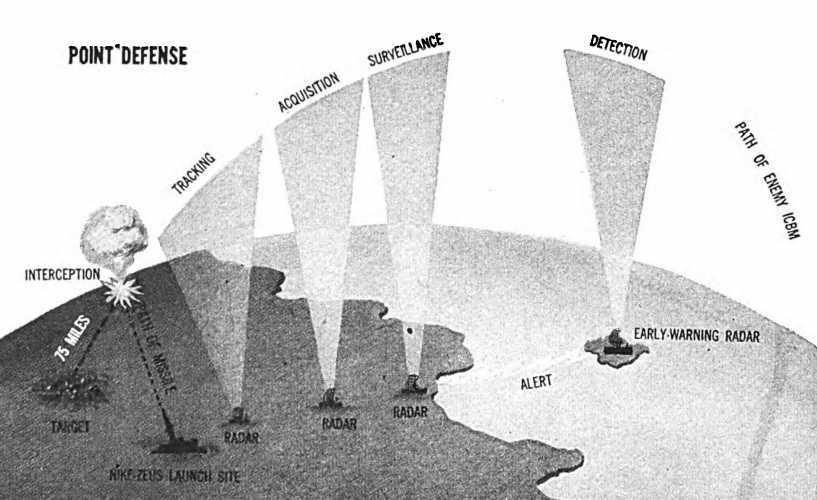
Zeus is a short-range, point defense missile system. If it works, it will intercept an incoming missile something less than 100 miles from the target. The system needs four types of radar, one of which presumably would be the Air Force's 3,000-mile surveillance set based at some distant point such as Thule or Turkey. Once an alarm is received, a second radar with a range of about 1,000 miles would have the task of detecting the target and assigning it to the acquisition radar of some 600-mile range, which must distinguish the ICBM from decoys and friendly aircraft, and provide accurate trajectory data. A fourth short-range (about 200-mile range) radar would track the enemy warhead after it gets in range. A similar beam is necessary to guide the Zeus for the intercept.

It is highly doubtful that any system could stop an ICBM warhead in the range contemplated for Zeus and at the speed with which it would be approaching. More important is the fact that the Zeus specifications give the potential enemy no credit for ability to improve his ICBM after the first generation.

Knowledgeable technicians feel confident more sophisticated ballistic missiles will spoof both tracking and guidance segments of defense systems, that they will find a way to divert from the ballistic trajectory, and that they will be improved in speed and range. When these improvements come, the point defense concept will be completely frustrated by the unforeseen intelligence of the incoming warhead.

The Air Force holds that it is too late to talk about how we are going to stop the first generation of ICBMs. It is not in favor of investing valuable time, considerable money, and precious brain power to build a system that will be antiquated before we can start to pour concrete and make black boxes.

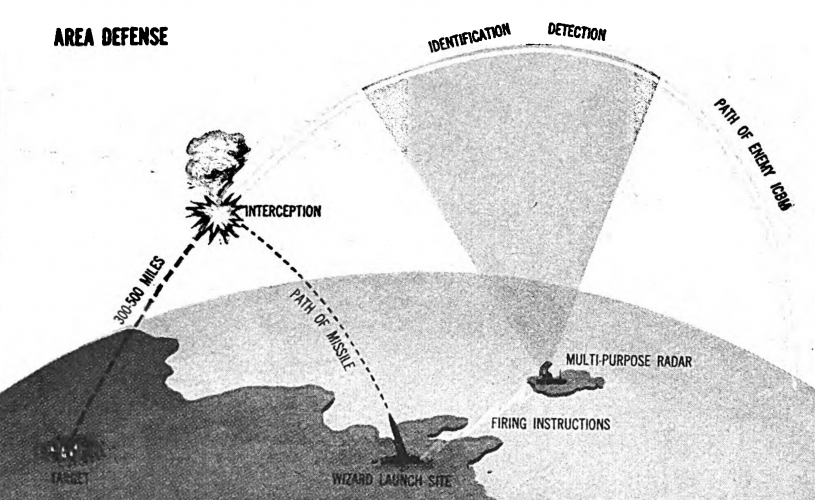
This approach is fundamental to USAF's missile defense studies called Wizard. They are studies and nothing more, recognizing both the gaps in our knowledge and the advances soon to be made by our own technicians and those who design ICBMs for the potential enemy. Wizard is a broad program, searching for a vastly more complicated and sophisticated system than Zeus. Specifications call for the weapon to have a range of at least 1,000 miles, capable of intercepting a warhead somewhere between 300 and 500 miles from the intended target.

Wizard seeks emphasis on distant interception, accurate discrimination, and an improved ground environment system. The latter must be a super-SAGE to provide instant electronic communication and calculation, universal in its application to any kind of threat through the air. If the job can be done, it may eat up a major part of the development effort.

Once perfected, Wizard promises real economy. The goal is to protect the nation, and it should be able to do this for a smaller outlay in cash and effort than required for a point defense system (of which Zeus is the prototype) to protect the country's industrial and military heartland. Wizard proponents, however, do not favor spending any money on hardware until they know where and how to spend it.

At the outset, the battle between Army and Air Force concepts appears to be one for funds and funds alone, with the winner more or less assured of a permanent spot as defender of the republic. But it is more than that. It is a battle for the safety of our cities. Under Army's point defense concept, who is to say we will defend Washington and let San Francisco be blown to smithereens? Or that we will let all the cities go for the present and defend the SAC bases?

The Army today is trying hard to parlay some obtainable hardware, useless for the long-run mission, into justification for a role the Army has not been given by Congress or administrative edict.

Major part of the Army's argument is a voluminous report, put on stage as a scientific evaluation but more realistically described by those who have seen it as an Army-financed rationalization to promote the Nike-Zeus and the point defense concept. The document has been the basis for presentations on Capitol Hill, in the Defense Department, and at the White House. It also was the source of a press report last November that the Army seeks between $6 billion and $7 billion to finance its effort to produce an antimissile missile by 1961.

The arithmetic made public at that time and since has been too modest. It has been estimated that pursuit of the Army's program, if the study included answers to a myriad of unsolved technical problems, would need an outlay of $120 billion in the next eight years.

Details of the Army's documentation are classified, and there are no publishable official evaluations of what it says. Its most severe critics say it is a witch doctor's justification for giving the entire air defense mission to the Army. Offered as the last definitive word on the subject and the best technical estimate ever made, it is reported by competent observers to be wrong in its premises, its procedure of calculation, its results, and its conclusions.

Among other things, the report is said to assume capabilities and reliability for electronic systems that are purely fantastic considering the present state of the art. It has ignored electronic countermeasures (ECM) or assumed that the Nike-Zeus system can overcome them with little or no trouble. The possibility of low-level attack was not considered, and there is no evaluation of the state of the art for manned interceptor defense systems.

Even sources outside the Air Force say the Army-sponsored study fails to give sufficient weight to the decoy problem and would provide no proper discrimination between friend and foe in the air. It is said to underestimate Russian offensive capabilities and assume that early-warning techniques are more advanced than is justified.

Basic fallacy of the entire approach is that it does not recognize, as USAF does, that the ballistic missile defense problem today is a research problem. It has been pointed out by reliable experts that this is no time to take an extreme step because it will take six to ten years to install a ballistic missile defense system of any kind, and we are on the verge of vast new discoveries that will have to be ground into the program. A second major point has to do with complexity. The ballistic missile defense system, when it is possible, will have to be a combination of a number of weapon systems. Not all of the threat will be from launching pads on the other side of the North Pole, coming at us from a relatively narrow segment of the compass. Like us, the enemy will have a variety of high-speed nuclear warheads, launched from distant hard sites, submarines, surface ships, airplanes, or manned spacecraft.

In the face of these facts the Defense Department at this writing still has no over-all system engineering supervision in action on the antimissile project. It has set up no procedures to ensure that the numerous and highly complex components of the weapon system will be compatible and properly phased into the development and production program, when one is possible.

For a sound evaluation of the antimissile defense picture, it is essential that we turn a deaf ear to all the arguments over the relative merits of any particular weapon -- or service -- for this purpose. Discussion of Nike-Zeus vs. Wizard is about as sensible as an argument over which of two unborn baby boys will be the better tennis player. Only the concept is worthy of words at this point.

If there is anything worse than dependence on a pure point defense system in the coming era of highly efficient ballistic missiles, it is split mission responsibility. And, so far as the development stages are concerned, a split mission is exactly what we have got.

On January 18 Defense Secretary Neil H. McElroy, in a decision that can be pardoned only as an excuse to avoid a decision, gave part of the immediate job to USAF and part to the Army. With the two services working on opposing concepts, the development was divided: USAF will continue work only on the radar and data-handling aspects of Wizard while the Army concentrates on the Nike-Zeus missile system, although permission since has been granted to continue the entire Wizard program until the end of this fiscal year, next June 30.

Immediately, the shotgun wedding of Wizard and Zeus has left us with no clear delineation of responsibility for the necessary compatibility of the radar and data-handling with the weapon itself. In USAF parlance, there is no Weapon System Project Office to make sure there will be a weapon system.

The struggle, of course, will be for funds, and it will be umpired by Roy W. Johnson, Director of the Advanced Research Projects Agency. Before him and Congress, Army will fight all efforts to put aside their program -- and their aspirations in the air defense mission -- until the state of the art justifies action.

Aghast at the staggering cost estimates of any missile defense system and timid about a firm decision to keep the Army out of the picture, the Defense Department appears to have created a muddle that can wind up only with some resolution as weak as the union of the Thor and Jupiter intermediate-range ballistic missiles. In that case, the Air Force got one weapon it didn't want and is paying an extravagant price to have it in inventory. In the area of defense against ballistic missiles it is being forced to accept part of the cure offered by a witch doctor, while standing convinced that magic is not the answer to our security problem.

And in a time when defense reorganization is being debated vociferously, the air defense muddle points up the fact that unification per se does not provide all the answers. In fact, the air defense dilemma has actually been exacerbated by a "unified" decision at the top. So centralization of authority must be accompanied by competence in decision-making or we still wind up confused -- even though unified. -- END

Air Force approach to missile defense, here greatly oversimplified, envisions 1,000-mile range, ability to intercept enemy ICBM 300-500 miles from target.

Army's antimissile proposal for point defense involves complex radar system, three types at launch site, to intercept incoming ICBMs at pointblank range.
 

Attachments

  • Public_Oversold_1958_Wizard.png
    Public_Oversold_1958_Wizard.png
    1.4 MB · Views: 24
  • Public_Oversold_1958_Zeus.png
    Public_Oversold_1958_Zeus.png
    1.6 MB · Views: 23
Convair Wizard Wins
Aviation Weekly, 21 Oct 1957


Washington—Convair Wizard air defense system has been endorsed by the U.S. Joint Chiefs of Staff for development by the Air Force as the prime future defense against all types of aerial vehicles, including intercontinental ballistic missiles. Convair’s Wizard system was in competition with the Army’s Nike-Zeus system developed by Bell Laboratories and Douglas Aircraft Co. and another USAF sponsored system involving Boeing Airplane Co., General Electric, and Ramo-Wooldridge Inc. (AW Oct. 7, p. 29; Oct. 14, p. 37).

Joint Chiefs in making the Wizard decision also reaffirmed USAF’s responsibility for area air defense in contrast to the Army’s role of point defense.

Wizard proposal was developed by Convair in cooperation with Radio Corp. of America and other specialist firms as an overall long-range air defense system that would be effective against all types of aerial vehicles, including Mach 2 bombers, air-to-ground missiles, and long-range ballistic missiles. It is based on both long-range detection devices and long-range defensive missiles using solid propellants and involves considerable advanced component development work on special antennas, electronic antenna steering devices, and high power sources.

Among the component developers associated with the Wizard program are:

  • General Electric on missile warheads.
  • Sanders Associates whose PANAR multi-element, multi-lobe antenna system is being adapted for Wizard due to its relative invulnerability to point-source jamming.
  • D. S. Kennedy Inc., working on problems of big parabolas.
  • Avco Inc., electronic antenna steering devices.
Special high power sources are being developed by Rome Air Development Center, Radio Corp. of America, and EIMAC. Wizard is still primarily in the design proposal stage and would require at least five years to provide early stage hardware capable of systems operation.
 
Wizard Reactivated
Aviation Week, 7 April 1958

Washington—Air Force Wizard anti-missile weapon system was reactivated last week by a directive from Defense Department missile czar William Holaday authorizing funding of four contractors programs for the remainder of Fiscal 1958.

Holaday’s action released about $3 million in USAF Fiscal 1958 funds to continue both the Convair-Radio Corp. of America and the Lockheed-Raytheon Corp. projects under the Wizard program until July when Fiscal 1959 money will become available. This action reversed Holaday’s directive of January 16 (AW Jan. 27, p. 18) in which he assigned sole development responsibility for anti-missile weapons systems to the Army for development of the Nike-Zeus program by Douglas Aircraft Co. and Bell Laboratories. RCA was directed by Holaday to proceed with development of advanced radar required for the anti-missile program. But no funds were provided for any part of the USAF Wizard program, including RCA, beyond March 31 under Holaday’s previous order.

Abandonment of the Wizard development program by order of Defense Secretary Neil McElroy on Holaday’s recommendation touched off a bitter USAF and congressional row (AW March 17, p. 19) over the advisability of concentrating on a single, relatively unsophisticated anti-missile weapon system while the entire problem was still in an early development stage.

Lt. Gen. Donald Putt, USAF deputy chief of staff for development, and Lt. Gen. C. S. Irvine, deputy chief of staff for materiel, strongly criticized the McElroy order canceling Wizard and assigning sole development responsibility in this field to the Army’s Nike-Zeus program in testimony before congressional committees. They contended that the entire problem was in too early a development stage for any decision on a particular system and urged that two, and possibly three, lines of exploratory development be continued for at least another year or two before a final decision was made. They also criticized the Nike-Zeus system’s capability because of its admitted inability to detect enemy decoy tactics with ballistic missiles.

Gen. Putt was severely reprimanded for his congressional testimony on Wizard by Defense Secretary McElroy and has since confirmed long standing plans to retire from USAF in June after completing 30 years service. On March 3, after the congressional row, USAF Secretary James Douglas sent a letter to McElroy requesting that the Wizard program be re-examined at Defense Department level with a view to providing funds to continue it beyond the March 31 deadline set by Holaday. The answer from Holaday to this request was dated March 20, just eleven days before the fund cut-off was scheduled to become effective.

USAF officials have testified before Congress that approximately $72 million was earmarked for the Wizard program in Fiscal 1959.

Congressional critics of the Wizard program cancellation based their opposition on two points:
  • Putting all the anti-missile development funds into a single program at such an early stage in the attack on the whole problem of defense against ballistic missiles.
  • Defense Department using control over funds appropriated for individual military services to alter roles and missions. Defense Department has previously assigned USAF the mission of area defense and the Army point defense out to a range of approximately 50 mi. Anti-missile defense is essentially an area problem with detection requirements up to 3,000 mi. and interception requirements to ranges of 1,000 mi. and altitudes up to 500 mi.
 
USAF Wizard Contract
Aviation Week, 19 January 1959

Washington—Theoretical studies and restricted experimental work on interception systems for intercontinental ballistic missiles originally begun under the Air Force Wizard program are being continued by the Defense Department’s Advanced Research Projects Agency.

ARPA authorized two contracts totaling more than $25 million with the Convair Division of General Dynamics Corp.—one through USAF’s Air Research and Development Command for theoretical and limited experimental studies of various kinds of ballistic missile defense systems, the other for basic research into the various phenomena involved in the operation of ballistic missile systems and defenses against them.

The second contract, for basic research type studies, will not be made final until Convair has conferred with scientists from Air Force’s Cambridge, Mass., research center and the Army Rocket and Guided Missile Agency at Huntsville, Ala. After agreement has been reached in these consultations, the contract will be submitted to ARPA for approval. The two service agencies will then be responsible for the detailed administration and technical direction of the contract, and ARPA will provide broad policy and technical guidance.

The work at Convair will be under the direction of J. M. Pasternak, who has directed the Air Force-Convair Wizard anti-ICBM studies for approximately four years.

There apparently will be no change in Army’s Zeus ICBM detection development program.
 
Gen. Putt Criticizes Anti-Missile Decision
Aviation Week, 3 March 1958

Washington—Decision to develop Army’s Nike-Zeus anti-missile missile system rather than Air Force’s competing Wizard system was termed “premature” last week in testimony released by the House Armed Services committee.

Lt. Gen. D. L. Putt, USAF deputy chief of staff for research and development, told the committee that the Wizard program would have had greater flexibility and more capabilities.

Gen. Putt indicated that Nike-Zeus will not have the flexibility to cope with possible countermeasures, while the Wizard could be developed to meet the situation.

He said Air Force had carried out studies and component developments with three different contractor teams and was close to a design decision when Defense Department ordered Nike-Zeus into development.

In a directive issued in January, Defense Secretary Neil H. McElroy ordered the Army to continue development of the Nike-Zeus and USAF to discontinue research and development of the Wizard missile (AW Jan. 27, p. 26). At the same time, Air Force was directed to continue development of the ballistic missile early warning system.
 
USAF Appeals Anti-Missile Decision
Aviation Week, 17 March 1958

Washington—Air Force Secretary James H. Douglas has appealed to Defense Secretary Neil H. McElroy to reverse a two-month-old decision and allow Air Force to continue development of its Wizard anti-missile missile system.

USAF still does not believe Army’s Nike-Zeus system has the growth capability to handle possible enemy evasion, decoy and countermeasure tactics.

Also, USAF feels too great a risk is involved in relying on only one system at this stage, and says competing efforts should be allowed. It cites Senate Preparedness Investigating Committee’s 17 points “upon which decisive action must be taken,” one of which is: “Put more effort into developing anti-missile missiles.”

Meanwhile, McElroy issued a one-sentence directive to halt Army’s plans to make Nike-Zeus installations capable of handling intermediate and intercontinental missiles.

“In order to avoid any misunderstanding regarding the responsibility for future (second generation) research and development in the field of land-based IRBMs and ICBMs, it should be understood that this function is the responsibility of the Department of the Air Force,” the memo said.

Not only would USAF not develop the Nike-Zeus system for immediate operational deployment if it had the choice; it has not yet decided which of the Wizard proposals is most desirable.

Under USAF’s plan, Wizard development would continue for perhaps another year at $2 million to $3 million per company before the final selection was made. Teams are Lockheed-Raytheon and Convair-Radio Corp. of America. General Electric is developing nose cones. Air Force also had a contract on the Douglas Aircraft-Bell Telephone Laboratories study which is the basis of the Army Nike-Zeus project.

Determination of the requirements and deficiencies in the nation’s overall air defense system will be influenced by reorganization of the Defense Department. Secretary McElroy’s recommendations on reorganization were due to be made by the end of this month.

Secretary Douglas told the House Armed Service Committee recently that he did not believe the present defense organization “has assured the kind of overall objective consideration that should be given to as complicated a system as this and its component parts.”

“I think if there is anything in Defense Department organization that should have attention, and that will have attention in the present discussions looking to some reorganization, it is establishing an overall basis for determination of requirements in the air defense area so that there is no longer the element of the fortuitous in determining the mix that we have of manned interceptors, of BOMARC controlled by SAGE and of Nike battalions spread out through the country,” Douglas said.

Although Douglas told the same committee on the same day that Air Force agreed to and had accepted McElroy’s mid-January order assigning anti-missile development to Army and long range detection to USAF, the Air Force is clearly on record as having little faith in Nike-Zeus.

The mid-January decision (AW Jan. 27, p. 26) specifically ordered USAF to drop missile development under the Wizard program and to continue only with detection and data handling phases, and to coordinate this work closely with Army and with Advanced Research Projects Agency.
 
Dual Missile Defense Predicted
Aviation Week, 31 March 1958

Salt Lake City—Ballistic missile defense system now under development is almost certain to become obsolescent before it becomes operational as result of technological advances in both ballistic missile design and detection techniques already on the horizon.

Warning comes from Dr. Richard C. Raymond, manager of General Electric’s Technical Military Planning Operation (Tempo), speaking here at the third annual Air Power Symposium.

Dr. Raymond predicted that presently planned ballistic missile defense system may have to be expanded to provide two distinctly different types of active defense missile systems:
  • Point-defense: short-range missile to protect Strategic Air Command bomber and missile bases. This corresponds to Army’s Nike-Zeus, programmed for ICBM defense (AW Feb 24, p. 66).
  • Area defense: longer-range missile to protect population-industry centers and give increased coverage to strategic striking force.
Dual-type missile defense system suggested by Dr. Raymond is comparable to objectives of Air Force Wizard program, recently halted by Secretary of Defense McElroy.

Fifteen minute warning to be provided by ballistic missile early warning system now under development is “barely sufficient” to launch strategic counterblows, Dr. Raymond said, and the figure will be “even less for some future (ballistic missile) trajectories.”

This will require greatly increased political-decision speed, if full advantage is to be gained from the costly surveillance system, he said.

Although SAC ballistic missile defense site can be “hardened to a certain extent,” Dr. Raymond said, there is no point to designing it to withstand a direct hit which would knock out the nearby SAC base it is intended to defend—particularly if the missile site’s rate-of-fire and effectiveness must be sacrificed to protect it from fallout.

Present point-defense concept of making relatively low-altitude attacks on enemy ICBMs, using the atmosphere to screen out light-weight decoys from warhead-carrying nose cones, is “probably all right,” Dr. Raymond said. If the attack is very heavy, the point-defense missile site can concentrate on those weapons dangerous to the target being defended and to ignore near misses.

But the requirements for an active missile defense for population-industry targets are quite different, Dr. Raymond pointed out, because this target cannot fly away or evacuate fast enough, and because penetration by a few missiles does not eliminate need for continued defense. Area-type missile sites must therefore be designed to operate for extended period, despite blast, thermal damage and radioactivity in the area, he said. Furthermore, the communication lines which link individual missile sites in an area-defense system must also be hardened against damage, and principal facilities must be located away from likely targets, unlike the point-defense sites.

Area defensive missile must strike while enemy vehicle still is in space, which requires use of techniques for discriminating between decoys and actual warheads, Dr. Raymond said. However, a compensating advantage is the fact that it may only be necessary to damage nose cone sufficiently to prevent it from successfully re-entering the atmosphere, without actually destroying it prior to re-entry.
 
Part of a larger article "USAF, Army Wage battle for control of Missile Defense Systems", 24 FEB 1958

USAF’s Wizard

Air Force has not surrendered hopes of developing its Wizard system, at least in competition with Nike-Zeus if not in place of it. Defense Secretary McElroy’s memorandum to USAF last month, however, said USAF was to discontinue research and development on the missile entirely—although leeway was left for further radar development.

USAF officials say that the proposed Wizard system is highly sophisticated with a long range, solid fuel missile and an effective multi-purpose radar with a very high degree of discrimination between warheads and decoys. They say the system has never gone beyond the planning stage simply for lack of money.

Features of the Wizard system are:
  • Phase I program is for the development of a single stage missile with a range of 1,000 mi., and the capability of intercepting all airborne vehicles.
  • Phase II program contemplates addition of a second stage to the missile to provide interception capabilities at altitudes of 300 to 500 mi.
USAF’s prime contractors on the Wizard project have been Radio Corp. of America and Convair Division of General Dynamics Corp. Subcontractors have included: General Electric on missile warheads, Sanders Associates for multi-element, multi-lobe PANAR antenna system, D. S. Kennedy Inc. on large parabolas and Avco on electronic steering devices.

Also part of the article was this:

Plato System

Designed to protect field armies and critical installations overseas, the Army’s Plato anti-missile missile system is into the hardware stage where prototype parts have undergone test.

A possible future application of Plato that is arousing much interest is the prospect of presenting the system to NATO allies as part of the inducement to accept IRBMs from the United States. One of the Soviets’ strongest threats in Europe is the nuclear-tipped IRBM.

System is presently being considered for protection of U.S. cities from submarine-launched IRBMs.

Plato is a relatively mobile system consisting of vans for the electronic equipment, erective antennas and specially designed mobile launchers for the Nike-Zeus missile. Plato is a command guidance system whereby a computer is fed continuous position data on both the incoming target and the Nike-Zeus missile. Computer then guides the missile to the intercept point and detonates its warhead by radio signal.

Prime contractor for Plato is Sylvia Electric Products. Subcontractors are Sanders Associates, General Electric and American Machine and Foundry.
 
Senate Rejects Nike Zeus Production
Aviation Week & Space Technology, April 22, 1963

Washington—Senate has approved overwhelmingly the Kennedy Administration plan to work on an improved anti-missile system rather than go into production on the Army-Western Electric Nike Zeus.

Endorsement came when the Senate voted 58-16 to strip from the military procurement bill language that would have provided the Army with $196 million more than the Defense Dept. requested for Nike Zeus.

The money would have been authorized, but not actually appropriated, to procure component parts.

Sen. Strom Thurmond (D-S.C.) led the fight for the extra money and put the Senate into secret session for more than five hours Apr. 11 so he could present classified information to buttress his case. But Chairman Richard B. Russell (D-Ga.) of the Senate Armed Services Committee contended that going into production on Nike Zeus, when it has not proved effective against strategic missiles, would be a waste of money.

He recommended to the Senate going along with the Defense Dept.'s plan to work toward an improved anti-missile missile under the Nike X project (AW Mar. 25, p. 35).

Sen. Stuart Symington (D-Mo.) said the Army-Western Electric Nike Ajax program "was worthless," and said "I never thought much of" the Army-Western Electric Nike Hercules and USAF-Boeing Bomarc. He said those programs plus the Nike Zeus amounted to about $7 billion "down the drain." He said the individual costs to date were $1,250,900,000 for Nike Ajax, $2,171,400,000 for Nike Hercules, $2,160,000,000 for Bomarc, $1,372,200,000 for Nike Zeus. About $262.6 million has been spent to date on the Nike X program, and $335 million is in the Fiscal 1964 authorization bill for it.

Sen. Russell said the $196 million to start Nike Zeus production would be just a down payment on a program that would cost between $12 billion and $20 billion to complete and provide questionable defense for 26 cities. Although the Nike X program could benefit from the Nike Zeus production to some extent, Defense Dept. witnesses said going ahead with Nike Zeus now and the improved system later would mean a net loss of $2.8 billion.

Army estimated the difference at $1.5 billion—$12,625,000,000 to produce Nike Zeus as currently developed and $14,124,000,000 to develop an improved version under the Nike X program.

Gen. Earle G. Wheeler, Army chief of staff, said during Senate Armed Services Committee hearings that "the advantages in protection of millions of people, and a large segment of our economy by deploying [Nike Zeus] as early as possible" is worth the extra cost.

"The Army proposal basically is to deploy as soon as possible what the state of the art will permit now and then move toward the Nike X concept as research and development and production will let us do so," he said.

Gen. Maxwell D. Taylor, Army chief of staff, also favors going into production on Nike Zeus on grounds an effective missile defense could tip the balance of power to the U.S.
 
From The Advanced Research Projects Agency, 1958-1974

Phased Array Radar.

In November 1960, just prior to General Betts' departure, the first full-scale prototype of the Electronically Steerable Array Radar (ESAR) was completed and put "on the air." Inherited from the defunct Air Force BMD program, the ESAR was the first sophisticated phased array radar and it had an enormous impact on military radar technology. It gave birth to both a direct Air Force follow-on radar (the SPADATS F-85, produced by Bendix, the ESAR contractor) and established the technological basis for the phased array radars incorporated into the Army's Nike-X/Sentinel/Safeguard system.

ESAR is consistently listed among the top ten orso contributions to military technology developed by ARPA over its entire history. ARPA's role in the development of phased arrays through the ESAR program may perhaps best be described as that of providing steadfast support to a highly uncertain technology at a time when strong Service support was quite unlikely.

The program was not conceived in ARPA, but only ARPA was willing and able to "stay the course" through the late 1950's and early 1960's in order to demonstrate that the phased array concept was a practical radar technology.

The Air Force, deprived of a BMD mission, would have had great difficulty in providing internal justification for the program (the phased array's primary virtue is its ability to observe multiple objects, a special requirement of BMD systems). On the other hand, the contemporary Army BMD program (including its prime contractor, Bell Telephone Laboratories) was wedded to the elaborate mechanically steered radars of the NIKE-ZEUS program, in which it had a considerable investment and continuing hopes for near-term deployment. For that matter, Lincoln Laboratories and ODDR&E were also opposed to phased arrays. Thus ARPA played a classic role in this instance by pursuing exploratory development of ESAR despite negative opinion and an obvious high risk of failure.

ESAR's major contribution, which started to become clear shortly after Betts' departure; is succinctly summarized by Dr. Ruina in Congressional testimony:

"This radar [ESAR] has successfully demonstrated that one can control the beam of a radar electronically and yet accurately, rather than by swinging a dish mechanically. This makes the beam much more agile thereby making it possible to observe many targets almost simultaneously. It is fair to say that this demonstration has changed radically all thinking about AICBM radars and that all systems presently considered, including Nike-X, depend heavily on the use of phased arrays .... when the program started there was a great deal of, doubt that it was really an important one and achievable. Now, it is ... an accepted part of the technical community."

Despite the turbulence of the Johnson period and the organizational uncertainty of the Betts year, phased array radar research was readily supported. The success of the ESAR program was founded on developments during this period.


The Bendix AN/FPS-46 Electronically Steerable Array Radar (ESAR) using L-band began transmitting in November 1960 as "the first full-size pencil-beam phased-array radar system."
 
Electronic-Design Vol 15 No 22 (1967)

says:

"Univac developed the first general-purpose computer for use with the Multi-function Array Radar. It had a data-handling ability of about 325,000 instructions per second."
 

Similar threads

Back
Top Bottom