
You are using an out of date browser. It may not display this or other websites correctly.
You should upgrade or use an alternative browser.
You should upgrade or use an alternative browser.
Lockheed Martin X-33 & Venture Star
- Thread starter flateric
- Start date


- Joined
- 6 August 2007
- Messages
- 4,374
- Reaction score
- 9,161
Had visited the abandon X-33 launch site at EAFB after cancellation.
34.874844, -117.619826
Could that linear aerospike work better on Phil Bono's very larger saucer HLLV....I could see it between the two vertical fins...perhaps with Big Onion type water landings....except of a skimming sort.
I like the idea of very wide, flat payloads that could offer....even wider than that afforded by OTRAG's largest cluster concept.
Somewhere on YouTube, (I can't find it atm) is a fascinating video of the 'belly-landing' tests done on the Lenticular Reentry Vehicle concept both on land and in the water. The HLLV "might" be a bit different due to the size but in general while landing on the heat shield worked great on land, water was a whole different story. And not a good one

(See: https://apps.dtic.mil/sti/pdfs/AD0263072.pdf and https://ntrs.nasa.gov/api/citations/19980228014/downloads/19980228014.pdf)
Randy
Could that linear aerospike work better on Phil Bono's very larger saucer HLLV....I could see it between the two vertical fins...perhaps with Big Onion type water landings....except of a skimming sort.
I like the idea of very wide, flat payloads that could offer....even wider than that afforded by OTRAG's largest cluster concept.
As to the actual question here, I think the linear aerospike would work on such a vehicle but it's far from enough to actually get SSTO by itself. Bono's 'saucer' as I understand it was mostly to show how NOT to design an SSTO but at a time when the military (specifically) was interested in the Lenticular Reentry Vehicle design concept, (the "Flying Saucer Orbital Bomber' which was actually just a control and servicing vehicle but who doesn't like "click-bait" titles
) as a follow-on to the NAA "10 Ton Orbital Carrier Vehicle" concept.You'd still likely need more propellant than could be contained internally to make a decent go of SSTO and frankly at that point it's not really any better than making a whole separate stage instead. Though I understand it was Bono's work on things like the "saucer" that got him to embrace drop-tank SSTO designs.
SSTO in general has some glaring issues that tend to get glossed over with the claims of 'easy and cheap recovery and turn-around' which themselves don't really look to pan out considering the margins you have to play with. (Or don't as the case may be
)Randy
- Joined
- 28 January 2008
- Messages
- 1,486
- Reaction score
- 3,782
One of the poor decisions which were made by LM, was having Allied-Signal at the time responsible for systems integration, A-S made various components but had no idea how to integrate the various vehicle systems, not in their wheelhouse, that should have been LM responsibility. Had a couple of former NGC buddies who worked X-33 at the time for LM.

Nik
ACCESS: Top Secret
- Joined
- 15 July 2009
- Messages
- 1,350
- Reaction score
- 1,181
I've a vague memory of reading that the available CFD 'Computational Flow Dynamics' software predicted significantly better performance than the Linear Aerospike prototypes actually gave. Bit like Fusion research, which has spent five decades discovering umpteen exasperating ways for hot, dense plasma to thwart sufficient containment...
Beside that 'bridge-too-far' of tankage design, could we do better now ? Or is the 'Linear Aerospike' concept inherently flawed ??
FWIW, I've seen a claim that, like MagLev, Linear Aerospikes only reach useful efficiency at an impracticably large scale...
Beside that 'bridge-too-far' of tankage design, could we do better now ? Or is the 'Linear Aerospike' concept inherently flawed ??
FWIW, I've seen a claim that, like MagLev, Linear Aerospikes only reach useful efficiency at an impracticably large scale...

- Joined
- 6 June 2006
- Messages
- 14,666
- Reaction score
- 20,605
Aerospike should work but it is not sure it brings enough performance improvement to make a SSTO happen. It is no the "silver bullet" Lockheed hoped for.
Aerospike tends to be heavier than a classic engine.
Aerospike tends to be heavier than a classic engine.
martinbayer
ACCESS: Top Secret
- Joined
- 6 January 2009
- Messages
- 4,735
- Reaction score
- 6,486
It really didn't though...It seemed such a great idea at the time..
martinbayer
ACCESS: Top Secret
- Joined
- 6 January 2009
- Messages
- 4,735
- Reaction score
- 6,486
As a pig-headed German aerospace engineer with a penchant/proclivity to not mince words, I'd say that Rockwell was screwed/shafted in that "contest", but I absolutely share your sentiment.Rockwell was robbed.
Beside that 'bridge-too-far' of tankage design, could we do better now ?
Lithium Aluminum would work instead
multiple wrongs.What a stupid, idiotic concept - as we Germans say: "nicht Fisch und nicht Fleisch". Late in the last millennium I did a quantitative comparative analysis of the two VTHL X-33 configurations by Rockwell and LM for the ESA FESTIP program, and the Skunk Works design ended up having a larger combined wing and body wetted area (and associated structural mass) than the classical Rockwell cylindrical body with wings for the same design mission, while even the nominally VTVL McDonnell Douglas concept derived from the Delta Clipper/DC-X all of a sudden started sprouting fins for reentry, much like Musk's current Starship. Coupled with the complex non-cylindrical tankage of the lifting body that failed in the actual X-33 demonstrator manufacturing, the takeaway message, as always, is KISS, but program cycles these days are apparently just too long and too few and far between for many actual lessons learned to be passed on to the next generation of engineers and designers. But even Musk, god bless his heart, is going with cylindrical fuselages with distinct fins and wings these days, so there is some hope for sanity yet.
A. Wings do not belong in space.
b. Delta Clip per/DC-X had aerosurfaces.
c. "sprouting fins" is from optimization. Instead of having a having a large RCS, it is better to share the load of control. The fins on DC-X follow-on are no different than the Falcon 9 grid fins or the New Shepard/Glenn fins.
d.Starship does not have wings. It is has two sets of control fins. They are not there for lift but for control. The Starship does not fly, it is still a controlled fall.
e. "nominally" VTVL McDonnell Douglas ? How does "all of a sudden started sprouting fins for reentry" change that?
The McDonnell Douglas entry was simpler and cheaper. The rocket equation is a bitch, Rockwell system would not have worked with the added mass of wings.
martinbayer
ACCESS: Top Secret
- Joined
- 6 January 2009
- Messages
- 4,735
- Reaction score
- 6,486
A.: The Shuttle/Buran/X-37B designers would like to have a word with you...multiple wrongs.What a stupid, idiotic concept - as we Germans say: "nicht Fisch und nicht Fleisch". Late in the last millennium I did a quantitative comparative analysis of the two VTHL X-33 configurations by Rockwell and LM for the ESA FESTIP program, and the Skunk Works design ended up having a larger combined wing and body wetted area (and associated structural mass) than the classical Rockwell cylindrical body with wings for the same design mission, while even the nominally VTVL McDonnell Douglas concept derived from the Delta Clipper/DC-X all of a sudden started sprouting fins for reentry, much like Musk's current Starship. Coupled with the complex non-cylindrical tankage of the lifting body that failed in the actual X-33 demonstrator manufacturing, the takeaway message, as always, is KISS, but program cycles these days are apparently just too long and too few and far between for many actual lessons learned to be passed on to the next generation of engineers and designers. But even Musk, god bless his heart, is going with cylindrical fuselages with distinct fins and wings these days, so there is some hope for sanity yet.
A. Wings do not belong in space.
b. Delta Clip per/DC-X had aerosurfaces.
c. "sprouting fins" is from optimization. Instead of having a having a large RCS, it is better to share the load of control. The fins on DC-X follow-on are no different than the Falcon 9 grid fins or the New Shepard/Glenn fins.
d.Starship does not have wings. It is has two sets of control fins. They are not there for lift but for control. The Starship does not fly, it is still a controlled fall.
e. "nominally" VTVL McDonnell Douglas ? How does "all of a sudden started sprouting fins for reentry" change that?
The McDonnell Douglas entry was simpler and cheaper. The rocket equation is a bitch, Rockwell system would not have worked with the added mass of wings.
B.: Correct, but the MDD X-33 design started out without *fins*, which were only added after apparently some aerodynamic insights were gained in the design process. The final design also had a clear top and bottom for reentry that almost made it look like a Shuttle fuselage with amputated wings, rather than the original four sided purportedly reentry orientation agnostic symmetry.
C.: Completely agree - you just made my point that aerodynamic appendages *do* have a place in RLV design, so thanks!
D.: I love a good semantics match as much as the next guy, so let's just call them aerodynamic surfaces per my point above, OK?
E.: Point taken - I should have elaborated that it ended up *not* being a purely ballistic design, but then again, apart from the Vostok/Voskhod spacecraft, even so-called ballistic capsules strictly weren't.
I firmly and strongly believe however that *neither* the Rockwell or MDD X-33 (and, quite obviously, let alone the "Chosen One" LM lifting body abomination) designs would ultimately have resulted in an actual operational SSTO, but at least the Rockwell design would have been a darn good point of departure for an actual VTHL TSTO RLV (as would have been the late lamented XSP/XS-1).
Last edited:
A. Shuttle and Buran are no longer around because of the economics. X-37 is a spacecraft and not a launch vehicle.A.: The Shuttle/Buran/X-37B designers would like to have a word with you...multiple wrongs.What a stupid, idiotic concept - as we Germans say: "nicht Fisch und nicht Fleisch". Late in the last millennium I did a quantitative comparative analysis of the two VTHL X-33 configurations by Rockwell and LM for the ESA FESTIP program, and the Skunk Works design ended up having a larger combined wing and body wetted area (and associated structural mass) than the classical Rockwell cylindrical body with wings for the same design mission, while even the nominally VTVL McDonnell Douglas concept derived from the Delta Clipper/DC-X all of a sudden started sprouting fins for reentry, much like Musk's current Starship. Coupled with the complex non-cylindrical tankage of the lifting body that failed in the actual X-33 demonstrator manufacturing, the takeaway message, as always, is KISS, but program cycles these days are apparently just too long and too few and far between for many actual lessons learned to be passed on to the next generation of engineers and designers. But even Musk, god bless his heart, is going with cylindrical fuselages with distinct fins and wings these days, so there is some hope for sanity yet.
A. Wings do not belong in space.
b. Delta Clip per/DC-X had aerosurfaces.
c. "sprouting fins" is from optimization. Instead of having a having a large RCS, it is better to share the load of control. The fins on DC-X follow-on are no different than the Falcon 9 grid fins or the New Shepard/Glenn fins.
d.Starship does not have wings. It is has two sets of control fins. They are not there for lift but for control. The Starship does not fly, it is still a controlled fall.
e. "nominally" VTVL McDonnell Douglas ? How does "all of a sudden started sprouting fins for reentry" change that?
The McDonnell Douglas entry was simpler and cheaper. The rocket equation is a bitch, Rockwell system would not have worked with the added mass of wings.
B.: Correct, but the MDD X-33 design started out without *fins*, which were only added after apparently some aerodynamic insights were gained in the design process. The final design also had a clear top and bottom for reentry that almost made it look like a Shuttle fuselage with amputated wings, rather than the original four sided purportedly reentry orientation agnostic symmetry.
C.: Completely agree - you just made my point that aerodynamic appendages *do* have a place in RLV design, so thanks!
D.: I love a good semantics match as much as the next guy, so let's just call them aerodynamic surfaces per my point above, OK?
E.: Point taken - I should have elaborated that it ended up *not* being a purely ballistic design, but then again, apart from the Vostok/Voskhod spacecraft, even so-called ballistic capsules strictly weren't.
I firmly and strongly believe however that *neither* the Rockwell or MDD X-33 (and, quite obviously, let alone the "Chosen One" LM lifting body abomination) designs would ultimately have resulted in an actual operational SSTO, but at least the Rockwell design would have been a darn good point of departure for an actual VTHL TSTO RLV (as would have been the late lamented XSP/XS-1).
b. My point is all versions had aerosurfaces. Flaps turning into fins not a big change.
c. Still not wings. And your point was not just simply "that aerodynamic appendages *do* have a place in RLV design"
d. There is a big difference between wings and fins.
e. not true, there are others.
f. The MDD would have been better departure as first stage than the Rockwell design and just as viable and also cheaper.
Wings on rockets do not follow KISS principle
martinbayer
ACCESS: Top Secret
- Joined
- 6 January 2009
- Messages
- 4,735
- Reaction score
- 6,486
You stated categorically that "Wings do not belong in space." That would logically apply to spacecraft as well, including the X-37. Don't try to lecture me on what points I make and have. Otherwise I'm eagerly waiting to learn about your professional background. Bye, man.A. Shuttle and Buran are no longer around because of the economics. X-37 is a spacecraft and not a launch vehicle.A.: The Shuttle/Buran/X-37B designers would like to have a word with you...multiple wrongs.What a stupid, idiotic concept - as we Germans say: "nicht Fisch und nicht Fleisch". Late in the last millennium I did a quantitative comparative analysis of the two VTHL X-33 configurations by Rockwell and LM for the ESA FESTIP program, and the Skunk Works design ended up having a larger combined wing and body wetted area (and associated structural mass) than the classical Rockwell cylindrical body with wings for the same design mission, while even the nominally VTVL McDonnell Douglas concept derived from the Delta Clipper/DC-X all of a sudden started sprouting fins for reentry, much like Musk's current Starship. Coupled with the complex non-cylindrical tankage of the lifting body that failed in the actual X-33 demonstrator manufacturing, the takeaway message, as always, is KISS, but program cycles these days are apparently just too long and too few and far between for many actual lessons learned to be passed on to the next generation of engineers and designers. But even Musk, god bless his heart, is going with cylindrical fuselages with distinct fins and wings these days, so there is some hope for sanity yet.
A. Krakatoa
b. Delta Clip per/DC-X had aerosurfaces.
c. "sprouting fins" is from optimization. Instead of having a having a large RCS, it is better to share the load of control. The fins on DC-X follow-on are no different than the Falcon 9 grid fins or the New Shepard/Glenn fins.
d.Starship does not have wings. It is has two sets of control fins. They are not there for lift but for control. The Starship does not fly, it is still a controlled fall.
e. "nominally" VTVL McDonnell Douglas ? How does "all of a sudden started sprouting fins for reentry" change that?
The McDonnell Douglas entry was simpler and cheaper. The rocket equation is a bitch, Rockwell system would not have worked with the added mass of wings.
B.: Correct, but the MDD X-33 design started out without *fins*, which were only added after apparently some aerodynamic insights were gained in the design process. The final design also had a clear top and bottom for reentry that almost made it look like a Shuttle fuselage with amputated wings, rather than the original four sided purportedly reentry orientation agnostic symmetry.
C.: Completely agree - you just made my point that aerodynamic appendages *do* have a place in RLV design, so thanks!
D.: I love a good semantics match as much as the next guy, so let's just call them aerodynamic surfaces per my point above, OK?
E.: Point taken - I should have elaborated that it ended up *not* being a purely ballistic design, but then again, apart from the Vostok/Voskhod spacecraft, even so-called ballistic capsules strictly weren't.
I firmly and strongly believe however that *neither* the Rockwell or MDD X-33 (and, quite obviously, let alone the "Chosen One" LM lifting body abomination) designs would ultimately have resulted in an actual operational SSTO, but at least the Rockwell design would have been a darn good point of departure for an actual VTHL TSTO RLV (as would have been the late lamented XSP/XS-1).
b. My point is all versions had aerosurfaces. Flaps turning into fins not a big change.
c. Still not wings. And your point was not just simply "that aerodynamic appendages *do* have a place in RLV design"
d. There is a big difference between wings and fins.
e. not true, there are others.
f. The MDD would have been better departure as first stage than the Rockwell design and just as viable and also cheaper.
Wings on rockets do not follow KISS principle
Last edited:
I have supported the either the prime and/or secondary payloads on the following shuttle missions:
while in the Air Force (1983-1992) 14
STS- 26, 27, 28, 29, 31, 32, 33, 36, 37, 38, 39, 44, 48 and 53
MDAC/Boeing on the Spacehab program (1992-2001) 16
STS-57, 60, 63, 76, 77, 79, 81, 84, 86, 89, 91, 96, 101, 106 & 107
The payloads on the following ELV launches:
while in the Air Force (1988-1992) 13
Titan 34D-2 and 16;
Titan-IV K-1, 4, 6, 10, 7, 9, 23;
Atlas I/II AC- 68, 69, 101, 103
With NASA (2001-Present) 24
Delta II ICESAT/CHIPSAT, MER A, MER B, Kepler, STSS Demo, & GRAIL.
Atlas V MRO, PNH, SDO, Juno, MSL, RBSP, MMS, OA-4, 6 & 7, GOES-R, S, & T, Solar Orbiter; Mars 2020;
Delta IV Heavy - EFT-1 & PSP.
Falcon 9 - DSCOVR; HALO/PPE; Europa Clipper
Ariane V - JWST.
Supported the launch of Jason/TIMED, Contour, MAP, TDRS-K, MAVEN, TDRS-L, OSIRIS-REX, TDRS-M, Jason-3, PSP, Lucy. 11
Also, worked OSP and CxP EELV studies and early X-37 integration.
And there is more than just supporting spacecraft ground ops or LV integration..
while in the Air Force (1983-1992) 14
STS- 26, 27, 28, 29, 31, 32, 33, 36, 37, 38, 39, 44, 48 and 53
MDAC/Boeing on the Spacehab program (1992-2001) 16
STS-57, 60, 63, 76, 77, 79, 81, 84, 86, 89, 91, 96, 101, 106 & 107
The payloads on the following ELV launches:
while in the Air Force (1988-1992) 13
Titan 34D-2 and 16;
Titan-IV K-1, 4, 6, 10, 7, 9, 23;
Atlas I/II AC- 68, 69, 101, 103
With NASA (2001-Present) 24
Delta II ICESAT/CHIPSAT, MER A, MER B, Kepler, STSS Demo, & GRAIL.
Atlas V MRO, PNH, SDO, Juno, MSL, RBSP, MMS, OA-4, 6 & 7, GOES-R, S, & T, Solar Orbiter; Mars 2020;
Delta IV Heavy - EFT-1 & PSP.
Falcon 9 - DSCOVR; HALO/PPE; Europa Clipper
Ariane V - JWST.
Supported the launch of Jason/TIMED, Contour, MAP, TDRS-K, MAVEN, TDRS-L, OSIRIS-REX, TDRS-M, Jason-3, PSP, Lucy. 11
Also, worked OSP and CxP EELV studies and early X-37 integration.
And there is more than just supporting spacecraft ground ops or LV integration..

litzj
BLOG : http://jaesan-aero.blogspot.com/
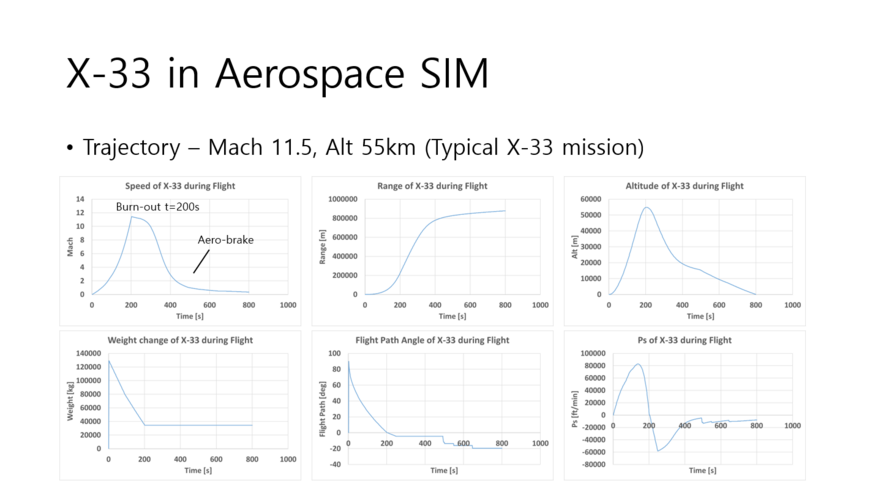
I had simple trajectory analysis for X-33 and Venture-Star with known references
https://jaesan-aero.blogspot.com/2022/03/trajectory-analysis-of-x-33-and.html

https://jaesan-aero.blogspot.com/2022/03/trajectory-analysis-of-x-33-and.html
martinbayer
ACCESS: Top Secret
- Joined
- 6 January 2009
- Messages
- 4,735
- Reaction score
- 6,486
Tracks perfectly with the fact that from burnout at 200 s onward the vehicle is descending. This is the flight path angle, not the angle of attack.@litzj : Minus 20deg?! Are you sure? That's a lot of drag and negative lift.



perseus
ACCESS: Restricted
- Joined
- 20 June 2012
- Messages
- 4
- Reaction score
- 9
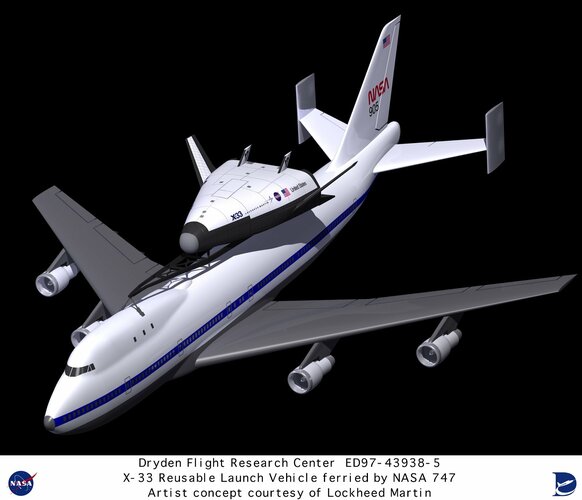
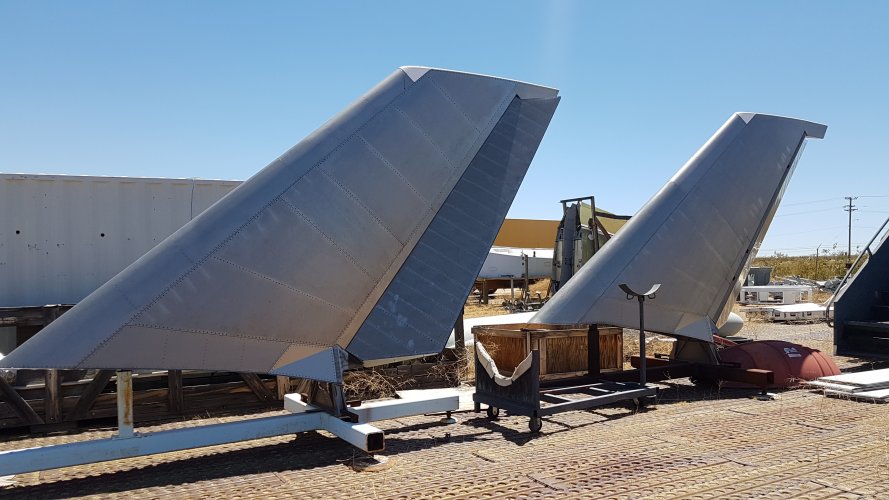
Thanks! This has puzzled me for days. I don't have any other photos.Believed to be residual X-33 [VentureStar half-size demonstrator] parts; stored at the AFTC Museum storage yard. Do you have any shots of the Mystery Van?
- Joined
- 6 June 2006
- Messages
- 14,666
- Reaction score
- 20,605
What is AFTC ? This museum ? https://en.wikipedia.org/wiki/Air_Force_Flight_Test_MuseumBelieved to be residual X-33 [VentureStar half-size demonstrator] parts; stored at the AFTC Museum storage yard. Do you have any shots of the Mystery Van?
I wondered for a quarter of century about the fate of the X-33 carcasse and remains - after it was canned in March 2001. Nice to see some bits of it survived !
Similar threads
-
 McDonnell Douglas X-33 SSTO Reusable Launch Vehicle
- Started by athpilot
- Replies: 10
-
 SURPRISE-SURPRISE ! ALL NEW 1-72nd X-33 from STRATOSPHERE MODELS !!
- Started by Desert Dawn
- Replies: 7
-
-
 Lockheed Skunk Works 1993-1998 NGLRV SSTO program - roots of X-33
- Started by flateric
- Replies: 3
-
