Phoenix_jz

ACCESS: Confidential
Joined
1 April 2020
Messages
164
Reaction score
658
Hello all;

I recently got my hands on a Storia Militare 'Dossier', the first part of a series covering the Italian navy from 1945 to 2015 (first part being from 1945 to 1970, issue no.14, Sept-Oct 2014) by Michele Cosentino and Maurizio Brescia.

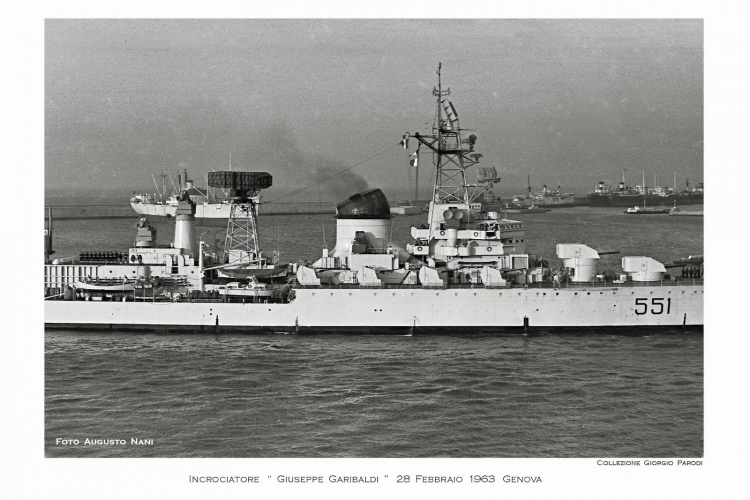
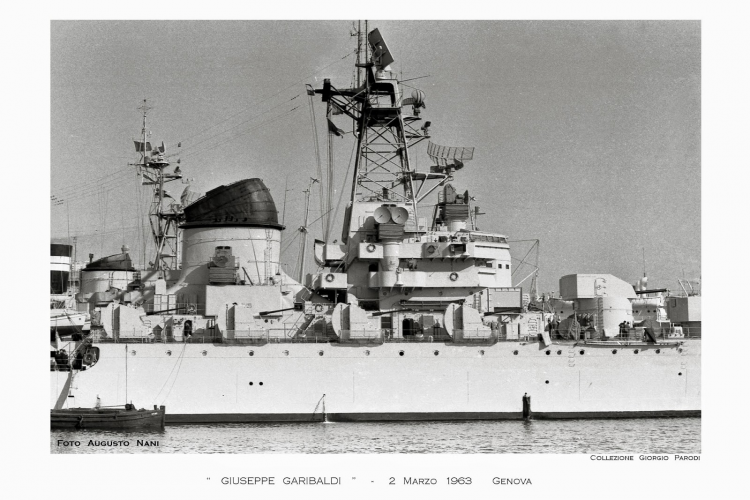
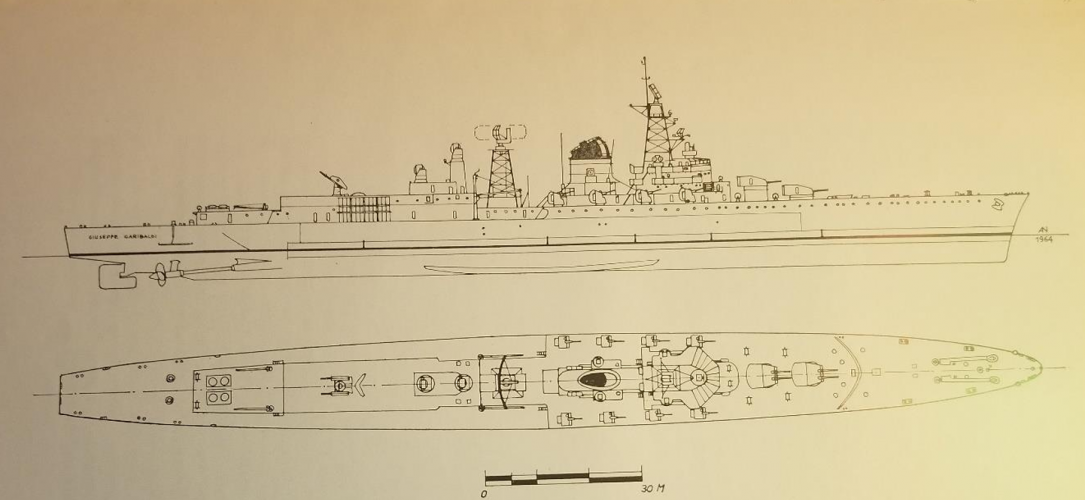
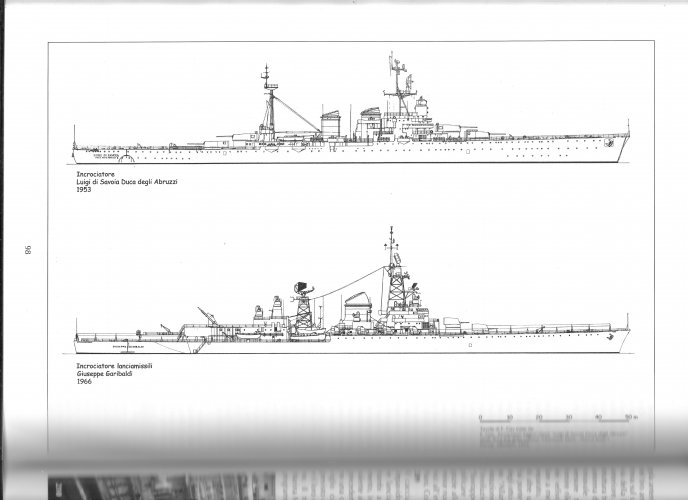
Within the SM 'Dossier' there is mentioned, in passing, about a 1950s project for converting the cruiser Giuseppe Garibaldi to an anti-aircraft cruiser. This design pre-dated the guided missile cruiser conversion plans, and involved the new automatic 135/45, and a planned 76/62 quadruple mount, based off the new 76mm 'Sovrapposto' twin mounts. Needless to say, this plan was never carried out, and when they were able to convert Giuseppe Garibaldi, it was to a far superior design utilizing the RIM-2 Terrier. This is probably for the best too, as the year work started (1957) was the same year the 76mm Sovrapposto mounts entered service on the Centauro-class frigates, and they proved extremely unreliable - the better known and vastly more widely used 76/62 Allargato followed soon after, leaving the Sovrapposto isolated to just the Centauro's, and even those mounts were replaced by the Allargato mounts in the late 1960s.

Unfortunately, as the design is only mentioned in passing, there are literally no details mentioned beyond the fact that;

  • The design emerged in the mid-1950s
  • It involved the new 135/45 and a planned quadruple 76mm mount based on the Sovrapposto
  • It remained on paper and was replaced by the plans for the conversion to a guided missile cruiser
I was wondering if anyone here had any more information on this ballistic-only AAW cruiser?
 
This is the second mention of a quad 76mm mount. In an article written by George Moore in Warship; I can't look up which edition as those are books are in storage. The article was about the immediate post war cruiser porjects a number of which featured quad 76mm mounts, which given the weight of the twin 76mm MK6 could have worked out extremely heavy. What was the projected of the twin Sovrapposto?
 
Oh my, a quad 76mm/62. If that doesn't inspire true fear, I don't know what will.
Though Garibaldi with a bunch of 13.5cm as a main battery sounds beyond fun.
 
Ohh! Fascinating! A Double Twin Sorapposto? Sounds like a side by side Sovrapposto! I'm intrigued!
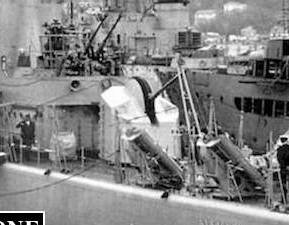
For those who don't know how the original Sovrapposto looked like (Basically an elevated twin mount) here are the only photos of it:
Official designation 76mm/62 Pozzuoli SMP-3 Sovrapposto
https://i.redd.it/5q8un3zh4y761.jpg
https://pbs.twimg.com/media/D9Lo3bjXsAErugC?format=jpg&name=small
http://giuseppe-peluso.blogspot.com/2012/02/smp3-lultimo-cannone-di-pozzuoli.html

Coupling the mounts is exactly what was intended, yes. The design of the mounts was intended to act as a prelude to that eventuality. Ex, as stated by the source I mentioned in my OP;

"La configurazione a canne sovrapposto avrebbe dovuto preludere alla realizzaione di un impianto quadruplo da 76/62, inizialmente previsto per l'imbarco sull'incrociatore Giuseppe Garibaldi trasformato, assieme ai nuovo impianti binati da 135/45;"

Note that the text specifically states that the Sovrapposto's arrangement should have been the prelude to the quadruple mount (had the later mount actually have been built).

Another text I have, a USMM publication from 1970 (Esploratori, Fregate, Corvette, ed Avvisi Italiani by Franco Bargoni & Franco Gay), states;

"...erano armi modernissime progettate per un eventuale complesso a quattro canne mediante accomppiamento di unità binate."

Bold part stating that they were designed for a possible four-gun mount via the coupling of two twin 'units'.


That being said, I would emphasis that the SMP-3 was a project of Stabilimenti Meccanici di Pozzuoli, while the Sovrapposto was a project of OTO Melara, albeit derived from the SMP-3, with a very different loading system, so it would be incorrect to describe the Sovrapposto as a Pozzuoli project. As far as I can tell the gun itself should be the same, at least in regards to ballistics, but needless to say the mount is very different, and so is the reloading system. It seems for the subsequent 76/62 Allargato developed by OTO-Melara, however, the gun itself did change, as the ballistics are different (heavier shell, lower MV, slightly greater range, according to the latter book).

This is the second mention of a quad 76mm mount. In an article written by George Moore in Warship; I can't look up which edition as those are books are in storage. The article was about the immediate post war cruiser porjects a number of which featured quad 76mm mounts, which given the weight of the twin 76mm MK6 could have worked out extremely heavy. What was the projected of the twin Sovrapposto?

Unfortunately none of my sources give a weight for the Sovrapposto.
 
Ohh? Looks like I remembered incorrectly about the Pozzouli mount being the Twin one.
Though it is indeed difficult to get info on early cold war Italian guns. Adds to the confusion that both Pozzuoli and OTO-Malera developed a Sovrapposto gun/mount

To my knowledge the Sovrapposto was mounted on these vessels:
Indonesian Pattimura class corvettes: 2x1 OTO-Melara Sovrapposto
Italian Albatros class corvettes: 2x1 Pozzuoli SMP-3 Sovrapposto
Italian Centauro class frigates: 2x2 OTO-Melara Sovrapposto
Dutch Lynx class corvettes: 2x1 OTO-Melara Sovrapposto
Portoguese Pêro Escobar class frigate: 2x1 OTO-Melara Sovrapposto
 
With the loading.
It is complex and difficult to repair or maintain.
And if you add first generation auto loading mechanisms, prone to jam or breakdown, add the difficulty to maintain and you can see why it wasn't continued.
Pro is that it requires basically the same deck space as a single mount
 
Ohh? Looks like I remembered incorrectly about the Pozzouli mount being the Twin one.
Though it is indeed difficult to get info on early cold war Italian guns. Adds to the confusion that both Pozzuoli and OTO-Malera developed a Sovrapposto gun/mount

To my knowledge the Sovrapposto was mounted on these vessels:
Indonesian Pattimura class corvettes: 2x1 OTO-Melara Sovrapposto
Italian Albatros class corvettes: 2x1 Pozzuoli SMP-3 Sovrapposto
Italian Centauro class frigates: 2x2 OTO-Melara Sovrapposto
Dutch Lynx class corvettes: 2x1 OTO-Melara Sovrapposto
Portoguese Pêro Escobar class frigate: 2x1 OTO-Melara Sovrapposto

The Sovrapposto should refer exclusively to the twin mounts - the name refers to how the guns are arranged in the twin mounts, in fact. Thus, as far as I know the armament of all the other ships - Lynx, Pêro Escobar, the Pattimura-class, and of course the Albatros-class, should all be armed with Pozzuoli-produced single mounts for their SMP-3. The actual 'Sovrapposto' mount produced by OTO-Melara is unique to the Centauro-class, and the first single-gun 76mm mount from OTO-Melara is the much better known Allargato.

Pozzuoli's single mount designs are rather distinctive looking, which makes them pretty easy to recognize, fortunately (and personally, I find them a lot cooler-looking than the Allargato, even if the latter was the better weapon system). Imagine of one of these mounts below;

ALCIONE 76 mm.jpg

You can also see some nice phots of the mount on Pêro Escobar here.

Another view here (via Esploratori, Fregate, Corvette, ed Avvisi Italiani);


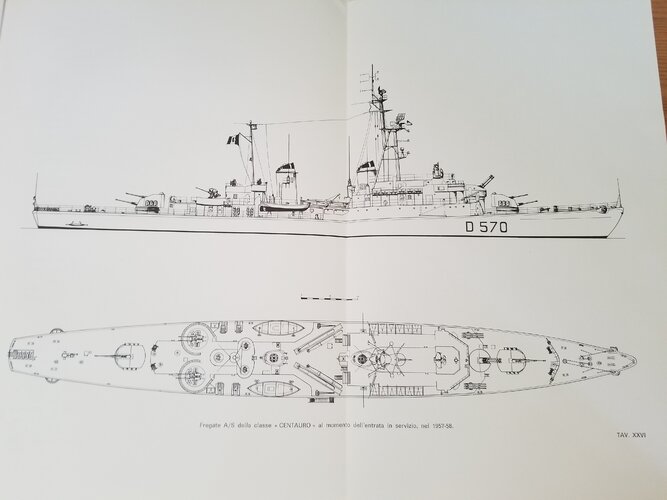
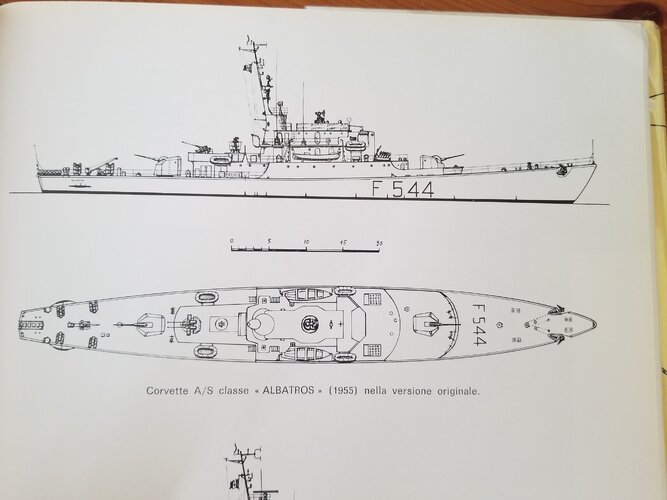
The book also includes line drawings for the Albatros-class corvettes and Centauro-class frigates, which I'll spoiler below;


Previously I've already drawn the elevated twin mount, now I imagine the quad would look like this:
View attachment 647382

Very nice work! The only thing I can really think to critique is that the stalk should be slightly further forward - if you see the line drawing above, you can see the overhang of the rear of the turrets are greater, and the front of the turret is nearly flush with the 'barbette'.

Previously I've already drawn the elevated twin mount, now I imagine the quad would look like this:
View attachment 647382
This reminds me a lot of Russian quadruple mounts. Is there any known inherent flaws with choosing this stacked arrangement?

As Tzoli said, such arrangements greatly complicate the internal arrangement and mechanisms of the turret. Ex, in this example the elevation mechanisms lie between the two guns. The SMP-3 single was guilty of being overly complex too. Unfortunately, I don't have an internal view of the Sovrraposto - just the Pozzuoli SMP-3 and the OTO-Melara 76/62 Allargato.

The SMP-3 operated as either a single fire or burst-fire system, reliant on a 14-round drum. When fired in burst, rate of fire was 50 rpm (aka, a round every 1.2 seconds, or about 16.8 seconds to empty the drum). Once the drum was depleted, the gun would have to elevate up to +90°, where the drum was reloaded (which took 3 seconds). The system in practice, fully automatic, was quite complex - too much for the time. In particular, the speed of reloading the drum proved to be a particular point of issue, and this had fatal consequences. On the Dutch corvette Lynx, a failure in the reloading mechanism occurred in the continuous elevator feeding the drum, where a cartridge was blocked, and the movement of the rollers against this blocked cartridge cause such friction as to cause the overheating and explosion of the cartridge. Believed to have been due to an incorrect amount of lubrications, this ultimately lead to the replacement of the guns on the ship with 40mm/70's, which was also in part a measure to fight topweight issues on the Albatros-class as a whole.

OTO-Melara ditched the drum system entirely when they developed the Sovrapposto mount, and each gun had its own replenishment system. This consisted of a hydraulic elevator, a carousel containing 11 cartridges, and a pair of oscillating arms. This system, when functioning properly, could allow the guns to be continuously reloaded without any interruption at any angle of elevation, and thus in theory a rate of fire of 55-60 rpm could be maintained until the magazines ran dry. Practically speaking, the only limit was the need to pause for ten seconds every 50-60 rounds to allow the barrel to cool. The system seems to have been safer, but was apparently still not satisfactory. Unfortunately, none of my sources actually specify what was unsatisfactory about them.

Whatever the case, the ultimate solution the MMI found seems to have been just using the 76/62 Allargato singles and slaving them in pairs to directors, which allowed for the same effective output - higher on paper, really, since the Allargato are sometimes credited with higher rates of fire (55-60 rpm usually, but I have a contemporary source that credits them with 70-80 rpm), and they incorporate a water-cooling system.
 
As I don't speak Italian and the very rare info I could find on the guns I might have incorrect info.
Still to my knowledge these are/were the post WW2 76mm Guns of the Italian Navy:
Pozzuoli SMP-3 Sovrapposto? from around 1951
OTO-Melara Sovrapposto from around 1952
OTO-Melara Allargato from around 1961
OTO-Melara Compact from around 1963
OTO-Melara Super Rapid from around 1988
and the final OTO-Melara Sovraponte from around 2019

all of them are 76mm/62

Also thanks for the drawings. My turret drawing was based on a ship drawing I've found on a Russian forum.
 
As I don't speak Italian and the very rare info I could find on the guns I might have incorrect info.
Still to my knowledge these are/were the post WW2 76mm Guns of the Italian Navy:
Pozzuoli SMP-3 Sovrapposto? from around 1951
OTO-Melara Sovrapposto from around 1952
OTO-Melara Allargato from around 1961
OTO-Melara Compact from around 1963
OTO-Melara Super Rapid from around 1988
and the final OTO-Melara Sovraponte from around 2019

all of them are 76mm/62

Also thanks for the drawings. My turret drawing was based on a ship drawing I've found on a Russian forum.

No worries! The language barrier can definitely be harsh, especially given the lack of coverage of period Italian armaments (especially in English, but even in Italian a lot of the niche technical stuff isn't a huge focus).

Your summary is correct for the most part. The only things I'd like to distinguish are that;

As mentioned before, the SMP-3 singles were just known as the SMP-3. Development on these started development around 1951 iirc, and entered service in 1955 with the first corvettes of the Albatros-class.

The Sovrapposto was a development of OTO-Melara, and though the gun is derived from the SMP-3, to my knowledge Pozzuoli had nothing to do with the Sovrapposto mount itself - and 'Sovrapposto' refers exclusively to this twin mount (due to how the guns are positioned). Unfortunately I'm not sure what year it started development (1952 doesn't seem unlikely), though its entry into service can be dated to 1957 with Centauro.

OTO-Melara's 76/62 Allargato, which used a new version of the gun (different ballistics, as mentioned previously) began development in 1958 and entered service in 1961 on Giuseppe Garibaldi.
 
According to Esploratori, Fregate, Corvette, ed Avvisi Italiani, the SMP-3 fired a 6 kg round at 950 m/s, with a range of 16,000 meters and a ceiling of 11,500 meters. The new OTO-Melara gun adopted for the Allargato is credited with a 6.2 kg round fired at 925 m/s, with range and ceiling increased to 16,300 meters and 11,800 meters respectively.

Which makes me curious if the figures given by navweaps (6.296 kg at 850 m/s to 18,400) are maybe a later round? Said data does match that which was eventually used on the 76/62 Compatto (Compact), and my source for obvious reasons isn't going to be able to account for anything past 1970.
 
Hello all;

I recently got my hands on a Storia Militare 'Dossier', the first part of a series covering the Italian navy from 1945 to 2015 (first part being from 1945 to 1970, issue no.14, Sept-Oct 2014) by Michele Cosentino and Maurizio Brescia.

Within the SM 'Dossier' there is mentioned, in passing, about a 1950s project for converting the cruiser Giuseppe Garibaldi to an anti-aircraft cruiser. This design pre-dated the guided missile cruiser conversion plans, and involved the new automatic 135/45, and a planned 76/62 quadruple mount, based off the new 76mm 'Sovrapposto' twin mounts. Needless to say, this plan was never carried out, and when they were able to convert Giuseppe Garibaldi, it was to a far superior design utilizing the RIM-2 Terrier. This is probably for the best too, as the year work started (1957) was the same year the 76mm Sovrapposto mounts entered service on the Centauro-class frigates, and they proved extremely unreliable - the better known and vastly more widely used 76/62 Allargato followed soon after, leaving the Sovrapposto isolated to just the Centauro's, and even those mounts were replaced by the Allargato mounts in the late 1960s.

Unfortunately, as the design is only mentioned in passing, there are literally no details mentioned beyond the fact that;

  • The design emerged in the mid-1950s
  • It involved the new 135/45 and a planned quadruple 76mm mount based on the Sovrapposto
  • It remained on paper and was replaced by the plans for the conversion to a guided missile cruiser
I was wondering if anyone here had any more information on this ballistic-only AAW cruiser?
Did you found any other data?
How many guns were envisioned? In what layout? Etc?
 
Without much data I assume the CLAA Conversion would be inspired by the French Colbert and DeGrasse. But likely the Regia Marina had less money for the conversion so a smaller gun armament of 4x2 135mm/45 and 4-6-8 (I go for 6) x4 76mm/62 Guns and some 40mm/70 OTO-Breda Type 350 light AA
 
Did you found any other data?
How many guns were envisioned? In what layout? Etc?

Unfortunately I have nothing better to go on at this time. There was a recent SM Briefing on the Abruzzi-class cruisers that covered Garibaldi's conversion to a Terrier cruiser, but that unfortunately did not include any discussion on the proposed CLAA conversion.
Without much data I assume the CLAA Conversion would be inspired by the French Colbert and DeGrasse. But likely the Regia Marina had less money for the conversion so a smaller gun armament of 4x2 135mm/45 and 4-6-8 (I go for 6) x4 76mm/62 Guns and some 40mm/70 OTO-Breda Type 350 light AA

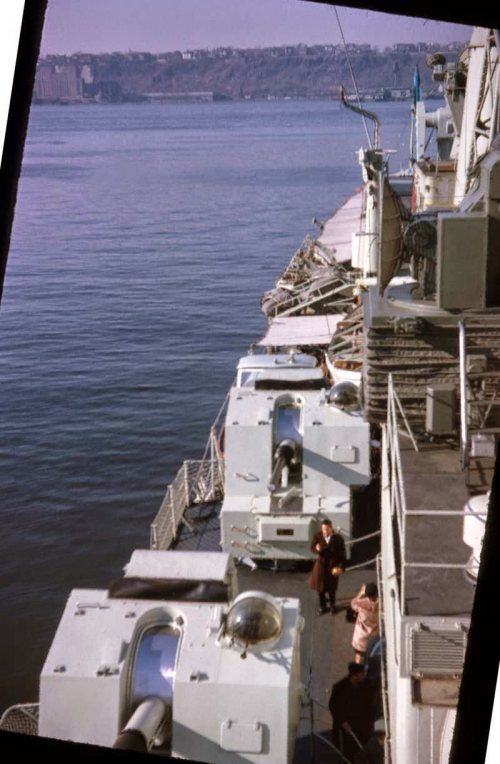
I would likewise assume a 4x2 arrangement, directly replacing the old 152/55 turrets.

With regards to to the 76mm armament - I would assume four turrets rather than six. Generally speaking on the cruisers (with eight 76mm guns), the Marina Militare would slave two gun systems (in those cases, of the Allargato) to a director and have each director group positioned to cover a different quarter of the ship from attack.

I would generally assume on the AA cruiser the same would hold true, but since they were using quadruple turrets it would be with each quad turrets rather than pairs of 76/62 Allargato.

I would be hesitant to include the OTO-Breda 40/70's, as this was a gun system the MMI had begun to move away from in the late 1950s due to the limited effective range. Ships designed with the 76/62 Allargato (like the cruisers) did not use them at all, and in some cases older classes had theirs removed (such as the Centauro-class frigates). Had the quadruple evolution of the 76/62 Sovrapposto been successful, I am not sure the MMI would have planned to install any 40/70 mounts on the ship.
 
Unfortunately I have nothing better to go on at this time. There was a recent SM Briefing on the Abruzzi-class cruisers that covered Garibaldi's conversion to a Terrier cruiser, but that unfortunately did not include any discussion on the proposed CLAA conversion.


I would likewise assume a 4x2 arrangement, directly replacing the old 152/55 turrets.

With regards to to the 76mm armament - I would assume four turrets rather than six. Generally speaking on the cruisers (with eight 76mm guns), the Marina Militare would slave two gun systems (in those cases, of the Allargato) to a director and have each director group positioned to cover a different quarter of the ship from attack.

I would generally assume on the AA cruiser the same would hold true, but since they were using quadruple turrets it would be with each quad turrets rather than pairs of 76/62 Allargato.

I would be hesitant to include the OTO-Breda 40/70's, as this was a gun system the MMI had begun to move away from in the late 1950s due to the limited effective range. Ships designed with the 76/62 Allargato (like the cruisers) did not use them at all, and in some cases older classes had theirs removed (such as the Centauro-class frigates). Had the quadruple evolution of the 76/62 Sovrapposto been successful, I am not sure the MMI would have planned to install any 40/70 mounts on the ship.
I'm not so sure on the 40mm guns.
The Centauro class was laid down/designed in1952 around the same time this gun only armed Garbiladi proposal was made while they were commissioned at the end of the 1950's around the time of the Missile Conversion was proposed. They carried two twin OTO-Breda Type 64 guns which were only replaced in the mid-late 1960's between 1966-69. That is enough time indeed for them to test these light AA guns. But as of early mid 1950's they did not know their effectiveness and also to my knowledge the Type 350 was designed around 1952, I'm not sure they were not considered for Garibaldi.
I agree on the 4 quad mounts as I making a drawing and the 3rd pair takes up precious place from the ship boats, on the other hand the aft section of the ship is basically empty! I wonder if a Helipad was considered or not?
I'm thinking that this CLAA proposal is one idea to save the ship from scrapping by extending it's usefulness, note the French built/building 2 AA cruisers around this time the deGrasse and the Colbert!

Until some sketch or more detailed text can be found we can only guess.
 
Regarding the Garibaldi's gun directors:
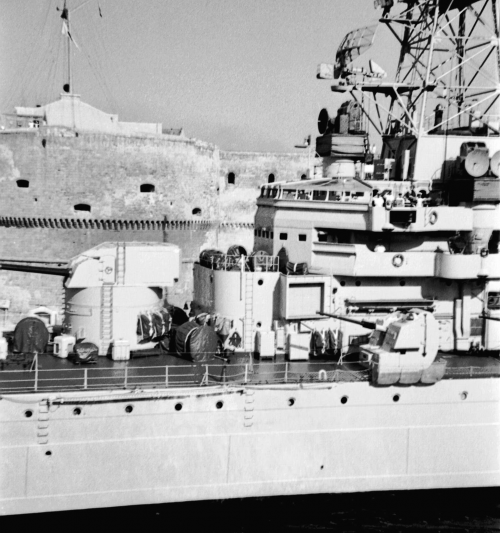
Do you know what they are called? They looks quite simple design with either one or two radar dishes. In her CLG form she had 5 such directors 2 of which twin dish versions:
1752823196558.png
1752823213108.png
1752823227335.png
1752823295729.png
 
I'm not so sure on the 40mm guns.
The Centauro class was laid down/designed in1952 around the same time this gun only armed Garbiladi proposal was made while they were commissioned at the end of the 1950's around the time of the Missile Conversion was proposed. They carried two twin OTO-Breda Type 64 guns which were only replaced in the mid-late 1960's between 1966-69. That is enough time indeed for them to test these light AA guns. But as of early mid 1950's they did not know their effectiveness and also to my knowledge the Type 350 was designed around 1952, I'm not sure they were not considered for Garibaldi.

With regards to the 40mm armament - these are all fair points. As I said, I'm hesitant and unsure about their presence on the design - but likewise I am not resolved against their presence. I just thought it was a point worth raising, as this is something of a transitory period.

With regards to specific mountings - I am not sure if we would see the Type 350, as this type was never adopted by the Marina Militare. I would suggest sticking with the Type 64 twin mounts.

I agree on the 4 quad mounts as I making a drawing and the 3rd pair takes up precious place from the ship boats, on the other hand the aft section of the ship is basically empty! I wonder if a Helipad was considered or not?

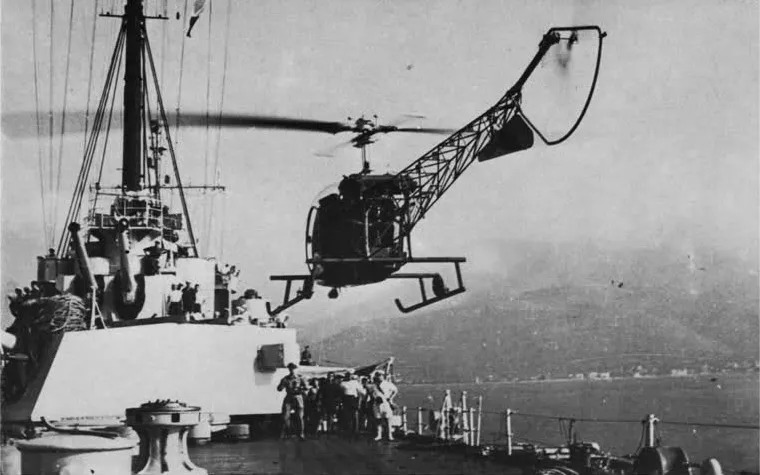
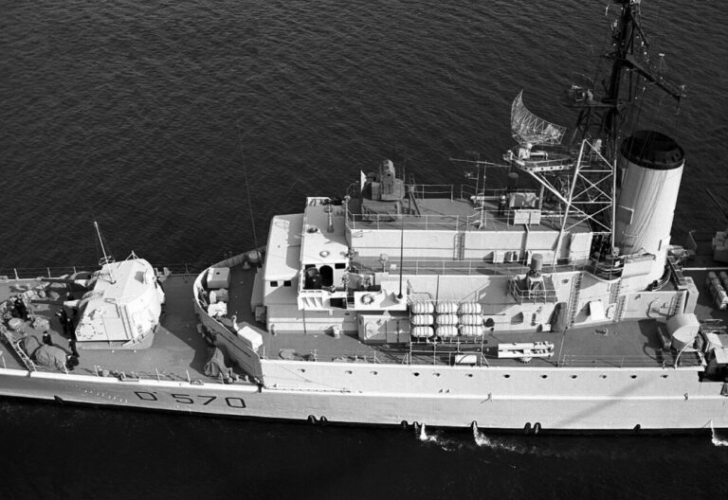
Yes - Giuseppe Garibaldi in fact already had a helipad installed during her 1949-51 refit, and it was from her that the MMI first conducted trials with the Bell 47 helicopter (5 July 1953 - see the photo below). She still retained this after her CG refit.


1752853378727.png

I'm thinking that this CLAA proposal is one idea to save the ship from scrapping by extending it's usefulness, note the French built/building 2 AA cruisers around this time the deGrasse and the Colbert!

Until some sketch or more detailed text can be found we can only guess.

This would be an incorrect interpretation. There was absolutely no intention of scrapping the ship that early.

At that point in time, the two Duca degli Abruzzi-class cruisers were the most effective surface combatants the Marina Militare had at their disposal, being relatively young (only a little over a decade of service by the early 1950s), not having been too badly worn during the War, and also going through notable modernizations in the late 1940s and early 1950s to improve their radar suites, AA armament, and install a COC (CIC). Garibaldi served as the operational flagship of the naval forces (role of navy flagship at this time was still with the Duilio-class battleships) when Duca degli Abruzzi went through her more extensive modernization from 1951 to 1953. Abruzzi would subsequently serve as the MMI's flagship until 1961, when Garibaldi returned to service and took over the role of flagship.

Garibaldi's reconstruction was a logical follow-on to Abruzzi's work - the major flaw of that project was the retention of the heavy 6" gun armament at a time when the Soviet surface threat was negligible and the MMI still did not have enough heavy AA guns at sea. Garibaldi went into reserve in 1954 and began a relatively slow-paced process of being stripped down - the Marina Militare had already started looking into the possibility of converting her into a missile cruiser, but at the time needed to study how this could actually effectively be done. The actual process of reconstructing her into a missile cruiser did not start until 1957 (and completed in 1961).


Regarding the Garibaldi's gun directors:
Do you know what they are called? They looks quite simple design with either one or two radar dishes. In her CLG form she had 5 such directors 2 of which twin dish versions:

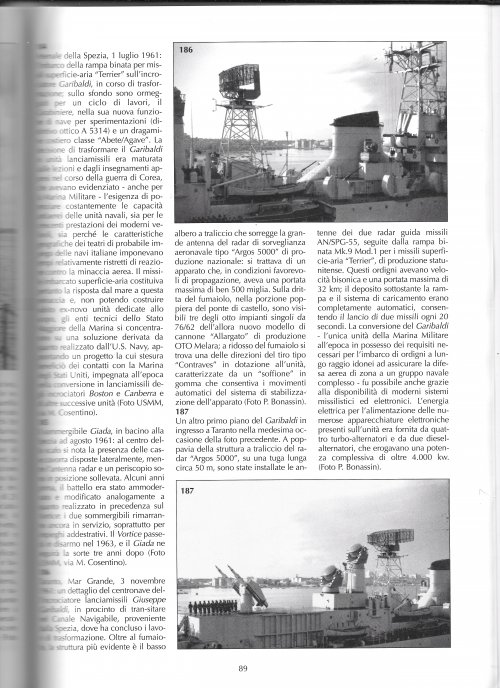
Yes. The director installed above the bridge was called the 'ADT II - mod. A' (ADT presumably being shorthand for 'Apparecchiature per la Direzione di Tiro', which featured the Selenia Orion 250 RTN-1A fire control radar (and then later replaced the Orion 250 RTN-3A). This then fed a CLT-135/76-1A fire control computer by Contraves Italiana, which, as the name suggests, could be used to control both the forward 135mm guns but also the 76mm guns if necessary.

The other four directors were the 'ADT II - mod. B', which used the Selenia's Sagittario 200 fire control radar (a CWFM pulse doppler). The fire control computer used was the CLT-76-1A.
 
Without much data I assume the CLAA Conversion would be inspired by the French Colbert and DeGrasse.
Influenced by is probably fair, but not-necessarily 'inspired by' given the RM had tried to build CLAAs at least twice - rebuilds of the Alberto de Guissano class c1938 (cancelled) and the Etna class rebuilds of the Thai Taksin class c1941. And there were also a bunch of projects for multi-barrel turrets - quads, sextuples, and octuples. So there's all the inspiration needed in their own institutional memory without needing to invoke the French.
 
Yes. The director installed above the bridge was called the 'ADT II - mod. A' (ADT presumably being shorthand for 'Apparecchiature per la Direzione di Tiro', which featured the Selenia Orion 250 RTN-1A fire control radar (and then later replaced the Orion 250 RTN-3A). This then fed a CLT-135/76-1A fire control computer by Contraves Italiana, which, as the name suggests, could be used to control both the forward 135mm guns but also the 76mm guns if necessary.

The other four directors were the 'ADT II - mod. B', which used the Selenia's Sagittario 200 fire control radar (a CWFM pulse doppler). The fire control computer used was the CLT-76-1A.

Visually (based on the few photos which actually shows this director) there seems to be no distinction between the two variants.
Even Impavido carried one of these:
1753080950032.png

I've been notified that some sources state the two-dish variant was used for missile guidance in conjunction with the two SPG-55 radars on the aft.

Also do you know any data (Dimensions, drawings) of the long range ARGOS-5000 radar?
 
Last edited:
Here is my iteration on this proposal:
https://www.deviantart.com/tzoli/art/Giuseppe-Garibaldi-AA-Cruiser-Design-1221169920
dk71wqo-08092496-0e1a-46bc-a3b6-855d69929389.png
 
Influenced by is probably fair, but not-necessarily 'inspired by' given the RM had tried to build CLAAs at least twice - rebuilds of the Alberto de Guissano class c1938 (cancelled) and the Etna class rebuilds of the Thai Taksin class c1941. And there were also a bunch of projects for multi-barrel turrets - quads, sextuples, and octuples. So there's all the inspiration needed in their own institutional memory without needing to invoke the French.

Yes, this is correct.

Even if you exclude wartime and pre-war projects, there were multiple proposed refits of Italian cruisers into improved anti-aircraft platforms. When the hull of Muzio Attendolo was recovered in 1949, the Marina Militare looked into trying to 'exchange' her with the heavily worn and obsolescent Luigi Cardona under the limits of the 1947 Paris Peace Treaty, and refurbish her into an anti-aircraft cruiser with ten to twelve 5"/38 in twin turrets. The MMI's meager budget at the time killed this project in the cradle and Muzio Attendolo was instead scrapped from 1949 to 1950.


Likewise there was the project for the reconstruction of the two Capitani Romani-class cruisers left over after the peace treaty into destroyer leaders, which was devised in 1950 though not executed until 1953, again due to budgetary limitations. Pompeo Magno was recommissioned as San Giorgio in 1955, and Giulio Germanico as San Marco in 1956.

Meanwhile, the decision to complete De Grasse was made in January 1951, and completed in 1956.

Visually (based on the few photos which actually shows this director) there seems to be no distinction between the two variants.
Even Impavido carried one of these:

Yes, they were essentially the same system. The director was developed from the ADT 127-A (and CLT-127-A fire control computer), which was developed by Contraves Italiana for the aft fire control position of the San Giorgio-class destroyers leaders (rebuilt Capitani Romani), using Selenia's Orion RTN-1A. The Regia Marina was so impressed by the performance of this system that they decided to have Contraves Italiana handle all the gun fire control mechanisms for Giuseppe Garibaldi's reconstruction. The ADT II - mod. A was very similar to the ADT 127-A (using the same fire control radar), while the ADT II - mod. B used the dual-dish Sagittario 200 (a continuous wave frequency modulated pulse doppler radar). Though, on closer look at photos, I'm noticing that Garibaldi's forward pair of ADT II - mod. B had the dual-dish radar, but the aft pair are a single dish set, which is interesting. I'm not entirely sure what's going on there.

---

Though, with that said - thinking about this a bit more, and if this is an earlier reconstruction of Garibaldi, it may be the case that she does not use these fire control systems - they would not have had time to prove themselves on the Santi, after all.

I would assume that the fire control system for the 135/45 would remain the same, but it may make more sense to have the rest of the fire control system more closely reflect what was installed on the Centauro-class frigates.

For the 76mm Sovrapposto battery, the fire control system was the NA-4 produced by Nuova San Giorgio (the same company as the pre-war San Giorgio, re-named in 1954. They were also responsible for the new automatic turrets for the 135/45). The fire control directors were the OG-2 from [the likewise still surviving] Officine Galileo, which utilized the MLT-4 fire control radar (an improved version of the MLT-1, which itself was a derivative of the American Mk.39 fire control radar).

For the 40mm battery, two OG-1 directors were used (colonnine, similar to the American Mk.51 directors).

I've been notified that some sources state the two-dish variant was used for missile guidance in conjunction with the two SPG-55 radars on the aft.

That is... interesting. I've not read of such a capability before - do you happen to know what sources these would be?

SPG-55 had an X-band CW component for illumination functions, so the Sagittario 200 in theory could perform such a task - but I'm unsure if this was the case in practice. It's not something I've read about before, but sources on this radar are scare to begin with.

Also do you know any data (Dimensions, drawings) of the long range ARGOS-5000 radar?

I can tell you it was positioned 23.5 meters above sea level, but unfortunately I'm lacking on other details.

Best I can do in terms of sketches are the following:


Apparently I've been mistaken that the Centauro Class carried the Type 64 OTO-Breda Gun.

This is a good catch. Yes, looking through what photos I have, the mounts definitely look more like the Type 106 than the Type 64. Which is interesting, because NavWeaps claims that the Type 106 only entered production in 1969. I think that claim is based off a Jane's entry for the guns? My uni library has some Jane's editions from the 70s and 80s, I will check when I next have access to them.
 
Question of 40/70 mounts on Centauro-class frigates and Albatros-class corvettes has always perplexed me.
Almost all websites claim they were Type 64, but Type 64 clearly looks different than mount on those early frigates. Moreover, Type 64 is quite an advanced mount (German navy replaced Type 106s with Type 64s on at least Hamburg-class destroyers and training ship Deutschland in late 1960s - early 1970s). Mounts on Albatros-class, for example, didn't last beyond early 1960s and were replaced by single Type 107 mounts.
However, there is a problem: they don't look like Type 106 either.
My hypothesis is: mounts used on Centauro-class and Albatros-class were a "quick and dirty" solution by Breda that not even received a Type number - it looks like someone just took two 40/70 autocannons and mounted them on an existing 40/60 Mk.1 or Mk.2 mount to create a 40/70 mount that would take the same amount of deck space as older 40/60 twin mount. After proper numbered breda-bofors series mounts began to be in production, that "quick-and-dirty" mount got replaced.
 
Even if you exclude wartime and pre-war projects, there were multiple proposed refits of Italian cruisers into improved anti-aircraft platforms. When the hull of Muzio Attendolo was recovered in 1949, the Marina Militare looked into trying to 'exchange' her with the heavily worn and obsolescent Luigi Cardona under the limits of the 1947 Paris Peace Treaty, and refurbish her into an anti-aircraft cruiser with ten to twelve 5"/38 in twin turrets. The MMI's meager budget at the time killed this project in the cradle and Muzio Attendolo was instead scrapped from 1949 to 1950.

That's very interesting, do you have any details about the layout of the guns (amidships turrets? wing turrets?), or whatever the light AA might have been? Assumedly damage would have to be repaired and new directors would be necessary, so it makes sense that the proposal was out of their price range
 
That's very interesting, do you have any details about the layout of the guns (amidships turrets? wing turrets?), or whatever the light AA might have been? Assumedly damage would have to be repaired and new directors would be necessary, so it makes sense that the proposal was out of their price range

There is no information on this account, unfortunately. I am not sure how detailed the plans were, as the idea did not survive particularly long given the political and financial constraints, which were never so great on the Marina Militare as they were in those years (1948-50).

I suspect that the main gun layout would reflect that of the Dido-class or Oakland 'class', depending on the number of turrets embarked - all centerline, with three forward, and two or three aft.

Physically there's more space aft above deck, but that aft deckhouse is right above the aft engine room, which means you can't have a magazine directly below an additional 5"/38 turret. Whereas if you radically rebuild the forward superstructure, you can remove the no.1 & no.2 boilers and re-build the forward funnel (and trunking) to reduce its footprint and size (as was done on Raimondo Montecuccoli, when she was rebuilt into a training cruiser from October 1953 to June 1954). Then you can remove the conning tower structure and build a new superstructure, shifted further aft, allowing for a third turret and a position for a Mk.37 director.

Longitudinal cut of a Montecuccoli-class cruiser, as built:

1759594190619.png

The Light AA would have almost certainly been composed exclusively of the Bofors 40/56, in a mix of Mk.1 twins and Mk.2 quads. The Capitani had twenty (3x4 Mk.2, 4x2 Mk.1) as rebuilt, Duca degli Abruzzi had twenty-four (4x4 Mk.2, 4x2 Mk.1), I suspect Muzio Attendolo would have fallen in a similar range if converted to an AA cruiser.
 

Similar threads

Back
Top Bottom