US Navy APHNAS (SSN with UGM-89 Perseus / STAM) 1971

Triton

Donald McKelvy
Senior Member
Joined
14 August 2009
Messages
9,704
Reaction score
3,625
Website
deeptowild.blogspot.com
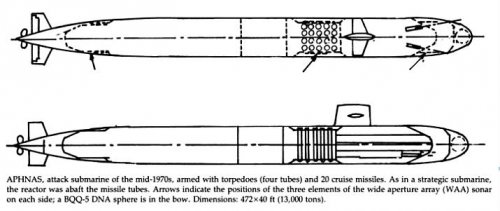
The APHNAS (Advanced Performance High-speed Nuclear Attack Submarine) from 1971 was armed with four torpedo tubes and 20 cruise missile tubes aft of the sail.

Specifications
-------------

LOA (ft): 400
Diamater (ft): 40
Surfaced displacement (tons): 12,075
Submerged displacement (tons): 13,649
Mean draft (ft): 32.8
Officers: 12
CPOs: 15
Enlisted: 84
Reserve bouyancy: 13%

Image and specifications from US Submarines Since 1945: An Illustrated Design History by Norman Friedman.

http://books.google.com/books?id=OJ...xsmzCg&sa=X&oi=book_result&ct=result&resnum=1
The new submarine was the first one designed for an entirely passive operation, that is, detecting targets passively at long range and then obtaining an entirely passive fire control solution. She was therefore designed at the outset to have a towed array. The active bow sphere had to be retained as a hedge against Soviet silencing.
(Page 170)

The project was killed by Admiral Elmo Zumwalt in late 1972.

If built, the ship would have been classified as an SSGN. SSGN-01?

The cruise missile tubes were supposed to carry 20 STAM (submarine tactical missile).
 

Attachments
  • APHNAS.JPG
    APHNAS.JPG
    37.8 KB · Views: 1,291
Last edited by a moderator:
Found information about STAM (Submarine Tactical Missile) or UGM-89 Perseus:

In March 1969, the U.S. Navy issued a requirement for the STAM (Submarine Tactical Missile), a new submarine-launched dual role (anti-sub/anti-ship) attack missile. It was to have a range between 9 km (5 nm) and 55 km (30 nm), and carry a new high-performance homing torpedo. STAM was to be a large missile with a length of about 7.6 m (300 in) and a diameter of 76 cm (30 in). This made it too large for torpedo tubes, and therefore a new attack submarine (SSN) type was proposed which would carry 20 STAMs in vertical launch tubes. This new SSN would have been much larger, and therefore much more expensive, than existing SSN classes. The STAM project and the new submarine class were eventually cancelled in 1973. As a replacement, the submarine-launched UGM-84 version of the Harpoon missile was developed and fielded on existing SSNs.

http://www.designation-systems.net/dusrm/m-89.html
 
If built, the ship would have been classified as an SSGN. SSGN-01?

Nope. The USN has numbered specialty combatant subs (e.g, ballistic missile and cruise missile boats) in the same SS/SSN sequence as the original attack boats, save for the odd exception for SSN-21, -22, and -23. There had already been one nuclear cruise missile sub -- USS Halibut (SSGN 587) -- and lots of boomers, so the practice was well-established. The precise hull number of APHNAS would depend on when the first one was ordered and how the previous production line was closed out, but something in the low 700s (e.g., SSGN-710) seems likely.
 
This site featuring data on the United States Missile and Rocket systems mentions a "New" Nuclear Submarine class to be equipped with 20x UGM-89 Perseus / STAMs (Submarine Tactical Missile) but both the submarine and the missile program cancelled in 1973.
http://www.designation-systems.net/dusrm/m-89.html
Do anybody know more about this 1973 USN SSN proposal? By the time frame it looks like a follow up / improved Los Angeles or earlier VLS Los Angeles class?
 
No. not really, Submarines ain't my favourite ship type.
 
This site featuring data on the United States Missile and Rocket systems mentions a "New" Nuclear Submarine class to be equipped with 20x UGM-89 Perseus / STAMs (Submarine Tactical Missile) but both the submarine and the missile program cancelled in 1973.
http://www.designation-systems.net/dusrm/m-89.html
Do anybody know more about this 1973 USN SSN proposal? By the time frame it looks like a follow up / improved Los Angeles or earlier VLS Los Angeles class?
Predecessor to Los Angeles class, IIRC. Looks like it would have been a probable replacement for Flight II, SSN-719 through SSN-750. 688 design started in 1967, STAM design in 1969.

Size wise, it's a stretched Seawolf., roughly the size of Jimmy Carter.
 
Last edited:
If built, the ship would have been classified as an SSGN. SSGN-01?
SSGN-719, it looks like, likely replacing the second flight of 688s (intended IOC in 1979). Or at least bumping the 688 VLS down the line. For whatever reason, all submarines are in a single series of numbers, regardless of type. SS, SSK, AGSS, SSN, SSG, SSGN, SSBN... The only exception is the Seawolf class that got slapped with SSN-21, -22, and -23.
 
Looks like my post did not made it before the forum issues.
None the less, here is my question again:

Did anybody seen drawings or sketches of the Perseus missile?
 
Looks like my post did not made it before the forum issues.
None the less, here is my question again:

Did anybody seen drawings or sketches of the Perseus missile?
No, not even in the back lot at SUBPAC HQ... (Not that I got to spend a lot of time there, I was basically panicking trying to find our mail and managed to run into the SUBPAC Flag Lieutenant, who saved my bacon and tore a very, very long strip off the dudes who were holding mail not addressed to them and addressed to a ship! But I had to hang out for a couple of minutes while he made phone calls instead of me running all over Pearl Harbor on foot.)

But for some reason I'm picturing a Polaris A3 shape...
 
Looks like my post did not made it before the forum issues.
None the less, here is my question again:

Did anybody seen drawings or sketches of the Perseus missile?
Only image I could find online is this shipbucket sketch of APHNAS with the artist's interpretation of STAM which kinda looks like some kind of mega-ASROC (note the blunt nose), probably extrapolating from the original 1969 requirements calling for a dual-role ASW/anti-ship torpedo carrying weapon, per the info in designation-systems.

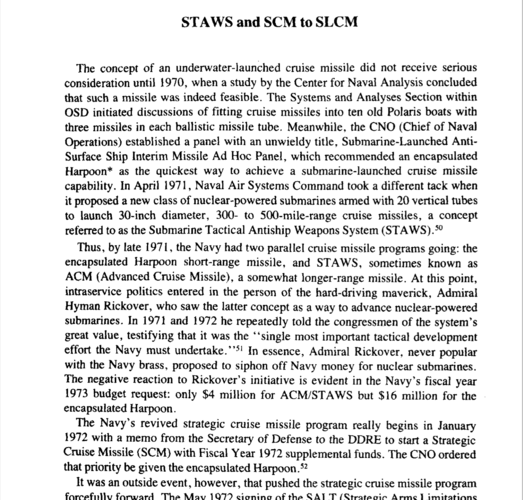
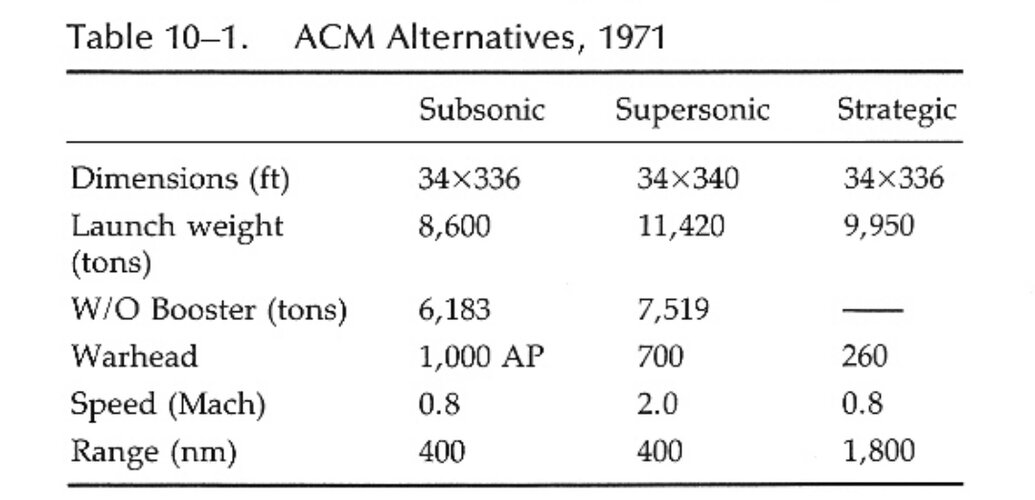
The 1971 STAWS/ACM with the three options for subsonic, supersonic and strategic-range cruise missiles per the Friedman and Werrell sources might be later proposals that grew out of STAM, or maybe are separate programs that just happen to also be slated for APHNAS' use until the whole program was cancelled in 1973.

But for some reason I'm picturing a Polaris A3 shape...
I myself am thinking containerized reduced size (34" from 50") Regulus II for the supersonic STAWS version.
 
Did anybody seen drawings or sketches of the Perseus missile?
As far as I understood, the Perseus was never finalized. The original design was basically -

looks like some kind of mega-ASROC (note the blunt nose)
- essentially the idea was to have a short-to-medium range rocket-powered missile, armed with heavy 21-inch homing torpedo. It was essentially viewed as conventionally-armed alternative to nuclear-only SUBROC.

But later the project became much less clear, with multiple radically-different varieties - sunsonic anti-ship long-range missile, supersonic strategic nuclear missile - appearing. My personal suspision, that at some point "Perseus" shifted from weapon development into "justification for APHNAS".
 
But later the project became much less clear, with multiple radically-different varieties - sunsonic anti-ship long-range missile, supersonic strategic nuclear missile - appearing. My personal suspision, that at some point "Perseus" shifted from weapon development into "justification for APHNAS".
That's sure what it sounds like to me.

I could see a development from Super-ASROC to big AShM, but supersonic strategic nuke?!? Nah, that's trying to score funding money.

Super-ASROC to big AShM makes sense in terms of having a long range strike weapon for subs or ships.

But the AShM was competing with both the Tomahawk AShM for long range and the Sub-Harpoon for short range AShM, and both of those could fit through a 21" torpedo tube. No reason for a new sub with fat VLS tubes to give Rickover one last War Boner. But nuclear strike would go through a different funding channel.
 
I could see a development from Super-ASROC to big AShM, but supersonic strategic nuke?!? Nah, that's trying to score funding money.
Essentially yes. The program, started initially as more or less specific idea of "super-ASROC" (or conventional SUBROC, to be exact) basically became "look what else we could fire from this awesome super-submarine". The submarine was clearly first in Rickover priorities - and Perseus mainly the way to force it into reality.
 
I could see a development from Super-ASROC to big AShM, but supersonic strategic nuke?!? Nah, that's trying to score funding money.
On the other hand, during the timeframe in question, the Cold War was increasingly going poorly for the United States and her allies, not least in the areas of tactical and strategic nuclear systems, thanks to insanities such as 'Strategic Sufficiency'.
 
The concept of Strategic Sufficiency was fine, in the era of Stagflation and the Oil Crisis defence spending could not rise uncontrollably, it's not like the Nixon administration was especially stingy when it came to the procurement of strategic systems, they did after all start the MX, Trident and B1 Bomber programs. You get the idea from some people on here that the US lost the Cold War because of insufficient defence spending.

Notably the Soviet Union's MIC was very good at getting what they wanted with very little in the way of limits or oversight, and that is ultimately one of the causes of their collapse.

As for the appearance of UGM-89 Perseus, Lockheed won the STAM contract in 1969, I wouldn't be surprised if the supersonic variants were related to their near contemporary CLAM and CLAMP studies that were being studied for the US Air Force earlier in the 1960, but adapted for being stored in missile tubes and launched underwater, although this is conjecture. I can't imagine the subsonic variants being much of a departure from later subsonic cruise missiles in terms of aerodynamics, only that UGM-89 would be much bigger.

The Shipbucket one in entire conjectural, iirc the person who drew it depicted a Mk 48 with some boosters.
 
Last edited:
What I mean is that a supersonic, heavy AShM roughly the same range as the "Conventional SUBROC" makes sense in terms of how far your submarine can reach and engage targets. It's a weapon for an extremely urgent target, say a boomer on the surface and launching or something similarly weird. Something that you cannot spend the time to sneak up on like submariners normally want to do.
 
The APHNAS (Advanced Performance High-speed Nuclear Attack Submarine) from 1971 was armed with four torpedo tubes and 20 cruise missile tubes aft of the sail.

Specifications
-------------

LOA (ft): 400
Diamater (ft): 40
Surfaced displacement (tons): 12,075
Submerged displacement (tons): 13,649
Mean draft (ft): 32.8
Officers: 12
CPOs: 15
Enlisted: 84
Reserve bouyancy: 13%

Image and specifications from US Submarines Since 1945: An Illustrated Design History by Norman Friedman.

http://books.google.com/books?id=OJ...xsmzCg&sa=X&oi=book_result&ct=result&resnum=1

(Page 170)

The project was killed by Admiral Elmo Zumwalt in late 1972.

If built, the ship would have been classified as an SSGN. SSGN-01?

The cruise missile tubes were supposed to carry 20 STAM (submarine tactical missile).
I am confused. In the text, the submarine's dimensions are given as 400' x 40', however, the diagram, included in the post, gives her dimensions as 472' x 40'
 
I am confused. In the text, the submarine's dimensions are given as 400' x 40', however, the diagram, included in the post, gives her dimensions as 472' x 40'
One assumes different stages in the evolution of the design.
 
I've noted this before, but Seawolf is effectively APHNAS without the vertical missiles.

Basically all the advanced innovations that went into Seawolf, except for the pumpjet propulsor and the bow diveplanes, which were later inventions, were originally part of the program brief for APHNAS - because the stand-off ASW missiles carried by APHNAS were so big that the boat needed to be 40 foot in diameter (perfect for Rickover's big D1W-derived reactor); they were so long ranged they needed a new sonar concept to get the range to locate targets (conformal flank arrays, and a large towed array); and the designers even thought to put eight large-diameter torpedo tubes so that it wouldn't have to reload mid battle and had room for future large diameter weapons.

And every last bit of that ended up in the Seawolf. Except the missiles.
 
I've noted this before, but Seawolf is effectively APHNAS without the vertical missiles.

Basically all the advanced innovations that went into Seawolf, except for the pumpjet propulsor and the bow diveplanes, which were later inventions, were originally part of the program brief for APHNAS - because the stand-off ASW missiles carried by APHNAS were so big that the boat needed to be 40 foot in diameter (perfect for Rickover's big D1W-derived reactor); they were so long ranged they needed a new sonar concept to get the range to locate targets (conformal flank arrays, and a large towed array); and the designers even thought to put eight large-diameter torpedo tubes so that it wouldn't have to reload mid battle and had room for future large diameter weapons.

And every last bit of that ended up in the Seawolf. Except the missiles.
I don't really see any similarities beyond the hull diameter (a coincidence), which is not surprising given that the programs were separated in time by over a decade.

There is no real similarity in the sonar beyond broader trends in U.S. submarine design: towed arrays were introduced to the fleet in the late '60s and become essentially ubiquitous in the 1980s when the Seawolf was being designed. The WAA envisioned for the APHNAS had little in common with the BQG-5 WAA fitted to the Seawolf. At that time, the WAA sub-arrays were rigid, planar panels like the older BQG-2 PUFFS, which required double-hull sections to integrate into the streamlined hull. The BQG-5 WAA has conformal sub-arrays that can be affixed to the pressure hull. The Seawolf had a unique passive-only spherical array (bigger than the BQQ-5/BQS-13 sphere) with an active hemispherical array below it.

There was nothing specific in common between the APHNAS and Seawolf propulsion plants. The 45,000-SHP S6W plant was a clean-sheet design that was less powerful than the 60,000-SHP D1W. The S6W is a low-flow, forced circulation design, which is likely very different than the D1W. And the Seawolf's machinery was the result of the Improved Performance Machinery Program, which began well after the APHNAS was cancelled. The method of sound-isolation was novel to the Seawolf.

Rickover had to sell his new reactor plant concepts to Congress, which often meant justifying a large reactor plant for a large submarine. Another contemporaneous project was a massive, twin-reactor (~30,000 tons, if memory serves) SSBN design, which Rickover tried to justify with the rather flimsy claim that SSBNs needed to be fast to evade Soviet SSNs. APHNAS strikes me as a similar exercise: a massive submarine with a novel reactor plant with the SSGN role as post-facto justification.
 

Similar threads

Back
Top Bottom