Gourdou-Leseurre/Gourdou Designations

Apophenia

ACCESS: Top Secret
Senior Member
Joined
25 July 2007
Messages
4,917
Reaction score
5,538
A stab at Gourdou-Leseurre and Gourdou aircraft designations. As usual, plenty of gaps to fill and a couple of mysteries.

One is the 'GL 87.192' project from 1937 (although that '.192' is likely just be a typo added on to GL 87). Another is the 'Gourdou ES.2' F-PAAT listed by Golden Years of Aviation:
http://www.airhistory.org.uk/gy/reg_F-23.html To me, that 'ES.2' seems more like a widowed Armée de l'Air role designator than a manufacturer's designation.

A minor mystery (for me anyway) is the CAP.2 alternative designation for the high-altitude GL 40/Type G. Does anyone know the meaning of that CAP acronym?

As always, any additions or corrections are most welcome ...

_________________________


Gourdou-Leseurre

Aircraft Designations of Charles Edouard Pierre Gourdou and Jean Adolf Leseurre

There were two basic forms of Gourdou-Leseurre designations - Type Letters and Alpha-Numerical listings.

Known type letters range from Type A to Type M. Type letters are sometimes rendered in lower case (eg Type a). Subtypes were given number suffix (eg Type B1). Type letters were presumably design office designations since alpha-numerical designations were also (or later) applied to these aircraft.

Alpha-numerical designations from 1917 to 1925 had a GL prefix. From 1926 to 1928, Gourdou-Leseurre was the design office for Ateliers et Chantiers de la Loire. During that period, GL designations became LGL (although, here, I have retained the GL form for simplicity sake). After 1930, the use of GL prefixes resumed until 1938 when G designations appear for Gourdou designs.

In normal French fashion, airframe developments receive a suffix number -- so, an improvement upon the GL 33 (aka LGL 33) is designated GL 331 (LGL 331). The suffix Hy (or HY) for Hydravion is added for floatplanes.

In published sources, GL numerical designations are rendered with a space, a period, or a hyphen. Individual airframe numbers follow after a hyphen. Military suffix letters/number designations follow with or without spaces or punctuation (I have used a space with a period between the role designator and crew number).
 
Gourdou-Leseurre Type Letter Designations

Type A - see GL 1; aka Type a

Type B - see GL 2; aka Type b; aka Type b C.1
- Type B : aka GL 2
- Type B2: aka GL 21
- Type B3: aka GL 22
- Type B4: aka GL 23
- Type B5: aka GL 22 ET
- Type B6: aka GL 24
- Type B7: aka GL 25; Lorraine Algol radial

Type C - (??)
Type D - (??)
Type E - (??)

Type F - 1921 2-seat recce-fighter to CAP.2*
-- * 1919-20 Service Aéronautique requirement
- F : High-altitude a/c; req. cancelled 1920
- F : aka Gourdou-Leseurre CAP 2

Type G - 1921 2-seat recce-fighter to CAP.2
- G : High-altitude a/c; req. cancelled 1920
- G : aka G CAP.2; aka Gourdou-Leseurre CAP 2

Type H - see GL 51

Type I - High-wing racer & fighter types; see GL 31; x 2
- I : Shoulder-wing racer for 1923 Coupe Beaumont; x 1
-- I : 1 x 380 hp Bristol Jupiter; retractable u/c
-- aka 'I 1'; aka 'I1'; aka GL I
- I 2: (Project) 1923 shoulder-winged fighter aircraft
-- I 2: 1 x 380 hp Gnome & Rhône 9 Ab Jupiter
-- aka I2, aka GL-I2; aka GL 30 (not built)
- I 3: 1926 parasol-winged fighter; private venture; x 1
-- I 3: 1 x 380 hp Gnome & Rhône 9 Ab Jupiter
-- I 3: aka I3; aka GL 31

Type J - (??)
Type K - (??)

Type L - 1926; L 2/L 3 for catapult observation a/c competition
- L : (??)
- L 2: 1926-27 recce float monoplane; F-AIJT, 1 x built
-- L 2: 1 x 380 hp Gnome & Rhône 9 Aa Jupiter
-- L 2: aka L 2-01, Loire-Gourdou-Leseurre L.2, withdrawn Oct 1931
-- https://www.secretprojects.co.uk/threads/villiers-projects-and-prototypes.6948/#post-59450
- L 3: 1928 pre-production recce floatplane; 6 x built
-- L3: Pre-production series for the GL-810 HY

Type M: Flying boat design
- M : (??)
- M 2: 1926 'raid' type biplane flying boat
-- M 2: 2 x 260 hp Hispano-Suiza 8 Fs

__________________________
 
Last edited:
Gourdou-Leseurre GL Designations

GL 1 --- 1917-18 parasol monoplane fighter prototype; x 1
- GL 1 : 1 x 180 hp Hispano Suiza 8Ab V8; span (??) m
-- Orig. Gourdou-Leseurre Type A; led to Type B/G 2 series

GL 2 --- 1918 parasol monoplane fighter; 20 x built
- GL 2 : 1 x 180 hp Hispano Suiza 8Ab V8; span (??) m
-- Originally designated Gourdou-Leseurre Type B
- GL 21: G 2 with revised ailerons; 21 x buil
-- CL 21: aka Type B2, Type B2 C.1, GL 21 C1
- GL 22: Revised wings, tail, & undercarriage; x 71
-- GL 22: aka Type B3; aka GL 22 C1
-- GL 22 ET (Ecole de Transition): unarmed trainer
-- GL 22 ET1: Type B3; Single-seat trainer; unarmed B3
-- GL 22 ET2: Type B5; tandem 2-seat trainer derivative
- GL 23: Test aircraft; aka Type B4; aka GL.23 C1; x 9
-- GL 23 : GL-22 C1 with GL-22 ET2 wings + tailplane
-- GL 23 TS: (Transport Sanitaire) air ambulance; x 1
-- GL 23 TS: 1 x 180 hp Hispano Suiza 8Ab; span 9.40 m
- GL 24: trial version of GL 22, aka B6, B6 C.1 or GL 24 C.1
-- GL 24X (Expérimental): Test airframe; 1 x built
-- GL 24X: For investigating the effects of overloading
- GL 25: Aerobatic variant; aka Type B7 (see below)
-- GL 25: 1 x Lorraine Algol 9Na radial; F-APOZ
- GL 26: (??)
- GL 27: (??)
- GL B6: 1934 aerobatic version for Jérôme Cavalli
-- GL B6: 1 x Hispano Suiza 9Qd 9-cyl. radial; x 1
- GL B7: Aerobatic version for F. Malinvaud & A. Bolland
-- GL B7: 1 x Lorraine Algol 9Na 9-cylinder radial; x 2*
-- * Civil reg. for one was F-APOZ (what was the other reg?)

GL 30 - (Project) 1923 parasol-wing fighter, retractable u/c
- GL 30: 1 x 490 hp Bristol Jupiter radial, span (??) m*
-- aka I 2, aka I2, aka GL-I2, not built (or not completed?)
-- * Possibly 10.50 m (given in some sources for GL 31)

GL 31 - 1922 parsol-wing single-seat fighter, 1 x prototype
- GL 31: GL I racer derivative, 4 x 7.7mm machine guns
- GL 31: 1 x 420 hp Gnome-Rhône 9A radial, span 12.20 m*
-- Some sources say never completed (finished as GL 32?)
-- * Some list span as 10.50 m (possibly for I 2 / GL 30?)

GL 32 - 1925 parasol monoplane fighter; 475 x built
- GL 32 : 1 x 420 hp Gnome-Rhône 9A radial; aka LGL.32
- GL 32 Hy: twin-float seaplane fighter version
- GL 32T: 'Turquie', Turkish export version, 12 built *
- GL 321: LGL.32 with 600 hp Bristol Jupiter, 1 conversion
- GL 322: (Project) Single-seat fighter, 1 x Gnome-Rhône (??)
- GL 323: Altitude record attempt aircraft; 1 x conversion
-- GL 323: Supercharged Bristol Jupiter VII 9-cyl. radial
- GL 324: 1929 landplane altitude record attempt; GL 323 conv.
-- * Other export GL 32s seem to lack such national suffixes

GL 33 - 1927 revised GL.32 with Lorraine 12Eb, 1 built
- GL 33 : aka Liore-Gourdou-Leseurre 33; LGL 33; LGL 33 .C1
- GL 331: (??), aka GL 331 C.1; F-AIHL; flew March 1927

LGL 34 - 1927 parasol monoplane fighter; GL.33 deriv; x 3
- LGL 34 : 1st prototype (F-AIIM); heavy W-12 engine; x 1
-- LGL 34 : 1 x 450 hp Hispano Suiza 12Gb; span 12.20 m
- LGL 341: As per LGL 34 except for 500 hp HS 12Hb; x 2

GL 35 - 1926-27 parasol monoplane;derived from GL 33
- GL 35 : Prototype (F-AIJU); re-designated LGL 354
- GL 351: 1 x 450 hp Renault 12Ja; span 12.20 m; x 1
-- GL 351: 1926 'chasseur jockey' contest entrant
- GL 352: (??)
- GL 353: (??)
- GL 354: 1927; GL 351 with increased fuel & armament

GL 390 - Night fighter prototype; conv. of LGL 32; x 1
- GL 390: 1 x 575 hp 'Hispano-Wright' HS.9Va (R-1820)

GL 40 -- 1922 Type G parasol monoplane fighter; x 1
- GL 40: Single-seat; to French 1921 C1 specification
-- GL 40: 1 x 300 hp Hispano Suiza 8Fb; Rateau blower
-- GL 40 achieved new altitude record of 12,066 m

GL 410 - 1928 parasol monoplane fighter, 2 x prototypes
- GL 410: Structure based on GL.31 wing, LGL.32 fuselage
- GL 410: 1 x 480 hp G-R Jupiter 9Asb, span 12.20 m
-- GL 410s tested at Villacoublay in 1932, not taken up

GL 42 - Parasol monoplane fighter derived from GL 32
- GL 421: (??)
- GL-422: GL-480 development; 1 x 500 hp Salmson 18 Asb

GL 43 - 1931 single-seat parasol monoplane divebomber
- GL 430: Carrier divebomber, 1 x 420 hp G-R 9Ady, x 1 (?)
- GL 431: (??)
- GL 432: 1936 divebomber; Aéronavale oper'al trials; x 4
-- GL 432: aka GL 432 BP1

GL 450 - 1930 single-seat parsol fighter, 1 x prototype
- GL 450: LGL 32 deriv., metal struc., for 1928 C1 comp.
- GL 450: 1 x 480 hp G-R Jupiter 9Ae, span 12.20 m
-- GL 450 tested at Villacoublay in 1932, not taken up

GL 480 - Gull-winged monoplane fighter; GL 32 deriv.
- GL 481: (Project) 1 x 500 hp Lorraine-Dietrich 12 Hdr
- GL 482: 1933 entrant into French 1930 C.1 competition
-- GL 482: 1 x 690 hp HS.12Xbrs V12; span 9.86 m; x 1

GL 50 - 1921 Type F parasol-wing 2-seat recce-fighter
- GL 50: 1 x 300 hp Hispano Suiza 8Fb V8; 1 x built
-- GL 50: Service Aéronautique CAP2 requirement*
-- * Possibly for Chasse d'Armée et Protection
-- * See c460's Reply #19

GL 51 - 1922 Type H parasol-wing 2-seat recce-fighter
- GL 51: 1 x 380 hp Gnome-Rhône 9Ab; GL 50 conv'n
-- GL 51: 1919-20 Chasse d'Armée de Nuit programme
-- GL 51: aka GL 51 CAN2

GL 52 - 1-seat parasol monoplane shipboard divebomber
- GL 520: Same as GL 52
- GL 521: 1937 , 1 x 750 hp G-R 9Kfr, 2 built (eg: FW-090)

GL 531 - (Project)1937 shipboard divebomber; GL 432 deriv.
- GL 531: 1 x 750 hp Gnome-Rhône 9 Kfr radial; span 12.20m
- GL 531: Long-chord cowl; recontoured fuselage; new tail

GL.601 - (Project) 1937 landplane; no details

GL 61 - (??) 1937 landplane; no other details
- GL 610B: (??)
- GL 611 : (??)

GL 630 - Parasol monoplane divebomber
- GL 630: Similar to Aéronavale's shipboard GL 432
- GL 631: (??)
- GL 632: (??)
- GL 633: 1 x 420 hp Gnome-Rhône 9Ady, 1 x conversion
-- GL 633: GL 630 mod to Basques for Spanish Civil War

GL 810 - 1930 3-seat monoplane catapult floatplane; x
-- L 2 : 1st prototype; mixed constr.; 1 x 380 G-R 9A; x 1
-- L 3 : 2-7 prototypes; 1 x 420 G-R 9Ady Jupiter; x 6
- GL-810 Hy: 1930; Aéronavale shipboard obs. a/c; x 14
- GL 811 Hy : 1931; for carrier Commandant Teste; x 20
- GL 812 Hy: 1933; Aéronavale shipboard obs. a/c; x 29
-- GL 812 Hy: New tail fin; revised, rounded wingtips
- GL 813 Hy: 1934; Aéronavale shipboard obs. a/c; x 13
-- GL 813 Hy: As per GL 812 Hy + Chauviere metal prop
- GL 814 Hy: Conv. to GL 812 Hy standard in 1936; x 11

GL 820 - 1935 4-seat monoplane catapult floatplane; x 3
- GL 820 Hy: Evolved variants of the GL 810 Hy series
- GL 820 Hy: 1 x 730 hp Hispano Suiza 9Vb radial; x 1
- GL 820: Differed from Gl 810 Hy in rounded vert'l tail
-- To 1933 recce seaplane contest (won by CAMS 120 boat)
- GL 821 Hy: 1936 GL-821 HY torpilleur floatplane; x 2
-- GL 821: 1 x 750 hp Gnome-Rhône 9Kfr; span 16.00 m
-- GL 821.01: 1936; 1st prototype; FW-068; open cockpits
-- GL 821.02: 1937; 2nd prototype; FW-001; 3-bladed prop*
-- * Unsuccessful GL 821.02 had enclosed crew positions

GL 830 - 2-seat colonial catapult patrol seaplane monoplane
- GL 830 Hy: (Project) 1 x 350 hp HS.9Qdr radial; not built
- GL 831 Hy: 1931 prototype; 1 x 250 hp HS.9Wa radial; x 1
- GL 832 Hy: 1934 production; 1 x 230 hp HS.9Qb; 22 x built

GL 880 Hy: (Project) Higher-powered GL 820 development
- GL 880 Hy: 1 x 930 hp Gnome-Rhône 14 Kfs radial

__________________________
 
Last edited:
Gourdou G Designations

G 10 - (Project) Telescoping-wing monoplane fighter
- G 10: Low wings; aft-set canopy; 1 x radial engine
-- https://www.secretprojects.co.uk/threads/gourdou-leseurre-prototypes-projects.8557/#post-195977

G 11 - (Project) 1938 Telescoping-wing monoplane fighter
- G 11: Similar to G 10 except for 1 x Hispano Suiza 12Y-51
-- https://www.secretprojects.co.uk/threads/gourdou-leseurre-prototypes-projects.8557/#post-646431

G 20 - (Project) 1938 single-seat light recce monoplane
- G 20: 1 x 220 hp Renault Bengali 6Q; aka G 20 R1

G 40 - (Project) 1939 dive bomber competition submission

G 50 - (Project) 1938 G 50 B2 light 2-seat bomber
- G 50: 2 x 680 hp Gnome-Rhône 14M radials

G 90 - (Project) 1939 high-wing STOL cabin monoplane
- G 90: 1 x 220 hp Renault Bengali 6Q; Fieseler Fi156 copy
-- G-90: aka G-90 A1 (Armée) artillery spotter a/c

G 110 - (??) same as G 11 (??)

G 120 - G 120 HY 2-seat observation floatplane, x 1
- G 120: 2 x 140 hp Renault 4P-01 engines; span 12.00 m

G 130 - (Project) twin-engined shipboard seaplane
- G 130: Unbuilt; SNCAC NC 420 flying boat preferred

G 490 - (Project) 2-seat dive-bomber; not completed

__________________________________________________
 
Last edited:
Many thanks Hesham. Hopefully forum members will be able to fill in some of the gaps :)
 
My dear Apophenia,I can add a little;


GL-I (or I1) was single seat racer aircraft
GL-I2 also known or developed from GL-I ?
GL-323 was developed from GL-32 with Jupiter VII engine


GL-422 was developed from GL-480,but fitted with 500 hp Salmson 18 Asb engine
 
Truly very, very impressive. Thank you so much Apophenia!
 
Thanks folks. And thanks for the additions Hesham -- those have been added to the list :)
 
Thanks folks.

AM: Thanks. 'GL 49' is missing but there seems to be a time gap between it and the G-490

Hesham: Perhaps this is my missing 'GL 60' series ?? (Obviously, 'Gordou' is just a typo.)

F-AFCF Gordou Leseurre GL.6 (25) 15.3.23 (1035) Mission Bapt., Le Bourget. Discarded 12.31.
F-AFCG Gordou Leseurre GL.6 (31) 15.3.23 (1036) Mission Bapt., Le Bourget. Discarded 12.31.
F-AFCH Gordou Leseurre GL.6 (38) 15.3.23 (1037) Mission Bapt., Le Bourget. Discarded 12.31.
 
May be my dear Apophenia,


but by Gordou-Leseurre they meant Gourdou-Leseurre.
 
hesham said:
...by Gordou-Leseurre they meant Gourdou-Leseurre.

Yes. It is quite impressive that there aren't more typos introduced considering the sheer size of these Air-Britain listings!
 
I have references to:
GL.450: a version of the GL.32 of which one was built in 1930.
GL.531: a version of GL.432 which flew for the first time on 17 March 1937.

I believe I got this information some 10 years ago from www.aviafrance.com.
 
Jos Heyman said:
GL.531: a version of GL.432 which flew for the first time on 17 March 1937.

Yes my dear Jos

of course GL-531 was a well known aircraft,how we missed it,it was a version
of GL-432,powered by one 750 hp Gnome-Rhone 9 Kfr engine in a close-fitting
long-chord cowling,a more smoothly contoured fuselage and a vertical tail of
entirely new design.
 
Apophenia said:
A minor mystery (for me anyway) is the CAP.2 alternative designation for the high-altitude GL 40/Type G. Does anyone know the meaning of that CAP acronym?
Hi,
"CAP.2" or "Cap.2" is a role designation used by the French Army for a shortlived program of two-seat high-altitude fighter and reconnaissance aircraft. I don't know what is the exact meaning of the CAP initials (maybe "Chasse d'Armée et Protection"). Specifications for this program were published in 1919, they asked for 200 km/h at 7,000m and 8,500m ceiling. These performance figures implied the use of a Rateau supercharger. The program was officially abandoned in 1920, but prototypes were nonetheless made to this specification in 1921, including the Gourdou-Leseurre GL.50/type F and GL.51/type H.

However the GL.40/type G was not related to this program. It was a single-seater and was made to a different C1 specification, dated 1921.

Source: L'aviation de chasse française 1918-1940 by Jean Cuny & Raymond Danel.

Apophenia said:
Type F - see GL 50
Type G - see GL 40, aka Gourdou-Leseurre CAP 2
Type H - see GL 51 (other sources say Type H was LGL-27)
See above remarks. I'm near certain that the name LGL-27 is bogus.

Apophenia said:
GL 40 -- 1922 parasol monoplane fighter, 1 x 300 hp HS.8Fb, 1 built, aka Type G
- GL 40: Rateau turbocharger, record alt 12066 m, aka Type G and CAP 2

GL 410 - modernized GL 40 for 1928 C.1 contest, divided u/c, 1 prototype built

GL 50 - 1921 2-seat recce-fighter, 1 x 300 hp HS.8Fb, 1 built, aka Type F

GL 51 - 1922 2-seat recce-fighter, 1 x 380 hp G-R 9Ab, 1 built, aka Type H
- GL 51: Re-engined GL 50 prototype, aka GL 51 CAN.2 *
-- * CAN.2 = chasse et à la reconnaissance de nuit, a 1921 programme

See above remarks about the CAP.2 category. The role designation CAN.2 corresponds to a different specification ("Chasse d'Armée de Nuit") introduced in 1919 and renewed in 1920. This specification was less stringent on high-altitude performance than the CAP.2.
Please also note that the GL.410 was not a modernized GL.40, it was related to the LGL.32 (for the fuselage) and the GL.31 (for the wing).
 
Hi,

GL-322 was a single seat fighter Project equipped with Gnome-Rhone engine.
 
I think there is some confusion over the dates & designation of the racer built to compete in the 1923 Coupe Beaumont. This aircraft was built with a retractable undercarriage & was powered by a Bristol Jupiter engine. According to Icare 230 ("Les Avionneurs Charles Gourdou & Jean Leseurre") page 62, this machine was designated GL I & first flew on 1st February 1923. Two further projects followed, the I 2 (alias GL 30) also with retractable undercarriage (not built) and the I 3 which was built as the GL 31.
Now if I search for GL30 I get a reference to a racer built in 1920 which had a retractable undercarriage & a Bristol Jupiter engine & which flew the Coupe Beaumont course in 1923. So this is the same aircraft but the date given of 1920 is wrong & it would appear, from Icare, that the designation is wrong as the GL 30 was never built. The correct designation of the racer should be GL I.
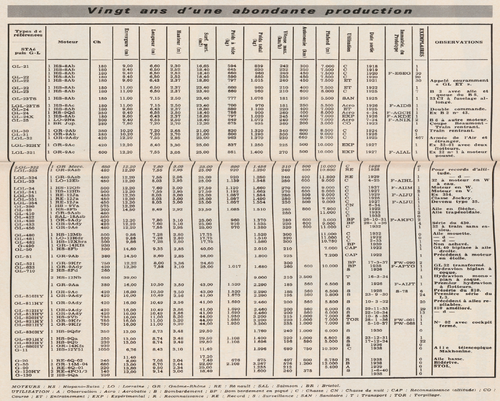
The list of aircraft from Aviation Magazine given in a previous post supports this, except that it doesn't give any designation for the racer. It does, however, give the correct year, 1923, & immediately below, it lists the GL 30 as not being built with a project year of 1924.
So it seems that the Gourdou-leseurre list should be amended to reflect this information & I would be interested to hear any comments.
 
Thanks for that. A Nov 1923 edition of Flight describes the "Gourdou-Leseurre Monoplane" in some detail but never actually identified the designation or model type. Others seem to have applied the 'GL 30' after the fact.

I also see that there is some understandable confusion out there between the GL 1 (aka Type A or GL a) and GL I.

I have made the changes to both 'Type' and 'GL' designation lists. Hopefully, whoever routinely pinches SPF stuff without accreditation for Wikipedia will now update their pages too ;)
 
Some sources say never completed (finished as GL 32?)
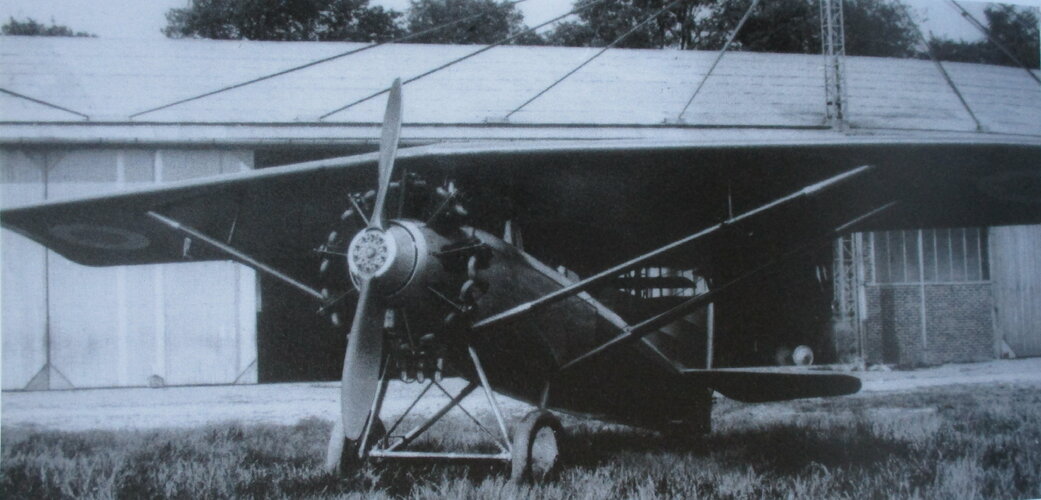
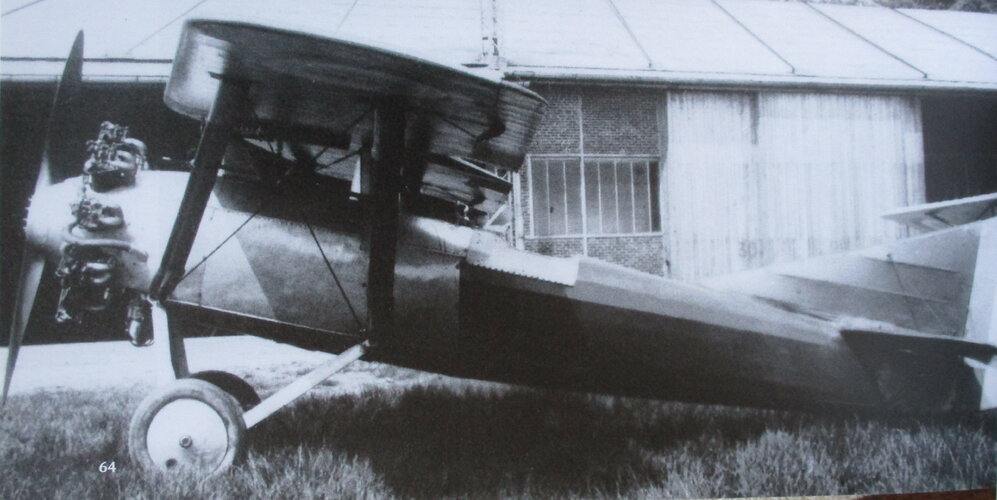
Good. I also notice that there is doubt about the GL 31 being built. From the same source as I cited above (Icare 230) I have attached 2 photos of the GL 31. The second clearly shows differences from the LGL 32 no 01.
 

Attachments

  • Gourdou-Leseurre GL 31 (1).JPG
    Gourdou-Leseurre GL 31 (1).JPG
    2.3 MB · Views: 47
  • Gourdou-Leseurre GL 31 (2).JPG
    Gourdou-Leseurre GL 31 (2).JPG
    2.2 MB · Views: 43
- GL 610B: [??], Loire-Gourdou-Leseurre 610B, LGL 610B

I check again from this designation,and I found it in my files,may
it was a patrol flying boat project ?,need confirm of course.
 
The Gourdou-Leseurre 610B and 611 are mentioned as 1940 projects that Messier worked on.

Many thanks,and please can you mention the new link for George Messier,also
I think they are wrong about the date (1940),we know GL-601 & GL-633 was appeared in late of 1920s,even GL-710 in 1930 ?!.
 
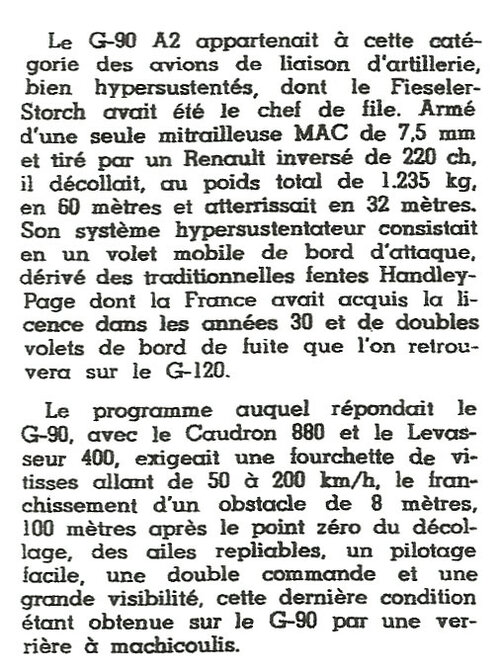
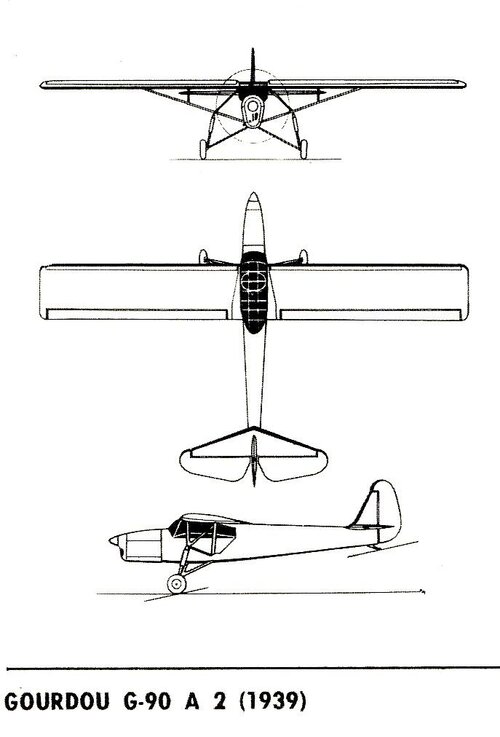
Can anyone confirm that the G.90 was not built? The chart provided by Hesham in reply #22 seems to say that it was not. I have seen a couple of drawings, but no photo. Anyone know more about this project?
 
Can anyone confirm that the G.90 was not built? The chart provided by Hesham in reply #22 seems to say that it was not. I have seen a couple of drawings, but no photo. Anyone know more about this project?
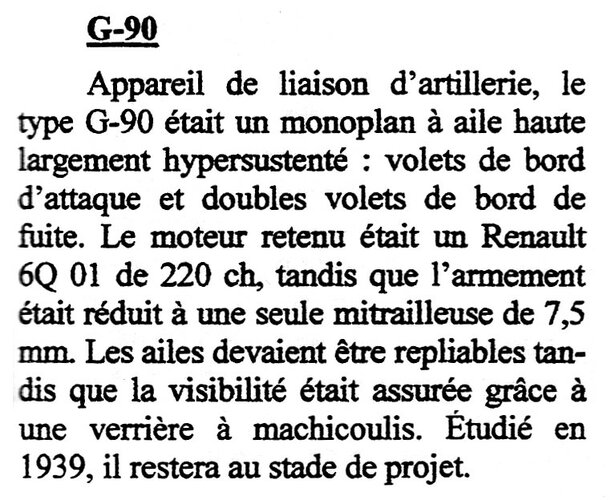
Here is what the text below says:
The G-90 was a high-wing artillery liaison monoplane with very high lift capacity (leading edge flaps and double trailing edge flaps). The engine chosen was the Renault 220 hp CQ 01, while the armament was reduced to a single 7.55 mm machine gun. The wings could be folded, and good visibility was ensured by a machicolated canopy. It was studied in 1939 but remained a project.
The second text adds a little more information:
It took off in 60 meters with a 1235-kg gross weight, and landed in 32 meters. The high lift system consisted of a mobile leading edge flap derived from the Handley-Page slots (which France had acquired the license of during the 1930s) and double trailing edge flaps, which eventually were used on the G-120.
The program for which the G-90, the Caudron 800 and the Levasseur 400 were submitted, required speeds ranging from 50 to 200 kms/h, being able to overtake an 8-meter obstacle 100 meters away from takeoff zero point, folding wings, easy handling, dual controls and great visibility ...
 

Attachments

  • G.90 (texte).jpg
    G.90 (texte).jpg
    114.9 KB · Views: 12
  • G.90 A2 (texte).jpg
    G.90 A2 (texte).jpg
    117.6 KB · Views: 16
  • Gourdou G-90 A2 plan (AviMag 499).jpg
    Gourdou G-90 A2 plan (AviMag 499).jpg
    65.8 KB · Views: 23
Thank you, Stargazer! I was fairly certain that the G.90 never flew, but even this new info is a little ambiguous, since the first text says it remained a project (which we usually understand as NOT a flying prototype), but the second text says it "took off in 60 meters."

Both the Levasseur and the Caudron prototypes flew in early 1940, but I think we can conclude that the G.90 never actually made it into the air.

Thanks again!
Chuck
 
I think there is some confusion over the dates & designation of the racer built to compete in the 1923 Coupe Beaumont. This aircraft was built with a retractable undercarriage & was powered by a Bristol Jupiter engine. According to Icare 230 ("Les Avionneurs Charles Gourdou & Jean Leseurre") page 62, this machine was designated GL I & first flew on 1st February 1923. Two further projects followed, the I 2 (alias GL 30) also with retractable undercarriage (not built) and the I 3 which was built as the GL 31.
Now if I search for GL30 I get a reference to a racer built in 1920 which had a retractable undercarriage & a Bristol Jupiter engine & which flew the Coupe Beaumont course in 1923. So this is the same aircraft but the date given of 1920 is wrong & it would appear, from Icare, that the designation is wrong as the GL 30 was never built. The correct designation of the racer should be GL I.
The list of aircraft from Aviation Magazine given in a previous post supports this, except that it doesn't give any designation for the racer. It does, however, give the correct year, 1923, & immediately below, it lists the GL 30 as not being built with a project year of 1924.
So it seems that the Gourdou-leseurre list should be amended to reflect this information & I would be interested to hear any comments.

I agree that @Apophenia's list ought to be amended.
For a start, it says that the GL.30 was a racer, when it was in fact a fighter project derived from the type "I" (letter).
Also, the racer was plain type "I", and it was built, contrary to what is written in the list.
Moreover, the designations "I 1", "L 1" and "M 1" are inappropriate, because we don't see the number "1" ever used in other Gourdou-Leseurre designation—for instance the type B moved straight from "b" to "B.2", while the type I went straight from "I" to "I.2", so it's more likely that the other designations were also plain "L" and "M" (if ever they existed).

G.-L.'s Type "I" (letter) came in three known variants:
  • Type I (1923) — a racer with shoulder wings, retractable gear, 380 hp Bristol Jupiter engine; 1 built for Coupe Beaumont 1923
  • Type I.2 (1924) = G.L. 30 — a fighter version of the above for 1923 tender, with a 380 hp Gnome & Rhône 9 Ab engine; not built
  • Type I.3 (1926) = G.L. 31 — a second fighter version developed as a private venture; same engine but parasol wing; 1 built
Not all Gourdou-Leseurre types received "G.L." numbers. If I understand correctly, those number designations were allocated to all manufacturers by the S.T.Aé. (Service Technique de l'Aéronautique) for evaluation at Villacoublay. But a racer did not have to fly outside of private airfields and was not aimed for marketing or official orders, so it didn't need to be evaluated—hence no G.L. number, just the company's own inhouse (letter) designation.

For the other instances of letter types not receiving G.L. numbers, I'm not so sure how to explain it, but they were as follows:
  • Type L.2 (1926) — the company's very first floatplane prototype with 380 hp Gnome & Rhône 9 Aa engine; 1 built [F-AIJT]
  • Type L.3 (1928) — development of L.2 and preseries of GL.810 HY; 6 built

  • Type M.2 (1926) — flying boat planned for "raid" work with two 260 hp Hispano-Suiza 8 Fs engines; the company's first of only two hull types/bimotors, and its only ever biplane type.
Also, apparently the 1924 CAP2 altitude record variant of the Type G wasn't designated G.L.40 but just G CAP2 for some reason.
 

Similar threads

Back
Top Bottom