Forest Green
ACCESS: USAP
- Joined
- 11 June 2019
- Messages
- 14,521
- Reaction score
- 31,570
Back then new missiles were not manufactured for the purpose of storage. Storage is something that happened as a result of treaties on existing missiles.Based on what? In service in 1990 meant deployed.
"In-service" has meant the same thing since the begining it means the missile is in the 'deployed' into the military missile storage, transport, maintenance AND on-alert system. 100 "deployed" simply means that many missiles in total are in the system not that they are installed in silo's and ready for use. The word is often used to MEAN such but it technically is not used that way by people who work in the field. In fact we use "in-storage", "in-maintenance", "in-transport" and "in-the-field" to specify where "in deployment" a missile is.
In this case 100 were 'deployed' into the system while only 48 were "in-the-field" deployed in silo's.
What part of all that being laid out in documentation is not clear? Funny how Russia and China don't see it that way.
What part of the documentation not being applicable when not building a past missile is not clear? The US could currently build a modernized version of the MMIII missile with little effort except where the legacy equipment no longer exists. Just like Russia and China can build missiles using their existing manufacturing process. The US could not build an MX or Midgetman as the manufacturing systems and equipment no longer exist. We'd have to build new ones and go from there. Could we? Yes, pretty easily but that's not the requirement because using what we have to build a new missile makes more sense. Russia and China are not building 'new' missiles using 'new' manufacturing systems but the same ones that built the original missiles in the first place. The US has been 'building' missiles as well to replace our older missiles and that manufacturing system is being used as the basis of the requirements for out 'new' missile system.
So what exactly are you talking about wrt a skills shortage around building solid propellant rockets when they're being built either way.
The last MMIII upgrade required that new mixing and pouring equipment be constructed and put into use and personnel be trained in it's use. Both the systems and personnel have been transfered away from those jobs since the upgrade was completed and there have been questions of the ability to get both back into service if we wait to long. There is also the issue with there being only two, (it may in fact be down to one now I'm not sure) manufacturer capable of producing large, monolithic pour solid motors.
Peacekeeper had a 2.34m diameter and Midgetman 1.18m. I believe this from an earlier thread covers it.
https://www.secretprojects.co.uk/threads/early-maneuverable-reentry-vehicle-studies.8981/
So why were there questions up-thread of fitting them to a MMIII? It in fact states that over three years three test vehicles, (prototype warheads basiclly) were successfully launched using MMI's as launch vehicles so there should be no issues fitting them to the MMIII? Length may be an issue as they look to be longer than the Mk21 but that shouldn't be an issue with land based missiles.
58.42cm vs 118cm. You could almost fit 2 at a push.
Only one a the Midgetman only had a single mounting point. Further a second warhead would require a significant upgrade of the guidance and warhead bus avionics and computers.

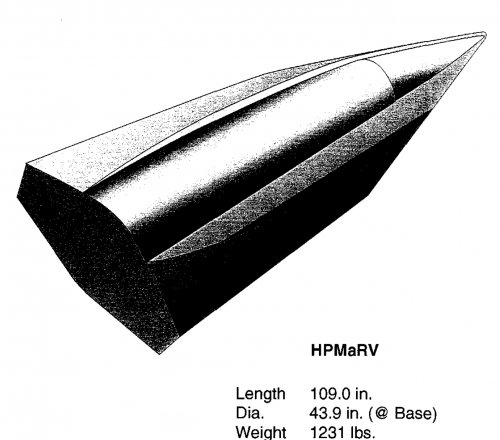
Even more advanced HGVs fit.
111.5cm vs 118cm.
The more advanced HGV would need a redesign/rebuild of the payload interface for one. Both would need new guidance and control, not a big issue but something to keep in mind for an operational system.
Err... oh no you don't, you referenced a missile dating back to the 1970s, which is the R-29 not the R-29RMU, which came in 2007. So let's not start the pigeon chess.So it wasn't I that brought up the comparision. Howver the R-29RMU2 is a basic advancment of of and from the R-29RMU, which was evolved from the basic R-29 from the 70s. In total it gained 10cm in diameter, 1.8m in length, (most of which was in the first modification in the late 70s where it went from 13.20m to 14.40m) of which it only grew 2cm on the R-29RMU. It has gained about 8,000kg of mass since the initial version but has lost around 3,000kg in the newest version despite the increased warhead load. Overall payload throw weight has remained the same since the mid-80s. You're assertion that it is a completely different missile doesn't hold up. F-18C to F-18E isn't an applicable comparision even to the original R-29 let alone the R-29RM or R-29RMU. F-18A to F-18C at best.Well actually you stated that "An R-29RMU2 is about as similar to a vanilla R-29 as an F-18E is to an F-18C. It's 15% longer, 5% wider, 25% heavier and can carry 12x as many warheads.
Given that most MM3s are only carrying one warhead, 1 HGV is still better.Given the above examples I'd agree, As I said originally I was going off the up-thread discussion as if this was an issue. Thanks for the correction.
But then I also have to point out why are we worried about the Russian's and the Chinese then? We successfully tested and set-aside a working prototype of an HGV capable of being carried on our MM fleet so using that as a basis we should be able to deploy an updated version in short order. The main issue is it likely can't be carried on our SLBM's which are length limited but a redesign of the MM payload fixture should allow at least two to be carried along with penetration aids.
Randy
The documentation also covers the manufacturing equipment you'll find. I disagree that building a new missile within the limitations placed by the defunct MM3 are the best options when the US's two main opposing powers are all building not 1 but several new missiles. And I think we have covered the fact that the R-29 and R-29RMU2 are not the same and the R-36 was built in Ukraine, so the idea that they're using the exact same manufacturing equipment and systems for the RS-28 is clearly false. The RS-26 was also a new missile although cancelled. The DF-41 is very clearly a new missile, as is the JL-3. But more to the point, this is about matching capabilities in terms of mobility and capacity, not choosing easy options. If the latter were the goal, then doing nothing would be the order of the day.
Boo-hoo. Deal with it and make the solid fuel.
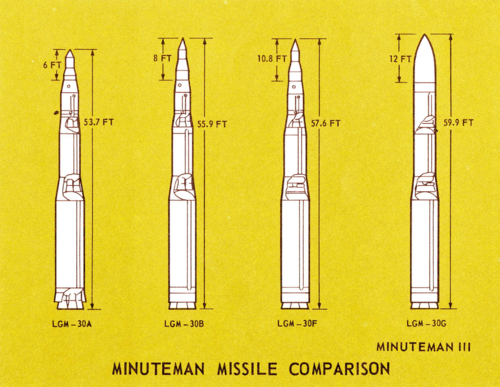
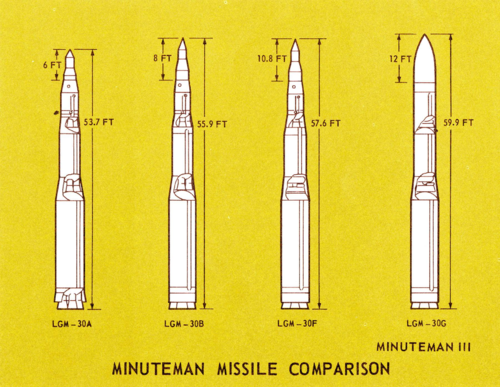
Length can't be a problem, those nose cones are 3 times as long as wide. The MM3 nose cone for instance is 12ft long (144in).
And a quick measure puts the MGM-134 nose cone at >2.5m long (>100in), not that changing a nosecone slightly would make a massive difference anyway.
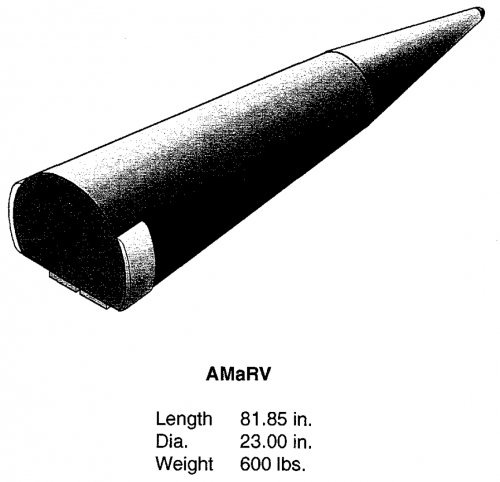
The AMARV was my original suggestion because it's relatively well tested, so that should fit and I was only saying 2 to emphasize that 1 easily fitted. The launch vehicles will need a different trajectory, and the guidance and control for the AMARV has already been worked out through testing.
The R-29RMU didn't enter service until 2007 and is still a smaller missile than the R-29RMU2. The RMU2 is 15m long and 1.9m wide. The RMU is 14.8m and 1.8m. The R-29 is 13.2m and 1.8m. But the more important thing is the increased warhead capacity. Now you're saying the mid-80s, earlier you said the 70s and that was what I made the F-18C to F-18E remark based on, which still holds.
But a Peacekeeper could carry far more.