When aircraft companies tried building houses

exclaimedleech8

ACCESS: Top Secret
Joined
30 September 2024
Messages
586
Reaction score
641
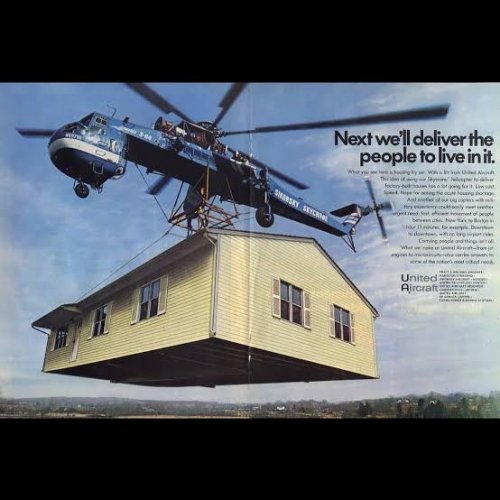
The aircraft industry is a highly cyclical business and airplane makers frequently find themselves with idle manufacturing capacity and so, historically, aircraft makers have looked for ways to diversify. This was especially the case after World War II. But just what kind of plowshares could they get from their swords? Then they realized; housing. Homes were in short supply and many airplanes had a footprint comparable to a house (A DC-3 example has a wing area alone of 983 square feet, making it larger than the Levittown Houses), so they had the factory floor space and their workers could rivet together aluminum houses just as they riveted together aluminum bombers.


1_heooVtaf-NyZXSFrmovggQ.jpg 1__v-qhD5-EJBdP5YlLFF4mA.jpg
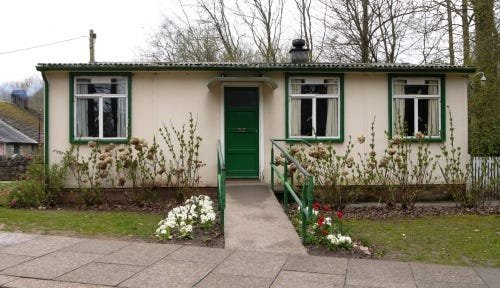
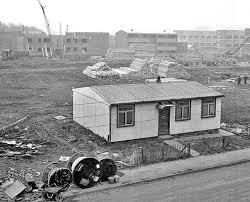
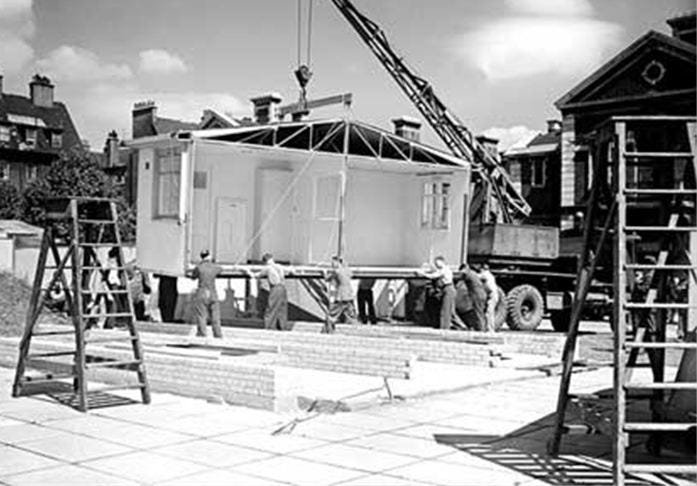
In England, this produced the AIROH (Aircraft Industries Research Organisation on Housing) Bungalow. It was made up of 2,000 different components and offered 675 square feet of floor space. To allow transportation by truck, it was split into 4 units that would be bolted together on site. 54,000 of them were built between 1946 and 1949 in factories owned by Bristol, Hawker, Vickers, and Jicwood, each using 2 tons of aluminum from airplanes that were totaled in the war. But there were problems: to allow them to be shipped without falling apart, they had to have small windows and walls that couldn't be changed. Worse was the high cost. Few of them are still standing.

Fritz-Haeg_large_0b40b328-d587-4178-95da-5b7ac27dfe02.jpg images (11).jpeg
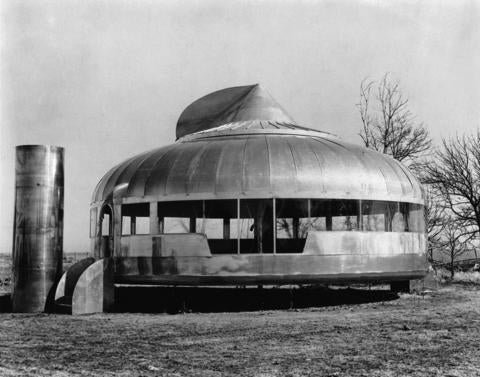
America may not have lost any homes to bombers, but the war led to major shifts in population from rural areas to cities and from East to West, leaving it with its own shortage of housing. Aircraft factories were once again looked at as a solution. The most famous attempt was Buckminster Fuller's Dymaxion House, dome shaped to use the smallest amount of material to enclose a given amount of space. The plan was to produce it at the Beech Aircraft factory in Wichita, KS, but it came to nothing.

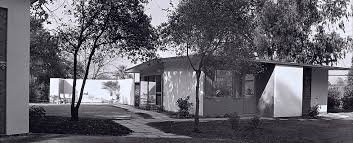
Convair had similar plans, even erecting a house made from honeycomb panels of aluminum with a paper core in South Pasadena. But they also ultimately decided against, presumably because they couldn't compete with wood for cost.
Block_BryantManor_big.jpg
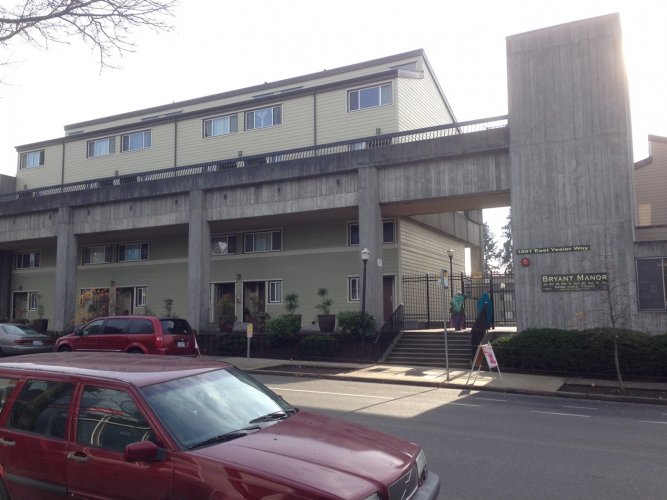
In the early 1970s, Boeing, struggling from a triple whammy of the end of the Apollo Missions, the cancellation of the SST project, and the winding down of the Vietnam War, decided to participate in the Federal Government's "Operation Breakthrough", which was an attempt to make assembly line homes a reality. All that came from it was a public housing complex in Seattle called Bryant Manor.
 

Attachments

  • images (10).jpeg
    images (10).jpeg
    10.3 KB · Views: 18
Hi,

The aircraft industry is a highly cyclical business and airplane makers frequently find themselves with idle manufacturing capacity and so, historically, aircraft makers have looked for ways to diversify.

In the case of Hugo Junkers, he was an industrialist with a variety of engineering-based businesses who had diversified into aircraft production, but I guess that still counts: He designed a variety of systems for the construction of steel hangars and houses, both small and high rise buildings: https://hugo.junkers.de/hugo-junkers/forscher-und-unternehmer/stahlbau/

He was also involved in the production of Bauhaus steel furniture. Not all that surprising, with Bauhaus being at home in Dessau just like the main Junkers factories, I guess.

Regards,

Henning (HoHun)
 
Rockford_143BBF64-4E63-4A5C-BE66-6BE62578F3FF.jpeg
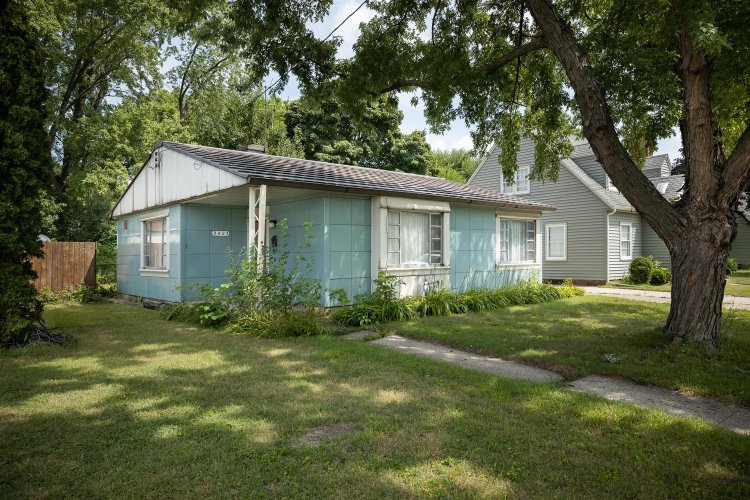
Another example, kind of. Carl Strandlund was a VP at a company in Chicago that made enameled steel products. One day he decided to go into the homebuilding business, with a loan from the Federal Government's Reconstruction Finance Corporation as well as a plant in Columbus, OH that had been used by Curtiss Wright to build bombers, leading to the founding of Lustron in 1947.

The homes were made out of porcelain coated steel. Each house had 3,000 parts; they would be made at the factory and then shipped to broker dealers who would arrange assembly for the buyer. The homes started at $10,000 for 1,000 square feet, comparable to conventional wood framed homes, but the company boasted that these steel frame houses would need almost no maintenance and would be immune to termites. They put much effort into squeezing as much usable space as possible; instead of a big furnace and radiators, they put a radiant heating system in the ceiling, kitchen cabinets, bookshelves, and a vanity were built into the walls, and they used sliding pocket doors.

Despite all of those virtues however, the company failed to sell enough homes to break even. Steel poses many problems as a building material: it offers terrible insulation, it traps moisture, it rusts, and it transmits noise like a drum. The company only built 2,500 homes before folding in 1950.

If it looks familiar, it was the inspiration for the homes in the Fallout video game franchise
 
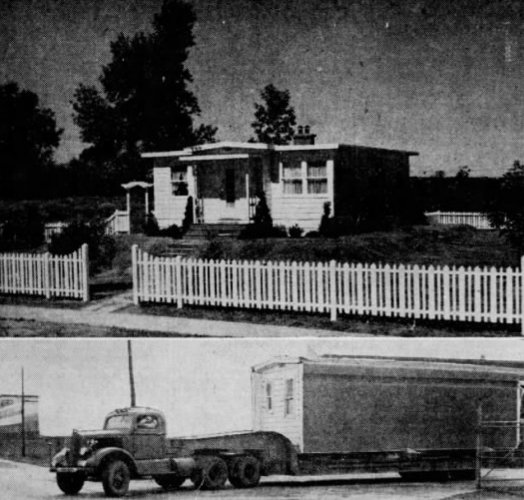
Fairchild Aircraft of Longueuil, Québec, delivered the last Curtiss SBF Helldiver dive bomber under its contract in June 1945, a month after Germany’s unconditional surrender. To make matters worse, major subcontracts were cancelled when Japan surrendered in August. As the production tooling for its Model 82, an excellent bush plane, had been scrapped during the Second World War, the aircraft manufacturer had to look for other options. It launched a subsidiary, Fairchild Industries, in the spring of 1945, to capitalise on the housing shortage in Canada and the general public’s interest in prefabricated houses. Inspired by American models, the Faircraft was one of the first houses of its kind produced in Canada after the conflict. Fairchild Aircraft embarked on this venture after being encouraged to do so by a federal agency, the National Housing Act Administration.

A typical Faircraft four-room, single story house sold for $3,300 f.o.b. factory. It was seemingly possible to buy one on monthly installments as low as $20. Fairchild Industries planned to build six to eight Faircraft homes a day in Fairchild Aircraft's all but deserted factory.

Incidentally, two extra rooms as well as a storage shed and garage could be added as desired.

At the time, that is the spring of 1945, engineers at Fairchild Aircraft were also reviewing the results of a survey designed to identify the needs of bush airlines. The aircraft they designed, the F-11 Husky, was the first all-metal Canadian bush plane – apart from a small amount of fabric on the wings. It featured numerous innovations. A prototype flew in June 1946. Fairchild Aircraft was hopeful of securing an order from the Ontario Provincial Air Service, which was looking to modernise its fleet at the time. Pilots from the Ontario government’s air service liked the Husky but considered it underpowered. The de Havilland Canada Beaver won the competition shortly after the maiden flight of this Canadian classic, in August 1947.

Deeply disappointed, Fairchild Aircraft nevertheless delivered eleven production Huskies in 1947–48. The cancellation of a Royal Canadian Air Force project to develop an advanced twin-engine trainer in January 1947 had somewhat shaken the aircraft manufacturer. The bankruptcy of Fairchild Industries later that year dealt it a far heavier blow. If truth be told, its prefabricated house was not selling well. Certain local by-laws required the installation of electrical wiring on building sites or prohibited the construction of houses as low as the Faircraft. Worse still, as well as being expensive and difficult to transport, the latter also had a leaky roof.

Informed by the Department of Reconstruction and Supply that Canadair and Avro Canada would be awarded all major aircraft contracts, Fairchild Aircraft closed its doors in early 1948. The Husky thus became the last in a long line of bush planes manufactured in Longueuil since the early 1930s. A major bakery, George Weston, soon moved into the factory.
 

Attachments

  • The Gazette 3 August 1945 page 13.jpg
    The Gazette 3 August 1945 page 13.jpg
    297 KB · Views: 12
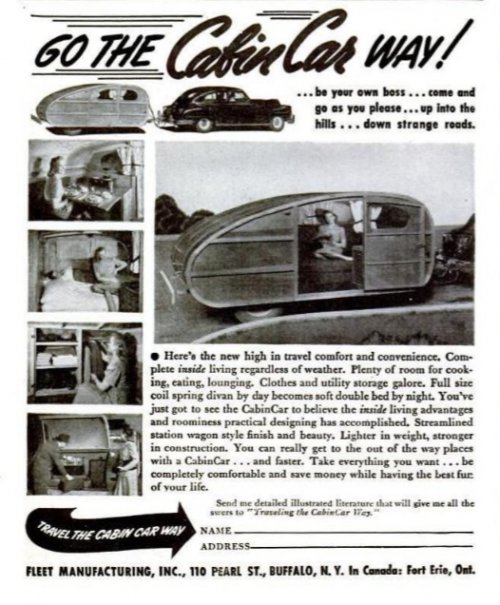
At the risk of going off topic, it is worth noting that Fleet Aircraft of Fort Erie, Ontario, acquired the world rights for a new type of travel trailer around May 1946. Norman Vincent, the new head of Fleet Manufacturing and Aircraft, as the company became in July, forged ahead with the idea, convinced as he was that Canadian and American veterans would want to travel. Designed around 1945 by a young American aeronautical engineer, Junius Augustine Holte, the CabinCar was much cheaper than its competitors, costing only $695, if not $625. The management of Fleet Manufacturing and Aircraft soon acquired Holte Motors. It hoped to export trailers to South Africa, among other places, but met with little success.

Deeply interested in the project, a Florida-based automobile dealer known all over the United States, R.S. Evans Motors, placed an order for 10,000 CabinCars no later than July 1946 and (seriously?) considered the possibility of ordering up to 50,000 units, if enough factory space could be found. As things turned out, Roy S. Evans did not have the necessary resources. Worse still, the North American trailer market was not as large as Fleet Manufacturing and Aircraft believed. Consequently, the company produced only 1 500 or so CabinCars in 1946–47.
 

Attachments

  • Life 2 June 1947 page 100.jpg
    Life 2 June 1947 page 100.jpg
    131 KB · Views: 9
Hi,

At the risk of going off topic, it is worth noting that Fleet Aircraft of Fort Erie, Ontario, acquired the world rights for a new type of travel trailer around May 1946. Norman Vincent, the new head of Fleet Manufacturing and Aircraft, as the company became in July, forged ahead with the idea, convinced as he was that Canadian and American veterans would want to travel.

There's a parallel in Germany, with Erich Bachem of Ba 349 Natter fame designed trailers shortly before WW2, and, together with Erwin Hymer - who also had an aviation background - in 1957 founded the Eriba company to massproduce such trailers. "Eriba" and "Hymer" today still are popular brands for trailers and motorhomes (RVs) respectively. Convergent development, I guess ... the expertise with light weight construction in aviation was applicable to many fields, from scooters to warehouse buildings, so we see this everywhere in the world when companies branched out after WW2 to find business in a peacetime world where fewer aircraft were ordered.

Regards,

Henning
 
The most famous attempt was Buckminster Fuller's Dymaxion House, dome shaped to use the smallest amount of material to enclose a given amount of space. The plan was to produce it at the Beech Aircraft factory in Wichita, KS, but it came to nothing.
On a side note, Beechcraft also tried their hand at building a car in the post-WWII era, the Plainsman.
 

Similar threads

Back
Top Bottom