What if there is no pause on capital ship and cruiser production in 1939?

Caryina2642

ACCESS: Top Secret
Joined
17 September 2022
Messages
582
Reaction score
311
What if Churchill doesn't pause capital ship and cruiser production in 1939, how does this effect the royal navy and the greater war?
This scenario, is based on Dr Alex Clarkes youtube video: What if Winston Churchill doesn't pause Carriers, Capital Ships & Cruisers in 1939?
View: https://www.youtube.com/watch?v=JHeDA4vm2rQ

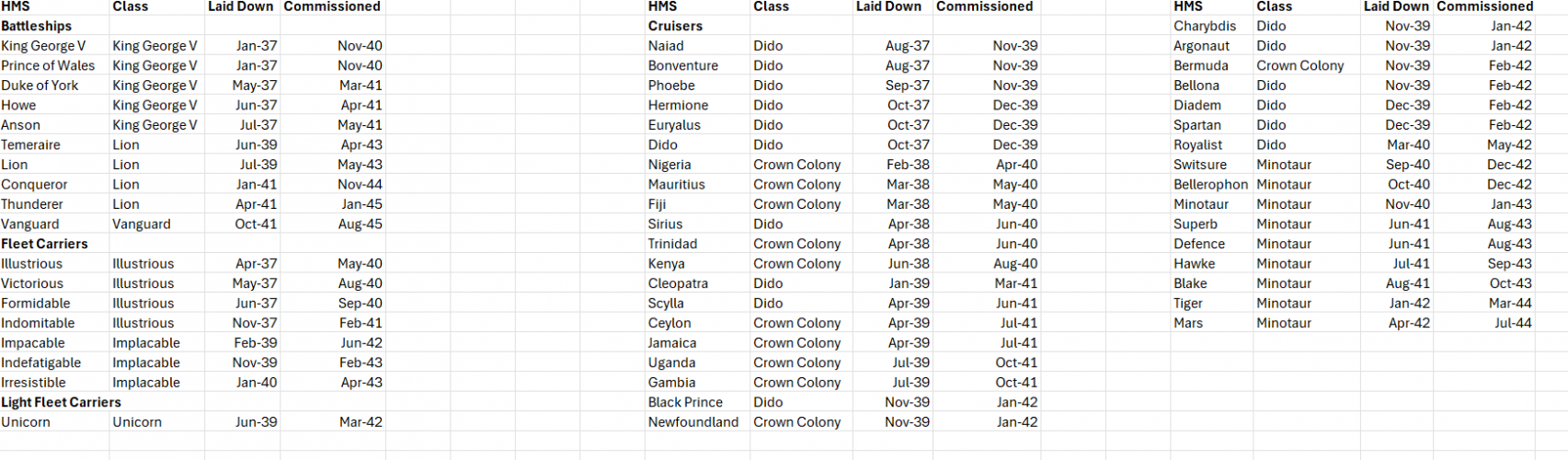
I have made a spreadsheet of when capital ships and cruisers should have entered service if there was no pause on construction.
Using 1400 days as the average for Battleship construction, 1200 for Fleet Carriers, 1000 for Light Carriers & 800 for Cruisers
1770977195050.png
With all these ships entering service earlier, how does it effect the war?
  • Is the Strike on Taranto now a Multi Carrier Strike?
  • Does the Battle of Denmark strait still happen? Is Hood there or in Refit?
  • Does Renown & Prince of Wales still get Sunk? Are the Royal Navy still pushed back to the Indian Ocean?
  • With all the extra cruisers how does the war in the Mediterranean look?
  • What would the Audacious Class look like?
  • Would the 1942 Light Fleet Carriers still happen? Maybe earlier in 1941? Or would the RN Concentrate on Fleet Carriers in this Scenario?
  • What does the British Pacific Fleet look like?
  • How would this effect the RN Post War?
 
Renown and PoW probably still sunk as it was not ships that lost that one but the lack of air cover.

Something the admiralty knew about but failed to act appropriately on.
 
What if Churchill doesn't pause capital ship and cruiser production in 1939, how does this effect the royal navy and the greater war?
This scenario, is based on Dr Alex Clarkes youtube video: What if Winston Churchill doesn't pause Carriers, Capital Ships & Cruisers in 1939?
View: https://www.youtube.com/watch?v=JHeDA4vm2rQ

I have made a spreadsheet of when capital ships and cruisers should have entered service if there was no pause on construction.
Using 1400 days as the average for Battleship construction, 1200 for Fleet Carriers, 1000 for Light Carriers & 800 for Cruisers
View attachment 801851
With all these ships entering service earlier, how does it effect the war?
  • Is the Strike on Taranto now a Multi Carrier Strike?
  • Does the Battle of Denmark strait still happen? Is Hood there or in Refit?
  • Does Renown & Prince of Wales still get Sunk? Are the Royal Navy still pushed back to the Indian Ocean?
  • With all the extra cruisers how does the war in the Mediterranean look?
  • What would the Audacious Class look like?
  • Would the 1942 Light Fleet Carriers still happen? Maybe earlier in 1941? Or would the RN Concentrate on Fleet Carriers in this Scenario?
  • What does the British Pacific Fleet look like?
  • How would this effect the RN Post War?
Thing is the carrier & cruiser programmes were not "paused" in 1939 because of Churchill. They continued. There were multiple factors that then affected warship construction in Britain in WW2 that resulted in extended build times. Lack of labour and / or materials, ever shifting priorities (destroyers and escorts over cruisers for examlple), design changes to take account of war experience and growing weight of additions to pre-war designs, enemy action, no nightime working under lights with the threat of bombing, etc etc. By early 1940 delays were beginning to mount up - anything from 3 to 15 months depending on the ship and the yard.

Churchill only returned to the Admiralty as First Lord on 3 Sept 1939 by which time the Admiralty had already formulated its plans of what to do on the outbreak of WW2.

The only reference that I can find to any sort of "pause" came around Feb 1940 in Moore "Building for Victory" where he includes a quote

The decision "to ask for no aircraft carriers this year and no cruisers of any kind, other than the two Fiji class and six of the Dido class already approved by the Treasury since the outbreak of war" was "regarded as a serious decision in naval policy appropriate to the conflicting needs of the present and the future".


But that needs to be viewed against the background of the time. The yards were struggling to keep up with the order books that they had for larger ships, while the demand for smaller vessels was growing ever greater.


For example with the carriers, Indefatigable. Ordered on 19 June 1939 and laid down on 3rd Nov 1939. Work on her progressed slowly until she was suspended, along with other ships, around 10 May 1940 following the German invasion of the low countries. Work was allowed to restart about 4 months later. Implacable was never suspended at all. Both yards however had lots of work in hand and the carriers did not have priority for labour and materials to move them along quickly. One result was that Fairfields carried out next to no work on Implacable for 13 months in 1940 / 41 while orders for two destroyers were transferred to John Brown. But that was very much down to labour shortages in the yard and priorities for other ships not any kind of formal "pause" from Churchill or the Admiralty.

While there were plans pre war to build carriers in the 1939, 1940 & 1941 programmes, nothing beyond Indefatiigable in the 1939 Programme was ever firmed up before the outbreak of WW2. From spring 1939 to Jan 1940 the number for the 1940 programme fluctuated between 1 and 2. It was October 1940 before the subject of carriers came up again. By then the request was for a single ship (later referred to as Irresistible) to be laid down in March 1941 for completion by the end of 1944. The design was then constantly modified from the Implacable design and was finally ordered in March 1942 as Ark Royal. Even then the changes were not done as later in 1942 it was decided to build her as an Audacious class. Finally laid down in May 1943.

As for the cruisers the Admiralty placed orders on 4 Sept 1939, in accordance with pre-war plans, for 2 Fiji class (which it had been planned to order later in the financial year). At the end of Sept the Admiralty cancelled a pair of Fijis to be built in the RN Dockyards under pressure from Churchill as by then the yards needed to deploy the labour towards repairs. The Admiralty also ordered 6 Dido class cruisers (an increase of 2 over pre-war plans and possibly to use the turrets originally ordered for Scylla & Charybdis) on 4 Sept. All of these were laid down before the end of 1939. Again the cruiser programme was affected by the events of May 1940 with 3 Fiji class and 5 Didos being suspended. That suspension was lifted about 4 months later.

Throughout the period the Admiralty were looking at new heavy & light cruiser designs.

By Oct 1940 they were looking forward to the 1941 Programme and a new 6in cruiser design. As that didn't emerge quickly enough orders were placed for another 3 Fiji deriviatives in March 1941 and 3 more in Dec 1941. A large cruiser programme was planned for 1942 but was sacrificed for a light carrier programme instead.

As for the battleships the Admiralty pre-war plan was:-

1. accelerate the KGV class so far as possible.
2. Lion & Temeraire laid down in Jun / July 1939 to have a low priority for the first few months
3. Conqueror & Thunderer and later battleshps would not be proceeded with for the first few months.

By early Oct 1939 it was agreed that Lion & Temeraire should be suspended for 12 months, while no work was to start on Conqueror (ordered in Aug) and Thunderer was not to be ordered (planned for Nov 1939). But some work was allowed to continue on guns, mounts and some other equipment.

As for the projected completion dates you have produced, it is interesting to compare with actual Admiralty anticipated comletion dates as of Sept 1939:-

KGV - Dec 1940
PoW - Mar 1941 (bombed while under construction causing a 3 month delay that was somehow clawed back)
DoY - Aug 1941
Anson - Dec 1941
Howe - April 1942
Lion - Aug 1942
Temeraire - Aug 1942
Conqueror - unknown since suspended
Thunderer - unknown since suspended

Illustrious - May 1940
Victorious - Sept 1940 (delays with armour plate coming from Czechoslovakia)
Formidable - Oct 1940
Indomitable - April 1941 (armour and redesign delays)
Implacable - Oct 1941 (labour issues see above. Also many changes were made to the design along the way)
Indefatigable - June 1942 (design changes)

The estimated completion dates for Implacable and Indefatigable always seem to me to be a bit on the optimistic side given the build times for the other 4 armoured carriers, but we don't know quite how those dates were arrived at.
Dido - Aug 1940
Euryalus - Jan 1941
Phoebe - May 1940
Sirius - Feb 1941 (delayed by amongst other things being bombed while under construction in April 1941 causing structural & electrical damage)
Hermione - Nov 1940
Charybdis - Dec 1940 (anticipated time saving by fitting 4.5in guns disn't come to fruition)
Cleopatra - March 1941
Scylla - Nov 1940 (anticipated time saving by fitting 4.5in guns disn't come to fruition and then builders yard badly affected by Clydeside Blitz in early 1941)
Bonaventure - June 1940
Naiad - April 1940 (bombed and damaged as construction neared completion)

Dido, Phoebe, and Bonaventure all completed minus a turret due to production delays.

Fiji - Feb 1940
Kenya - July 1940
Mauritius - July 1940
Nigeria - May 1940
The contractual build time for the above four ships was 27 months from delivery of the plans to the yards.

Trinidad - April 1941 (A turret was lost when the ship carrying it to the yard was mined in Feb 1941. The replacement from HMS Belfast then required modified incurring further delay. She was then bombed in April incurring some damage)
Built in a Royal Dockyatd so no contractual build time.

Gambia - Oct 1941
Jamaica - Sept 1941
Ceylon - Aug 1942 (suspended in 1940 and redesigned with 3 turrets )
Uganda - Nov 1941 (as above)
Contractual build time for the above 4 ships was between 31 & 34 months.


Bermuda - Feb 1942
Newfoundland - June 1942 (suspended in 1940 and redesigned with 3 turrets)
Delivery time not specified in these wartime build contracts.

Argonaut - Aug 1941
Royalist -Aug 1941 (suspended in 1940)
Bellona - by June 1942 (as above)
Black Prince - by June 1942 (as above)
Diadem - by June 1942 (as above)
Spartan - by June 1942 (as above)


With regard to Vanguard, when laid down in Oct 1941 she was expected to complete in Dec 1944 but that quickly began to slip in 1942. By March 1943 it had slipped to Dec 1945. Again shortage of labour plays its part with Indefatigable having priority over Vanguard at John Brown in 1942. Also the gun pits at H&W had to be dug out and refurbished before the extensive work required to modify the old turrets could begin. The turrets were still in those pits in summer 1945. In the end she wasn't launched until 30 Nov 1944.

 
I was thinking about the extended build times for wartime built ships and it occurs to me that there are three factors, the effect of which are generally ignored. I'll limit things to 1939-41.

1. Conversion work
2. Yard disruption due to enemy action
3. repair work due to enemy of weather damage
4. creation of an amphibious shipping force from mid-1940

1. Conversion work
Looking through the information I have, there were a large number of ships brought in for conversion from Aug 1939 to 1941 and beyond that had an effect on the British shipbuilding industry generally. The problem is tying that down to particular yards. But it was something that did affect even the big naval yards.

Armed Merchant Cruiser conversions - 49 ships converted in British yards alone for this Sept 1939 to Jan 1940. 15 were lost carrying out this role, but starting 1941 they began to be released for conversion for other roles starting with troopships, and then repair ships, HQ ships, LSI(L), escort carrier & depot ships. Carinthias conversion was by John Brown.

Armed Boarding Vessels - 12 ships from Sept 1939 to Jan 1940 and another in 1941.

Ocean Boarrding Vessels - 13 ships Aug -Oct 1940 + another 2 in 1941.

Auxiliary AA ships - 7 ships given very extensive conversions starting late 1939 and running into late 1941. Springbank (requisitioned Nov 1939 & completed Nov 1940) was converted at Cammell Laird, Ulster Queen at H&W Belfast (Aug 1940 - Aug 1941) & Tynwald at Portsmouth RN Dockyard. A nimber of smaller coastal ships were also given far less extensive conversions for the role.

Minelayers - 3 train ferries taken up Aug-Sept 1939. 3 large vessels requisitioned Dec 1939-Jan 1940 with roughly 6 month conversion periods. Another pair were acquired while under construction in merchant yards that would have extended their build times.

Repair ships - Wayland converted at Portsmouth Nov 1940 to Sept 1942. Blenheim & Philoctetes requisitioned 1940 completed 1941.

Town class destroyers - most of the 50 Town class destroyers from the destroyer for bases deal arrived in Britain between 26 Sept 1939 and March 1941 to be refitted before entering service. The length of the refit depended on the state of individual ships.

Seaplane carrier / aircraft transport - Athene & Engadine. Acquired in 1940 while under construction. Athene transferred to John Brown for conversion taking about 1 year.

Escort carrier - conversion of the Audacity took 5 months in early 1941.

Those are just the conversions of larger vessels. Large numbers of smaller craft were also requisitioned and fitted out e.g. several hundred trawlers for AS & MS work, large yachts as patrol craft.


2. Disruption due to enemy action
This includes not just damage to facilities and ships but time lost to taking cover in air raid shelters during raids or after the major night blitz attacks in Spring 1941 that targeted the shipbuilding towns & cities. Portsmouth, Plymouth, Belfast, Clydebank, Greenock & Glasgow were all very badly hit. While the John Brown yard at Clydebank (believed to be the worst hit town in Britain) escaped major damage during the raids of 13-15 March 1941 the surrounding town where the workers lived was devastated. Only about 10% of the workforce turned up on 15 March as they sought to reorganise their daily lives and find new accomodation for their families. By the next week that increased to 70% and then 80% the week after.

The Scotts yard at Greenock wasn't so fortunate when it was hit on 6-7 May 1941. As well as ships damaged on the slips they lost the head office building (with many of the ships' plans etc) and the boiler / machinery works was heavily damaged. It took about 6 months before full production was restored. Some ships built at Scotts after that were towed up river for completion by John Brown

The White yard at Southampton, IIRC, was so badly hit that the company took the opportunity to reconstruct it to operate more efficiently.

Ships damaged while still under construction / conversion / refit included

PoW
Sirius - badly damaged at Portsmouth 5 April 1941
Naiad
Trinidad - bombed Devonport April 1941
Norseman (renamed Nepal) -12/40 Thorneycroft, Southampton - severe damage from a direct hit (blew her side out) and 2 near misses. Launch delayed by almost a year
Opportune - 12/40 Thorneycroft, Southampton - near miss from the same raid that damaged Nepal. She escaped with lesser damage
Marksman (renamed Mahratta) - so badly damaged on the slip at Scotts, Greenock she had to be scrapped and laid down on another slip. About 15 months work lost.
Loyal - was also affected by the Greenock Blitz
Cameron - an old Town class. severely damaged while in dry dock at Portsmouth 5 Dec 1940. Became a total loss.
Tynald - Auxiliary AA ship bombed at Portsmouth Jan 1941 and severely damaged delaying her completion by several months.
Prince Charles - LSI(S) bombed at Devonport April 1941, slight damage


3. Repairs
A lot of repair work was required on ships as a result of the extremely bad Atlantic weather in the winter of 1939/40. There are plenty of stories around about the damage suffered both by RN ships, particularly cruisers on the Northern Patrol later replaced by the AMC conversions, and merchantmen that had to be patched up.

And then we have combat damage. In later years of the war some of this might have seen ships written off as constructive total losses but in 1939-41 they were being repaired. For example Eskimo lost her bow all the way back to B gun mount at Second Narvik (She went to Barrow for repairs that took 4-5 months). Javelin lost bow and stern (13 months in dock). Belfast (mined Nov 1939 & returned to service Nov 1942 after repairs at Devonport)

4. Constructing / converting landing ships and craft
Landing ships - In Jun 1940 having had to retreat from the continent, the RN begins conversion of ships for amphibious landings. Those included the 3 large Glens (converted from already requisitioned fast supply ships. Conversions as LSI (L) complete by end of year). Two train ferries as LSC (June 1940-June 1941 at Southampton). 8 cross channel ferries (converted Aug 1940-Sept 1941 at Penarth, Devonport, Falmouth & Belfast).

Plans for LSTs were formed at the end of 1940 with 3 Maracaibo tankers selected for conversion. One was undertaken at the VA(Tyne) naval yard and the other pair in a merchant yard. H&W Belfast also received an order for 3 Boxer class LST in March 1941 that took until late 1942 to complete.

In 1940/41 the big naval yards were also drawn into constructing LCT. Not in huge numbers but something else to draw labour away from larger ships.
 
The White yard at Southampton, IIRC, was so badly hit that the company took the opportunity to reconstruct it to operate more efficiently.
Cowes, not Southampton.

ETA: The other disruption to consider is disruption in what we'd nowadays call the supply chain. You mentioned the loss of Trinidad's turret, when the ship carrying it was sunk en route, but IIRC the lost vessel was a specialist in that work, so we'd see disruption beyond simply Trinidad and the knock-on effect of replacing it with one from Belfast, which would then itself need replacing. Beyond ships lost in convoy, there was disruption of the rail network - not perhaps as much as there might have been when you consider the allied anti-rail campaign, but even just the need to take shelter during air raid warnings would disrupt the work of marshalling yards and delay the dispatch of trains.

And of course there was the disruption caused by the enlistment of men whose work was vital. AIUI even the list of reserved occupations often only kicked in at 25, meaning younger men were still subject to conscription.
 
Last edited:
Cowes, not Southampton.
Doh!!

When reorganised after the bombing it was set up for welding, producing what is generally claimed to be the first all welded destroyer* for the RN. HMS Contest laid down 1 Nov 1943, launched 16 Dec 1944 & completed 9 Nov 1945.

* The first all welded ship for the RN was the Halcyon class minesweeper Seagull built at Devonport and completed May 1938.
 
For example with the carriers, Indefatigable. Ordered on 19 June 1939 and laid down on 3rd Nov 1939. Work on her progressed slowly until she was suspended, along with other ships, around 10 May 1940 following the German invasion of the low countries. Work was allowed to restart about 4 months later. Implacable was never suspended at all. Both yards however had lots of work in hand and the carriers did not have priority for labour and materials to move them along quickly. One result was that Fairfields carried out next to no work on Implacable for 13 months in 1940 / 41 while orders for two destroyers were transferred to John Brown. But that was very much down to labour shortages in the yard and priorities for other ships not any kind of formal "pause" from Churchill or the Admiralty.
I think you said that Indefatigable was laid down earlier than planned because of the declaration of war, not in spite of it, when you put me right after I asked the same question as @Caryina2642. Is that correct? Or am I wrong about that too?
 
I think you said that Indefatigable was laid down earlier than planned because of the declaration of war, not in spite of it, when you put me right after I asked the same question as @Caryina2642. Is that correct? Or am I wrong about that too?
Sorry, but I really don't recall saying that about Indefatigable.

I did refer to two of the Fiji class cruiser orders being being brought forward. The story there was that the 1939 Programme, agreed in early 1939, was to include four cruisers. There was then some discussion about exactly what design they should be (Fiji or a ship still within Treaty limits but with fewer guns and more armour). It wasn't until 19th May 1939 that The Board of Admiralty agreed that they should be built as Fijis. The first pair, to be built in the Portsmouth and Devonport Royal Dockyards were ordered on 1 Aug 1939 with the second pair to be ordered from commercial yards in March 1940.

Tenders for the machinery for the first pair (unlike commercial yards the Royal Dockyards didn't build the machinery for the ships they built) were received in July 1939 with John Brown & Cammell Laird being advised of the acceptance of their bids on 8th Sept.

Builders for the second pair (Bermuda at John Brown & Newfoundland at Swan Hunter) were identified in July 1939 following receipt of tenders. The difference with these contracts was that no delivery dates were specified.

Then war broke out and the Admiralty decided to bring forward the construction of the second pair of 1939 Programme ships. Orders were placed on 4th Sept 1939 with Bermuda laid down 30th November and Newfoundland on the 9th.

Then on 28th Sept 1939 the orders for the two RN Dockyard ships were cancelled, something that Churchill seems to have had a hand in. Considering the amount of conversion, repair & refit work that then began to flow into them, it was probably a sensible decision.
 
According to this extract from Brassey's 1933 British warships were ordered and laid down in the financial year they were authorised until 1924. It gives the example of the first 5 County class which were authorised in the Navy Estimates for the 1924-25 financial year and were ordered and laid down in the 1924-25 financial year. From the 1925-26 financial year onwards they were ordered and laid down in the following financial year. E.g. Ark Royal was authorised in the Navy Estimates for the 1934-35 financial year, but she wasn't ordered until 17.04.35 and laid down until 16.09.35 both of which was in the 1935-36 financial year.

DELAYED SHIPBUILDING.
The outstanding feature of shipbuilding for the Royal Navy during 1932 was the postponement of the start of the 1931 programme for six months, by which £1,300,000 was saved by the Admiralty as one of the contributions towards balancing the Budget. The First Lord announced this when introducing the Navy Estimates for 1932-33 on March 7, 1932. "By far the worst feature of these Estimates," he said, "is the postponement of last year's programme."
Instead of being started in March, 1932, it was put off until September of that year. The effect of this was felt most by the shipyards. It was not so urgent for the Navy, because as the First Lord explained we have got to have the ships allowed us by 1936 under the Treaty of London, and "there is no doubt we shall have them," added Sir Bolton Eyres- Monsell. The First Lord said that he "had included a sum in this year's Estimates (1932-33) for starting the 1932 building programme at the normal time in March of next year," but where this sum is provided is not clear from the official figures. The postponement is of great concern to the shipyards, which were already having serious difficulties. The First Lord assured them of his very deepest sympathy.
Only the very grave financial emergency could justify such a step. The programmes since 1929 have been cut to the bone. If their execution is also being interfered with, and the interference continues for any length of time, it will completely undermine the position, already hazardous, facing the Royal Navy in 1936. It should also be pointed out that what the First Lord called the "normal time" for starting a programme-March of the year after authorisation has only become so since 1925. It was not formerly the practice to defer laying down ships until the very last month (or later) of the year in which they first appeared in the Estimates. As an example, when cruisers construction was resumed after the war, and the five ships of the "Kent" class were authorised, in March, 1924, they were ordered forthwith and their keels laid between September 30 and November 15, 1924. It is sound policy to translate design into the finished ship at the earliest possible moment. Thereby experience on trial is available much earlier, the personnel become acquainted with newer material, and the country gets an earlier return for the money invested in building.
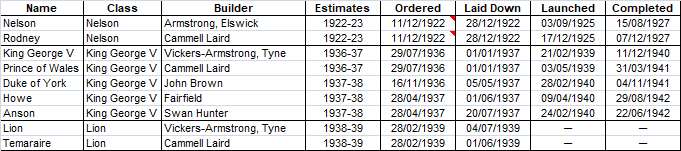
My observation is that this practice continued (with exceptions) until the war started. This table shows some of the exceptions and non-exceptions.

British Battleships 1922-39.png

British financial years run from 1st April to 31st March. So Nelson and Rodney were authorised, ordered and laid down in the same financial year (1922-23).

The King George V class were amongst the exceptions in the post-1924 system as they were authorised, ordered and laid down in the same financial years. King George V and Prince of Wales in 1936-37 and the others in 1937-38. Except Duke of York was ordered in the 1936-37 financial year, not authorised until 1937-38 and was laid down in the 1937-38 financial year.

Lion and Temerarire were authorised in the navy estimates for the 1938-39 financial year. They were ordered 11 months into that financial year. They were laid down 3 or 4 months into the 1939-40 financial year.
 
Sorry, but I really don't recall saying that about Indefatigable.
Your apology is not necessary. It must be false memory syndrome on my part, so it's my fault and I'm the person that has to apologise. Sorry.

Somehow, I've got it into my head that Indefatigable (1939-40 Programme) was to be laid down in 1940. It might be because Implacable (1938-39 Programme) wasn't laid down until February 1939. And I've also got it into my head that Indefatigable was ordered and laid down earlier than planned due to the worsening international situation following the German occupation of Czechoslovakia in March 1939.
 
As far as DoY was concerned 16 Nov 1936 was not the formal order date no matter what Wiki says. The sequence of events as detailed in Ian Buxton & Ian Johnston book "Battleship Duke of York. An Anatomy from Building to Breaking" which draws heavily on the John Brown records is as follows:-

Nov 1936 - indicated to JB that "that they were likely to get one of the 1937 battleships, so they were able to start preparatory work, such as piling No 3 berth and ordering steel".

Their Appendix A notes that "Although it was a foregone conclusion about who the builders of the five King George V class battleships were to be, tendering, although not in this case competitive, still had to be carried out to establish an accounting basis for the contract."

21st Dec 1936 - tender requested from JB
15 Feb 1937 - JB tender submitted (details in Appendix A and also in the "Battleship Builders" by the same authors)
28th April 1937 - Admiralty accepted the JB tender and ordered the ship. That is also the date used by Moore in "Building for Victory"
5th May 1937 - DoY laid down
10 July 1936 - contract for construction of "a battleship" was signed (copies of the first and last pages in the book)

Some other interesting titbits from the Board Minutes and other yard reports:-

The JB Board noted in their January 1937 Board meeting that 1,300 tons of structural steel for keel & double bottom had beeen ordered and Admiralty approval obtained "in our choice of suppliers of various materials and orders were placed to avoid rises in market prices".

25th Jan "As a result of a Conference held in Newcastle with the other contractors concerned, a schedule for the preparation of drawings split up among the various firms has been put to the Admiralty. Arrangements have also been concluded for the circulation of of plans before submission and after approval for the guidance of the different builders."

15th Feb "A commencement has been made to adjust the levels and declivities for the purpose of aying the keel blocks [on building berth No 3]"

30th April some 2,000 tons of steel of 4,000 tons ordered, already delivered.

The orders for KGV and PoW were placed early to allow the the builders to begin collecting materials and preparing to build ships that by Treaty couldn't be laid down until 1 Jan 1937. But from what I've noted above all three of the other builders of the 1937 Programme ships seem to have been doing the same thing albeit on an informal "handshake" basis prior to the formal orders actually being placed on 28th April 1937.
 
Also the gun pits at H&W had to be dug out and refurbished before the extensive work required to modify the old turrets could begin.
Out of interest are there any decent sources, either published or online, that that you could suggest which lay out how many gun pits the UK had leading up to and during WW2 and their details?


You mentioned the loss of Trinidad's turret, when the ship carrying it was sunk en route, but IIRC the lost vessel was a specialist in that work…
It's snippets of information like this that often make these threads so interesting.
 
Out of interest are there any decent sources, either published or online, that that you could suggest which lay out how many gun pits the UK had leading up to and during WW2 and their details?
I'm not aware of any comprehensive source providing that kind of detail so it is snippets from here and there. A good source on the whole subject is "The Battleship Builders" by Ian Johnston & Ian Buxton. I believe that there were 7 large pits in use by the late 1930s.

Between 1895 and 1945 there were just 3 manufacturers of heavy gun mountings for British battleships. Who built what for each ship is detailed on p191 of that book.

The simplest one to deal with is Coventry Ordnance Works. Set up to break the duopoly of the other pair, It opened a new plant at Scotstoun on the Clyde. It had a set of 5 pits adequate to build 13.5in & 15in turrets starting with HMS Conqueror completed in 1911. Inter-war this factory was bought by Harland & Wolff and repurposed with all the pits filled in. Four were dug out starting in 1941 to allow modification of the turrets from Courageous & Glorious for Vanguard.

You can find photos of that work on the internet as here, taken in 1945.


The Armstrong works at Elswick on the Tyne (later Vickers Armstrong) underwent updating on several occasions over time to accomodate ever larger turrets (twins to triples to quads and of increasing calibre). "The Battleship Builders" has a drawing of the works (No 24 shop, which was one of 3 such shops to erect 12in, 13.5in, 14in, 15in and 16in mounts) as it was in 1921 with pits for 3 triple turrets for the Nelson class. These were 35ft wide and 50ft deep below floor level with the cranes being some 70ft above floor level. The Admiralty financed the third of these large diameter pits to allow work on all three turrets of each ship in parallel. No 24 shop was then extended in the 1930s to incorporate an extra large diameter pit.

This works built all 6 turrets for Nelson & Rodney. Elswick built 3 twin turrets and 5 quads for the KGV class and also rebuilt the twin 15in turret for the WW2 monitor Abercrombie.

The Vickers works at Barrow was the third works. It built the 4 turrets for the Hood and then 2 twin and 5 quads for the KGVs. But some modifications must have been made to accomodate the quad turrets for the KGVs.

Elswick & Barrow were each awarded a contract for a set of three 16in turrets for the Lion & Temeraire.

Always worth remembering that while fewer battleship turrets were required over time, more turrets for cruisers, carriers and the secondary armament of reconstructed battleships were required. So earlier battleship facilities that became redundant could be repurposed.

Have a look around the Navweaps site as there are photos of various mounts being constructed or installed that might be of interest.

And The Dock Museum at Barrow has an online archive showing activities there
 
As far as DoY was concerned 16 Nov 1936 was not the formal order date no matter what Wiki says.
In a similar vein the Type 42 destroyer Manchester was laid down six months before she was ordered. According to the Ian Allan book on the Type 42s she was laid down on 19.05.78 and ordered on 10.11.78. So does Jane's Fighting Ships. Do you know anything about that?
 
In a similar vein the Type 42 destroyer Manchester was laid down six months before she was ordered. According to the Ian Allan book on the Type 42s she was laid down on 19.05.78 and ordered on 10.11.78. So does Jane's Fighting Ships. Do you know anything about that?
Can't help with the Type 42 I'm afraid.

Going back to Ark Royal for a moment, yes the construction of a carrier was authorised as part of the 1934 Programme (1934/35 as you refer to it) but that was the culmination of much work over several years much of which had led to nothing. Work on a new Staff Requirement for a carrier resumed again in summer 1933. It took until May 1934 to produce a preliminary sketch design which the Board of Admiralty approved on 21 June 1934. Only then could detailed design begin. The final design, much altered from the May / June preliminary design, was submitted in Nov 1934. But even then the design was not final. Changes to the armament were still being made in March 1935 (8 twin 4.5in in place of the previous 16 single 4.7in). See Friedman.

This was also the period running up to the Second London Naval Conference when the various parties were sounding each other out about what the new limits on ship sizes should be. Both Japan & the US were floating the idea of a 20,000 ton limit on carrier size (down from 27,000 tons in WNT 1922). Britain wanted 22,000 tons (Ark design was 22,800 tons with hopes of reducing it in build). So in Dec 1934 / Jan 1935 various trade offs were under consideration.preliminary. So maybe a reluctance to get caught out placing an order too early? Note as with international conferences today, much of the work is done by unnamed individuals in the months or even years leading up to the conference itself.

I can't find a date for the Admiralty sign off on the final design. But then you need to add in some time for a tendering process (I can't identify if it was competitive or not) before the order could be placed. So I can see how the order would not be placed until the following financial year.

A similar thing happened around that time with the first pair of Town class cruisers. Sketch designs were prepared Aug / Sept 1933, Then some to and fro between the various Admiralty Depts before a revised sketch design was approved by the Admiralty Board on 9th Nov 1933 allowing detailed design to proceed. That work was not presented to the Admiralty Board until 28th Feb 1934 nor signed off until 8th March. Even then another change was signed off a week later.

Invitations to tender with appropriate drawings were sent out on 2nd March (in anticipation of Admiralty Board approval and to 8 companies it was thought could do the job). All 8 viewed the sent people to assess the plans. Only 3 actually submitted tenders (the eventual winners and Cammell Laird) Successful bidders (VA Tyne & John Brown) notified on 1st June 1934 and orders placed the same day with ships laid down 4 Oct and 21 Nov 1934. The VA tender included a proposal to reopen the High Walker yard on the Tyne, an area of high unemployment.

The process for the three 1934 ships was able to be much quicker. Most of the changes had been approved by Sept 1934 (although some of the drawings weren't ready until July 1935). Tender invitations were sent out on 5 Sept 1934 for the two ships to be built in commercial yards. Again only 3 companies submitted tenders - Scotts, VA (for the Barrow yard) & Cammell Laird. The first two were successful albeit the VA contract specified the ship be built on the Tyne with the ships being ordered on 17 Dec 1934. VA were able to lay Sheffield down on 31st Jan 1935 no doubt helped by their early experience with Newcastle. Scotts were able to lay Glasgow down on 16th April 1935.

Invitations to tender went out on 23rd Aug 1935 for the two 1935 Programme ships to be built in commercial yards. There were 3 responses, from Fairfield, Hawthorn Leslie & Harland & Wolff Belfast. Tenders from the first two were accepted and orders placed on 11 Nov 1935.with the ships being laid down on 17th Feb & 28th March respectively.

From the above you can see that when a ship authorised for a Programme can be laid down down depends on a variety of factors.
1. when is the final design completed
2. time taken to tender
3. time to accept tender
4. time for yard to gather materials down and make internal arrangements to allow the ship to be laid down

Each step takes time. Sign off on the design late in a financial year and the ship may well end up being laid down in the following financial year. And with so much technological change in the 1920s and early 1930s ship design took longer.

There was a bit of a cartel system being operated in this period, with the tacit acceptance of the Admiralty to share the work around the country, maintain a decent level of profitability and, perhaps most importantly for what was to come, maintain warship building capability and capacity.
 
Both Japan & the US were floating the idea of a 20,000 ton limit on carrier size (down from 27,000 tons in WNT 1922). Britain wanted 22,000 tons (Ark design was 22,800 tons with hopes of reducing it in build
Huh, I hadn’t heard of the U.S. and Japan looking at a 20,000 ton limit. Most discussions around Second London I have been part of seem to assume that the reduction in carrier tonnage was a British goal alone and that the 23,000 limit was the other powers compromising with this.

If the British proposal was actually the higher one that changes the context somewhat. And makes me wonder where the 23,000 ton limit came from instead of the 22,000.
 
If the British proposal was actually the higher one that changes the context somewhat. And makes me wonder where the 23,000 ton limit came from instead of the 22,000.
Simple, it must be the dastardly French!

On a more serious note, the US and Japanese pushing for a 20 000 t limit doesnot actually surprise me, as their pre-war standard carrier designs, the Yorktowns for the US and Soryū and Hiryū for the Japanese came under 20 000 t standard displacement. Compared to these, HMS Ark Royal was actually rather larger. I wonder how much HMS Ark Royal, which gained quite some media coverage for its large size and advanced features when under construction and just completed (as far as I know, the word supercarrier was first used by the US press when describing the new Ark Royal in 1938), influenced the significant jump in size in the ensuing Shōkakus and Essexes.
 
Huh, I hadn’t heard of the U.S. and Japan looking at a 20,000 ton limit. Most discussions around Second London I have been part of seem to assume that the reduction in carrier tonnage was a British goal alone and that the 23,000 limit was the other powers compromising with this.

If the British proposal was actually the higher one that changes the context somewhat. And makes me wonder where the 23,000 ton limit came from instead of the 22,000.
The information came from Friedman's "British Carrier Aviation". But as I noted this was all about officials kicking the ball around before they got to the Conference (9 Dec 1935 to 25 March 1936) to find out what everyone could actually live with. And remember at this stage the WNT limits on overall carrier tonnage still existed. So each navy was trying to balance individual carrier size against the numbers that could be achieved within the overall limit. Of course the overall tonnage limit was at the end of the day negotiated away. 25,000 ton limits had been discussed at some of the failed Geneva disarmament talks.

So, as with many of these Treaty terms everything becomes a compromise. The ship limit needed to come down from 27,000 tons. 25,000 tons was unacceptable to some. 20,000 tons was unacceptable to others. The RN was looking at 22,000 tons but the Ark design was coming in at 22,800 tons, with the hope that it could be reduced to 22,000 tons during construction. That latter hope was not achieved. She came in at 22,585 tons, declared for Treaty purposes as 22,500 tons (see Friedman "British Carrier Aviation".

The design process for the Yorktowns began in 1931 just as CV-4 Ranger was being laid down. In all some 15 proposals were made in July / Aug ranging in size from 13,800 tons (Ranger sized) to 27,000 tons (the WNT limit), some with 8in armament. While a 20,000 ton design was selected in spring 1932, no funding was available from Congress until the National Recovery Act was passed in June 1933 and changes went on into late 1934, even after CV-5 & 6 had been laid down in May & July that year.

The IJN began to look at new carriers in 1933 with the 15,900 ton G9 preliminary design that led to Soryu preliminary being completed at the end of Oct 1934.
 
Simple, it must be the dastardly French!

On a more serious note, the US and Japanese pushing for a 20 000 t limit doesnot actually surprise me, as their pre-war standard carrier designs, the Yorktowns for the US and Soryū and Hiryū for the Japanese came under 20 000 t standard displacement. Compared to these, HMS Ark Royal was actually rather larger. I wonder how much HMS Ark Royal, which gained quite some media coverage for its large size and advanced features when under construction and just completed (as far as I know, the word supercarrier was first used by the US press when describing the new Ark Royal in 1938), influenced the significant jump in size in the ensuing Shōkakus and Essexes.

I've never read of Ark having any influence over USN or IJN carrier design.

To understand the limits on Essex design you need to understand that the 135,000 limit on carrier tonnage set in WNT 1922 had been enshrined in US domestic law. That tonnage was virtually used up with CV-2 to 7. Another 40,000 tons was added with the 1938 navy expansion act. 20,000 tons was used for CV-8 Hornet, which left just 20,400 tons for another carrier. That was the starting point for CV-9 Essex in 1939.

Problem for the USN was that increasing aircraft size was seeing air group size on the 20,000 ton Yorktowns being eroded while their increased fuel consumption demanded more space for aviation gas. To restore the capability, including reserves, to 90 aircraft meant a larger ship.

Fortunately for the USN, shortly after the discussions about the Essex design began, WW2 broke out, the Treaty system finally collapsed and the ship limit disappeared and US domestic law changed with the Two Ocean Navy Act of 1940. Now they could build the Essex as large as they wanted.

When designed Ark Royal was intended to carry an air group of 72 aircraft The limit being determined by hangar capacity (like the IJN but unlike the USN). By the time she completed that capacity was reduced to just 60 (42 Swordfish & 18 Skuas). And that was set to fall further as Albacores and Fulmars replaced earlier types (they were 4ft longer than their predecessors).

For the IJN by the time they got around to designing the two Shokakus, they had already announced that they were leaving the Treaty system (the two year notice period was given in late 1934 and they were then officially out from 1 Jan 1937). And the IJN decided on qualitative superiority over their potential enemies, so determined to build bigger than before. So they were planned around an enlarged air group of 72 aircraft plus 12 reserves that could be easily assembled.

The starting point for the IJN carrier designers, was to take the Hiryu design (already an improved Soryu with an air group of 57 + 16 reserves) and enlarge it. But some redesign took place after Shokaku was laid down to move the island from port to starboard.
 
Back
Top Bottom