[USN] 1998 Spring Style Studies: Corvette & Frigate

TomS

ACCESS: USAP
Senior Member
Joined
16 April 2008
Messages
10,322
Reaction score
17,245
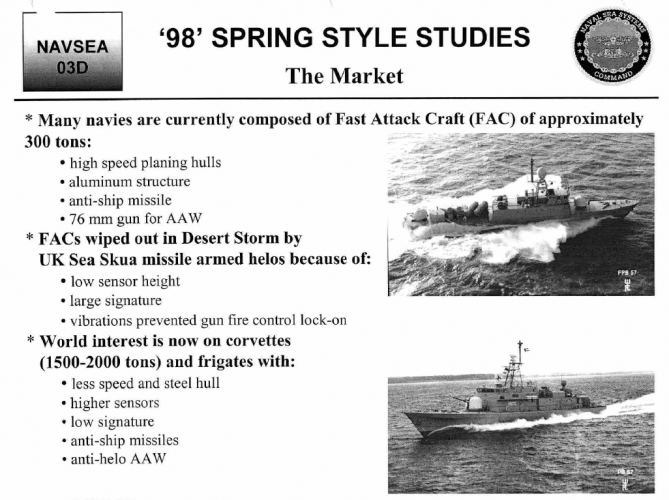
The below is taken from a set of briefing slides I recently unearthed from my archives (aka that box of old files in the garage). It is a set of design studies done by then NAVSEA 03D on possible corvette and frigate designs that would be suitable for foreign navies. I suspect this is a bit of a dodge to avoid giving the appearance of offering a competing alternative to the SC-21/DD-21 effort that was then underway. But these ships are more likely designed around USN requirements than foreign ones, given the choice of systems. OTOH, one of the stated objectives was to "offer possible alternative fleet configurations," and a range of frigates and corvettes certainly is an interesting alternative to the DDG-51/DD-21/LCS fleet we actually got.

Two basic low-observable hull forms were investigated: a "platypus" monohull (essentially the DD-21/DD(X) hull shape) and a trimaran with a similar inverted bow shape. One of the goals was to improve the design tools and methodology for designing future ships using these hull forms. The brief makes an interesting point about LO surface ships: they are more like submarines than traditional surface ships, in that the shape and size is dictated largely by external shaping needs and that the ships are designed "from the outside in," fitting the components into a more or less fixed hull shape, rather than other other way around.

The designs tinker with a variety of different armament and equipment outfits; only one point design for each major configuration is shown. Notably, some early slides talk about a short Mk 41 VLS, but the final designs are using some version of Concentric Canister Launchers instead.

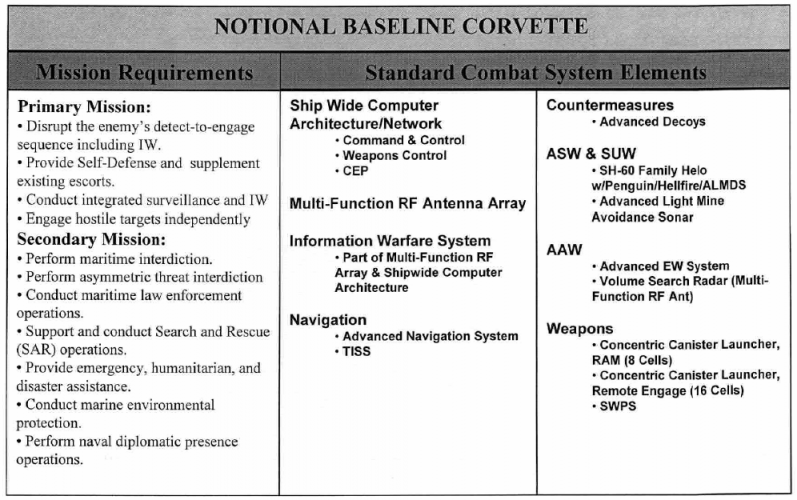
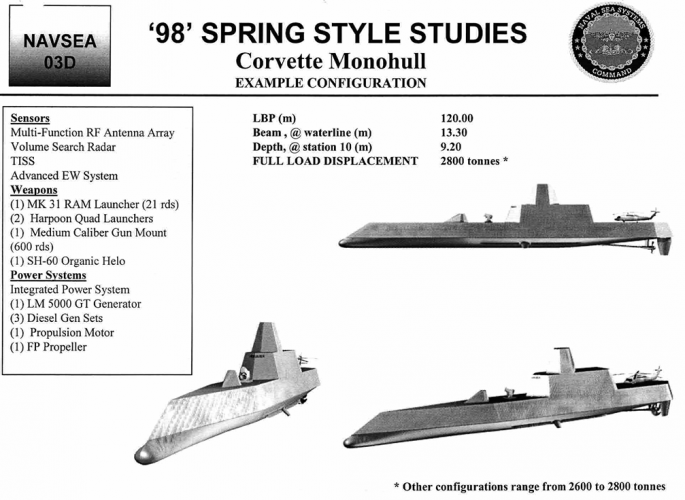
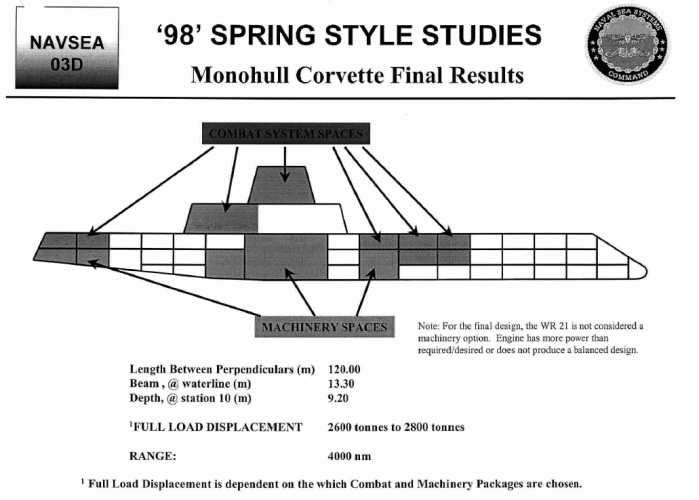
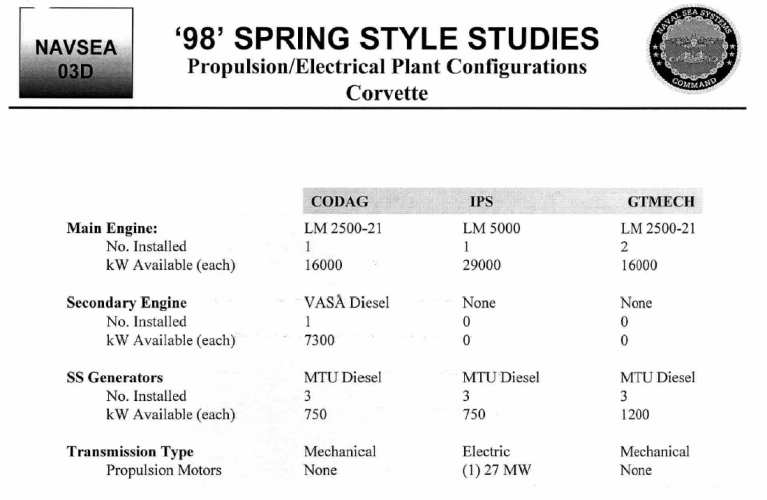
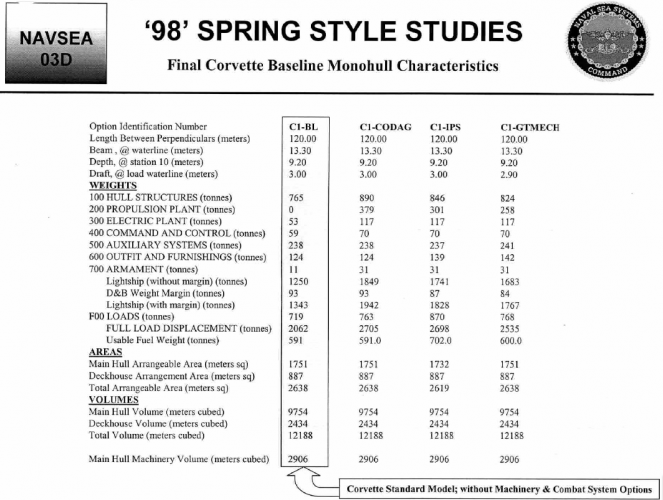
First design discussed is the Corvette Monohull. This would be a ship remarkably like LCS in certain ways, designed to disrupt enemy "detect-to-engage" systems using both weapons and electronic warfare, but with fairly limited self defense capabilities. The first slide below calls for an 8-cell RAM launcher (CCL) and 16 larger CCL tubes for Engare on Remote (Cooperative Engagement Capability) using offboard sensors. It also mentions SWPS, probably the Stabilized Weapons Platform System, basically an anti-swarming small boat weapon (eventually met by Phalanx Block 1B and the advanced versions of Mk 38). Note that the actual design shown in slide 2 has changed to a Mk 31 RAM launcher, a 5-inch gun in a concealed mount, and 2x4 Harpoon (not actually shown but probably buried somewhere in the superstructure) plus one LAMPS III helo. This design has a fairly conventional-looking single fixed-pitch prop driven via electric drive and a very chonky LM5000 gas turbine plus diesels.
1766344340865.png


1766343323918.png

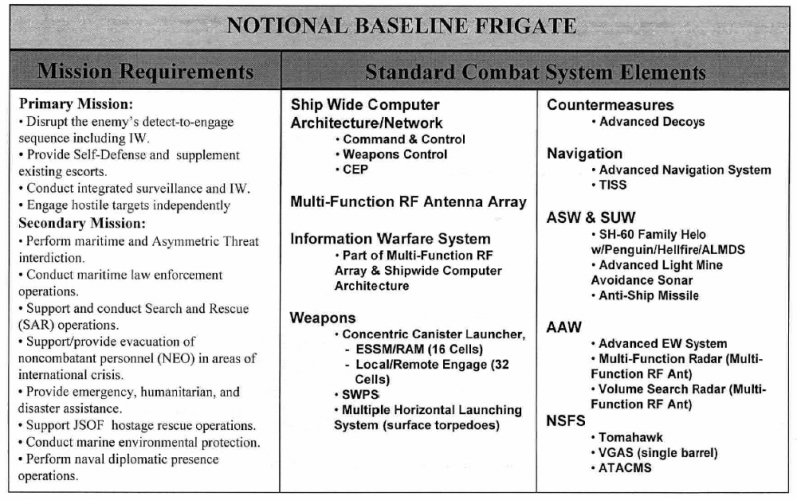
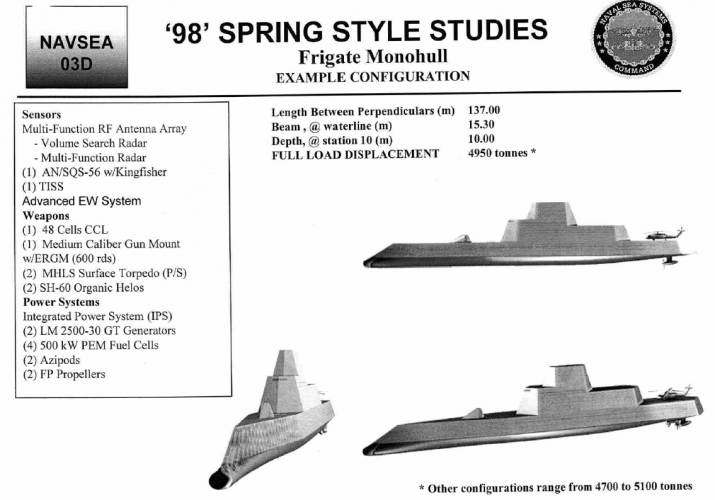
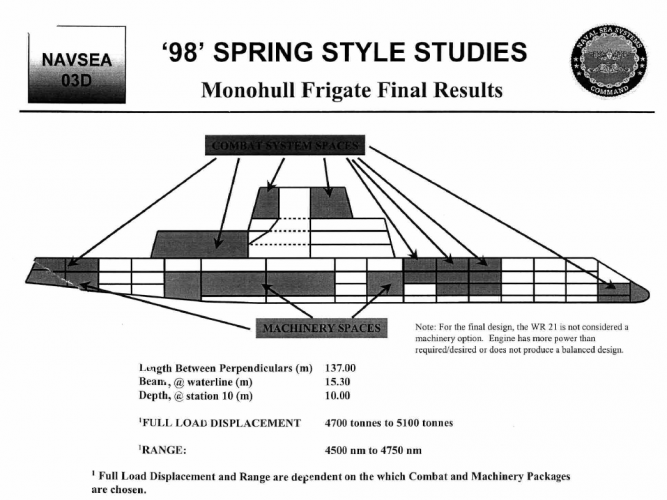
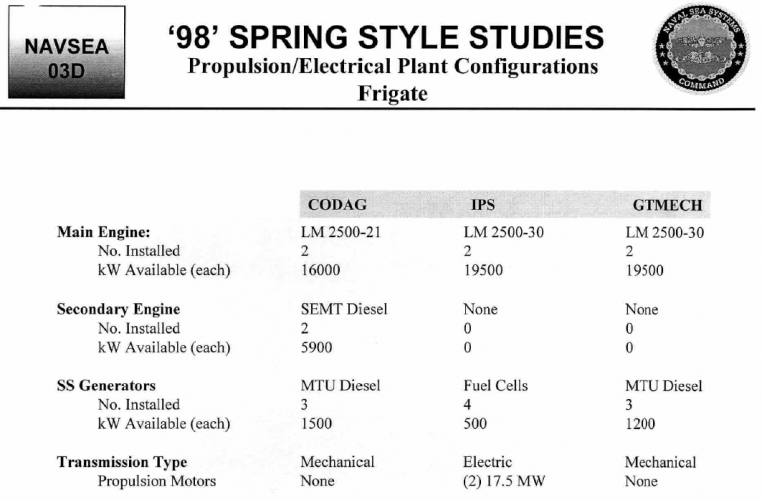
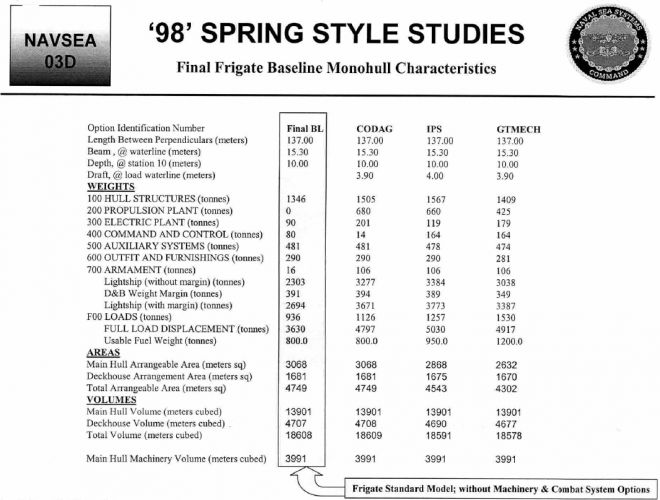
The Frigate Monohull is a scaled up version of the same basic idea but with a more versatile weapon suite. Again, the first slide lays out the baseline configuration, with armament including a CCL with 16 cells for ESSM or RAM and 32 cells for other missiles. There are the same SWPS plus torpedo launchers. MHLS was in vogue, basically an airbag-based launcher that could fire a variety of different weapons, not just standard lightweight torpedoes. Interestingly, they also call for NSFS weapons, including Tomahawk, ATACMS, and a single-barrel VGAS. It's not clear if these were just part of the trade studies or intended to be included in the baseline. They will not appear again. The example configuration shown has 48 CCL cells, a 5-inch gun, 2 sets of torpedo tubes, and 2 LAMPS III helicopters. It has a pair of steerable azipods driven by two uprated LM2500-30 turbines and fuel cells for ship service power.


1766345463431.png

1766345838616.png
 
Last edited:
Absolutely wonderful stuff, I had speculated if they looked at something similar to this a little while ago. With regards to the medium caliber gun mount referenced, is this similar to AGS in that it is built from the ground up, or is it just a stealth mount 5in? The single VGAS is extremely interesting also, I wish we could see how that might've been laid out.
 
Hi,

Thanks for posting these. Its interesting to see what some of the early thinking was on small combatants around that time, and also some of the potential issues that the Navy hadn't identified at that time.

Specifically, it is my understanding that due to the nature of a tumblehome hull shape where the waterplane area decreases as draft increases beyond your design draft that such ships have been found to need to potentially being bigger than a conventional type monohull in order to ensure adequate intact and damage stability, if I am understanding correctly. In addition because this plus the relatively sharp bow and broad stern there is a potential for this type of ship to potentially dig its bow in if caught in a following sea where waves tend to push it down the slope (ie surf) down the wave and drive its bow into the trough of the wave ahead of it, which could lead to broaching or capsize in some conditions.

I believe that issues like this are part of the reason why a the DDG1000 hullform ended up so large and fitted some wave heifght detection sensors and also was part of the reason why the since canceled CG(X) program considered not using a tumblehome hullform. Overall though I think that reasons like this eventually led to such hullforms falling out of favor for small surface combatant, though they still might potentially be under consideration for some special warfare craft etc.

Its also interesting to see how small they thought a 48cell FFG type design would be when fitted with a double helo hangar and a volume search radar.
 
Last edited:
Overall though I think that reasons like this eventually led to such hullforms falling out of favor for small surface combatant
It's quite interesting to me. Inverted bows have seen quite the rise in popularity over the last two decades, from Zumwalt, to the French FDI, some notional KDDX models, to the MEKO A400 AMD (proposed basis for F127) or the conceptual MEKO A210. But only the Zumwalts combined the inverted bow with a tumblehome hull, while all the others have flared hulls with inverted bows.
 
It's quite interesting to me. Inverted bows have seen quite the rise in popularity over the last two decades, from Zumwalt, to the French FDI, some notional KDDX models, to the MEKO A400 AMD (proposed basis for F127) or the conceptual MEKO A210. But only the Zumwalts combined the inverted bow with a tumblehome hull, while all the others have flared hulls with inverted bows.
Hi,

Yes, as you noted notionally inverted bows (or in some cases a vertical bows) have been used on p-or in some cases proposed for a number of recent designs, these typically have noticeable full or in many cases flared hulls that help ensure a good amount of reserve buoyancy forward.

It is my understanding that the sharply inverted bow (potentially further augmented by the long protruding sonar dome) combined with the tumblehome sides, and broad stern (with noticeable cut away under the waterline) as shown in the figure provided above for the Springstyle Corvette and Frigate as well as the DDG 1000 combine to provide a large surface aft for following waves to act on, along with a sharp bow with little reserve buoyancy that could potentially easily plow into a preceding wave trough, and the loss of waterplane (and its associated righting force/moment of inertia) than can potentially cause a ship to broach if it finds itself in the wrong circumstances, and hence makes the type of hullform, as shown in the images of the Corvette and Frigate concept posted above not desirable for such sized combatants.

There were some Society of Naval Architects and Marine Engineers papers a while ago (back during the early days of the DD(X)/DDG1000 program that touched on some of these issues that I might be able to dig up. In particular I vaguely recall seeing images of a model of such a hullform broaches in a model basin during testing.
 
Re: Disrupt enemy "detect-to-engage" systems using both weapons and electronic warfare

Is there anything unique to this mission, beyond than nomenclature of the time period? To my eyes this seems like EW, helos, sonobuoys, etc.. I find it interesting that this is considered a/the primary mission, even from a sensor-fusion or battle network POV, because these are very big and expensive senor nodes to be used for lesser contested environments. Not sure my corvettes need to be linked with CEC and have shipwide computer architecture, etc.
 
Comparison of monohull and trimaran designs to follow, hopefully tomorrow.

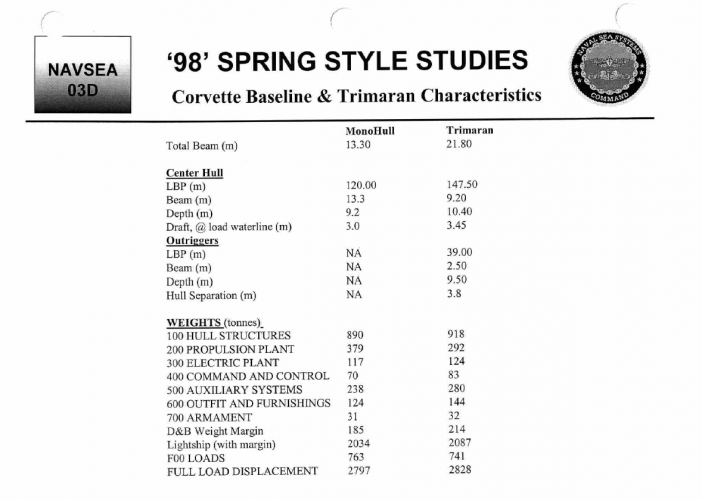
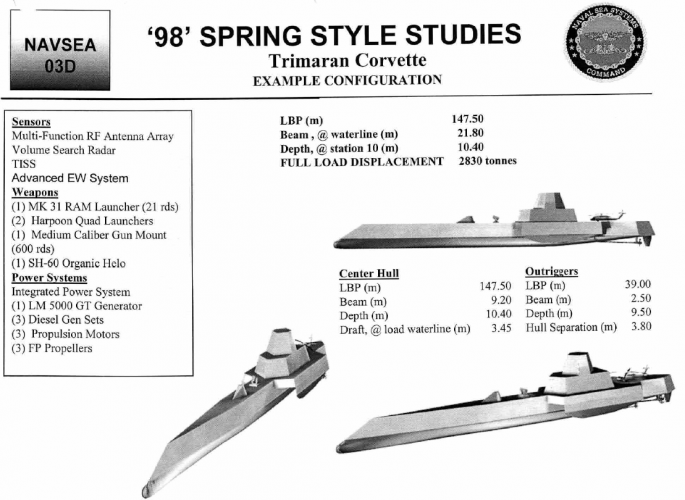
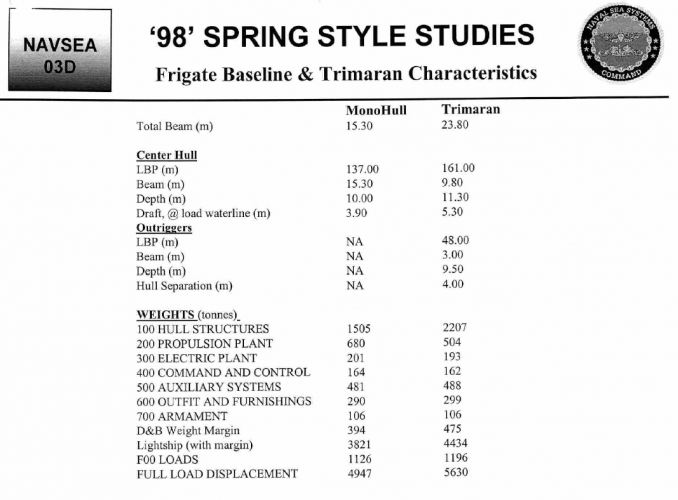
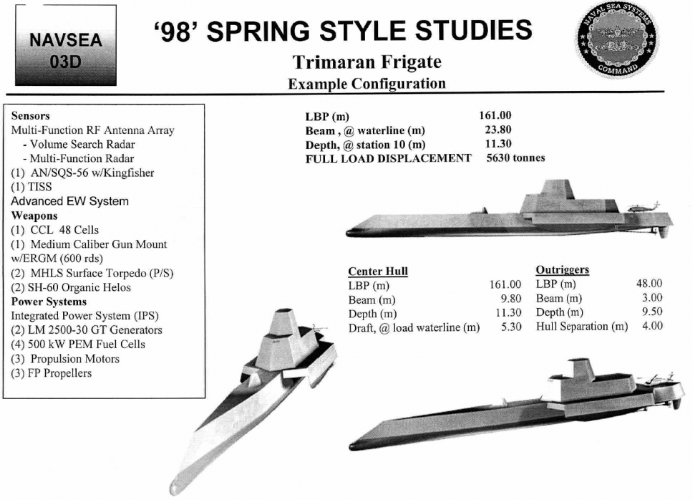
OK, got distracted by the "battleship" discourse yesterday, but here are the monohull vs trimaran comparison slides. The trimaran shape here has very small outriggers (aka sidehulls), which I believe turns out to be the optimal solution in most cases.

The methodology was to take the most demanding monohull combat system and machinery configuration, then translate that into a trimaran. In both cases, the trimaran overall displaces more than the monohull, even accounting for reduced propulsion machinery weights (same prime movers used in both, so I'm guessing this is due to smaller fuel tanks, mainly). Hull structure weight grows significantly. As experience predicts, this is much worse in the larger frigate than the corvette (only about a 3% structural weight difference for the corvette, but nearly 50% for the frigate). Trimaran hulls just don't scale well beyond about 3,000 tons.

One notable distinction is that the trimaran frigate revers to traditional shaftlines rather than azipods. I suspect there just wasn' t enough space in the center hull for two azipods, so they switched to three fixed props, one in the main hull and one in each outrigger.


1766523430990.png

1766523471951.png

1766523517549.png

1766523541406.png
 
One thing to note is that none of these designs call out significant ASW systems. The frigate has the same SQS-56 sonar with Kingfisher as the FFG-7s but there is no mention of TACTASS or a VDS of any sort.
 
Is this an oversight or is this a deliberate choice driven by predicted USN requirements?

I think it's deliberate, and driven by what they saw as the "world market." They were really looking at this as somewhere between a FAC-M replacement (especially the corvette) an a general-purpose frigate.

1766583979318.png

That said, both the corvette and frigate do include Combat Systems spaces at the stern below the flight deck. These may be just for torpedo detection sonar and towed decoys, but the frigate in particular should have enough room there for a TACTASS-type towed array.

1766584169356.png


1766584416878.png
PS: I apologize for posting this piecemeal, but the overall brief scanned at 22 MB and so is too big to upload.
 
Absolutely wonderful stuff, I had speculated if they looked at something similar to this a little while ago. With regards to the medium caliber gun mount referenced, is this similar to AGS in that it is built from the ground up, or is it just a stealth mount 5in? The single VGAS is extremely interesting also, I wish we could see how that might've been laid out.

Sorry, forgot to reply to this. I'm fairly certain it was a Mk 45 Mod 4 (127mm/62) in a new disappearing barrel gunhouse like the Bofors SAK57 Mk 3 stealth cupola.

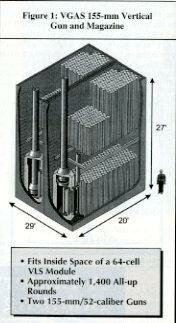
As for single-barrel VGAS, if you look at the diagram we do have, it's functionally two single guns with a bulkhead between them. So a module about 14 feet wide, 20 feet long, and 27 feet deep.

1766598643242.png
 
While snooping around I found this study by NSWC on high-speed, small naval vessels concerning monohulls, catamaran and trimaran designs?

It also looked at considerations for materials to be used such as: steel, aluminum, titanium, composites (glass, carbon fibers), and sandwich structures (LASCOR laser-welded corrugated core).
 

Attachments

  • ADA417876.pdf
    3.7 MB · Views: 35
One thing to note is that none of these designs call out significant ASW systems. The frigate has the same SQS-56 sonar with Kingfisher as the FFG-7s but there is no mention of TACTASS or a VDS of any sort.

Thank you for posting these. The ASW sensor suite seems like the only weak spot equipment wise in an otherwise comprehensive fit. I noted the VSR/MFR combo in particular, do you know if any assumptions were made about the array size? E.g. was it the full DD-21 set or was it scaled down?

I can't help thinking the displacement feels low for the offered capability, especially when compared to the Euro frigates (FREMM, Type 26) that emerged subsequently. A 5" gun, 48 VLS cells, 2 x SH-60, VSR/MFR, MHLS, etc. wrapped in a low RCS hull and superstructure at ~5,000 tons seems remarkable even considering the space advantages offered by CCL/MHLS. I assume these would have had very lean manning as on DD-21? The Norwegian Nansens ordered around this time perhaps make for an interesting comparator in terms is size and equipment.

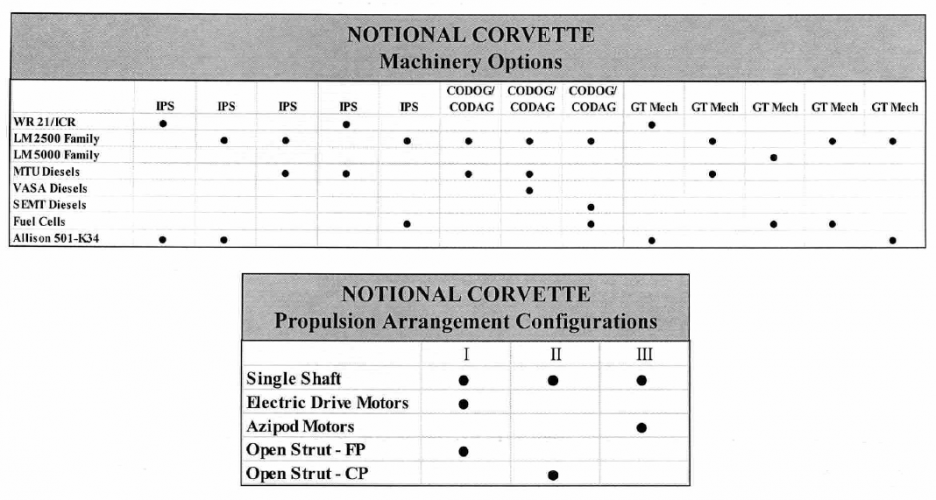
I noted a reference to the WR-21 on one of the slides, were any other propulsion configurations considered? E.g. a single LM6000 in place of the LM2500s? I recognise that wouldn't be good from a redundancy perspective but could it have had operating cost advantages? The LM6000 was a candidate for DD-21 for a while.

Overall, I am reminded of the path not taken and where the USN is today. I have a note that the plan in 1999/2000 was for 32 DD-21s and 27 CG-21s to br ordered between FY04 and FY24. Those ships with CCL/MHLS and VGAS would have produced a very different looking, but more expensive, Navy. Could a force mix with less DD/CG and some ~5000 ton frigates with common systems have reduced the total cost enough to be workable? Noting the the DD-21 objective was for 256 VLS cells.
 
Last edited:
do you know if any assumptions were made about the array size? E.g. was it the full DD-21 set or was it scaled down?

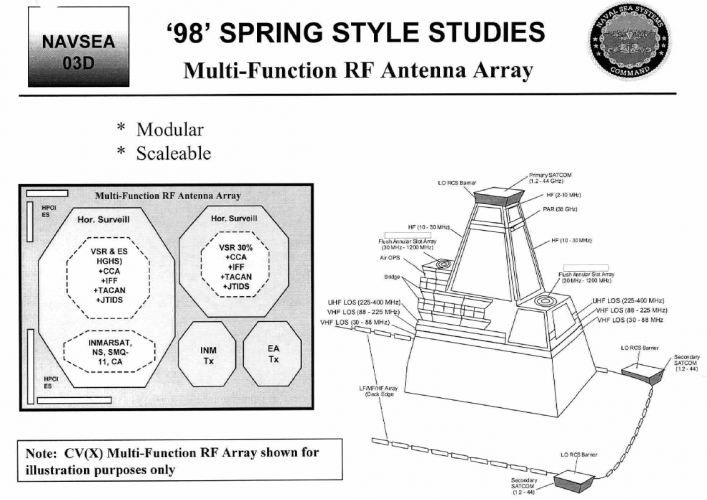
Fairly certain they were scaled down, and probably generic. There's a discussion of multi-function antenna arrays, which proved to be a bridge too far for DD-21. Scalability is mentioned as a key benefit.

1766611903097.png

I assume these would have had very lean manning as on DD-21?

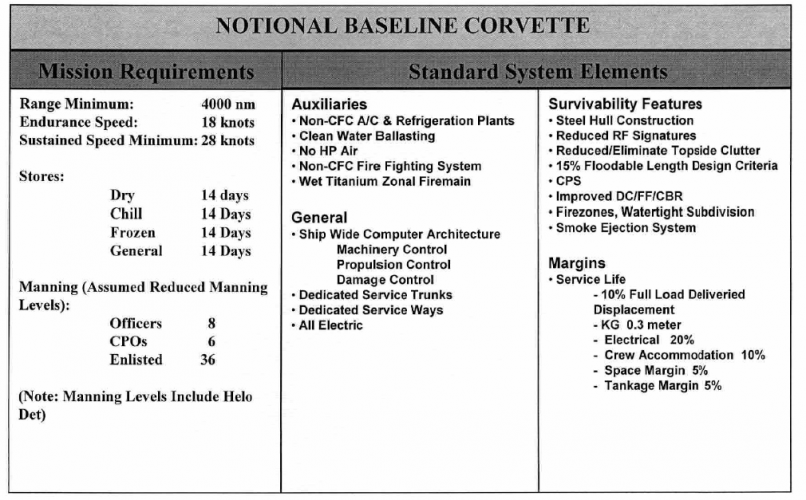
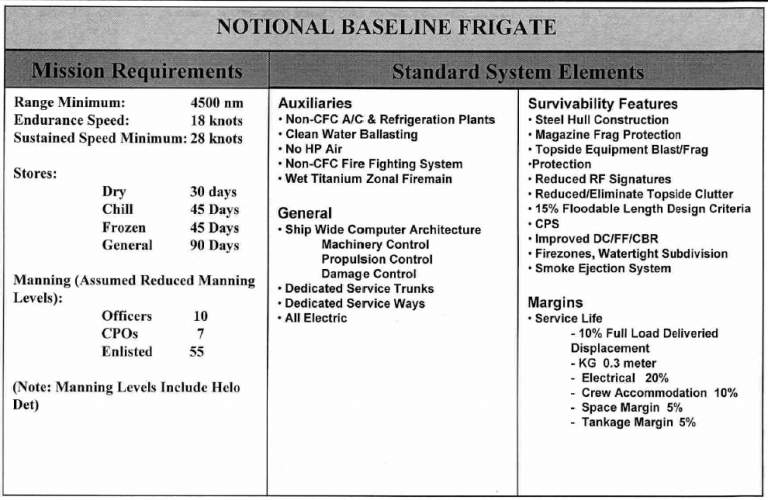
They take Sa'ar V as their baseline for the corvette but also note that they did not do any actual workload analysis -- it's far too basic a concept to really get into that. Corvette they baselined at 50 crew, frigate at 72.

1766612182244.png

1766612254959.png
I noted a reference to the WR-21 on one of the slides, were any other propulsion configurations considered? E.g. a single LM6000 in place of the LM2500s? I recognise that wouldn't be good from a redundancy perspective but could it have had operating cost advantages? The LM6000 was a candidate for DD-21 for a while.

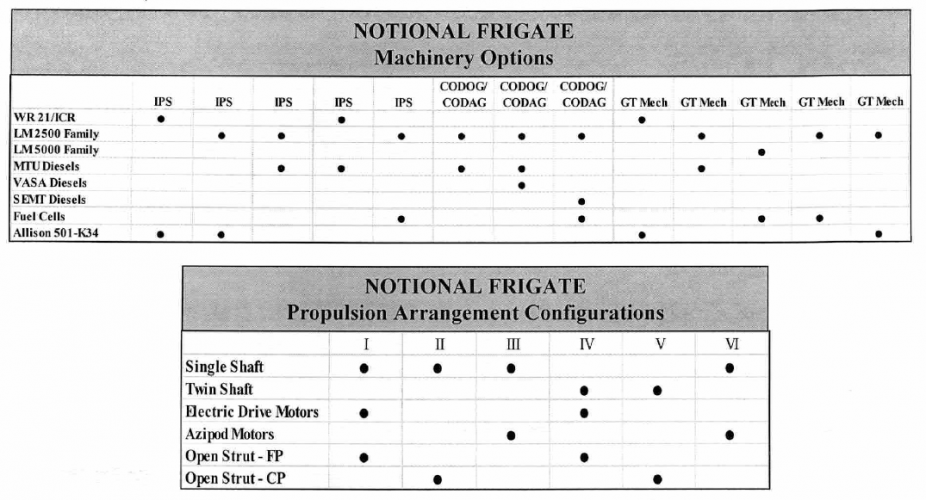
Oh, my yes. They did a whole lot of optmization studies on various machinery and propulsion arrangements.

1766612425688.png

1766612536298.png

1766612734994.png

1766612468111.png

1766612564857.png

1766612773551.png

I really do need to upload the whole thing. @overscan (PaulMM) is there any way to upload a larger file somehow?
 
It’s really kind of pointless to have such a thread if all analysis and discussion is considered off topic (and deleted by the mods) the moment any comparison to other designs is made.
 
One thing to note is that none of these designs call out significant ASW systems. The frigate has the same SQS-56 sonar with Kingfisher as the FFG-7s but there is no mention of TACTASS or a VDS of any sort.
I still think that most nations would want a frigate with a towed array of some kind. Either VDS or conventional, not both, and probably VDS with the big hull sonar. If there's a space in the stern, that's "good enough"
 
Fairly certain they were scaled down, and probably generic. There's a discussion of multi-function antenna arrays, which proved to be a bridge too far for DD-21. Scalability is mentioned as a key benefit.

View attachment 796335


They take Sa'ar V as their baseline for the corvette but also note that they did not do any actual workload analysis -- it's far too basic a concept to really get into that. Corvette they baselined at 50 crew, frigate at 72.

View attachment 796336

View attachment 796337


Oh, my yes. They did a whole lot of optmization studies on various machinery and propulsion arrangements.

View attachment 796338

View attachment 796340

View attachment 796342

View attachment 796339

View attachment 796341

View attachment 796343

I really do need to upload the whole thing. @overscan (PaulMM) is there any way to upload a larger file somehow?
Yep, send it to me I can add to the web server.
 
Sorry, forgot to reply to this. I'm fairly certain it was a Mk 45 Mod 4 (127mm/62) in a new disappearing barrel gunhouse like the Bofors SAK57 Mk 3 stealth cupola.

As for single-barrel VGAS, if you look at the diagram we do have, it's functionally two single guns with a bulkhead between them. So a module about 14 feet wide, 20 feet long, and 27 feet deep.

View attachment 796316
It's half a 64 cell Mk 41 divided lengthwise. Which means given a wide enough beam, peripheral mounting would also be possible.
 
1766611903097.png
This may be better off going in a new thread but, seeing as it is mentioned, I am currently deep diving into CV(X). Would you happen to have any documentation that you could share or references for documents I can request?
 
This may be better off going in a new thread but, seeing as it is mentioned, I am currently deep diving into CV(X). Would you happen to have any documentation that you could share or references for documents I can request?

Sorry, I worked for the surface combatant side, nothing much on CV(X).
 
Sorry, I worked for the surface combatant side, nothing much on CV(X).
Thanks anyway, I think I've found the docs I need to FOIA so they might appear on SPF sometime soon.

It is my understanding Directorate 03D (which I believe became 05D?) made proposals such as these based upon what the predicted battlespace would look like in the future. Is it fair to say that, much like with DDX, the focus on minimizing signature was such that they could penetrate littoral environments against green water navies such as Iran? Further, what was the predicted threat environment and did it make any allowances for peer conflict?
 
Further, what was the predicted threat environment and did it make any allowances for peer conflict?
I was in the Navy 00-06, and we didn't really consider there to be any peers in the ocean. Anyone with the crew quality (Brits/Aussies, Japan) didn't have the numbers, anyone with the numbers didn't have crew quality.
 
Sorry, forgot to reply to this. I'm fairly certain it was a Mk 45 Mod 4 (127mm/62) in a new disappearing barrel gunhouse like the Bofors SAK57 Mk 3 stealth cupola.

As for single-barrel VGAS, if you look at the diagram we do have, it's functionally two single guns with a bulkhead between them. So a module about 14 feet wide, 20 feet long, and 27 feet deep.

View attachment 796316
I forgot to mention, this is the same size as a 64-cell Mk-41 module. Depending on load out, those can top out at around 240 tons, or 30 tons per 8-cell module. I don't know the weights for this, but assuming similar you could be looking at 120 tons for a single gun with 700 rounds.
 
I forgot to mention, this is the same size as a 64-cell Mk-41 module. Depending on load out, those can top out at around 240 tons, or 30 tons per 8-cell module. I don't know the weights for this, but assuming similar you could be looking at 120 tons for a single gun with 700 rounds.

I've never seen a weight quoted, but I suspect it's even denser than the maximum TLAM load in a Mk 41.
 
It's half a 64 cell Mk 41 divided lengthwise. Which means given a wide enough beam, peripheral mounting would also be possible.
15x20x27.

That's about like having two PVLS units together, Mk57s are 8x15x27. I would want a heavier armor bulkhead inboard, but it's not a terrible idea. It'd be even better if it was possible to reshape the magazine to half the width again, to fit within the footprint of 2-3 PVLS cells.
 
15x20x27.

That's about like having two PVLS units together, Mk57s are 8x15x27. I would want a heavier armor bulkhead inboard, but it's not a terrible idea. It'd be even better if it was possible to reshape the magazine to half the width again, to fit within the footprint of 2-3 PVLS cells.
Those dimensions are off. The length and width in the illustration are switched. It would be 10x29x27, just two feet wider than a pair of Mk57s. And I don't think you could shrink the width much if at all since it looks like the breech and ammo handling take up most of the width of the compartment.
 
Those dimensions are off. The length and width in the illustration are switched. It would be 10x29x27, just two feet wider than a pair of Mk57s. And I don't think you could shrink the width much if at all since it looks like the breech and ammo handling take up most of the width of the compartment.
Okay, if that's the right numbers that would be a very viable option to replace a pair of PVLS. Per side.
 

Similar threads

Back
Top Bottom