- Joined
- 16 April 2008
- Messages
- 10,612
- Reaction score
- 18,221
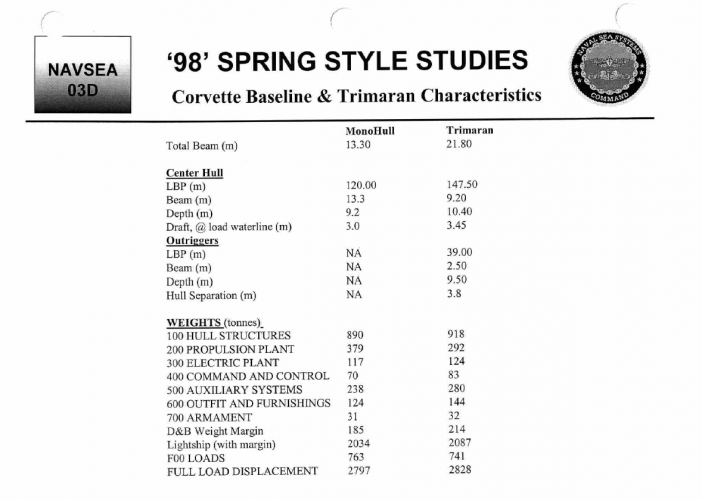
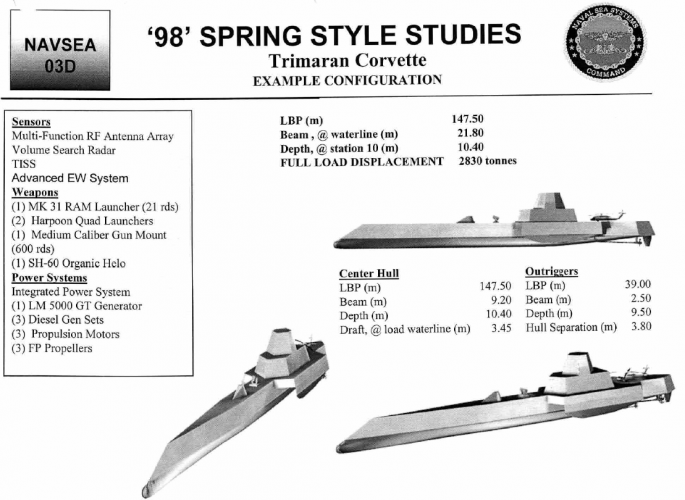
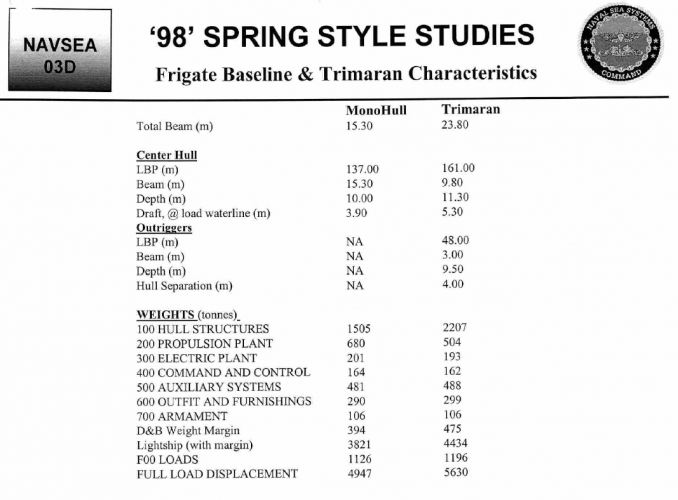
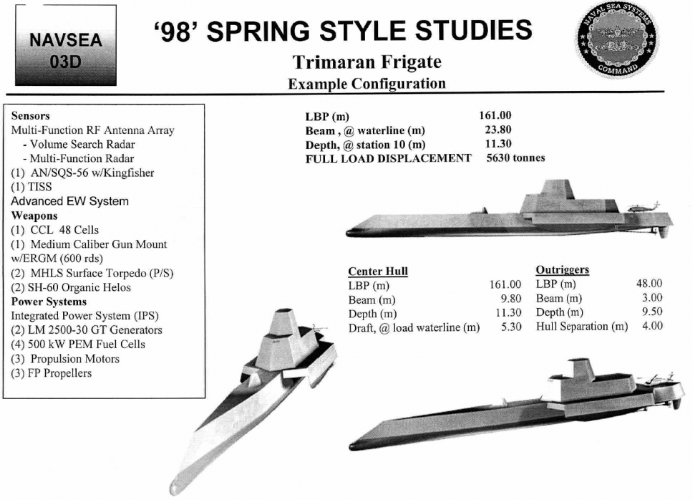
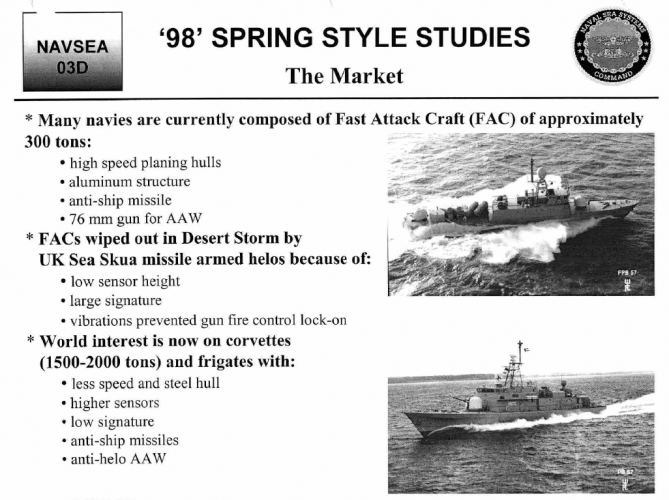
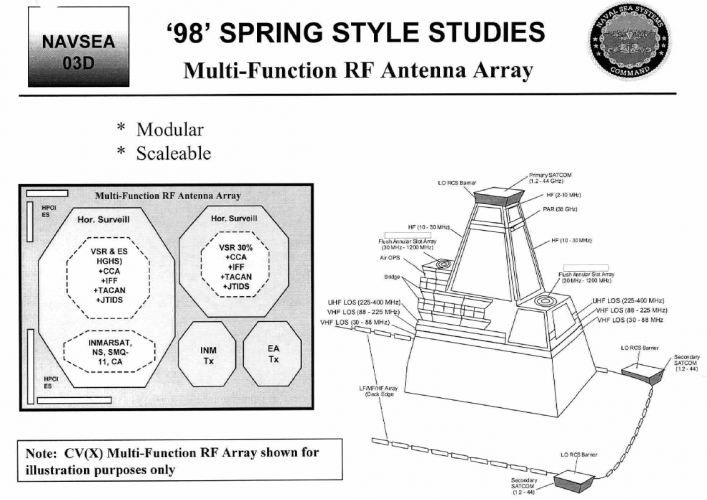
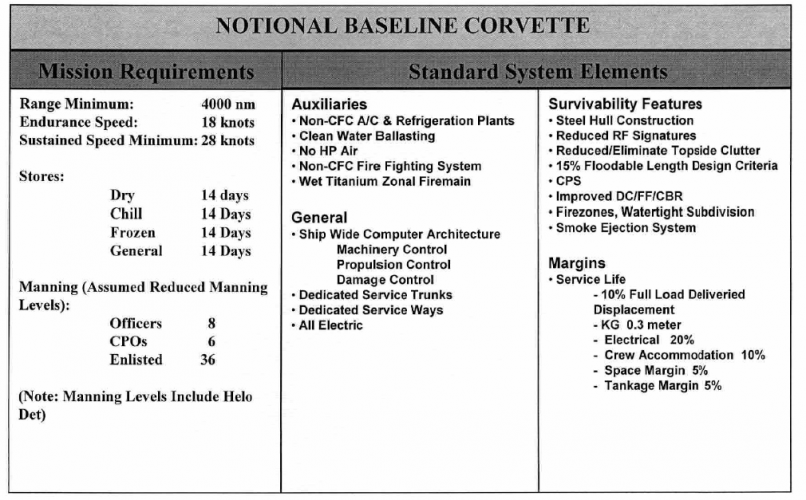
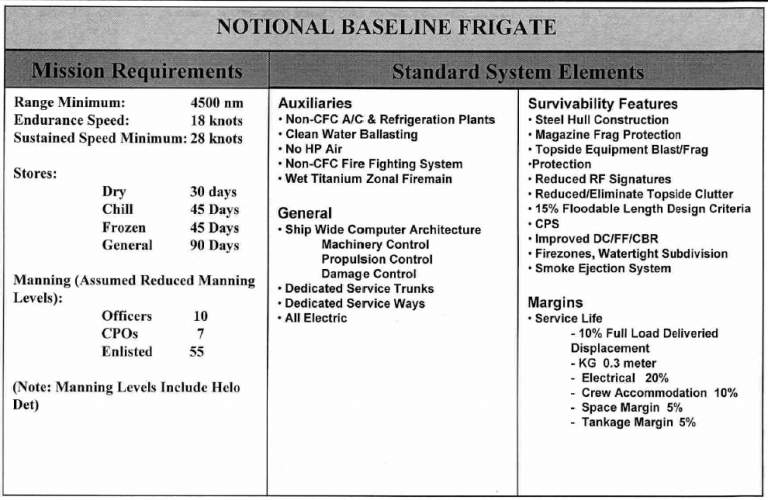
The below is taken from a set of briefing slides I recently unearthed from my archives (aka that box of old files in the garage). It is a set of design studies done by then NAVSEA 03D on possible corvette and frigate designs that would be suitable for foreign navies. I suspect this is a bit of a dodge to avoid giving the appearance of offering a competing alternative to the SC-21/DD-21 effort that was then underway. But these ships are more likely designed around USN requirements than foreign ones, given the choice of systems. OTOH, one of the stated objectives was to "offer possible alternative fleet configurations," and a range of frigates and corvettes certainly is an interesting alternative to the DDG-51/DD-21/LCS fleet we actually got.
Two basic low-observable hull forms were investigated: a "platypus" monohull (essentially the DD-21/DD(X) hull shape) and a trimaran with a similar inverted bow shape. One of the goals was to improve the design tools and methodology for designing future ships using these hull forms. The brief makes an interesting point about LO surface ships: they are more like submarines than traditional surface ships, in that the shape and size is dictated largely by external shaping needs and that the ships are designed "from the outside in," fitting the components into a more or less fixed hull shape, rather than other other way around.
The designs tinker with a variety of different armament and equipment outfits; only one point design for each major configuration is shown. Notably, some early slides talk about a short Mk 41 VLS, but the final designs are using some version of Concentric Canister Launchers instead.
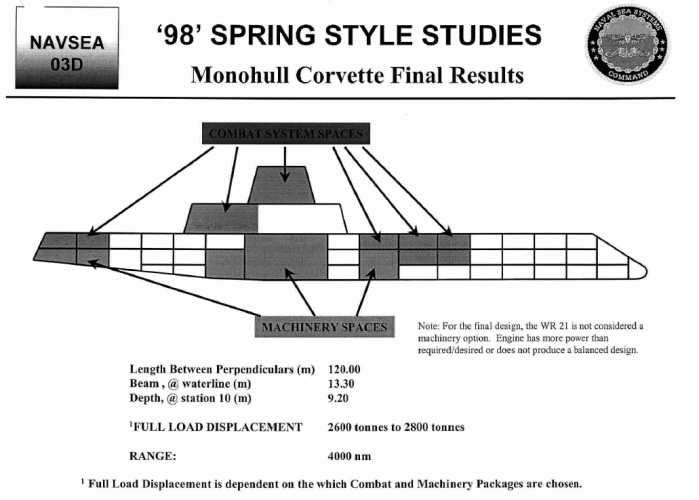
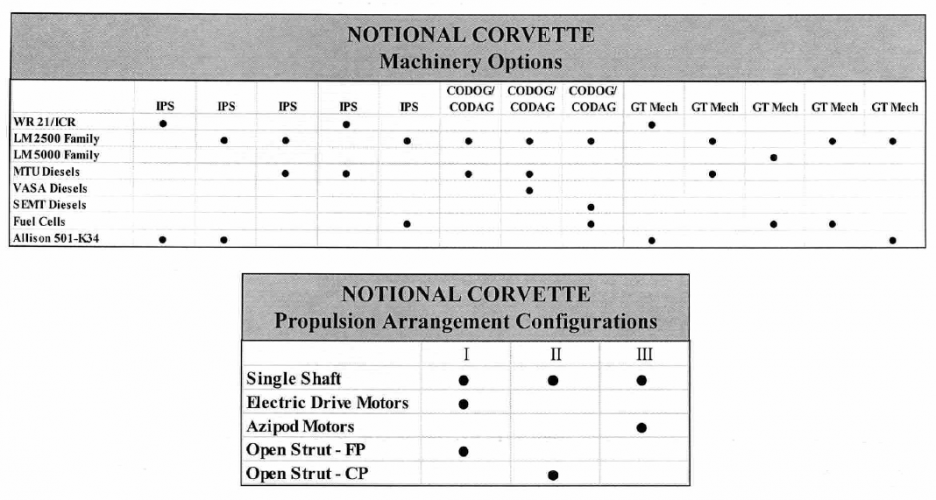
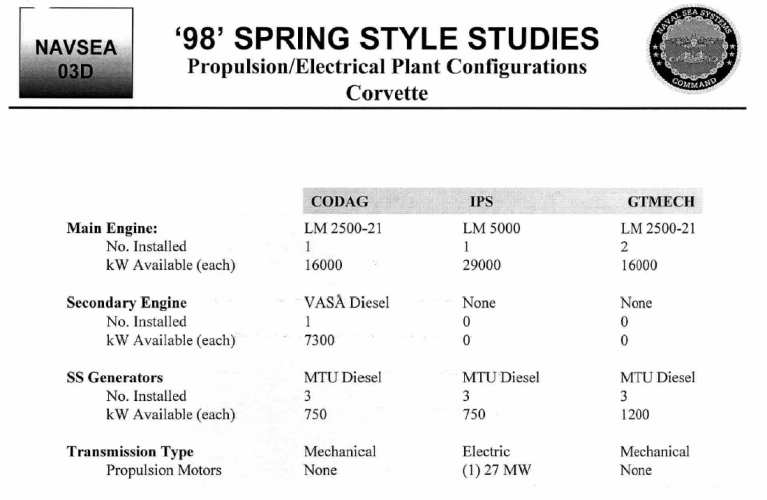
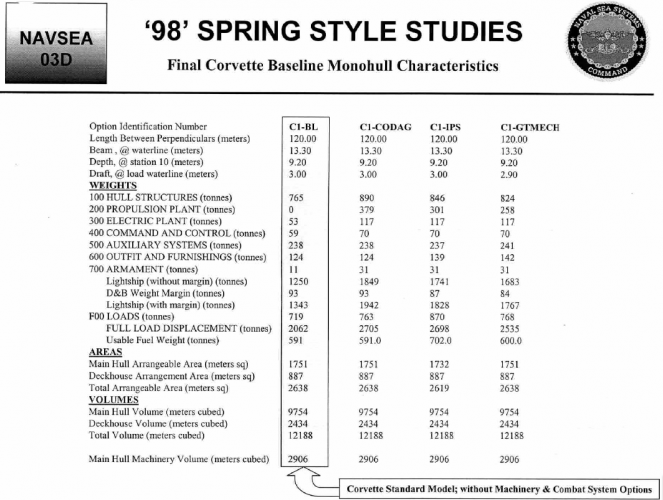
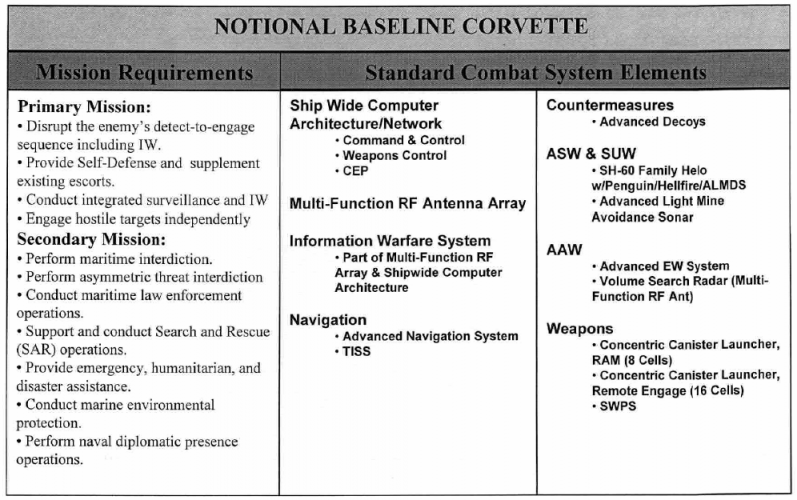
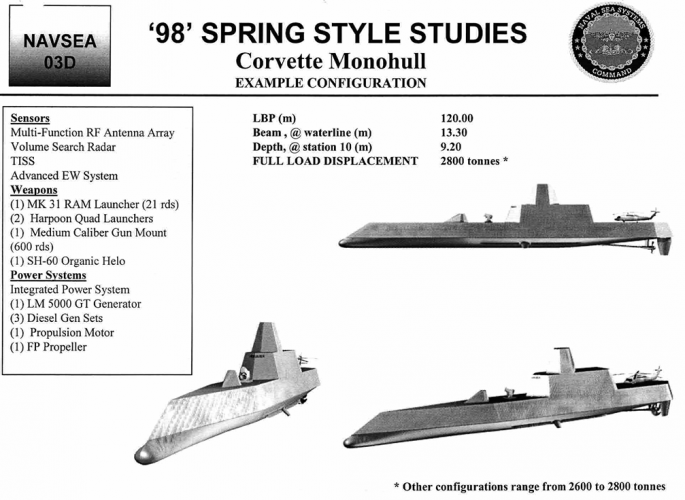
First design discussed is the Corvette Monohull. This would be a ship remarkably like LCS in certain ways, designed to disrupt enemy "detect-to-engage" systems using both weapons and electronic warfare, but with fairly limited self defense capabilities. The first slide below calls for an 8-cell RAM launcher (CCL) and 16 larger CCL tubes for Engare on Remote (Cooperative Engagement Capability) using offboard sensors. It also mentions SWPS, probably the Stabilized Weapons Platform System, basically an anti-swarming small boat weapon (eventually met by Phalanx Block 1B and the advanced versions of Mk 38). Note that the actual design shown in slide 2 has changed to a Mk 31 RAM launcher, a 5-inch gun in a concealed mount, and 2x4 Harpoon (not actually shown but probably buried somewhere in the superstructure) plus one LAMPS III helo. This design has a fairly conventional-looking single fixed-pitch prop driven via electric drive and a very chonky LM5000 gas turbine plus diesels.


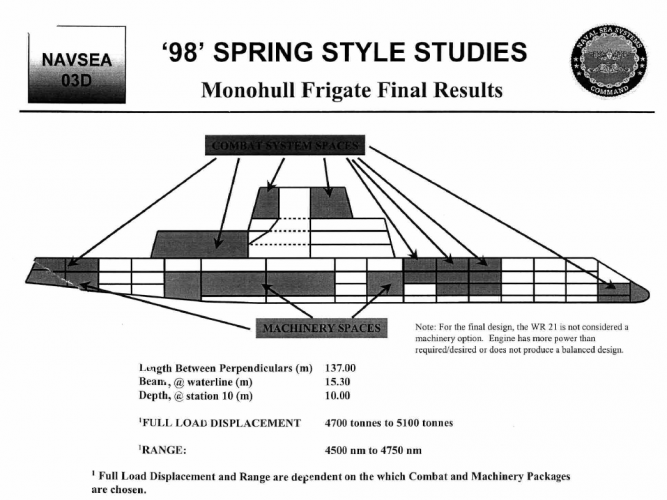
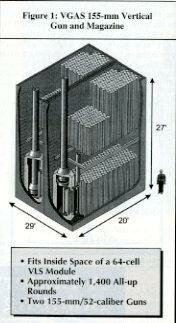
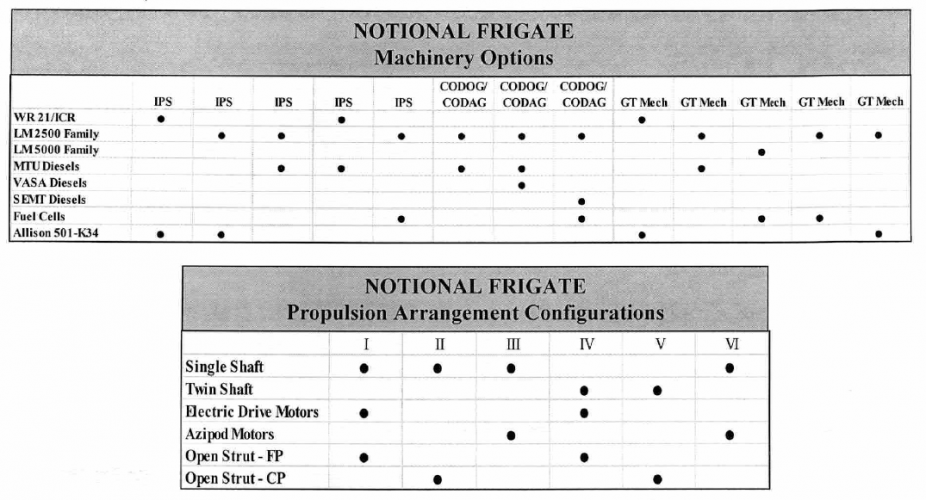
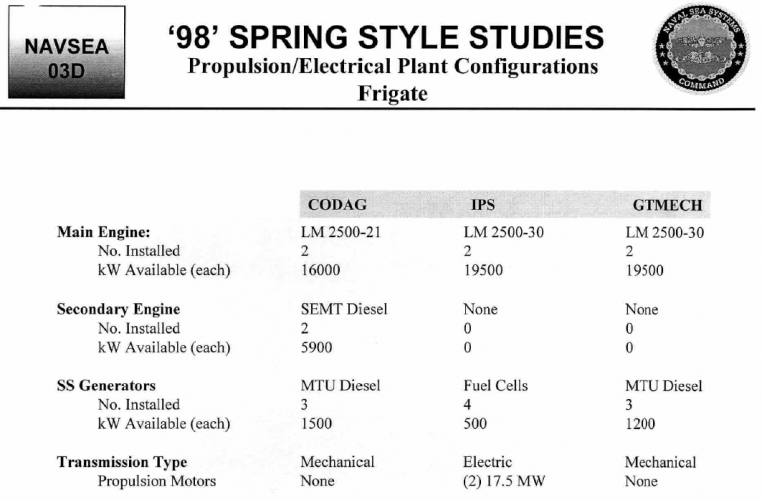
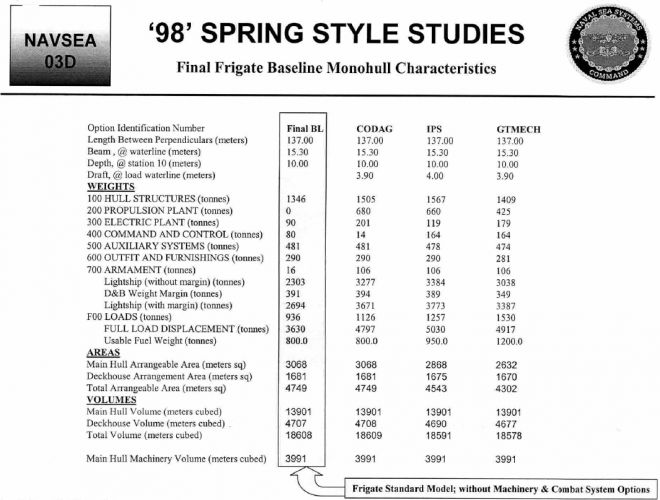
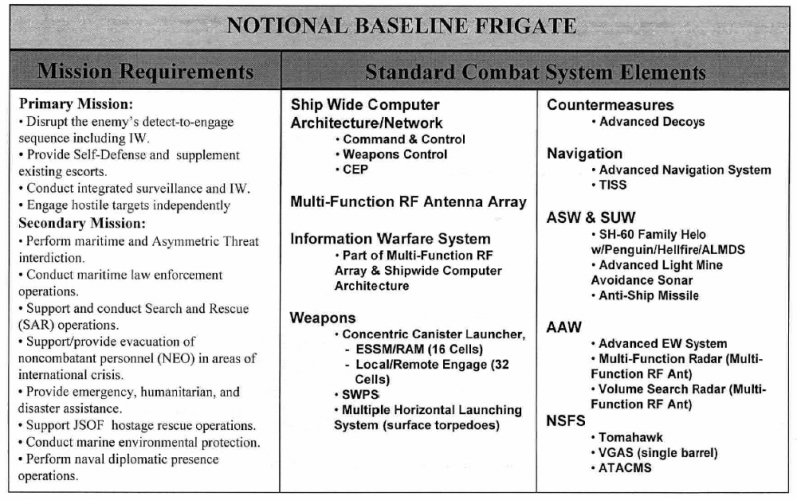
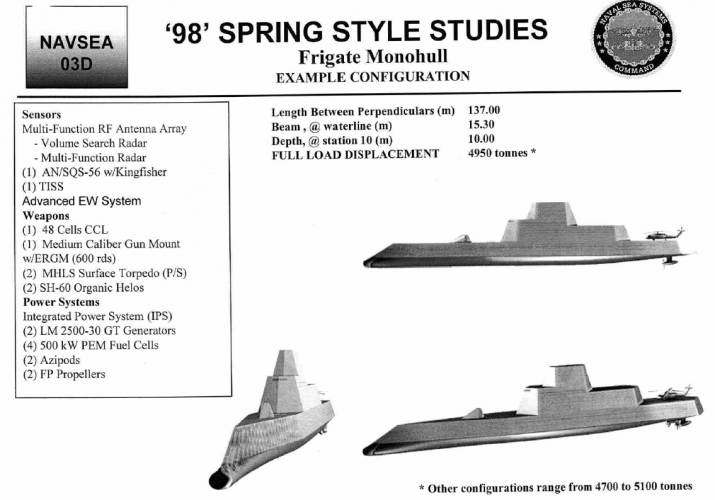
The Frigate Monohull is a scaled up version of the same basic idea but with a more versatile weapon suite. Again, the first slide lays out the baseline configuration, with armament including a CCL with 16 cells for ESSM or RAM and 32 cells for other missiles. There are the same SWPS plus torpedo launchers. MHLS was in vogue, basically an airbag-based launcher that could fire a variety of different weapons, not just standard lightweight torpedoes. Interestingly, they also call for NSFS weapons, including Tomahawk, ATACMS, and a single-barrel VGAS. It's not clear if these were just part of the trade studies or intended to be included in the baseline. They will not appear again. The example configuration shown has 48 CCL cells, a 5-inch gun, 2 sets of torpedo tubes, and 2 LAMPS III helicopters. It has a pair of steerable azipods driven by two uprated LM2500-30 turbines and fuel cells for ship service power.


Two basic low-observable hull forms were investigated: a "platypus" monohull (essentially the DD-21/DD(X) hull shape) and a trimaran with a similar inverted bow shape. One of the goals was to improve the design tools and methodology for designing future ships using these hull forms. The brief makes an interesting point about LO surface ships: they are more like submarines than traditional surface ships, in that the shape and size is dictated largely by external shaping needs and that the ships are designed "from the outside in," fitting the components into a more or less fixed hull shape, rather than other other way around.
The designs tinker with a variety of different armament and equipment outfits; only one point design for each major configuration is shown. Notably, some early slides talk about a short Mk 41 VLS, but the final designs are using some version of Concentric Canister Launchers instead.
First design discussed is the Corvette Monohull. This would be a ship remarkably like LCS in certain ways, designed to disrupt enemy "detect-to-engage" systems using both weapons and electronic warfare, but with fairly limited self defense capabilities. The first slide below calls for an 8-cell RAM launcher (CCL) and 16 larger CCL tubes for Engare on Remote (Cooperative Engagement Capability) using offboard sensors. It also mentions SWPS, probably the Stabilized Weapons Platform System, basically an anti-swarming small boat weapon (eventually met by Phalanx Block 1B and the advanced versions of Mk 38). Note that the actual design shown in slide 2 has changed to a Mk 31 RAM launcher, a 5-inch gun in a concealed mount, and 2x4 Harpoon (not actually shown but probably buried somewhere in the superstructure) plus one LAMPS III helo. This design has a fairly conventional-looking single fixed-pitch prop driven via electric drive and a very chonky LM5000 gas turbine plus diesels.
The Frigate Monohull is a scaled up version of the same basic idea but with a more versatile weapon suite. Again, the first slide lays out the baseline configuration, with armament including a CCL with 16 cells for ESSM or RAM and 32 cells for other missiles. There are the same SWPS plus torpedo launchers. MHLS was in vogue, basically an airbag-based launcher that could fire a variety of different weapons, not just standard lightweight torpedoes. Interestingly, they also call for NSFS weapons, including Tomahawk, ATACMS, and a single-barrel VGAS. It's not clear if these were just part of the trade studies or intended to be included in the baseline. They will not appear again. The example configuration shown has 48 CCL cells, a 5-inch gun, 2 sets of torpedo tubes, and 2 LAMPS III helicopters. It has a pair of steerable azipods driven by two uprated LM2500-30 turbines and fuel cells for ship service power.
Last edited: