USAF/USN 6th Gen Fighters - F/A-XX, F-X, NGAD, PCA, ASFS News & Analysis [2008- 2025]

Status
Not open for further replies.
NGAS (tanker) and NGAP (engine) are tied to manned NGAD. Sentinel is taking a lot of funding. CCA is not yet.
Sentinel is very not a priority it have zero need in a battle, nuclear weapons are a waste of money , Bomber and submarines are enough for launching nuclear weapon. This is not a sentinel missile who will stop the Chinese expansion, this end of the world weapons have realy no utility, insteed if we want a collective suicide. They are speaking a lot of Space weapons it seem to be a hurry now for this kind.
This is interesting :
"“What motivated us to take another look [at NGAD] was the affordability” Kendall said, noting that there were other missions to which the service wanted devote added resources such as “more aggressive counter-space capabilities, airbase protection, particularly our forward air bases.” Is there a hurry to fight in Space a new priority ?
"former Chiefs of Staff, and senior generals—came up with regarding NGAD, Kendall said they reached “a consensus that there are a number of other things that we need to fund”
What is more important to fund than a new fighter ?
And the last interesting too:
"And we looked at some other ’out of the box’” ideas, he said, adding that “some of them might be worth pursuing independently.”
 
Last edited:
Well at this point, funding and focus are likely in flux until incoming administration officials make choices. There probably was a well defined plan, and some here have outlined it, but the program is an open question now.
Maybe we can get our 6th gens cheaper and in larger quantities by copying China? Or could be available on Amazon for FY2026 for outright purchase and 2-day delivery, Amazon Prime.
 
https://www.airandspaceforces.com/k...continueFlag=267ea948fdc8e9d139fe041992ce3132
Analyses and wargames indicate the second increment of the Collaborative Combat Aircraft program should not be an “exquisite” aircraft—meaning very stealthy and equipped with many sensors and weapons—but it should have more capability than Increment 1, and an additional cost of 20-30 percent would be acceptable, Air Force Secretary Frank Kendall told Air & Space Forces Magazine this week.
 
Last edited:
Surprised at that point about not having a stealthy CCA myself dark sidius, will that come with CCA2 though? We will just have to wait and see what happens next.
 
I think 1) stealth is relative, and the Incr1 CCAs might well be low enough in signature to get into a firing position and 2) there are other aspects of NGAD that we probably are not seeing. The complete system of systems was to be comprised of several different UAV types of different sizes/costs - CCA appears to be the top tier UAV, and possibly the only armed platform, but there might be more numerous and more expendable UAV platforms that operate solely as sensor/ECM nodes. There also might be MALD like expendables associated with the program, with the major difference being’NGAD MALD’ (for lack of a better word) is under constant control of a larger swarming/Mission Control agent rather than a vehicle with pre programmed route or even waypoint updates. The goal would be to blur the line between all of these platforms and conceal which ones were actually armed UCAVs, thereby making engagement dependent on non radar related sensors or else forcing prohibitively large AAM expenditures against low value targets. This strategy would not require VLO CCAs.

ETA: as an example, it would probably be quite easy for either Incr 1 platform to carry a pair of MALDs on ejectable wing pylons while retaining a pair of conformal/internal AAMs. XQ-58 already has a similar payload mass (600 lb internal/600 lb wings). It also would be easy for the CCAs to have a MALD like blip enhancement capability such that everything might likely look the same to most types/frequencies of airborne radar. We have also seen an air launched UTAP-22 mounted on an F-15 with what appears to a FLIR/IRST and missile detection/avoidance sensors.
 
Last edited:
The Pentagon is still plagued by shiny new toy syndrome. By the time they are ready to actually make a decision on increment two, they'll say let's wait for increment three which will be even neater.
Anything other than buying actual hardware that exists. Let's divest all of our actual weapons so we can keep seeding more vaporware so I can get a cushy job on a corporate board or a lobbyist when I retire.
 
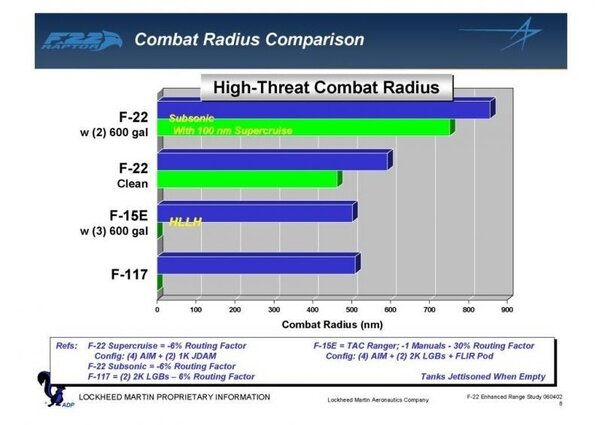
I would think that the NGAD PCA would need to have sufficient combat radius to reach Taiwan while operating from the Second Island Chain installations, which would indicate a combat radius of at least 1,500 nmi, likely with a portion of it in supersonic cruise in order to improve sortie generation and also help with human factors (i.e. mission duration).

Roughly 1,500 nmi with a 'supercruise' requirement would put the NGAD platform at something like 2x the performance of the F-22A when equipped with 2 x 600-gallon tanks. Even with more efficient adaptive engines, you are probably looking at an internal fuel load that's +>50% vs F-22A..perhaps closer to 30,000 lbs?..perhaps something like 50+% more fuel for 100% more range...
 

Attachments

  • F-22_Combat_Radius.jpg
    F-22_Combat_Radius.jpg
    60.9 KB · Views: 59
Last edited:
Roughly 1,500 nmi with a 'supercruise' requirement would put the NGAD platform at something like 2x the performance of the F-22A when equipped with 2 x 600-gallon tanks. Even with more efficient adaptive engines, you are probably looking at an internal fuel load that's +>50% vs F-22A..perhaps closer to 30,000 lbs?
Since we are talking range extension, what's your take on VLO conformation fuel tanks coming into the mix for our current fleet of stealth birds? I know there's much in the works for birds like the raptor with drop tank studies. But I wonder if there will be a CFT program in response to potential action in the Pacific Theater. Will PCA or F/A-XX (carrier-borne I know) be able to carry what they need to get it done, or are we going Strike Eagle on this.
 
It will be better signing for the NGAD fighter insteed to be proud for signature, CCA1

You'd be lucky if the Inc 1 RDT&E effort for CCA funds 1/10th of NGAD development. CCA's get expensive to develop later in the FYDP but one would assume that a lot of the RDT&E around autonomy and buying test and development assets for increment 2.
 
Since we are talking range extension, what's your take on VLO conformation fuel tanks coming into the mix for our current fleet of stealth birds? I know there's much in the works for birds like the raptor with drop tank studies. But I wonder if there will be a CFT program in response to potential action in the Pacific Theater. Will PCA or F/A-XX (carrier-borne I know) be able to carry what they need to get it done, or are we going Strike Eagle on this.
Conformal tanks on current, as in 5th gen, is very unlikely. 6th gen would be a possiblity if they are designed for such an option from the jump, but I doubt it. We're more likely to simply see much greater fuel fraction in the base design.
 
Since we are talking range extension, what's your take on VLO conformation fuel tanks coming into the mix for our current fleet of stealth birds? I know there's much in the works for birds like the raptor with drop tank studies. But I wonder if there will be a CFT program in response to potential action in the Pacific Theater. Will PCA or F/A-XX (carrier-borne I know) be able to carry what they need to get it done, or are we going Strike Eagle on this.
Maybe some collab work with the Israeli for small CFTs on the F-35s, unless we reactivate the wing tanks. Raptor has the LDTP which is probably enough for CONUS and Japan air defense, and they won't be performing bomber escort anytime soon.

I doubt that PCA will have CFTs right off the bat. More likely - NGAS, MQ-25 and high fuel fraction design.
 
The Pentagon is still plagued by shiny new toy syndrome. By the time they are ready to actually make a decision on increment two, they'll say let's wait for increment three which will be even neater.
Anything other than buying actual hardware that exists. Let's divest all of our actual weapons so we can keep seeding more vaporware so I can get a cushy job on a corporate board or a lobbyist when I retire.

Everything to date indicates this is not the route CCAs are going. While Oncr 2 requirements may not have been decided, there does not appear to be any delay in the program, and Incr1 seems to be proceeding at its anticipated schedule. Barring some kind of direct action on the part of the incoming administration I think the USAF is on course to introduce a new increment every 2-3 years.
 
I wanted to circle back to something we discussed a page or two ago regarding mission management /swarming software agents - some had mentioned trying to run something like this on CCA would make it prohibitively expensive; others like myself believe it is a manageable cost. But it occurs to me there is no reason to duplicate this functionality into every armed CCA, and indeed it would probably better served living in a high altitude VLO platform dedicated to communication relay and processing. It could serve as a gateway to various control platforms, from manned aircraft to ships to ground stations to satellite networks, and could provide mission level automation for a force of CCAs and other NGAD UAVs. The “Gambit” series of GA UAVs that XQ-67 seems to be based on already has a hypothetical platform that might fill that role.
 
Roughly 1,500 nmi with a 'supercruise' requirement would put the NGAD platform at something like 2x the performance of the F-22A when equipped with 2 x 600-gallon tanks. Even with more efficient adaptive engines, you are probably looking at an internal fuel load that's +>50% vs F-22A..perhaps closer to 30,000 lbs?..perhaps something like 50+% more fuel for 100% more range...

There is probably a lot to be gained by modest range extensions even if NGAD is still tanker dependent from the second island chain. Presumably you will need an intact runway to launch from anyway.
 
I wanted to circle back to something we discussed a page or two ago regarding mission management /swarming software agents - some had mentioned trying to run something like this on CCA would make it prohibitively expensive; others like myself believe it is a manageable cost. But it occurs to me there is no reason to duplicate this functionality into every armed CCA, and indeed it would probably better served living in a high altitude VLO platform dedicated to communication relay and processing. It could serve as a gateway to various control platforms, from manned aircraft to ships to ground stations to satellite networks, and could provide mission level automation for a force of CCAs and other NGAD UAVs. The “Gambit” series of GA UAVs that XQ-67 seems to be based on already has a hypothetical platform that might fill that role.

Heterogeneity is probably going to be a feature in the CCA family. Whether that's within each increment, or across increments remains to be seen. I think it will be the former since that's where you get the biggest impact on performance and cost.
 
There is probably a lot to be gained by modest range extensions even if NGAD is still tanker dependent from the second island chain. Presumably you will need an intact runway to launch from anyway.
Double the range is not marginal. Or did you mean marginally more than even 2x? I'm looking at the cost which has been described to be something like $300 MM a pop by Frank Kendall. depending on what dollar years that is you are somewhere between 30 and 50% above the unit cost of the F-22A in current year dollars which is a constraint that will likely define size / weight and other features..
 
Double the range is not marginal. Or did you mean marginally more than even 2x? I'm looking at the cost which has been described to be something like $300 MM a pop by Frank Kendall. depending on what dollar years that is you are somewhere between 30 and 50% above the unit cost of the F-22A in current year dollars which is a constraint that will likely define size / weight and other features..
I think that a single variable cycle engine and a high aerodynamic design for the NGAD in a size a little more than a F-35 could match the need for long distance fight, for a not too much cost by plane , like the last Loockheed design we saw .
 
I think that a single variable cycle engine and a high aerodynamic design for the NGAD in a size a little more than a F-35 could match the need for long distance fight, for a not too much cost by plane , like the last Loockheed design we saw .
Will they be able to get the power generation, sensors and avionics they need to fit in a much smaller airframe like that? USAF has been studying power generation in the MW class and I dont think thats possible in something F-35 sized.
 
I liked the look of that last lockheed design dark sidius, I wonder if they are going to modify it beyond what we saw though? It would not surprise me if they did.
 
Double the range is not marginal. Or did you mean marginally more than even 2x? I'm looking at the cost which has been described to be something like $300 MM a pop by Frank Kendall. depending on what dollar years that is you are somewhere between 30 and 50% above the unit cost of the F-22A in current year dollars which is a constraint that will likely define size / weight and other features..

To put things in perspective:

HEARING ON NATIONAL DEFENSE AUTHORIZATION ACT FOR FISCAL YEAR 2024 AND OVERSIGHT OF PREVIOUSLY AUTHORIZED PROGRAMS BEFORE THE COMMITTEE ON ARMED SERVICES HOUSE OF REPRESENTATIVES ONE HUNDRED EIGHTEENTH CONGRESS FIRST SESSION FULL COMMITTEE HEARING ON DEPARTMENT OF THE AIR FORCE FISCAL YEAR 2024 BUDGET REQUEST HEARING HELD APRIL 27, 2023

Secretary KENDALL

We also have a very serious challenge on the basis of affordability. The aircraft that we currently have in production, both the EX and the F–35, are costing on the order of $85 million to $100 million apiece. The NGAD platform, the Next Generation Air Dominance manned platform, is going to cost multiple times those numbers.

And in other places the Air Force has indicated it wants the NGAD price to be closer to those (F-35, etc.)

But the F-35 and F-15 have the advantage of much larger production runs, which drives down the unit cost. If the F-35 had been produced in the quantities being discussed for NGAD the unit price would have been much, much larger.

NGAD would deliver new, expensive to develop capabilities in a much smaller production buy. Of course the unit cost is going to be much higher. The development cost for the engine alone will drive the aircraft unit cost up considerably.
 
If anyone thinks that's a Mach 6 platform, they're wrong. There are other reasons for the wing sweep. It reminds me of when the USAF first showed pics of the F-117 to intel people from a spysat perspective and due to the faceting and wing sweep they all thought it was a hypersonic aircraft. Rightly so, because a hypersonic aircraft would have those features, but they must have concealed it's size, as it was much too small to be a hypersonic vehicle.
Not to mention, there are different theta-beta-M tables and charts for 2D ramp flow, conical flow, and those aren't interchangeable. And of course it changes again when you're dealing with a non-axisymmetric shape of a radome with chines.

This is why these visual analyses both here and on X/Twitter using nose radome angles are frankly not helpful.
 
But the F-35 and F-15 have the advantage of much larger production runs, which drives down the unit cost. If the F-35 had been produced in the quantities being discussed for NGAD the unit price would have been much, much larger.

NGAD would deliver new, expensive to develop capabilities in a much smaller production buy. Of course the unit cost is going to be much higher. The development cost for the engine alone will drive the aircraft unit cost up considerably.

Right. Which is why I compared it to the F-22A which had a small production run as well. F-22A had a fly-away cost of around $130 Million in FY07. That would be roughly $215 Million in 2020 dollars or $260 Million in 2024 dollars. A $300 Million NGAD is going to be around 40% more expensive than the FY20 cost though who knows what dollar year Kendall may have been using.
 
Heterogeneity is probably going to be a feature in the CCA family. Whether that's within each increment, or across increments remains to be seen. I think it will be the former since that's where you get the biggest impact on performance and cost.

I would think more the latter, unless the payloads are truly swapable (MQ-28 seems to have a large nose mounted payload section). But so far Incr1 CCA seems to be the armed flavor of UAVs for NGAD, and the outsized length of AAMs on such a small aircraft probably limit payload flexibility. I suspect other programs cover different NGAD capabilities - for instance the XQ-67A for OBSS. That would not mean those non combat platforms were necessarily unrelated to the CCAs, again with OBSS being a good example. But the CCAs seem to be the A2A platforms. Perhaps we will see more variation in later increments.
 
Double the range is not marginal. Or did you mean marginally more than even 2x? I'm looking at the cost which has been described to be something like $300 MM a pop by Frank Kendall. depending on what dollar years that is you are somewhere between 30 and 50% above the unit cost of the F-22A in current year dollars which is a constraint that will likely define size / weight and other features..

I just meant even if a 1500 mi combat radius was unachievable for reasonable weight and financial costs, extending to say 1000-1200 mi would still have merit. Also I think the distance from Guam to the center of Taiwan is more like 1700 anyway; I do not think tanker independent operations from the 2nd chain will be practical.
 
I think a 2x increase over F-22A with tanks is not completely off the books but is not easy either assuming a 30-40% cost increase over inflation adjusted F-22 fly away cost. ACE is something like 38% increase in sub/super range for NGAD over prior gen engines so the aircraft would most certainly have to carry somewhere around 30K lbs of fuel which would be around 30-40% more vs what the YF22 and 23 carried IIRC. It becomes more complicated if you expect it to get there without using those low-drag tanks that the F-22's are testing.
 
Is that enough though? Wasn't there a statement made a while back by Gen CQ Brown or someone else stating that NGAD would not need tanker support to accomplish mission? That would certainly suggest a radius significantly greater than 1-1.2K nmi. Perhaps 2 to 3 times that. But I haven't been able to dig that statement up so perhaps I'm confusing with something else.

So I was able to dig it up (in this very thread a hundred or so pages back)..
Brown brushed that notion aside, however, saying the Next Generation Air Dominance family of systems, intended to operate inside an enemy integrated air defense system (IADS), will have “the range to go where it needs to go” and that an escort tanker is probably not needed. Brown specifically said, “I wouldn’t call [KC-Z] an escort tanker.”
https://www.airandspaceforces.com/b...gad-has-the-range-to-go-where-it-needs-to-go/
Now it could be that Gen Brown was rolling in "NGAS" into NGAD Family of Systems and thus drawing the distinction between NGAS and KC-Z etc. but it could also mean that they were at the time planning for a much larger, longer ranged aircraft. This was a full year before they dropped the RFP for NGAD IIRC.
 
I would think more the latter, unless the payloads are truly swapable (MQ-28 seems to have a large nose mounted payload section). But so far Incr1 CCA seems to be the armed flavor of UAVs for NGAD, and the outsized length of AAMs on such a small aircraft probably limit payload flexibility. I suspect other programs cover different NGAD capabilities - for instance the XQ-67A for OBSS. That would not mean those non combat platforms were necessarily unrelated to the CCAs, again with OBSS being a good example. But the CCAs seem to be the A2A platforms. Perhaps we will see more variation in later increments.
For instance there is no A/A unmanned fighter in the CCA1, both of Anduril and GA have poor kinematics capacity, and not realy stealth to face of 5 th or 6th gen fighter.
 
For instance there is no A/A unmanned fighter in the CCA1, both of Anduril and GA have poor kinematics capacity, and not realy stealth to face of 5 th or 6th gen fighter.

They both might well have sufficient kinetic performance and signature reduction to get within BVR range. And even if they do not, I have outlined an alternative strategy when employed with other lower value platforms.
 
For instance there is no A/A unmanned fighter in the CCA1, both of Anduril and GA have poor kinematics capacity, and not realy stealth to face of 5 th or 6th gen fighter.

What does 'face-off' against 5th and sixth gen platforms even mean in this context? We are building adjunct magazines here for NGAD and/or other aircraft. CCA's, tactically have to :

i. Present a credible threat from an ability to seek (sensor & networking) and shoot (weapons they carry)
ii. Able to shoot a weapon and get a 4/5/5+ gen aircraft kill if needed
iii Compete against similar 'affordable-mass' fielded by the enemy

If we build with the intention of being a worthy adversary to a sixth gen fighter then we will end up with a $100 Million UCAV. That's not what a CCA is supposed to be. You have UCAV programs for that higher end capability.
 
For instance there is no A/A unmanned fighter in the CCA1, both of Anduril and GA have poor kinematics capacity, and not realy stealth to face of 5 th or 6th gen fighter.
Adding my 5 cents,

"Not really stealth to face" means two things:
either
system is inconsequential due to prohibition losses
or
it can be shot when circumstances add up. Meeting 5/6 gen fighter in the air, one that can also just shoot CCAs freely without care, is not an every day scenario.

As Ukrainian and middle easte war generally shows, in modern war, unless supreme (and hardly sustainable) concentration of effort is undertaken, even makeshift crop kamikaze planes sometimes get through.

Even slightly more specialized airframes get through well enough.

If you don't really try to get through at all(and cca inc1/2 don't), no serious stealth is good enough.

Which is important, because there's an uncomfortable loop: deep stealth platforms can get through, but they aren't invulnerable, and they bloody cost. It's a commitment, and also tech risk. Remember s-70.

On the other hand, modest platforms...also can get through, just with attrition (and they may cost close enough to more capable interceptors fired at them).
And when they don't need to get through, there's simply going to be more of them.
 
More evidence that Kendall and possibly AF leadership do not know what they are doing. What's the purpose of Increment 1? Is it a munitions carrier to extend the reach and increase the magazine depth of 5th Gen fighters and NGAD? Or are they just spending money to find out what they want to what they build next in Increment 2 or what will one day be the unmanned companion for NGAD?

Kendall says Increment 2 needs to be better than Increment 1 but will not be exquisite, whatever that means. So more than $20-30 million? Or is Increment 1 really more like like $40 million as has been itimated by JJ Gertler when he said it would be half the price of an F-35. What is Increment 1 lacking in terms of stealth, performance, payload, or mission systems to perform whatever mission it is supposed to perform? Will $10 million more make a difference? How much does an Exquisite CCA cost anyway?

While Rome burns the Chinese are modernizing their Air Force and iterating faster than the US, we are taking a pause because we are not sure. The same indecisiveness that is still present in the, Navy manifesting itself currently in FFG-62, is now infecting the Air Force.

For seemingly valid reasons, requirements drove the AF to develop a $300 million PCA fighter. At the 11th hour you need to take a pause because you are not sure. Dave Deptula discussed NGAD and CCAs on the Defense and Aerospace today and reiterated his previous call for evaluating these competing systems through their cost per effect. An NGAD fighter the cost of an F-35 or cheaper, or a CCAs at whatever price point must be evaluated against the alternatives. The lack of information regarding cost, capabilities, and CONOPS of Increment 1 by the primes and the AF might be a case of holding things close to the vest on a truly revolutionary weapon system? Or it might indicate lack a maturity in the technology and thoughts on how to employ it?

This does not seem to be the case with NGAD. It was fast tracked to become operational by 2030. Deptula is right. Increase production of the F-35 to more than 70 year and stop wasting time and money and proceed with NGAD.
 
What does 'face-off' against 5th and sixth gen platforms even mean in this context? We are building adjunct magazines here for NGAD and/or other aircraft. CCA's, tactically have to :

i. Present a credible threat from an ability to seek (sensor & networking) and shoot (weapons they carry)
ii. Able to shoot a weapon and get a 4/5/5+ gen aircraft kill if needed
iii Compete against similar 'affordable-mass' fielded by the enemy

If we build with the intention of being a worthy adversary to a sixth gen fighter then we will end up with a $100 Million UCAV. That's not what a CCA is supposed to be. You have UCAV programs for that higher end capability.
How do you make sure it does not become a PLAAF Turkey Shoot vs our CCAs? Need a lot of decoys - MALD and next gen MALD. Need something like LongShot that is really cheap, assuming you have a target rich environment. You are going to lose a lot of CCAs and a lot of AAMs when the CCAs go down. The hope is that some of them get off a shot and hit enemy manned fighters and CCAs.
 
100% positive that KC46 aircrew have this as a morale patch. :D :D :D :D


Everything to date indicates this is not the route CCAs are going. While Oncr 2 requirements may not have been decided, there does not appear to be any delay in the program, and Incr1 seems to be proceeding at its anticipated schedule. Barring some kind of direct action on the part of the incoming administration I think the USAF is on course to introduce a new increment every 2-3 years.
That should be okay, if there's space for improvements inside each Increment as well (I'm looking at WW2 fighters for comparison here)


I wanted to circle back to something we discussed a page or two ago regarding mission management /swarming software agents - some had mentioned trying to run something like this on CCA would make it prohibitively expensive; others like myself believe it is a manageable cost. But it occurs to me there is no reason to duplicate this functionality into every armed CCA, and indeed it would probably better served living in a high altitude VLO platform dedicated to communication relay and processing. It could serve as a gateway to various control platforms, from manned aircraft to ships to ground stations to satellite networks, and could provide mission level automation for a force of CCAs and other NGAD UAVs. The “Gambit” series of GA UAVs that XQ-67 seems to be based on already has a hypothetical platform that might fill that role.
I would absolutely prefer to have the mission management software agents on every aircraft.

That way, as long as you can get a signal to 1x CCA, it can be acted upon. If you're in jamming so hard that you can't talk to anyone, I don't think you're going to succeed in whatever your mission happens to be if your manned plane doesn't have the ordnance and equipment onboard directly.

But yes, if the cost of the mission agent is too high to install on every aircraft then it needs to go to the manned component and whatever the sneaky recon unit is.


More evidence that Kendall and possibly AF leadership do not know what they are doing. What's the purpose of Increment 1? Is it a munitions carrier to extend the reach and increase the magazine depth of 5th Gen fighters and NGAD? Or are they just spending money to find out what they want to what they build next in Increment 2 or what will one day be the unmanned companion for NGAD?
Right now, the USAF has an untested CONOPS for CCAs.

Increment 1 is to test the CONOPS in the real world. And to see if there's a drone mission that they're missing that really needs to be inside the CCA group. And to see if there's systems that need to be on every drone, like say not just an EOTS for ground navigation but a good IRST.

Increment 2 would then apply the modifications to the CONOPS and verify that they work. And add whatever extra missions and hardware came up in Increment 1.

For example, right now it's looking like Increment 1 is simply some "spear-carriers", drones carrying a couple of AMRAAMs for the manned plane to control. After some flying and wargames, it'd be good to have a TACIT BLUE-type ISR drone.
(guessing here) Then Increment 2 adds a stealthy ISR-and-comms-relay drone with EOTS, a GMTI radar, and the BACN comms node. Now Increment 2 is new "spear-carriers" with a good IRST, and this recon drone. After some flying and live wargames, it'd be good to have an EW drone, and the spear-carrier CCAs would be a lot better with a radar as well as the IRST.
(still guessing) So Increment 3 adds EW drones (recoverable MALD-Js, basically, which may-or-may-not be carried by another plane to their launch point). The Increment 3 "spear-carrier" CCAs now have a good IRST and radar (and carry 4x AMRAAMs each), plus there's recon drones and jammer drones. After some flying and live fire wargames, it'd be nice to have a bomber drone that's a step above a cruise missile that we can reuse if it doesn't get shot down, to get into the outer edges of an A2AD zone and then attack something inside a tougher A2AD bubble.
(still more guessing) So Increment 4 adds a fairly large drone (it needed to carry more than 4x 2000lb bombs or ~24x 500lb bombs the same range as the NGAD, for example). It's got EOTS and a radar that's good for ground-search, because that's needed to drop bombs in all weather. It does not have bays for AAMs. Keep the Increment 3 "spear carrier" CCAs, the Increment 2 "TACIT BLUE" CCAs, and the Increment 3 Growler/MALD-Js (whichever size they end up).

At the end of Increment 4 and going into Increment 5, we have enough CCAs in support that you could make one Manned NGAD the lead for an entire strike package.

And somewhere between Increment 4 and 5, someone is going to say, "how much to make the spear carrier CCAs capable dogfighters?"

 
The assumption seems to be that the PLAAF will detect CCA and engage it at will without repercussions. That seems a little presumptuous, if only because BVR range cuts both ways and J-20s only have four BVR weapons. It seems to me if you can shoot at CCA, it can shoot at you, and by firing you have highlighted your position. Unlike a manned aircraft, CCA is under no obligation to evade if closing with the target and firing at the last second gives a good probability of a kill.

I will take it one step further : if CCAs have missile detection gear and ejectable countermeasures, I would have to think an AI pilot would have some advantages in terms of coordination of countermeasure ejections with its maneuvers over a manned aircraft, despite its kinematic disadvantages. It would know everything about the angle and proximity of the incoming and select the optimal maneuver and CM ejection pattern to time with the incoming, even if it’s a one turn aircraft. That might well be enough to make it a target you have to double tap - and that would get expensive in AAMs.
 
The assumption seems to be that the PLAAF will detect CCA and engage it at will without repercussions. That seems a little presumptuous, if only because BVR range cuts both ways and J-20s only have four BVR weapons. It seems to me if you can shoot at CCA, it can shoot at you, and by firing you have highlighted your position. Unlike a manned aircraft, CCA is under no obligation to evade if closing with the target and firing at the last second gives a good probability of a kill.

I will take it one step further : if CCAs have missile detection gear and ejectable countermeasures, I would have to think an AI pilot would have some advantages in terms of coordination of countermeasure ejections with its maneuvers over a manned aircraft, despite its kinematic disadvantages. It would know everything about the angle and proximity of the incoming and select the optimal maneuver and CM ejection pattern to time with the incoming, even if it’s a one turn aircraft. That might well be enough to make it a target you have to double tap - and that would get expensive in AAMs.

The more salient question that should be asked is not about the PLAAFs manned aircraft engaging USAF CCAs, but what are the underlying assumptions of each sides' respective MUMT/CCA air combat system of systems.

Some of the USAF NGAD discussion that has continued/proceeded with recent PLA next gen aircraft developments in the last few weeks have focused on the wrong bits -- instead of focusing on the aircraft like J-36 itself, thinking about what kind of system of systems it is intended to operate in and what its CCA/UCAV elements may look like, are more important.
IMHO that in turn can partially inform the higher level operational/strategic contexts regarding USAF NGAD and CCA planning.
 
So far the UCAV part of the PRC system has not obviously revealed itself. I think the U.S. is ahead in this regard. When it comes to 10,000 lb MTOW UAVs that can carry a pair of BVR AAMs, the U.S. has a half dozen choices flying already.
 
Last edited:
The best (and most important) use-case for CCA Increment 1 is to get Anduril and Kratos into the 10,000lbs MTOW UAV category.

In that case, it is absolutely worthwhile, so long as those two companies are around to build larger aircraft.
 
Status
Not open for further replies.

Similar threads

Back
Top Bottom