USAF/USN 6th Gen Fighters - F/A-XX, F-X, NGAD, PCA, ASFS News & Analysis [2008- 2025]

Status
Not open for further replies.
It’s worth noting that there were a rather small number of supersonic bombers that actually entered service, and almost all were only briefly supersonic on afterburner (Tu22, Tu-22M, Tu-160, F-111, B-1B marginally). The only exception I can think of is the B-58.

One thing I did not think of when first posting this is that almost all of the examples are variable geometry on top.
 
I wonder if the B-1A could super cruise as it was a Mach-2 design.
 
I wonder if the B-1A could super cruise as it was a Mach-2 design.
Not a great engine candidate for supercruise. There are a lot of Mach 2 designs. Almost none of them supercruise.
 
In the early 2000s NASA was doing work on efficient supersonic cruise. While NASA did focus on civil applications DoD did certainly participate and benefit from this research. Some of the research could clearly be applied to NGAD.
 

Attachments

  • 20080005526.pdf
    698.4 KB · Views: 61
There is a study of high speed bombers from the 1990's or early 2000's. There is a longer version but I did not find it. This is the short version. The thing to keep in mind here is that the entire system needs to be optimized, not 1 parameter. RAND looked at building a supersonic bomber not to be more survivable in the air, but to make the air bases more survivable by keeping them in CONUS.

1. The bombers still need RCS reduction to be survivable (obvious).
2. The bombers cannot be low IR emissions. Not a problem then, a huge problem now.
3. The bombers deliver low cost shorter range munitions.
4. The bombers need F-22 and tanker support.
5. The bombers are more efficient than subsonic bombers because they complete more sorties per unit time.
6. The study seems to ignore the entire history of supersonic flight, ie that whenever an air force or an airline has a choice, they choose subsonic. It can be said that USAF moved back to subsonic to increase bomber survivability (low altitude) but the airlines never went supersonic. In the end, the bomber is a delivery system. A study that trades off R&D cost, production cost, operating cost, munitions delivery per unit time, survivability, and the types of munitions that can be delivered due to that level of survivability has, to my knowledge, not been released. No RAND or CNA study that I have seen looks at this issue. It is germane to the issue we are discussing here though. A further complication is the fact that capabilities can be offloaded to other platforms much more easily than when the RAND study appeared. I suspect that the complexity of this study is why NGAD has been paused. I suspect that a technological development occurred that caused the USAF to redo the study of the type described here, a study they must have performed. The results of this study will not be available to us although we will see the results in NGAD. A further complication is that NGAD has to have A2A capability, a capability ignored in the RAND study. I think the sheer difficulty of developing a model, then crunching numbers while factoring in tech changed over the life of NGAD that will need to be accommodated in the program makes this vastly more complex than anything we have ever seen before.

The study below is a good start to see why speed is a good idea though.

RAND Supersonic Bomber Study

There was a civilian-side comparison done: 2707 versus 707 and 747, for a flight from eastern US to London or Paris.

Cost is a bit higher, about twice that of the slower planes due to fuel burn, but you get ~3x as many trips at Mach 2.7.


The RAND study called for a flight profile that was supersonic except for takeoff, climb, descent, and aerial refueling. When I read the study, it just screamed "unrealistic".
Funny, that's basically the same flight profile as the Blackbird.

Not so unrealistic.
 
There was a civilian-side comparison done: 2707 versus 707 and 747, for a flight from eastern US to London or Paris.

Cost is a bit higher, about twice that of the slower planes due to fuel burn, but you get ~3x as many trips at Mach 2.7.


Funny, that's basically the same flight profile as the Blackbird.

Not so unrealistic.
Reuse the SR-71 engine concept with today technology, for less fuel burning with the same speed.
 
Don't know that I'd want to put all my eggs in one basket. All it takes is the datalink being jammed, or otherwise compromised, and that's that.

I guess they better get to work on improving that data link.

Has anybody been talking about at what altitude these cca's will be operating?
 
Don't know that I'd want to put all my eggs in one basket. All it takes is the datalink being jammed, or otherwise compromised, and that's that.

Collaborative Operations in Denied Environment, other programs. They have been working on it for a long time.
 
Collaborative Operations in Denied Environment, other programs. They have been working on it for a long time.

Incr1 is geared to work with F-35, so I would expect similar cruise altitude. Other increments will vary.
 

Attachments

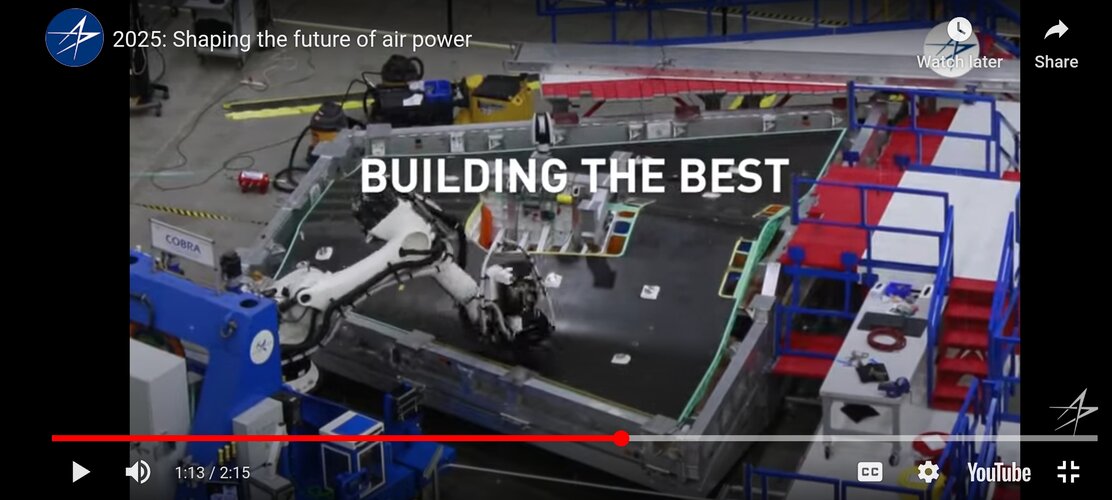
  • 2025 Shaping the future of air power [TubeRipper.com].mp4_snapshot_00.02_[2025.01.07_19.27.23].jpg
    2025 Shaping the future of air power [TubeRipper.com].mp4_snapshot_00.02_[2025.01.07_19.27.23].jpg
    292.4 KB · Views: 75
  • 2025 Shaping the future of air power [TubeRipper.com].mp4_snapshot_01.41_[2025.01.07_19.31.52].jpg
    2025 Shaping the future of air power [TubeRipper.com].mp4_snapshot_01.41_[2025.01.07_19.31.52].jpg
    350.4 KB · Views: 50
  • 2025 Shaping the future of air power [TubeRipper.com].mp4_snapshot_01.42_[2025.01.07_19.31.57].jpg
    2025 Shaping the future of air power [TubeRipper.com].mp4_snapshot_01.42_[2025.01.07_19.31.57].jpg
    324.8 KB · Views: 96
Last edited by a moderator:
There is a study of high speed bombers from the 1990's or early 2000's. There is a longer version but I did not find it. This is the short version. The thing to keep in mind here is that the entire system needs to be optimized, not 1 parameter. RAND looked at building a supersonic bomber not to be more survivable in the air, but to make the air bases more survivable by keeping them in CONUS.

1. The bombers still need RCS reduction to be survivable (obvious).
2. The bombers cannot be low IR emissions. Not a problem then, a huge problem now.
3. The bombers deliver low cost shorter range munitions.
4. The bombers need F-22 and tanker support.
5. The bombers are more efficient than subsonic bombers because they complete more sorties per unit time.
6. The study seems to ignore the entire history of supersonic flight, ie that whenever an air force or an airline has a choice, they choose subsonic. It can be said that USAF moved back to subsonic to increase bomber survivability (low altitude) but the airlines never went supersonic. In the end, the bomber is a delivery system. A study that trades off R&D cost, production cost, operating cost, munitions delivery per unit time, survivability, and the types of munitions that can be delivered due to that level of survivability has, to my knowledge, not been released. No RAND or CNA study that I have seen looks at this issue. It is germane to the issue we are discussing here though. A further complication is the fact that capabilities can be offloaded to other platforms much more easily than when the RAND study appeared. I suspect that the complexity of this study is why NGAD has been paused. I suspect that a technological development occurred that caused the USAF to redo the study of the type described here, a study they must have performed. The results of this study will not be available to us although we will see the results in NGAD. A further complication is that NGAD has to have A2A capability, a capability ignored in the RAND study. I think the sheer difficulty of developing a model, then crunching numbers while factoring in tech changed over the life of NGAD that will need to be accommodated in the program makes this vastly more complex than anything we have ever seen before.

The study below is a good start to see why speed is a good idea though.

RAND Supersonic Bomber Study

Air forces have consistently chosen supersonic delivery systems tbf. Ballistic missiles are just an evolution of the B-17 bomber in use case.

A few NGBs were supersonic regional or intercontinental class bombers though.
 
Honestly, I'm not sure how valuable the Sentinel program is. Does nuclear sponge theory really work when your opponents will still have enough warheads left over for all your major population centers? Cutting Sentinel and moving to a two-leg 'triad' would save $160B and counting. Half of that could be invested into the submarine industrial base to get Columbia faster and in greater quantities, and simultaneously help with capacity for Aukus. The rest could get invested into NGAD. I know this is just a fantasy, congress won't allow it, but there it is.
All the basing studies (from Minuteman to MX era) said broadly the same thing. When hidding ballistic missiles, nothing beat nuclear submarines roaming the ocean depths.
Since 1998 British nuclear deterrent is only submarines.
Since 1996 and the shutting down of Plateau d'Albion, French nuclear deterrent is only submarines + ASMP (a very secondary, nice-to-have capability : for its flexibility and showdown)
Let's face it: whatever Congress and the Air Force think, Minuteman or MX or Sentinel in silos make little sense. Bombers at least can be use as a very visible threat - nuclear and conventional. The B-52 has excelled at that role over the last 60 years.
 
The MM force requires you to attack it with a lot of resources or else leave it behind as a potential second strike. That seems to add a lot of padding to the deterrent posture. Outside the boats at sea, the current U.S. nuclear bomber and SSBN fleets, along with US nuclear storage areas, could be readily be handled by a couple dozen warheads. Were the boats at sea under any risk, that could be a problem. Silos are also an incredibly cheap to maintain force compared to submarines - the current expense is the coast of letting infrastructure rot for nearly half a century.
 
Last edited:
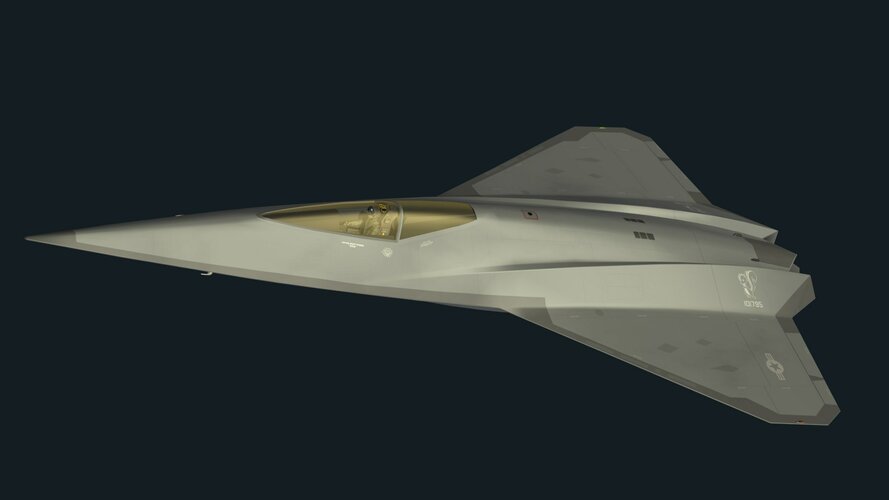
If anyone thinks that's a Mach 6 platform, they're wrong. There are other reasons for the wing sweep. It reminds me of when the USAF first showed pics of the F-117 to intel people from a spysat perspective and due to the faceting and wing sweep they all thought it was a hypersonic aircraft. Rightly so, because a hypersonic aircraft would have those features, but they must have concealed it's size, as it was much too small to be a hypersonic vehicle.
 
θ-β-M relationship basically is the formula describing the relation between oblique shock angle, flow deflection angle and mach number. It could be used to do a very rough estimate of an airframe's top airspeed since generally as the post said you do not want the leading edge of the shockwave to interfere with the wings and control surfaces so you could find the angle between the nose and the edge of the wings to calculate how fast the plane needs to be going so the leading edge of the shockwave formed at the nose start interfering with the wings. But imo it is a very rough way of estimating top speed and there's a few specially designed aircraft that could operate beyond these restrictions so I personally wouldn't take it as solid facts.
 
If anyone thinks that's a Mach 6 platform, they're wrong. There are other reasons for the wing sweep. It reminds me of when the USAF first showed pics of the F-117 to intel people from a spysat perspective and due to the faceting and wing sweep they all thought it was a hypersonic aircraft. Rightly so, because a hypersonic aircraft would have those features, but they must have concealed it's size, as it was much too small to be a hypersonic vehicle.
Mach 2.5 is a pretty good speed.
 

Asked what recommendation his blue-ribbon panel of stealth experts—including analysts, former Chiefs of Staff, and senior generals—came up with regarding NGAD, Kendall said they reached “a consensus that there are a number of other things that we need to fund” but if resources are available, “then it would still be beneficial to have an NGAD-like aircraft.”

Kendall could not go into detail because of classification, but said several alternatives were considered.

“We looked at something that’s more of a lower-cost, multi-role kind of a capability. We looked at something that’s more tailored to work with [Collaborative Combat Aircraft], although, of course, NGAD could do that. And we looked at some other ’out of the box’” ideas, he said, adding that “some of them might be worth pursuing independently.”

I haven't heard this said explicitly before. The consensus is that PCA is not the highest priority to fund. I assume "other things" refers to CCAs, NGAS, maybe NGAP, and potentially could be expanded to include entirely separate programs like Sentinel.
 
Well at this point, funding and focus are likely in flux until incoming administration officials make choices. There probably was a well defined plan, and some here have outlined it, but the program is an open question now.


I haven't heard this said explicitly before. The consensus is that PCA is not the highest priority to fund. I assume "other things" refers to CCAs, NGAS, maybe NGAP, and potentially could be expanded to include entirely separate programs like Sentinel.

NGAS (tanker) and NGAP (engine) are tied to manned NGAD. Sentinel is taking a lot of funding. CCA is not yet.
 
Status
Not open for further replies.

Similar threads

Back
Top Bottom