USAF/USN 6th Gen Fighters - F/A-XX, F-X, NGAD, PCA, ASFS News & Analysis [2008- 2025]

Status
Not open for further replies.
Russian production numbers do not even equal European ones, AFAIK. The majority of their force does not even employ AESA. European F-35s obviously come at the expense of U.S. production, but that assumes the U.S. air arms had the financial capability to buy more aircraft if there were no foreign sales. F-35 provides all the overmatch necessary for NATO. The current Su-57 contract will be outnumbered 2:1 by the purchases of NATO border nations Poland, Finland, and Norway alone.

If China was not a threat, NGAD would have been cancelled by now and the CCAs would be a DARPA project.
 
Statistics for manufacturing and industrial automatization are heavily against US.
China is massively ahead in that metric(490 to 297/10000), despite having workforce larger than entire population of the US.

Due to China's intractable and worsening demographic issues that advantage is already withering away due to the PRC's population rapidly ageing (PRC demographers also admitted either early this year or last year that they had over-counted the PRC's population by over 100 million people).
 
Due to China's intractable and worsening demographic issues that advantage is already withering away due to the PRC's population rapidly ageing (PRC demographers also admitted either early this year or last year that they had over-counted the PRC's population by over 100 million people).

There’s no threat to PRC production in any reasonable time frame. Defense related industries could simply be prioritized over other sectors of the economy; see Russia. But we are far off topic now.
 
In the US, we get hot and bothered over an NGAD and now the bureaucracy kicks in and now we are scrambling between what the USAF wants and needs coupled to CCAs. Don't get me wrong, we do have to balance capability against cost for an NGAD and CCAs are a good idea for integration into the mission structure but I detect a little internal panicking going on. I still think the USAF and USN programs need to be separate. I know others previously posted and they mentioned the F-4. The F-4 was a very good fighter for the time but the USAF does like buying a USN aircraft and they still don't.

We have some good, current off the shelf engines (F135 and F110 as examples) including avionics and other mission systems from F-22, F-35, F-15E/EX and even B-2. The F110 seems have room for upgrading. We have have LO composite airframe design and development down to the tee but we just cannot get out of our on way in some cases. I know this is off topic and I apologize but the Boeing Starliner is DEAD as one example! Cannot keep doing this to programs.
 
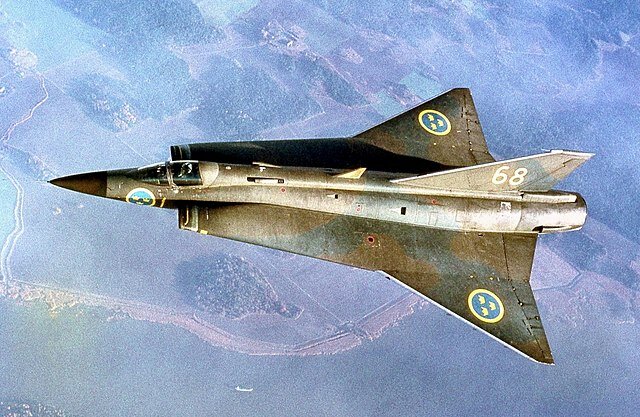
Interesting how much range can be squeezed out of slender, efficient single engine airframe.
Also, 1st ic(verbal) gives some freedom of interpretation.
As soon as you change the payload volume from a pair of BVRAAMs to something bigger, airframe volume goes way up.
 
As soon as you change the payload volume from a pair of BVRAAMs to something bigger, airframe volume goes way up.
Personally, I would ask for enough depth and length for one Quickstrike (Mk63)/JDAAM/MK83, or two staggered AMRAAMs. Shouldn't be too much deeper than the AMRAAM bay.
But there are good reasons to ask for less than that in some iteration, as well. Particularly if you buy multiple types for service.
 
Personally, I would ask for enough depth and length for one Quickstrike (Mk63)/JDAAM/MK83, or two staggered AMRAAMs. Shouldn't be too much deeper than the AMRAAM bay.
But there are good reasons to ask for less than that in some iteration, as well. Particularly if you buy multiple types for service.
IIRC, the Mk83 body fits into the same volume as a clipped-fin AMRAAM. I'd want volume for Mk84s, Harpoon/SLAM, etc.
 
IIRC, the Mk83 body fits into the same volume as a clipped-fin AMRAAM. I'd want volume for Mk84s, Harpoon/SLAM, etc.

CCA is an anti air platform. B-21 is the strike platform. I do not think the USAF has any interest in air to ground ordnance in the CCAs for the first few iterations. Platform size/power would have to dramatically increase for anything bigger than SDBs.
 
CCA is an anti air platform. B-21 is the strike platform. I do not think the USAF has any interest in air to ground ordnance in the CCAs for the first few iterations.
That's certainly what they've said.

The war games have all featured strike capable CCAs.


Platform size/power would have to dramatically increase for anything bigger than SDBs.
Yes, at least a few of the "CCAs" I'm picturing would be most of the size of an F35 or F18. Those would obviously not be very cheap, but ideally you wouldn't need more than a couple hundred of them even in a war.
 
I can see systems being transferable but not sure about the actual airframe. Divergent requirements.
 
The USN has hard requirements that cannot change for an embarked aircraft - eg MTOW/stall speed/length limits. If both services used the same airframe, it would essentially be USAF adopting FAXX, not a compromise between the two requirements. Perhaps a USAF variant could shed some internal structure weight or have more clipped wings like the F-35A vs C, but there would be little room for major changes.
 
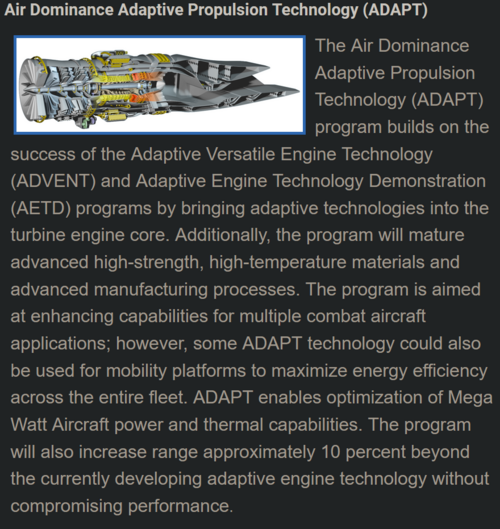
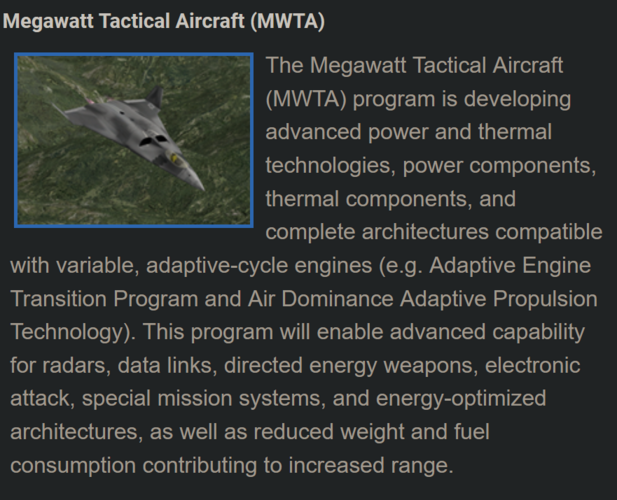
Some interesting tidbits I found on a web archive. USAF studying 1MW power generation for a future fighter. And Another study on adaptive engines which proposes even further improvements upon AETD for 10% more range. Maybe a glimpse into some of the stuff they want out of NGAD? How does one even go about cooling up to 1MW of total electrical usage on an aircraft? Makes F-35s 80kw~ cooling capacity look incredible paltry in comparison lol

1734211039223.png 1734211057540.png
 
Some interesting tidbits I found on a web archive. USAF studying 1MW power generation for a future fighter. And Another study on adaptive engines which proposes even further improvements upon AETD for 10% more range. Maybe a glimpse into some of the stuff they want out of NGAD? How does one even go about cooling up to 1MW of total electrical usage on an aircraft? Makes F-35s 80kw~ cooling capacity look incredible paltry in comparison lol

View attachment 752355View attachment 752356
I remember XA100 was said to achieve 35% more already so if possible (and usable for it) then close 45% or 1.797km is possible for A/C. Thats a lot mate
 
Some interesting tidbits I found on a web archive. USAF studying 1MW power generation for a future fighter. And Another study on adaptive engines which proposes even further improvements upon AETD for 10% more range. Maybe a glimpse into some of the stuff they want out of NGAD? How does one even go about cooling up to 1MW of total electrical usage on an aircraft? Makes F-35s 80kw~ cooling capacity look incredible paltry in comparison lol

View attachment 752355View attachment 752356
Very cool. Also probably dead soon.
 
Some interesting tidbits I found on a web archive. USAF studying 1MW power generation for a future fighter. And Another study on adaptive engines which proposes even further improvements upon AETD for 10% more range. Maybe a glimpse into some of the stuff they want out of NGAD? How does one even go about cooling up to 1MW of total electrical usage on an aircraft? Makes F-35s 80kw~ cooling capacity look incredible paltry in comparison lol
Pump the heat into the fuel on its way to the engines.
 
Pump the heat into the fuel on its way to the engines.
Your limiting factor there is the HP Turbine Entry Temperature. They already operate fairly close to their limit. That said, by heating the fuel, you may be able to use slightly less to get the same heat. This would reduce mass flow rate slightly, but the AFR is very high for jet engines, so this would probably be negligible.
 
Your limiting factor there is the HP Turbine Entry Temperature. They already operate fairly close to their limit. That said, by heating the fuel, you may be able to use slightly less to get the same heat. This would reduce mass flow rate slightly, but the AFR is very high for jet engines, so this would probably be negligible.
Didn't they want to achieve like ~2700° for ADAPT
 
Some interesting tidbits I found on a web archive. USAF studying 1MW power generation for a future fighter. And Another study on adaptive engines which proposes even further improvements upon AETD for 10% more range. Maybe a glimpse into some of the stuff they want out of NGAD? How does one even go about cooling up to 1MW of total electrical usage on an aircraft? Makes F-35s 80kw~ cooling capacity look incredible paltry in comparison lol

View attachment 752355View attachment 752356
Capture AREA51 (3).PNG
 
Oops, I apparently forgot to post this earlier...

Pump the heat into the fuel on its way to the engines.
Exactly.

Your limiting factor there is the HP Turbine Entry Temperature. They already operate fairly close to their limit. That said, by heating the fuel, you may be able to use slightly less to get the same heat. This would reduce mass flow rate slightly, but the AFR is very high for jet engines, so this would probably be negligible.
Yes, it is. When you're talking design TITs over 2500degC, though, you can probably get away with soaking a lot of heat into the fuel.

It'd be kinda interesting to know what the J58 max TIT was, since the limiting factor was Compressor Inlet Temp instead of TIT.
 
It'd be kinda interesting to know what the J58 max TIT was, since the limiting factor was Compressor Inlet Temp instead of TIT.
I imagine that's only due to the fact they were expanding a lot of the exhaust flow purely via the nozzle above a certain speed. For any pure jet engine the HP TET is always a limiting factor.

It'd be kinda interesting to know what the J58 max TIT was, since the limiting factor was Compressor Inlet Temp instead of TIT.
2500degC? Well that's considerably ahead of anything around today. Any link to source?:)
 
Last edited:
Oops, I apparently forgot to post this earlier...


Exactly.


Yes, it is. When you're talking design TITs over 2500degC, though, you can probably get away with soaking a lot of heat into the fuel.

It'd be kinda interesting to know what the J58 max TIT was, since the limiting factor was Compressor Inlet Temp instead of TIT.
Yes, heating fuel by using it as a heat sink for cooling various systems does bring that heat to the engine combustor and slightly improve SFC. But there is a fuel temperature stability limit before it starts breaking down and causing coke deposits in the fuel system, which is around 325F for Jet-A or JP-8. The JP-7 used in the SR-71 had a much higher limit due to the high ambient temperatures it was exposed to at M3+.

The J58 had a high TIT limit for its time at around 2000F, but not nearly as high as current engines allow. The engine measured EGT, which ran at 790-800C (cockpit gauge units) during cruise. The engine had an electronic EGT trim system to raise or lower main combustor fuel flow to maintain the EGT in that band at Mil power and above. The control system modulated the convergent exhaust nozzle area to hold a constant 7400 RPM during cruise. If the EGT trimmer added fuel to raise the EGT, that increases RPM. The nozzle would close to raise exhaust pressure, reducing the pressure drop across the turbine, which lowers RPM back to the 7400 target, and thrust goes up. If the trimmer lowered fuel flow to reduce EGT, the nozzle opens to maintain RPM and thrust goes down.

Bottom line, Turbine temperature was not a limiting factor for speed for the J58 because it was held steady by the control system. But inlet temperature keeps going up the faster you go, so 427C inlet temperature was the engine speed limit.
 
In the US, we get hot and bothered over an NGAD and now the bureaucracy kicks in and now we are scrambling between what the USAF wants and needs coupled to CCAs. Don't get me wrong, we do have to balance capability against cost for an NGAD and CCAs are a good idea for integration into the mission structure but I detect a little internal panicking going on. I still think the USAF and USN programs need to be separate. I know others previously posted and they mentioned the F-4. The F-4 was a very good fighter for the time but the USAF does like buying a USN aircraft and they still don't.

We have some good, current off the shelf engines (F135 and F110 as examples) including avionics and other mission systems from F-22, F-35, F-15E/EX and even B-2. The F110 seems have room for upgrading. We have have LO composite airframe design and development down to the tee but we just cannot get out of our on way in some cases. I know this is off topic and I apologize but the Boeing Starliner is DEAD as one example! Cannot keep doing this to programs.
I agree with you, I'm just stating this for general purposes, since people seam to intentionally ignore this or not know it.

For some reason I have to keep saying this; The mission defines the airplane, not the other way around. The USAF could use the F-4 back in the sixties because the plane they were looking for had similar mission requirements to the USN's. Of course, they had to just live with the heavier weight and longer field length required due to the landing gear layout. Which is why they added the drogue chute.

The NGAD and the F/A-XX do not have similar mission profiles. In fact, based on what has been reported, they're vastly different. To use the same airframe for both would be incredibly dumb. Not to mention, as Quellish keeps stating, the way the USAF wants to manage the tech and the airframes is completely at odds with the route the USN is taking. The only area where I could see sharing among the two would be in subsystems. RADAR, ECM, etc. But even those systems would require different tailoring for the mission requirements.

If the USAF was forced to take the F/A-XX in lieu of the NGAD I haven't any doubt the USAF would cancel NGAD and just concentrate on unmanned systems. Simply because the F/A-XX doesn't do what the USAF wants NGAD to do. There's no point in buying something that can't do what you want and the same is true in reverse. Although it would be much more difficult to make a navalized NGAD.
 
Yes Sundog I agree with you as well, the USN and USAF have different mission requirements and they should define their own platforms, no more bi or tri-service platforms. Actually as a USN example, the Navy had the F-8 then F-4 but even with these two aircraft, the USN sort of had primary and secondary-type fighter mission capabilities. The F-4 could also drop bombs where the F-8 did not but the F-8 also evolved into recce missions when the F-14 came online. The Navy definitely allowed flexibility of all of their airframes, primarily out of necessity due to deployed carrier operations.

When I was on CVN-65 in the early 1980's and on our '82-'83 WestPac, here was our aircraft mix:
F-14, A-6/KA-6, EA-6, A-7, S-3, C-2, E-2, C-1 (short haul COD), and SH-3. We also deployed EA-3 and USMC F-4s and A-6s (took them onboard when in NAS Cubi Point). With this mix, every mission covered and were very effective. Hell, the USN could have made good use of the production version of the X-32 which in its latest configuration did not look bad an would have done the job.

The USN needs is own mission-defined F/A-XX and a good semi-LO medium attack platform which they really need. A production version of the X-47B would have been good and a well defined future USN CCA, if done right, yes, just common sense.
 
The J58 had a high TIT limit for its time at around 2000F, but not nearly as high as current engines allow. The engine measured EGT, which ran at 790-800C (cockpit gauge units) during cruise. The engine had an electronic EGT trim system to raise or lower main combustor fuel flow to maintain the EGT in that band at Mil power and above. The control system modulated the convergent exhaust nozzle area to hold a constant 7400 RPM during cruise. If the EGT trimmer added fuel to raise the EGT, that increases RPM. The nozzle would close to raise exhaust pressure, reducing the pressure drop across the turbine, which lowers RPM back to the 7400 target, and thrust goes up. If the trimmer lowered fuel flow to reduce EGT, the nozzle opens to maintain RPM and thrust goes down.

Bottom line, Turbine temperature was not a limiting factor for speed for the J58 because it was held steady by the control system. But inlet temperature keeps going up the faster you go, so 427C inlet temperature was the engine speed limit.
Right, the TIT was not a concerning factor because the engine controls kept the overall system below the Turbine blade temp limits.

You could still get a hot start, for example.

Also, I keep getting differing answers on what a CFM56 max TIT is. I've seen 1350degC, and yet I'm also seeing ~900degC. I suspect that the 900 is sustained and 1350 is max. 2000degF is ~1100degC, so you should be able to run a modern engine a couple hundred degrees C hotter than a J58 without trouble.


I agree with you, I'm just stating this for general purposes, since people seam to intentionally ignore this or not know it.

For some reason I have to keep saying this; The mission defines the airplane, not the other way around. The USAF could use the F-4 back in the sixties because the plane they were looking for had similar mission requirements to the USN's. Of course, they had to just live with the heavier weight and longer field length required due to the landing gear layout. Which is why they added the drogue chute.

The NGAD and the F/A-XX do not have similar mission profiles. In fact, based on what has been reported, they're vastly different. To use the same airframe for both would be incredibly dumb. Not to mention, as Quellish keeps stating, the way the USAF wants to manage the tech and the airframes is completely at odds with the route the USN is taking. The only area where I could see sharing among the two would be in subsystems. RADAR, ECM, etc. But even those systems would require different tailoring for the mission requirements.
At the very least, the NGAD seems to have a requirement for about 50% more range than FAXX. Not to forget the USN's very hard limits on weight and length due to catapults, arresting gear, and elevators.

Assuming the stats that have been talked about are correct, this suggests an NGAD that is about 105klbs while the FAXX would be about 85klbs. And the USAF NGAD could easily grow to 125klbs.


If the USAF was forced to take the F/A-XX in lieu of the NGAD I haven't any doubt the USAF would cancel NGAD and just concentrate on unmanned systems. Simply because the F/A-XX doesn't do what the USAF wants NGAD to do. There's no point in buying something that can't do what you want and the same is true in reverse. Although it would be much more difficult to make a navalized NGAD.
I don't think the USAF would do that, simply because it'd mean losing all those pilot slots.


The USN needs is own mission-defined F/A-XX and a good semi-LO medium attack platform which they really need. A production version of the X-47B would have been good and a well defined future USN CCA, if done right, yes, just common sense.
I suspect that the FAXX will be a more air-to-air capable version of that semi LO medium attack platform. Not sure which side will dominate in the DNA, it could be like the saying about the Tomcat and Hornet: Tomcat is heavy on the F, light on the A, while Hornet is light on the F and heavy on the A.

Even though the F-35C is a striker, I expect the FAXX to be heavier on the attack side of the equation than the Lightning.
 
I suspect that the FAXX will be a more air-to-air capable version of that semi LO medium attack platform. Not sure which side will dominate in the DNA, it could be like the saying about the Tomcat and Hornet: Tomcat is heavy on the F, light on the A, while Hornet is light on the F and heavy on the A.

HEARING ON NATIONAL DEFENSE AUTHORIZATION ACT FOR FISCAL YEAR 2024 AND OVERSIGHT OF PREVIOUSLY AUTHORIZED PROGRAMS BEFORE THE COMMITTEE ON ARMED SERVICES HOUSE OF REPRESENTATIVES ONE HUNDRED EIGHTEENTH CONGRESS FIRST SESSION SUBCOMMITTEE ON TACTICAL AIR AND LAND FORCES HEARING ON FISCAL YEAR 2024 BUDGET REQUEST OF THE DEPARTMENT OF DEFENSE FOR FIXED–WING TACTICAL AND TRAINING AIRCRAFT PROGRAMS HEARING HELD MARCH 29, 2023

STATEMENT OF RADM ANDREW J. LOISELLE USN, DIRECTOR,
AIR WARFARE, U.S. NAVY

The F/A–XX is the manned quarterback strike fighter component of this family of systems, orchestrating manned-unmanned teaming at the leading edge of the battlespace. Included in the unmanned tactical platforms for the NGAD family of systems are ‘‘loyal wing- man’’ unmanned aircraft referred to as Collaborative Combat Air- craft. These CCA’s will augment current and next-generation crewed platforms with lower cost complementary capabilities to in- crease combat effectiveness in highly contested environments. Collectively, the carrier air wing will maintain strike fighter

STATEMENT OF NICKOLAS H. GUERTIN ASSISTANT SECRETARY OF THE NAVY (RESEARCH, DEVELOPMENT AND ACQUISITION) AND LIEUTENANT GENERAL BRADFORD GERING DEPUTY COMMANDANT FOR AVIATION AND REAR ADMIRAL MICHAEL DONNELLY DIRECTOR AIR WARFARE BEFORE THE TACTICAL AIR AND LAND FORCES SUBCOMMITTEE OF THE HOUSE ARMED SERVICES COMMITTEE ON DEPARTMENT OF THE NAVY FISCAL YEAR 2025 BUDGET REQUEST FOR TACTICAL AVIATION APRIL 16, 2024

The NGAD FoS is comprised of crewed and uncrewed tactical platforms, advanced weapons, sensors and networks to attain and maintain air superiority. F/A-XX is the strike fighter component of the NGAD FoS and is the designated replacement for the F/A-18E/F. Design maturation efforts remain on track and the program is now considered to be in a source selection environment. The Navy released a request for proposal (RFP) for a follow-on development contract in December 2023 to Boeing, Northrop Grumman, and Lockheed Martin. F/A-XX is designed from the outset to incorporate crewed and uncrewed teaming. Included in the uncrewed tactical platforms for the NGAD FoS are the family of CCA’s. Navy and Marine CCA’s will augment current and next generation crewed platforms with multiple lower cost, complementary capabilities to increase combat effectiveness in highly contested environments.


HEARING ON NATIONAL DEFENSE AUTHORIZATION ACT FOR FISCAL YEAR 2022 AND OVERSIGHT OF PREVIOUSLY AUTHORIZED PROGRAMS BEFORE THE COMMITTEE ON ARMED SERVICES HOUSE OF REPRESENTATIVES ONE HUNDRED SEVENTEENTH CONGRESS FIRST SESSION FULL COMMITTEE HEARING ON DEPARTMENT OF THE AIR FORCE FISCAL YEAR 2022 BUDGET REQUEST HEARING HELD JUNE 16, 2021

Mr. NORCROSS. Thank you. Continuing on the four-plus-one, and we are looking at NGAD, which there is a considerable amount of money going towards that. And in the past, the Air Force has said time and time again they want to get away from that single-role fighter. To the degree you can in this environment, can you tell us, are you looking at NGAD as a single- or multi-role platform?

General BROWN. I would like to have it be multi-role. But the primary aspect for NGAD is air superiority, and with air superi- ority, it is an increased weapons load; it is increased range, par- ticularly when you look at operating in the Indo-Pacific and against the threat we expect to see in the Indo-Pacific. So, I look to the fu- ture, but what I really look at for all of our fighters is to have multi-role capability to be able to go from a high-end conflict all the way down to homeland defense, and that drives a combination ca- pability. But, really, NGAD is really focused more so on a highly contested environment, to have the weapons load both air-to-air primarily, but some air-to-ground capability to ensure, one, that it can survive, but also provide options for our component com- manders and for the joint force.

There is very similar testimony from the Navy which I can't locate right now, that in response to a question the Navy stated that they see NGAD/F/A-XX as a direct replacement for the Super Hornet, with a primary strike role and some small air-to-air role. Essentially the opposite of the USAF manned NGAD.

The Navy has been very clear than on F/A-XX air-to-air is not a priority.
 
The Navy has been very clear than on F/A-XX air-to-air is not a priority.
Huh. Was not expecting that, was expecting it to be more Tomcat than Hornet. Yes, capable of delivering A2G, but focusing more on Air-to-Air.


Does this imply that the F-35 will have the air-to-air role, and thus will be a more capable interceptor than the F/A-XX?
I'm expecting that to be the job of CCAs.
 
Huh. Was not expecting that, was expecting it to be more Tomcat than Hornet. Yes, capable of delivering A2G, but focusing more on Air-to-Air.
Long range strike is first best anti air means of a csg. It's the greatest enabler.

CSG isn't static, it's a highly mobile asset. What for land airfield is a binary equation (does their bomber reach you or not), for navy is additional space(area of circle). CSG has to be found, identified within this huge area. And carrier (s) within CSG has to be found and identified, too.

Same range extends stand off from land for any target csg attacks(and of course ability to prosecute it in the first place). Range means safety for CSG, very straightforward.

Range means exposure for defender's aircraft.
Remember how CSGs exposed even backfires for (virtual) Formosing.

F-14 was the thing precisely because navy already had ideal long range striker in A-6, but badly needed intercept and escort(failure of f-111b didn't mean much).

F/a-xx will take both of those still, especially since interceptor for the navy now means aim-174b. Aircraft being able to move those to a long range is almost by default a strike aircraft in modern age.
Add supersonic capabilities, RIO/mission specialist - and you have enough of interceptor.

Overall - perfectly in line with my expectations, and exactly what navair needed since the late 1980s.
 
Does this imply that the F-35 will have the air-to-air role, and thus will be a more capable interceptor than the F/A-XX?
Well the F-35 was to replace F-16s, F-18C/Ds and AV-8Bs, the F/A-XX is to replace F-18E/Fs, so it should at least be better than the F-35s at A2A.
 
Status
Not open for further replies.

Similar threads

Back
Top Bottom