USAF/USN 6th Gen Fighters - F/A-XX, F-X, NGAD, PCA, ASFS News & Analysis [2008- 2025]

Status
Not open for further replies.
Phase 1 has already proven the USAF is on the right path and Boeing and LM are no longer the only game in town. Perhaps if we are talking manned NGAD then I would agree but CCA has opened the flood gates now and the options are much broader. Doesn't mean LM and Boeing won't play in the CCA space but they have a lot more competition to keep them honest and hungry.

It has not.

Phase I and Phase II CCA have to integrate with existing aircraft and other systems to be viable. At one point the technology was advertised by a certain organization as mature when the fighter pilot had to manually control companion aircraft through an iPad while also flying his own aircraft in a simulated engagement.

That… didn’t… work.

I planned to post a complete, concise account of what the Air Force is trying to achieve vs what has actually been delivered and advertised as mature, but I am concerned about where this information may end up.

However if I were an enterprising individual I would look at some of the recent abrupt, unexpected changes in USAF leadership and draw some conclusions based on that. Like is some mindless ticket punching automaton was replaced with someone more experienced in acquisitions…
 
It has not.

Phase I and Phase II CCA have to integrate with existing aircraft and other systems to be viable. At one point the technology was advertised by a certain organization as mature when the fighter pilot had to manually control companion aircraft through an iPad while also flying his own aircraft in a simulated engagement.

That… didn’t… work.

I planned to post a complete, concise account of what the Air Force is trying to achieve vs what has actually been delivered and advertised as mature, but I am concerned about where this information may end up.

However if I were an enterprising individual I would look at some of the recent abrupt, unexpected changes in USAF leadership and draw some conclusions based on that. Like is some mindless ticket punching automaton was replaced with someone more experienced in acquisitions…
Are we talking about vendors and a wider pool or are we talking about the integration work being done?

For the integration work no production ready Phase One CCA has been handed over so I think you are a little early to discount what is happening. Will it all be sunshine and lollypops, undoubtedly not but the CCA portion of NGAD is clearly showing incredible promise and over the next five years will see progression that I expect will dwarf much of what has happened in aviation over the last 50 years previously.
 
Software is one of the biggest problems with the program right now. Software and the politics/commercial interests around it.

Does anyone really think that Lockheed is going to willingly integrate with non-Lockheed CCA platforms, or are they going to push to make the CCAs as well? And use integration with an existing platform as leverage?
Oh, they're not going to get a choice in the matter.


Boeing, Lockheed: “play ball? We’re the only game in town, baby!”

The Air Force wants to use the CCA program to grow new and innovative contractors. Do you really think Boeing and Lockheed are ok with that?
"Not for long with that attitude. Hang on while I call DoJ and see what to do about this effective monopoly you have created for yourself here. Oops, Boeing just got split into 3 separate companies (minimum). Lockheed is getting split into about 20."
 
Boeing, Lockheed: “play ball? We’re the only game in town, baby!”

The Air Force wants to use the CCA program to grow new and innovative contractors. Do you really think Boeing and Lockheed are ok with that?

I do not think they get a vote. NG and Kratos are already better placed for Incr2. Look at what the SDA has done with Incr 0/1/2 so far: it has at least seven satellite contractors I can identify. Play ball or be replaced.

ETA: if the concern is the controller aircraft, which initially is planned to be the F-35, then I think that stumbling block falls over soon too. I think USAF is ultimately looking for full automation or control via high altitude platforms and/or SDAs new global satellite network. If LM won’t play ball, I suspect NG will.
 
Last edited:
NGAD is a long term project beyond 2030, possibly way beyond 2030 now. The B-21 is one of the most successful USAF development programs in recent memory and it still had its contract signed a decade ago with a design freeze in 2018. So ~2035 seems like a realistic estimate to me. If you believe a war comes before that, or you believe air to air warfare as we know it becomes unrecognizable by then, what is the solution? Quite possibly, not any manned platform at all, or at least not the one you envisioned a decade ago.
That would be a reasonable course of action. There is only one problem. They are not acting like they are preparing for the short term. Kendall and the rest of the AF's leadership has given every excuse in the book, except that one.

If that were the case then they would slash NGAD funding for the platform, fully commit to F-22 modernization - including upgrading the Block 20 up to the current standard, preprogram NGAP funding to the AETP engine for the F-35A to extend its range, and designating the F-22 and F-35 as the short term controllers for the CCAs. F-22/F-35 CCA teaming would be used to validate manned/unmanned teaming in penetrating counter air missions in the short term - something that really hasn't been done before.

But they have never said that or hinted at it.
 
The UK was also willing to foot the bill for installing HASs.

Philippines can't afford it, Japan doesn't want to look military, do I need to keep going?

Japan certainly has hardened shelters on its own bases, as well as modest hardening efforts at Kadena and numerous HAS at Misowa. However the USAF is generally of the opinion hardening is of limited value due to penetrating PGMs. They are more interested in decoys and dispersion. I personally think that shelters that can obscure the presence of aircraft and stop fragments would still be immensely useful.
 
What no one is doing yet is massive roof surfaces all around the airbase. Those can be made of light and cheap materials.
The idea being to have literally 100 by 1000 m roof here, a 100 by 500 m roof there, bunch of 50 by 300 m roofs, all connected together.
So optical and radar sensors can't know where, under all that roofage, a plane is. Or how many there are. There could even be secondary hangars on wheels moved around underneath, hangars being able to withstand cluster munitions. Again, positions of such hangars would be unknown to the enemy, as they would change positions under all the roofage.
Roofs would also be modular in construction, say 5 by 5m, so whole patches could be replaced after an attack.
 
The UK was also willing to foot the bill for installing HASs.

Philippines can't afford it, Japan doesn't want to look military, do I need to keep going?

Japan has changed their defense posture quite a bit over the last decade.

They have up'd their defense spending quite a bit, relaxed their prohibition on exporting military technology and have moved away from their completely defensive military posture.

In short, they are taking their own defense much more seriously and are not so shy about it.
 
Don't know for Typhoon but Rafale F4 and F5 seems good enough until 2040. What truly bothers me are the low numbers procured. Very low numbers.
Just slapping an AESA Radar and an up-to-date datalink onto them seems like a largely good enough way to turn European owned aircraft into 4.5th gen and keep them modern (since they usually have long lives left in them); you don't necessarily need to buy expensive aircraft in this economy.
 
Just slapping an AESA Radar and an up-to-date datalink onto them seems like a largely good enough way to turn European owned aircraft into 4.5th gen and keep them modern (since they usually have long lives left in them); you don't necessarily need to buy expensive aircraft in this economy.
They do need the ability to control the CCAs, though.

And at least right now, that looks like 2 seats because the dude driving the plane can't be distracted while giving the CCAs as much attention as they currently require.

So, how many 2-seat Rafales and Typhoons are there?

(Crud, this might actually give Gripen some more sales, just because you can buy 2-seaters)
 
(Crud, this might actually give Gripen some more sales, just because you can buy 2-seaters)

Ehem...their two seaters are still in production...?

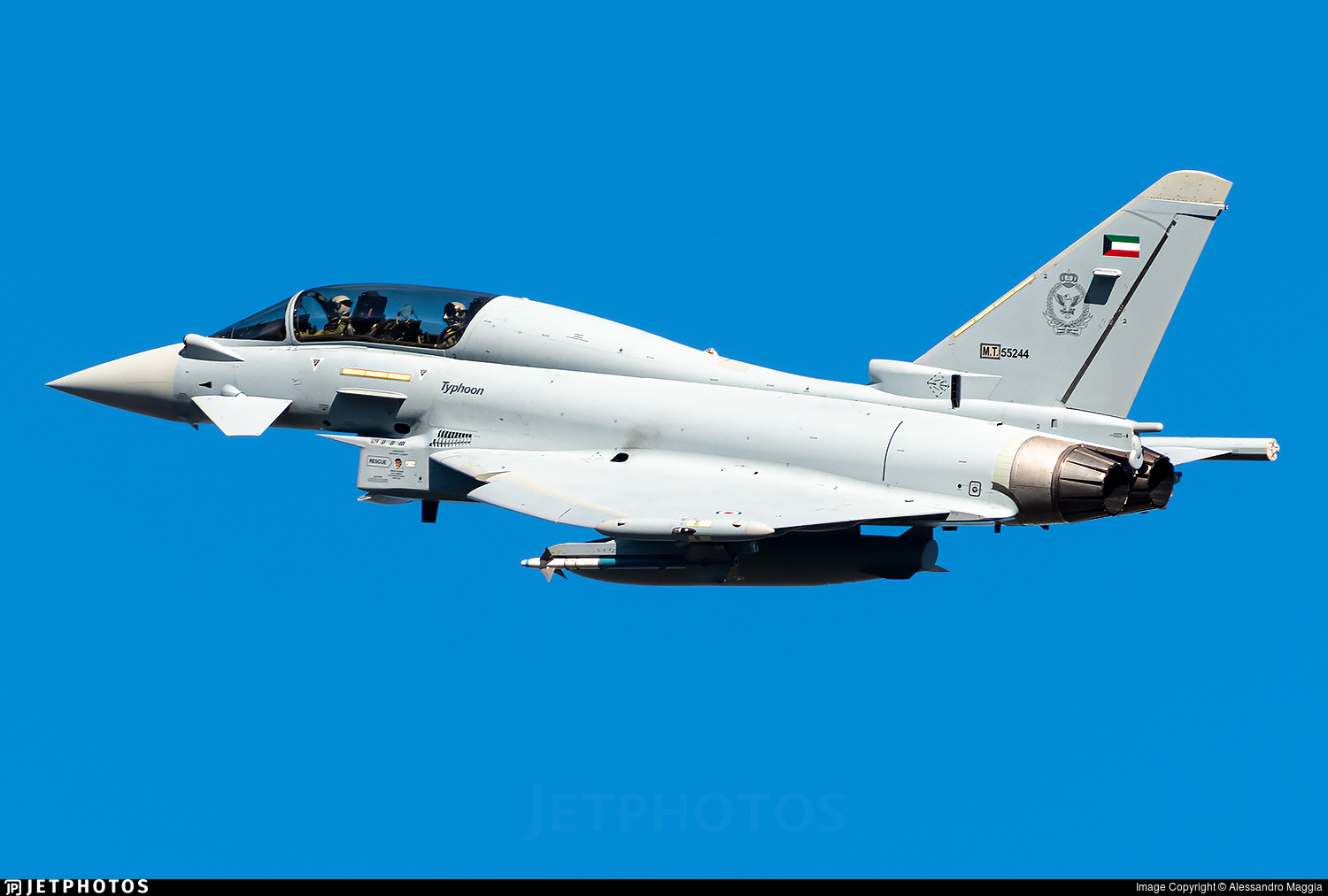
Here's a recently delivered (don't know how recent but it can't be older than two years) Kuwaiti Typhoon:

86086_1638815141.jpg


Here are Greek Rafales (these could be ex-French aircraft though):

5726235-1568x882.jpg

IMG_2178.jpg


They do need the ability to control the CCAs, though.
I think by that point this role would fall on the GCAP and (if it ever materializes) FCAS which would get inducted just in time for when large scale trials of this new "collaborative air combat" begins.
 
Last edited:
They do need the ability to control the CCAs, though.

And at least right now, that looks like 2 seats because the dude driving the plane can't be distracted while giving the CCAs as much attention as they currently require.

So, how many 2-seat Rafales and Typhoons are there?

(Crud, this might actually give Gripen some more sales, just because you can buy 2-seaters)
You don't need two seats for CCA control.

Jobe noted that in the experimentation underway for CCAs, concerns that pilots in fighters would be task-saturated managing two CCA escorts have proved unfounded. Former pilots in F-22 simulators could comfortably manage up to six CCAs, he said.
 
You don't need two seats for CCA control.
Well, you don't, but at least China decided that it's still better to have more people in the air.
And, of all things, I am not sure China will be now too far behind US in understanding drones or autonomy.
 
Well, you don't, but at least China decided that it's still better to have more people in the air.

Not necessarily. If you're referring to the twin seat J-20B, so far we don't know if it will enter service (the more recent consensus is it's a series of tech demos that assists in the development of the new J-20A variant).
Even if J-20B does enter service, we don't know how its CCA/UCAV control is in an absolute sense, only that it would likely be superior to a single seater.

For example (just throwing a number out there), a generic single seater of the near future may be able to control six CCAs while carrying out its regular missions, while a generic twin seater of the near future may be able to control twenty CCAs while carrying out its regular missions, and having both single seater and twin seaters in service could prove useful (regular CCA control versus augmented uber CCA control).
 
Is that while in combat, or while flying from McChord AFB to Germany?
Maj. Gen. R. Scott Jobe, director of force design, integration and wargaming

What are your thoughts on whether he would only test transits...?
 
Well, you don't, but at least China decided that it's still better to have more people in the air.
And, of all things, I am not sure China will be now too far behind US in understanding drones or autonomy.
The whole point of CCA is autonomous operations. Task the asset to go and do something and it will do it and report back, if it survives.
Depends on what he wants the tests to say.
Not a fan of people that take those philosophical positions. If you are of the bent that every General is there to feather their own nest I expect you either haven't met too many of them or worked with people who go on to become Generals/Senior leadership. Almost all I have worked with are driven individuals who want to achieve big things but their people and the mission always comes first.

Any General ranked individual would surely have an appreciation of how much bigger the scandal would be were he/she to reach down into their organisation attempting to adjust test outcomes compared to failing tests.

A perfect example would be Brig. Gen. Jason E. Bartolomei who oversaw the ARRW program. Despite ARRW's failure and being dropped he has gone on to lead AFRL. https://www.af.mil/About-Us/Biographies/Display/Article/3260359/ Moral of the story is you don't have to have a successful program for you to be promoted and integrity is still a highly valued quality in senior leadership.
 
Any General ranked individual would surely have an appreciation of how much bigger the scandal would be were he/she to reach down into their organisation attempting to adjust test outcomes compared to failing tests.
Oh, my sweet summer child.

  • LtCol Rene Studler, during the NATO rifle trials, changed the terms of the testing so that the .280 British would not win. There's documented protests over this in the diplomatic archives.
  • Every test given in relation to the A-10, including the A-10 versus A-7 comparison. And the A-10 v A-7 comparison was the most balanced evaluation, showing that the A-10 does things that the A-7 could not do, and that the A-7 did things that the A-10 did very poorly, so the best answer for the USAF was to keep both in service.
Do I really need to keep going?
 
Oh, my sweet summer child.

  • LtCol Rene Studler, during the NATO rifle trials, changed the terms of the testing so that the .280 British would not win. There's documented protests over this in the diplomatic archives.
  • Every test given in relation to the A-10, including the A-10 versus A-7 comparison. And the A-10 v A-7 comparison was the most balanced evaluation, showing that the A-10 does things that the A-7 could not do, and that the A-7 did things that the A-10 did very poorly, so the best answer for the USAF was to keep both in service.
Do I really need to keep going?
You have mentioned two instances, both of which are more than 40 years ago. There will always be a bad egg or two amongst the bunch but as of today there are 245 individuals across the various General ranks of the USAF and Joint positions. I expect you would struggle to find even 10 examples across the last 30 years of what you are suggesting and that would be from a potential group numbering in the thousands.
 
You have mentioned two instances, both of which are more than 40 years ago. There will always be a bad egg or two amongst the bunch but as of today there are 245 individuals across the various General ranks of the USAF and Joint positions. I expect you would struggle to find even 10 examples across the last 30 years of what you are suggesting and that would be from a potential group numbering in the thousands.
While not a general, there's always Principal Deputy Undersecretary of the Air Force for Acquisition Darleen Druyun WRT Boeing KC-46 and the SDB 1 (and I have my suspicions about CSAR-X as well).
 
Not necessarily. If you're referring to the twin seat J-20B, so far we don't know if it will enter service (the more recent consensus is it's a series of tech demos that assists in the development of the new J-20A variant).
Even if J-20B does enter service, we don't know how its CCA/UCAV control is in an absolute sense, only that it would likely be superior to a single seater.

For example (just throwing a number out there), a generic single seater of the near future may be able to control six CCAs while carrying out its regular missions, while a generic twin seater of the near future may be able to control twenty CCAs while carrying out its regular missions, and having both single seater and twin seaters in service could prove useful (regular CCA control versus augmented uber CCA control).
4-6 CCAs might give you air dominance over the modern battlefield, but when competitors begin fielding CCAs in a decade or two, you'll want to add more airframes and increase specialization to maintain the advantage. Eventually at some arbitrary size, managing a swarm of combat drones will be a full-time job unless you want to pass all mission authority to the AI.
 
4-6 CCAs might give you air dominance over the modern battlefield, but when competitors begin fielding CCAs in a decade or two, you'll want to add more airframes and increase specialization to maintain the advantage. Eventually at some arbitrary size, managing a swarm of combat drones will be a full-time job unless you want to pass all mission authority to the AI.
I'd be very surprised if AI advances didn't allow CCA parent drones managing child drones on behalf of the manned platform. The manned platform still manages overall strategy and intent with the parent CCAs having devolved authority for specific actions. The slowest part of this whole process is the manned portion trusting the AI to operate autonomously. I expect a conflict or two will either remove those barriers or enforce them and given the pace of the sector I'd say removing barriers seems more likely.
 
I'd be very surprised if AI advances didn't allow CCA parent drones managing child drones on behalf of the manned platform. The manned platform still manages overall strategy and intent with the parent CCAs having devolved authority for specific actions. The slowest part of this whole process is the manned portion trusting the AI to operate autonomously. I expect a conflict or two will either remove those barriers or enforce them and given the pace of the sector I'd say removing barriers seems more likely.
Whatever the case, the USAF needs to manage risk of relying on unmanned combat aircraft for a new role and function. It didn't do this when the US didn't develop the F-4 with a canon, believing that a simpler autonomous weapon than CCAs, the air to air missile, had made guns as the primary air to air weapon on fighters obsolete.

AF leadership seems to be engaging in group think. Everyone has been sold the idea of affordable mass, but like other forms of technology the reality may be different than the promise.
 
Whatever the case, the USAF needs to manage risk of relying on unmanned combat aircraft for a new role and function. It didn't do this when the US didn't develop the F-4 with a canon, believing that a simpler autonomous weapon than CCAs, the air to air missile, had made guns as the primary air to air weapon on fighters obsolete.
For sure the technology is new but if they don't push it now then they will likely either obtain parity or fall behind. The US leads AI research and more than any other country in the world has the ICT startup culture to develop and push the boundaries of what is possible with AI. Fortunately for the US Military there are multiple startups such as Andruil who are committed to the defence cause.

As an aside I was always curious if manned NGAD, which seems less and less likely now, would also be equipped with a cannon. Noting F-35B/C lost theirs would that be present on NGAD, F/A-XX, FCAS, GCAP etc.

AF leadership seems to be engaging in group think. Everyone has been sold the idea of affordable mass, but like other forms of technology the reality may be different than the promise.
Hence why phase one and phase two etc, incremental steps forward. If they build it right then the underlying platform hardware acquired, so airframe and engine and cooling and generic interfaces can remain relatively static, but the systems can be upgraded with new software and sensors.
 
As an aside I was always curious if manned NGAD, which seems less and less likely now, would also be equipped with a cannon. Noting F-35B/C lost theirs would that be present on NGAD, F/A-XX, FCAS, GCAP etc.
Once more nations get most of their Air Force equipped with stealthy aircraft, then yes the gun is still going to be needed.

In Vietnam, the problem assumed in the Phantom was that most combat would be BVR. Which would have been accurate in the event of a US v USSR fight. But when you have USN, USAF, USA, RAAF, ROKAF, ROKA, RVNAF, ARVN etc all flying overhead and you don't have reliable IFF systems, you need to get positive visual ID to avoid fratricide. And now you're close enough to need guns.

When only one side in a conflict has LO aircraft, they control the range at which the fights happen. And it'll be overwhelmingly BVR. Once both sides in the fight have LO aircraft, we're looking at WVR (or pretty close to that using IRSTs). So you're going to need guns again.
 
Once more nations get most of their Air Force equipped with stealthy aircraft, then yes the gun is still going to be needed.
I'm not sure the presence of stealth aircraft enforce use of a gun. Reasoning expanded below.

.In Vietnam, the problem assumed in the Phantom was that most combat would be BVR. Which would have been accurate in the event of a US v USSR fight. But when you have USN, USAF, USA, RAAF, ROKAF, ROKA, RVNAF, ARVN etc all flying overhead and you don't have reliable IFF systems, you need to get positive visual ID to avoid fratricide. And now you're close enough to need guns.
The ROE constrained the US forces in Vietnam, some of that was perhaps limited IFF but I'm not sure it can all be attributed to that. It could well be argued the very poor performance of the AIM-4 was as much an issue as the ROE constraints,

Putting some number to it, US gun kills were approx 20% of A2A kills over Vietnam and a majority of those were F-105s with no AAM on the aircraft so no other option. Hence I'm not sure the presence of a gun would have significantly changed the kill ratio. Having a better performing AAM over the AIM-4 likely would have made a difference, at least in the early years.
When only one side in a conflict has LO aircraft, they control the range at which the fights happen. And it'll be overwhelmingly BVR. Once both sides in the fight have LO aircraft, we're looking at WVR (or pretty close to that using IRSTs). So you're going to need guns again.
If you are close enough to see the other aircraft then I'm not sure a gun is required. HOBS missiles are good enough now that as long as the target is detectable then a missile seems far more effective than a gun which, with obviously the absence of a turret, is limited to nose pointed engagements. Maybe min fuzing distances for the missiles might be a factor but I doubt it. The presence of a gun would IMO be more a factor in A2G tasking.

To conceive a scenario, a manned NGAD is shot down behind the FLOT and while supporting a CSAR the NGAD wingman needs an appropriate sized weapon to keep adversary infantry away from the downed aircrew's position. A perfect use of a gun. Of course that is a contrived scenario and I'm not anti gun, just not sure the USAF will go there.

Taking it a step further then, will we see a gun equipped CCA? Seems ideal for interdiction tasks against soft targets as well a CAS and potentially then also A2A against other drones. They are probably out there but I haven't seen any concepts that have a gun as the primary or even secondary weapon on a CCA.
 
But can a CCA be really relevant in a dogfight? I mean, you need a lot of engine power and CCA while, being built for range and persistence, doesn´t look like performers there.
So why someone would want them to have a gun for DCA?
Similarly, what kind of profile attack would a CCA use while strafing? Dive and pull-up at 5G? I am not sure they can do that efficiently and have the power to not linger at low alt within ground defense reach.
 
Last edited:
But can a CCA be really relevant in a dogfight? I mean, you need a lot of engine power and CCA while, being built for range and persistence, doesn´t look like performers there.
So why someone would want them to have a gun for DCA?
Similarly, what kind of profile attack would a CCA use while strafing? Dive and pull-up at 5G? I am not sure they can do that efficiently and have the power to not linger at low alt within ground defense reach.
All valid points. Phase One doesn't appear to have a gun. The GA aircraft doesn't appear overly manoeuvrable, the Andruil Fury may be a bit better but the control surfaces don't appear large either.

I expect that in CAS scenarios then perhaps the attritable portion of the CCA comes in to play. You likely wouldn't use the aircraft for gun runs until it had exhausted its other munitions. Alternatively maybe we will see CCA's custom designed for CAS with gun armaments that trade the internal weapons for higher thrust, perhaps armour in certain locations and better manoeuvrability?

I'm again not saying this will happen, just a thought exercise given we tend to focus on missiles and smart bombs as the primary weapons.
 
Last edited:
Status
Not open for further replies.

Similar threads

Back
Top Bottom