
dark sidius
ACCESS: Top Secret
- Joined
- 1 August 2008
- Messages
- 1,546
- Reaction score
- 1,609

Xi made a statement about being ready to fight.Where did this 2027 timescale come from?

How DC became obsessed with a potential 2027 Chinese invasion of Taiwan
Some in defense circles say the U.S. needs to prepare for Beijing's invasion of Taiwan in 2027. China experts say it isn’t a deadline.www.defensenews.com
Were the mainland willing to let the economic ties drag the island back under mainland control in the ~2050s
Xi made a statement about being ready to fight.
Plus it's the 100th anniversary of the PLA.
In addition, their fighting mass of military age men is falling pretty rapidly, I suspect there is an even stronger drop coming around 2027.
If your military ability to take and hold ground is weakening, you get stuck in a mentality of "use it or lose it".
Also, there's Xi's age to consider.
Were the mainland willing to let the economic ties drag the island back under mainland control in the ~2050s, it wouldn't be much of an issue to anyone.
But the political apparatus at the mainland is not making noises like they are happy with that plan any more. Probably because it's gotten even less likely to work since the mid 2010s.
In addition to the PRC's acute and worsening demographic issues it also has severe, intractable economic problems that will only get worse (I strongly suspect that by 2030 the PRC will be economically and demographically buggered). The PRC has only about four-five years realistically to attempt and amphibious invasion of Taiwan.
Agreed.The crackdown on Hong Kong largely slammed the door shut on a peaceful reunification, or at least a peaceful reunion not forced under the explicit threat of military confrontation. The idea of “two systems, one country” was proven a long term sham that amounted to total surrender of sovereignty, and I think that realization by both sides also influenced military preparations.
The one advantage is that it will take some time to move enough sealift into the vicinity of Taiwan, in addition to moving all the combat units. So there will be warning of an attempted invasion.There are systematic economic problems that may or may not be addressed, and long term demographics that are basically unsolvable without largely divorcing productivity from labor force. That in no way changes the capabilities of the PLA; given enough political will they could easily be in position to force reunification indefinitely. It’s just a question of resource allocation, and even a faltering PRC would have more resources than practically anywhere else.
Xi made a statement about being ready to fight.
Plus it's the 100th anniversary of the PLA.
In addition, their fighting mass of military age men is falling pretty rapidly, I suspect there is an even stronger drop coming around 2027.
If your military ability to take and hold ground is weakening, you get stuck in a mentality of "use it or lose it".
Also, there's Xi's age to consider.
Were the mainland willing to let the economic ties drag the island back under mainland control in the ~2050s, it wouldn't be much of an issue to anyone.
But the political apparatus at the mainland is not making noises like they are happy with that plan any more. Probably because it's gotten even less likely to work since the mid 2010s.

Ironically, China deterring Taiwan from de jure political independence guarantees that the US will intervene in a conflict between Taiwan and China.The way I see it, there are only a few prongs to the PRC's Taiwan strategy:
1. Have sufficient forces to wage a war over Taiwan if political circumstances force it
2. Ideally, possess forces that are able to A) deter Taiwan from moving towards de jure political independence and/or B) deter US intervention if conflict occurs
3. Continue to develop and grow the military forces as well as the non-military circumstances to enable 1. and 2. to occur more and more in the PRC's favour as time goes on
4. In the long term, achieve such an overmatch in military, economic/industrial/technology and political capability in the regional level and on the global level that Taiwan will be forced to unify on China's terms.
Of those prongs, only 4. is a situation where China might prepare to actively initiate a conflict, but the prerequisites for them to even start planning step 4. is still not fully existent yet, and certainly not going to happen in 2027.
Thing is, China is already in a major manpower crunch and it's looking to greatly collapse by about 2030.The relevance of all of the above to USAF's caution to getting NGAD right, IMO can be summarized to a single question -- "whose side is time on?"
There seems to be some elements of the natsec community who believe that if the US can get through the mid/late 2020s without a conflict (or if conflict occurs, being able to win one), then by the early 2030s various technological/economic/political circumstances will shift back to the US's favour, including in terms of the ability to get superior military capabilities in service by then which the PLA won't be able to match.
That's also partly why the US military seems very cognizant of also wanting to try and maximize its preparedness and attain some degree of near term "deliverable" capabilities to be ready for a "2027" (or mid/late 2020s) conflict if it occurs, with the risk that this may partly be to the detriment of capabilities desired for the 2030s (in terms of opportunity cost).
No, there's not.I wouldn't be surprised if the USAF is trying to work out all of the permutations and possibilities for what PLA capabilities in the 2030s (and 2040s, and beyond) may look like, before fully committing into a potential big ticket air superiority/manned fighter project.
There isn't much margin for error.
I believe the CSIS Taiwan wargame indicated that the US cannot win without at least having Japan/Ryukyus to operate from. If the plan was to operate long range fighters from the Second Island Chain, which had the combat radius to reach Taiwan unrefueled, this was very foolish. I really doubt this was the case as you correctly indicate that it would have required a planform more like a bomber than a fighter. It seems the demonstrators were fighter sized, but Vago Muradian and JJ Gertler have talked about NGAD being a different planform than a traditional fighter to achieve gains in combat radius. Was that some kind of a hint?I think the question to ask is: where exactly is NGAD going to be based out of? And the sevetal answers are basically first island chain (Japan, possibly PI), second island chain (U.S. and associated protectorates), or Australia. The first option requires no large increase to combat radius. The third requires a likely unachievable combat radius for anything with fighter-ish performance. The second option is limited to a small handful of airports/bases with runways capable of handling large aircraft, and no longer offers much more protection against PRC PGMs as their effective range has increased.
My guess is that the spiraling costs forced a harder look at the survivability of the platform given its basing scheme. That may or may not force a major change to the program requirements. But it is worth reconsidering the program if basically every suitable runway at the range band the aircraft can achieve is located in Guam. It seems to me having a fighter and tanker force with better short/rough airstrip performance is a more flexible basing concept, even if it comes at the sacrifice of absolute range of the combat platform.
Another thought as to why this has changed recently - besides the huge Sentinel cost overruns and increased PLARF range and precision, Japan has taken a decidedly more assertive security role in the region in the last year or two. “Offensive “ weapons are now on order. Japan’s reset might have convinced USAF planners that it will always be available for forward basing, where as previously the USAF might have been planning around a U.S. only contingency. The U.S. might have come to the conclusion that Japan is fully committed to hosting U.S. forces in a Sino-American conflict, or alternatively they may have come to the conclusion the U.S. cannot win without Japanese basing and there is no point in designing equipment around that scenario. It is even possible some kind of formal agreement was reached on open ended use of Japanese bases in private.
i am not sure where the program stands or what the optimal solution is; just some food for thought.
Ironically, China deterring Taiwan from de jure political independence guarantees that the US will intervene in a conflict between Taiwan and China.
The US has said repeatedly that Taiwan declaring independence from China means that the US will no longer support them as the last remnants of the 1912 Republic of China.
Thing is, China is already in a major manpower crunch and it's looking to greatly collapse by about 2030.
And that pushes China towards an attitude of "if we do not militarily take Taiwan soon, we will not have the military power to do it later."
Fallout from the One Child policy for decades. Culturally, the Chinese only wanted sons, to carry on the family name. But that means that female infants are aborted or abandoned at birth, announced to family and friends as a stillbirth. No one for all those sons to marry, so no one to take the family name for a next generation.
Imagine a 40yo who realizes that he will never have a family. You can do a lot with that "nothing left to lose" mentality.
No, there's not.
Especially since I think the US needs to get back to a 20-year aircraft life, and alternating between the high end F-15/F-22/NGAD and the low end F-16/F-35/maybe CCAs.
Because stealth tech and electronics will have changed so much that the aircraft will not be viable for much more than 30 years from introduction to service.
It's foolish to try to operate airbases that the enemy can hit with ballistics and hypersonics. Even without the enemy using nukes.I believe the CSIS Taiwan wargame indicated that the US cannot win without at least having Japan/Ryukyus to operate from. If the plan was to operate long range fighters from the Second Island Chain, which had the combat radius to reach Taiwan unrefueled, this was very foolish. I really doubt this was the case as you correctly indicate that it would have required a planform more like a bomber than a fighter. It seems the demonstrators were fighter sized, but Vago Muradian and JJ Gertler have talked about NGAD being a different planform than a traditional fighter to achieve gains in combat radius. Was that some kind of a hint?
Agreed, that's beyond foolish.Relying on a complex choreography of larger tankers refueling NGAS, which then refuels NGAD is another foolish idea. Guam has limited ramp space. Are KC-46s going to escort NGAS out, then top off at some point, and then meet them on the way back? Or would they top off the fighters at some point and NGAS would join up at some point?
And that's the challenge. There'd be very large protests outside any bases used by the US to attack China, nevermind the "oops, sorry we missed the base and bombed a large part of Tokyo" factor.It might be more cost effective to build the infrastructure in Japan to harden bases, building hardened aircraft shelter, prepositioning runway repair supplies/equipment, and improving air defenses. As long as Japan would be willing to be targeted, an advanced industrial large island nations provides a greater ability to support a war effort than small islands such as Guam, Tinian, Saipan, Palau, etc.
There's no particular element of China's current Taiwan strategy which anticipates the PRC to initiate a conflict over Taiwan in 2027, however the goal of continued military modernization and growth in military capability (and whole of nation economic/tech/industry advancement) is basically still the priority.
If they were serious about wanting to initiate a conflict in 2027 their procurement wouldn't be looking like what it was for the last few years -- it instead would be much more expansive and much more near term and Taiwan oriented, rather than the relatively moderate pace of purchasing new platforms (yes, the production of new ships and fighters some have called "war footing" is more like a fraction of what they're actually capable of) and R&D (medium/long term) focused approach we have observed
The way I see it, there are only a few prongs to the PRC's Taiwan strategy:
1. Have sufficient forces to wage a war over Taiwan if political circumstances force it
2. Ideally, possess forces that are able to A) deter Taiwan from moving towards de jure political independence and/or B) deter US intervention if conflict occurs
3. Continue to develop and grow the military forces as well as the non-military circumstances to enable 1. and 2. to occur more and more in the PRC's favour as time goes on
4. In the long term, achieve such an overmatch in military, economic/industrial/technology and political capability in the regional level and on the global level that Taiwan will be forced to unify on China's terms.
Of those prongs, only 4. is a situation where China might prepare to actively initiate a conflict, but the prerequisites for them to even start planning step 4. is still not fully existent yet, and certainly not going to happen in 2027.
The relevance of all of the above to USAF's caution to getting NGAD right, IMO can be summarized to a single question -- "whose side is time on?"
There seems to be some elements of the natsec community who believe that if the US can get through the mid/late 2020s without a conflict (or if conflict occurs, being able to win one), then by the early 2030s various technological/economic/political circumstances will shift back to the US's favour, including in terms of the ability to get superior military capabilities in service by then which the PLA won't be able to match.
That's also partly why the US military seems very cognizant of also wanting to try and maximize its preparedness and attain some degree of near term "deliverable" capabilities to be ready for a "2027" (or mid/late 2020s) conflict if it occurs, with the risk that this may partly be to the detriment of capabilities desired for the 2030s (in terms of opportunity cost).
I wouldn't be surprised if the USAF is trying to work out all of the permutations and possibilities for what PLA capabilities in the 2030s (and 2040s, and beyond) may look like, before fully committing into a potential big ticket air superiority/manned fighter project.
There isn't much margin for error.
It's foolish to try to operate airbases that the enemy can hit with ballistics and hypersonics. Even without the enemy using nukes.
The key to this though remains software. The platform itself likely won't change too much going forward but how the software iterates over the life cycle of the airframe is the key differential. GA and Andruil with CCA phase 1 have spoken about this at length and it clear that software and open architectures are where the real progression will come from.No, there's not.
Especially since I think the US needs to get back to a 20-year aircraft life, and alternating between the high end F-15/F-22/NGAD and the low end F-16/F-35/maybe CCAs.
Because stealth tech and electronics will have changed so much that the aircraft will not be viable for much more than 30 years from introduction to service.
In the meantime the USAF should be buying F-35B, but that will never happen.
The B-21 model works, so far, because it hasn't been as innovative as manned NGAD likely needs to be.NGAD is a long term project beyond 2030, possibly way beyond 2030 now. The B-21 is one of the most successful USAF development programs in recent memory and it still had its contract signed a decade ago with a design freeze in 2018. So ~2035 seems like a realistic estimate to me.
“The central idea of the B-21 approach is that it is going to leverage decades' experience from a variety of aircraft developmental programs. That is why we say it is using rather mature technologies, but they will be put together in a new and creative way.”
—Deborah Lee James, Former Secretary of the Air Force
Aug. 8, 2017

 www.northropgrumman.com
I expect with CCA and AI progression we are almost past the point of manned fighters. I'm not sure how that bodes for Tempest and FCAS and where those programs will end up, will the manned portions also dissappear...If you believe a war comes before that, or you believe air to air warfare as we know it becomes unrecognizable by then, what is the solution? Quite possibly, not any manned platform at all, or at least not the one you envisioned a decade ago.
We might have simply reached a point where manned fighters are not cost competitive, not in terms of money, but just in development time. Certainly NGAD reportedly being several hundred million dollars per copy is a huge bet for 2035 that might have an LCS level ending.
Not at this point in time. That would be a significant paradigm shift away from fixed airfields. We are seeing that with USAF Air Mobility who are looking at unmanned in a big way but no indication that USAF has any interest in the Bee.I was under the impression that the USAF was going to buy a limited number of F-35Bs.
It's foolish to try to operate airbases that the enemy can hit with ballistics and hypersonics. Even without the enemy using nukes.
And the US doesn't own the bases in the Pacific to fit them with HAS and SAMs etc.During the Cold War, bases in Western Europe were subject to Soviet attack. The US had no choice but to defend their bases with pass defenses such as hardened aircraft shelters and active defense. You cannot win against China with stand off forces and munitions. It is too expensive - you cannot generate enough sorties or mass.
I was under the impression that the USAF was going to buy a limited number of F-35Bs.
That would require the people in charge of their expeditionary airfield program to have enough power to make the purchase recommendation stick.I would be a good idea IMO for the USAF to have two-three squadrons of the F-35B on hand.
A lot of other things to consider as well in that purchase such as training pipelines, different spares and maintenance for the system. Greater life cycle costs and also both reduced range and payload for the Bee. Nothing cosmic but to a big wieldy difficult to move beast that is the USAF these things would take some effort.That would require the people in charge of their expeditionary airfield program to have enough power to make the purchase recommendation stick.
What value is there in a two seat F-35 other than reducing the internal fuel load...?They should really be building or buying F-35I two-seaters instead if NGAD can't be ready before a major conflict
What value is there in a two seat F-35 other than reducing the internal fuel load...?
All those are tradeoffs that might increase fuel load but would result in other losses. Cee wings on an A clearly results in reduced transonic acceleration for example.you could make a two-seat F-35, call it the F-35D, with an adequate internal fuel load if you used the F-35B nose-section (The second seat in place of the lift-fan), the centre and aft sections of the F-35A with the wings of an F-35C (With the wing folds and folding mechanisms deleted).
But none of that addresses why you need two seats...?

The key to this though remains software.
Cee wings on an A clearly results in reduced transonic acceleration for example.
I suspect that there will be one generation of manned fighters past the F22/F35. Maybe two, though the second generation would definitely be a Human/AI combo working together (Yes, I've read Yukikaze, that's where I got the idea from). It's possible that the 6th generation would have an AI copilot, kinda depends on the software engineers at this point.
Past that, it's AI-controlled UCAVs basically told "anything flying in the following geographical area that doesn't pass IFF is to be shot down."
The difference between a classic Hornet and an F-35 though is night and day. The two seats Hornets were/are used as FACs. I expect an F-35 pilot would be able to accomplish that role today.I can't remember the name of the paper but I remember reading a paper touching on this subject about 11-12 years ago from the DTIC website about how the USMC after it got the F/A-18 hornet over time realised that it needed two-seaters for reasons other than training. I don't recall the exact details but I suspect that a two-seat version of the F-35 would have its uses.
I haven't seen anything that suggests manned NGAD would be multi-crew. Conversely I have seen this from the USAFThe NGAD has always been planned as multicrew because they would scale the number of drone wingmen up as they upgraded it
This ends up needing a dedicated weapons officer
Jobe noted that in the experimentation underway for CCAs, concerns that pilots in fighters would be task-saturated managing two CCA escorts have proved unfounded. Former pilots in F-22 simulators could comfortably manage up to six CCAs, he said.
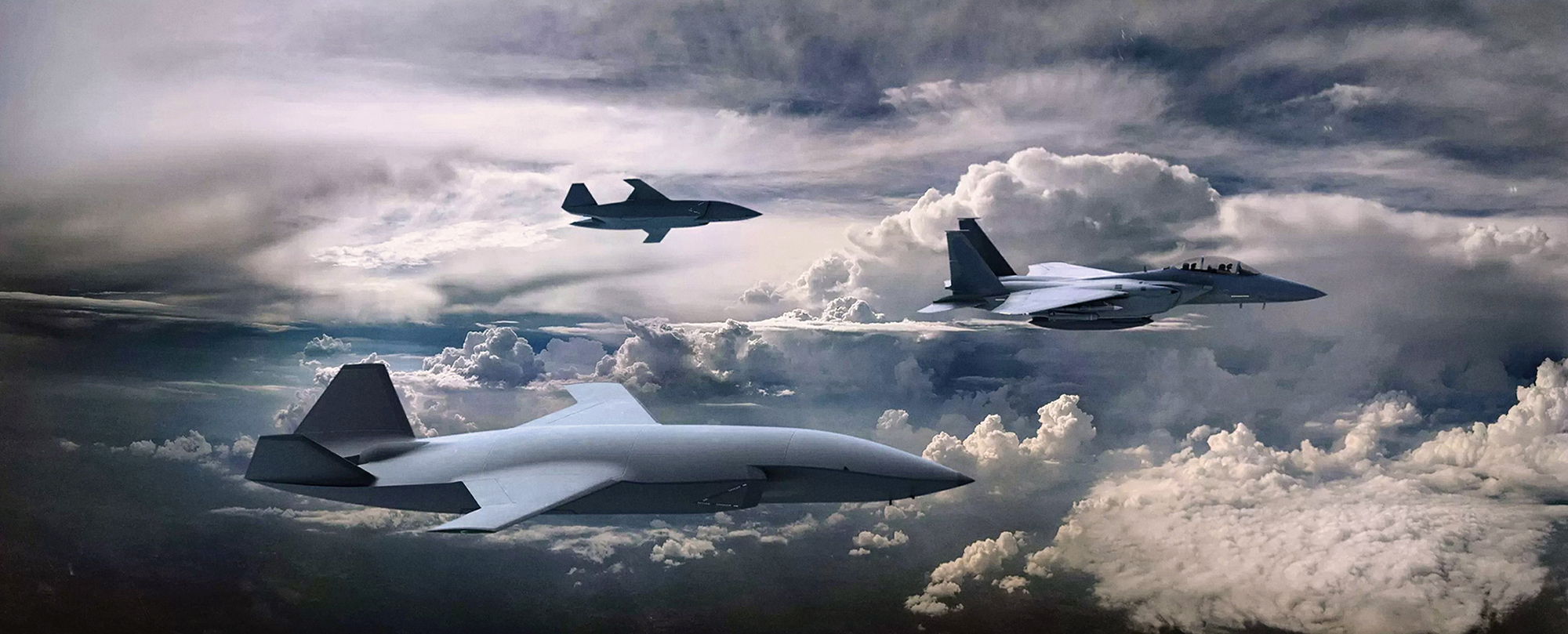
 www.airandspaceforces.com
While primarily focused on EW that paper is from 2008. Today we have cognitive EW which significantly reduces the workload of the operator while also significantly improving the effectiveness of the EW programs.I just did a search over at the DTIC website for "Two-seat JSF" and this was the first entry:
JSF: The Need for a Two-Seat Variant EWS Contemporary Issue Paper
I do believe this was the paper I mentioned in my previous post (I must reread it).
Have you viewed the transonic acceleration numbers for the A versus the Cee? The Cee is a little heavier but the main difference is the wings and horizontal stabilizers.Why would it reduce transonic acceleration?
And the US doesn't own the bases in the Pacific to fit them with HAS and SAMs etc.
I and the quote from Scott I was responding to wasn't talking about the F-35 which you are clearly referencing.Software is one of the biggest problems with the program right now. Software and the politics/commercial interests around it.
Does anyone really think that Lockheed is going to willingly integrate with non-Lockheed CCA platforms, or are they going to push to make the CCAs as well? And use integration with an existing platform as leverage?
It does not help that the primes and certain DoD components outright lied to SECAF about aspects of the program and how ready the technology was.
If the press was competent this would have been out in the open by now rather than “shrouded in secrecy”.
Software is one of the biggest problems with the program right now. Software and the politics/commercial interests around it.
Does anyone really think that Lockheed is going to willingly integrate with non-Lockheed CCA platforms, or are they going to push to make the CCAs as well? And use integration with an existing platform as leverage?
It does not help that the primes and certain DoD components outright lied to SECAF about aspects of the program and how ready the technology was.
If the press was competent this would have been out in the open by now rather than “shrouded in secrecy”.
if you don’t want to play ball, you aren’t part of the program.
Boeing, Lockheed: “play ball? We’re the only game in town, baby!”
Phase 1 has already proven the USAF is on the right path and Boeing and LM are no longer the only game in town. Perhaps if we are talking manned NGAD then I would agree but CCA has opened the flood gates now and the options are much broader. Doesn't mean LM and Boeing won't play in the CCA space but they have a lot more competition to keep them honest and hungry.Boeing, Lockheed: “play ball? We’re the only game in town, baby!”
The Air Force wants to use the CCA program to grow new and innovative contractors. Do you really think Boeing and Lockheed are ok with that?

