USAF/USN 6th Gen Fighters - F/A-XX, F-X, NGAD, PCA, ASFS News & Analysis [2008- 2025]

Status
Not open for further replies.
That's a great question - everybody seems to be jumping onto datalinks that are only getting more fragile.

The future transportation layer satellites likely will provide a more resilient option over the current constellations. I think over a hundred are scheduled to be launched in the next five years.

I would presume that CCAs will have some kind of MADL like link to their local controllers.
 
This is just missile gap all over again. Compare to "WS15" to F135, F119... :rolleyes:

In this case, the PRC doesn’t have the same requirements the US does. The USAF needs to cover more distance than the PLAAF. So the PLAAFs engine requirements are far less stringent for an anti air platform, since they have no shortage of local bases.

As for UAV teaming with manned aircraft, that is probably where engines will be a problem. The US has a multitude of off the shelf engines in the 2000-8000lb range for moderately sized fast subsonic UAVs. I’m sure China has some, but I suspect the options are fewer and less efficient. That probably will be problematic even if they are at the same AI level as the USAF, which I think is questionable.

What really probably is killing them engine wise is H-20. Even the H-6K/N/J still uses Russian engines to the best of my knowledge. Trying to build a stealth bomber with a combat radius beyond the second island range must be incredibly difficult.
 
Whatever it is worth..
 

Attachments

  • US20160273452A1.pdf
    897.3 KB · Views: 181
  • US8371104B2.pdf
    164.1 KB · Views: 111
  • US9862482B2.pdf
    716.3 KB · Views: 93
  • US20160376987A1.pdf
    940.7 KB · Views: 79
  • US8690097.pdf
    964.4 KB · Views: 83
  • US9908633.pdf
    932.5 KB · Views: 86
  • US9874144.pdf
    977.6 KB · Views: 76
  • AU2020203920A1.pdf
    1.8 MB · Views: 87
  • US11118510.pdf
    1.2 MB · Views: 82
  • US10718264.pdf
    2.1 MB · Views: 101
Whatever it is worth..
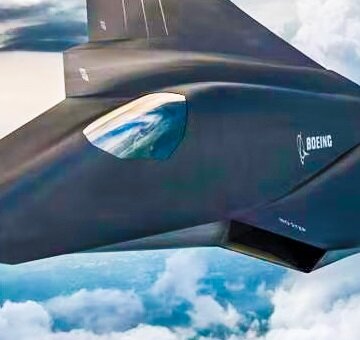
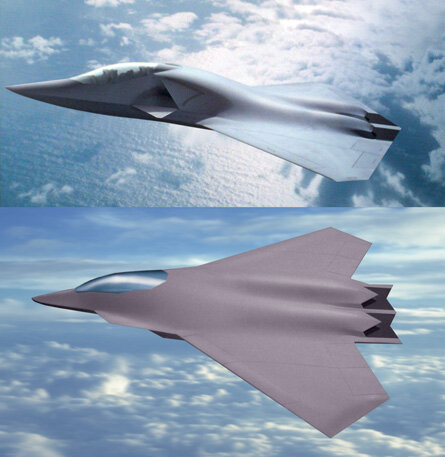
The variable caret inlet (US20160273452A1) looks similar to Boeing NGAD illustration. The top (starboard) inlet looks as though it has a seam between the top of the inlet and the wing, possibly allowing it to cant upwards allowing supersonic airflow. The thrust vectoring apparatus in the second pdf (US837110482) looks similar to the Boeing exhaust system in the NGAD picture below.
 

Attachments

  • Boeing NGAD Inlet Design.jpg
    Boeing NGAD Inlet Design.jpg
    51.6 KB · Views: 300
  • boeing-ngad-boeing_34159.jpg
    boeing-ngad-boeing_34159.jpg
    65.9 KB · Views: 297
Interesting air intake design on the top picture on the second Boeing NGAD photo. All I can say is it looks rather strange, and that it must have been a very early design Dynoman.
 
I do not know why the US Congress are bothered about the USAF 2050 design plan bobbymike, as 2050 is a long way off and many of the those in Congress will have been retired by then. Also who knows what type of technologies will come out by then.
 
I do not know why the US Congress are bothered about the USAF 2050 design plan bobbymike, as 2050 is a long way off and many of the those in Congress will have been retired by then. Also who knows what type of technologies will come out by then.
"those in Congress will have been DEAD by then"

Fixed it for you. :)
 
I do not know why the US Congress are bothered about the USAF 2050 design plan bobbymike, as 2050 is a long way off and many of the those in Congress will have been retired by then. Also who knows what type of technologies will come out by then.

Possibly because China is looking that far ahead.
 
Possibly because China is looking that far ahead.
Well there’s was an article questioning our ability to build an ICBM maybe congress wants to see if we can still build fighters 26 years from now.
 
Last edited:
I do not know why the US Congress are bothered about the USAF 2050 design plan bobbymike, as 2050 is a long way off and many of the those in Congress will have been retired by then. Also who knows what type of technologies will come out by then.
R&D and entry into service of the 7th gen aircraft will probably take that long and the 6th gen will be 25+ years old by then. Doesn't sound unreasonable.
 
Forgot about the 7th generation fighters piginapoke. It will be interesting to see what they will look like if the current crop of 6th generation fighter designs are anything to go by. No doubt the technologies will be beyond anything that we have right now.
 
Has the DOD or FBI announced any plans to give more scrutiny towards Chinese/Taiwanese engineers working within the 6th gen fighter programs?

Given that it's a known and credible security concern, you'd think it would be a necessary step to safeguard US IP.

The most notorious American spies are invariably European-American. Perhaps the USA should ban anyone with the name "Ames", "Nicholson", or "Walker", yet they keep hiring European-Americans for their secret projects. Wonder why that is, truly.

R&D and entry into service of the 7th gen aircraft will probably take that long and the 6th gen will be 25+ years old by then. Doesn't sound unreasonable.

7th generation is a bit optimistic when NGAD still has hurdles, like actually entering service and being produced in quantity, to overcome tbf.

If F-35 and F-22 are any indication, it will take about 20 years for it to reach IOC, and involve a lot of troublesome production changes that will delay the FRP. That's if Lockheed gets it, of course. If Boing gets it, the USAF likely won't get anything, and Boing will lose a second vowel.

In either case, the USAF thinking NGAD will be "entering production by 2030" is a bit optimistic. Sometime in the early 2030's, probably, and then another decade or so, just to work out all the low rate production issues that will crop up. Or it simply goes the way of F-22 and never gets fixed.
 
Last edited:
I think USAF NGAD 6th gen has been around much longer than most of us realize, probably when USAF/USG knew there was only going to be 189 F-22s. You know the GE YF-120 engine evolved into the new GE adaptive cycle engine. When I was on YF-23 as an example, the PAV 2/YF-120 combination, the performance was something else, only a handful know the true supercruise potential. We sustained high-g, supercruise turn rates with no performance degradation, just kept going. Had to aerial refuel with one engine at idle, YF-120 had tons of power.

I actually think NGAD may be fairly mature. I also think there is 6th gen tech cross-pollination across other classified programs including B-21.
 
If nothing else, the CCA component of NGAD likely enters service before the end of the decade.
 
Let's wait and see what happens Josh_TN whether the CCA enters service before the end of the decade, if that is true then the manned NGAD will quite possibly enter service before the unmanned CCA. It will be very interesting to see what happens during the later parts of the decade in regards to the development of both systems.
 
Is there any indication of what type of performance leap they are trying to achieve? Full aspect stealth; maybe no tail fins, while maintaining high aoa maneuverability, drone control capability, electronic attack capability, super cruise, better climb performance than any current fighter; better range than f-22; top speed? I think the transition from f-4 to f-15 was about twice the performance capabilities; and the f-22 made the leap even further. Are they going to try to hit mach3?
 
The two programs - at this point - seem to have serious flaws.

NGAD is willing replicating the error of the F-22. Make a small boutique fleet (200 airframes) that cost a fortune and is too fragile for any serious war.

CCA (which contractors rationally think is the more solid of the two programs) is based upon autonomy technology which has not been demonstrated in any serious way.

Neither, I think, proceed from a good understanding of the future operational environment. Both are still tied to major airbases (which are now little more than targets) and seem to be a bit beside the point. NGAD is to achieve air superiority in a war where successful strike missions are more important. CCA is to give mass-at-range but still tied to the large airbases. In a way, the 4th Gen, 5th Gen, 6th Gen mindset is producing a design cul-de-sac.

Nobody is thinking of reviving STOL strike aircraft (F-111, Tornado, SU-24), airplanes to operate from a wider range of air bases, roadways, and the like. Trade absolute performance for basing flexibility. Focus on a stand-off missiles delivery truck. That isn't necessarily a generational leap forward, but a response to the greatly changed operational environment.

 
You still need to protect those 'missile trucks' from long range look-down-shoot-down missiles... so contesting the airspace with your own interceptor is still attractive.

As for a STOL stand-off weapon delivering aircraft capable of nape-of-the-earth flight... does that really have to be manned?

That said, your argument is quite persuasive overall. I just think that sensor abilities (i.e. being able to spot a affordable strike aircraft at range) might make it vulnerable if air-superiority isn't contested, and also that RWR and terrain following sensor capabilities are already probably enough for a drone to effectively navigate at low altitude and detect/evade threats almost as well as a human.
 
The range question is tricky, because a look-down / shoot-down interceptor can get an airplane if it's within - say - 50-100nm of the launcher. But if everybody is carrying 300nm range missiles (or longer), the interceptor has to establish a far more challenging defended zone. Escort aircraft will help - but all they need to do is establish some sort of keep-out range, push back the interceptors long enough for the tactical-bombers to reach stand-off launch point.

As for unmanned, very good point. A STOL missile-truck doesn't exactly have to be manned at all. It's a rather simpler mission: take-off, fly to launch point, evade long-range threats, return. If autonomy cannot do that, it's hopeless for anything more advanced. It doesn't even need low-level flight at first - that's a nice to have for closer-in shots.
 
The two programs - at this point - seem to have serious flaws.

NGAD is willing replicating the error of the F-22. Make a small boutique fleet (200 airframes) that cost a fortune and is too fragile for any serious war.

CCA (which contractors rationally think is the more solid of the two programs) is based upon autonomy technology which has not been demonstrated in any serious way.

Neither, I think, proceed from a good understanding of the future operational environment. Both are still tied to major airbases (which are now little more than targets) and seem to be a bit beside the point. NGAD is to achieve air superiority in a war where successful strike missions are more important. CCA is to give mass-at-range but still tied to the large airbases. In a way, the 4th Gen, 5th Gen, 6th Gen mindset is producing a design cul-de-sac.

Nobody is thinking of reviving STOL strike aircraft (F-111, Tornado, SU-24), airplanes to operate from a wider range of air bases, roadways, and the like. Trade absolute performance for basing flexibility. Focus on a stand-off missiles delivery truck. That isn't necessarily a generational leap forward, but a response to the greatly changed operational environment.
Nobody know about NGAD program so how you can say that a mistake ? Are you in the know ?
 
Nobody know about NGAD program so how you can say that a mistake ? Are you in the know ?

If I did know - would I post here?

I'm working off two statements:
A. Somebody somewhere suggested a 200 airframe purchase
B. Suggestions of very long range and decently low observable airframe, which suggests a significant basing requirement. This comes from the repeated talk of a 6th Gen Design.

If NGAD is instead making a STOL airframe designed for dispersed basing on regional airfields in Asia, built for a dual-mode operation (Air Superiority and Cruise-Missile Carrier) and given a reduced set of requirements so the USAF can buy 600+ airframes, then yes I'd be wrong. I haven't seen the slightest hint of that however.
 
It seems like the manned NGAD is a large, long range bespoke aircraft that needs a full airbase (though it might have sufficient range to make Australia a useful fighter basing area). The CCAs on the other hand might well be STOVL. I’d love to see a slightly enlarged XQ-58 as an entry. We don’t know. But it also seems likely multiple designs of CCA from multiple companies are produced with a common software core, which seems like a great idea to me. Some might larger and more airbase dependent; others might RATO their way into the air. Given a solid AI program that knows how to behave across platforms, the CCA part of the program might easily evolve with the threat. AI might not be there yet, but implications of a lower cost aircraft that doesn’t need a pilot training program, especially across multiple UAV manufacturers, could have massive implications if it works. You cannot avoid the possibility that it would be absolutely game changing, given that anyone who has the technology is trying to achieve the same thing. Experiments to date make me think it is a workable objective by end of decade. We shall see.
 
Is there any indication of what type of performance leap they are trying to achieve? Full aspect stealth; maybe no tail fins, while maintaining high aoa maneuverability, drone control capability, electronic attack capability, super cruise, better climb performance than any current fighter; better range than f-22; top speed? I think the transition from f-4 to f-15 was about twice the performance capabilities; and the f-22 made the leap even further. Are they going to try to hit mach3?
Unlikely. Going faster isn't that much of an improvement. Well, barring being able to cruise at Mach 1.8-2.2 for long distances.


If I did know - would I post here?

I'm working off two statements:
A. Somebody somewhere suggested a 200 airframe purchase
B. Suggestions of very long range and decently low observable airframe, which suggests a significant basing requirement. This comes from the repeated talk of a 6th Gen Design.

If NGAD is instead making a STOL airframe designed for dispersed basing on regional airfields in Asia, built for a dual-mode operation (Air Superiority and Cruise-Missile Carrier) and given a reduced set of requirements so the USAF can buy 600+ airframes, then yes I'd be wrong. I haven't seen the slightest hint of that however.
The long range is coming from talk about "the Pacific", when US planes need to fly from Guam, Japan, Hawaii, or Alaska to get to the fight, because everything closer is within China's A2AD umbrella.

This leads me to suspect a 100klb aircraft for the USAF version, and a ~84klb aircraft for the USN due to catapult limits.

I really hope that the USAF buys more than 200 birds.
 
Unlikely. Going faster isn't that much of an improvement. Well, barring being able to cruise at Mach 1.8-2.2 for long distances.


The long range is coming from talk about "the Pacific", when US planes need to fly from Guam, Japan, Hawaii, or Alaska to get to the fight, because everything closer is within China's A2AD umbrella.

This leads me to suspect a 100klb aircraft for the USAF version, and a ~84klb aircraft for the USN due to catapult limits.

I really hope that the USAF buys more than 200 birds.

NGAD might just manifest as a JSF technology inserted FB-22 with CCA for the actual attritable loss capacity tbf. Not as revolutionary as F-22 was compared to F-15, more like B-2 and B-21, perhaps. People seem to be reading a bit much into "6th generation" after all. A more producible, medium-range aircraft that meets current needs is probably all that 6th generation will end up being. The aircraft simply isn't as important as the manufacturing base that builds it at the moment.

It's also no secret that F-22's combat radius is a bit weedy nowadays and even F-35C is looking a bit skimpy in the South China Sea.
 
Status
Not open for further replies.

Similar threads

Back
Top Bottom