Scott Kenny
ACCESS: USAP
- Joined
- 15 May 2023
- Messages
- 19,511
- Reaction score
- 27,958
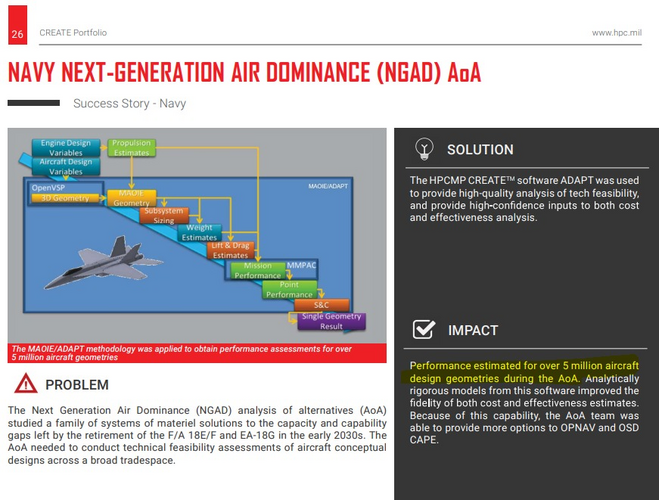
Ah, a study about how to build planes better. Not building better airplanes, how to make the building process better.

Ah, a study about how to build planes better. Not building better airplanes, how to make the building process better.

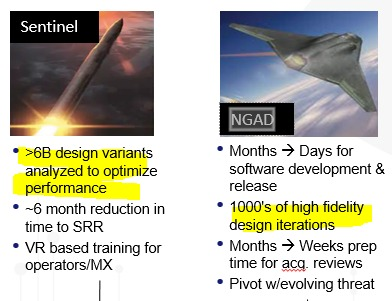
NGAD x-planes? Not impossible
I was thinking it may just be what it is - an illustrative art not related to anything particular.Could also be a technology demonstrator which is demonstrating something which isn't effected by the number of turbines.

Very possible, but not very funI was thinking it may just be what it is - an illustrative art not related to anything particular.

I don't think so, the battle as start between Lockheed and Boeing for the big contract..I was thinking it may just be what it is - an illustrative art not related to anything particular.

If everything is really automated, then why do you need an extra crewman dedicated to this?

But it hasn't been, at least not in any public discussions.
Testing of MUMT with Apache Es and MQ1Cs has shown that the current generation of drones require far too much pilot/operator input for someone to fly an aircraft and fly the drone at the same time.
So unless the current CCA designs are at a point where they require as much operator interaction as a JDAM, you're going to need a back seater to quarterback the drones while a pilot keeps the quarterback safe.

There's been plenty of live demonstrations of autonomous aircraft taking task based commandsAs Scott Kenny put it, nobody has demonstrated an autonomous CCA or anything remotely approaching it. A bit of humility about our technological capabilities would go a long way in getting some form of CCA capability now rather than leaving it in development hell.
I haven't seen one, but most of the folks here are better plugged in than I am to hear about or find an open source CONOPS.Btw, is there any concept of operations in public domain that shows envisaged operational scenarios in detail?
I know the Army has been doing MUMT with Apache Es and Gray Eagles, I don't know if that has been in combat or what.Has anyone demonstrated anything like CCA activity in a modern battlefield? It takes some effort to make an autonomous demonstration, but demonstrations really mean nothing. It takes far far more effort to make robust autonomy. Autonomous cars were demonstrated a decade ago, we're nowhere near autonomous cars. Compared to the CCA, autonomous cars have had far more money and better engineer talent working on them, for very little practical result.
The Army MUMT has shown that at least Predator level drones need too much operator input for one person to both fly a plane and fly the drone.Hence the WSO: a WSO lowers the development target threshold compared to single-piloted aircraft.
They won't all work in concert from take-off to landing. Some will meet at way points. Munitions can also be launched from over the horizon from one node, targeting directed by a second node, all managed by piloted aircraft. Line of sight from the piloted aircraft to the targeting node or munition is all that's required.Btw, is there any concept of operations in public domain that shows envisaged operational scenarios in detail?
In particular for ground launched / reusable "loyal wingman" in the likes of MQ-28. I have a hard time to imagine how multiple vehicles gonna work in concert with a high performance fighter, from take-off to landing.
That's harder to do over the Pacific. Only so many places to launch from, so it's quite possible that the CCAs are going to fly with the manned plane from launch to recovery.They won't all work in concert from take-off to landing. Some will meet at way points. Munitions can also be launched from over the horizon from one node, targeting directed by a second node, all managed by piloted aircraft. Line of sight from the piloted aircraft to the targeting node or munition is all that's required.
If you want a human to help the automation, then why do they need to be in an tacitcal aeroplane vs having many people sitting comfortably in a big airliner or on the ground?Hence the WSO: a WSO lowers the development target threshold compared to single-piloted aircraft.
Simpler communication paths and shorter comms lag.If you want a human to help the automation, then why do they need to be in an tacitcal aeroplane vs having many people sitting comfortably in a big airliner or on the ground?
Why are those an issue for something sat 200-400nm back when it's not for Reaper Ops the other side of the world? And this is for something more automated than a remotely piloted system like ReaperSimpler communication paths and shorter comms lag.
Because Reapers are not flying in/into denied airspace like the NGAD and CCAs will be, so you don't care about a 3sec comms delay.Why are those an issue for something sat 200-400nm back when it's not for Reaper Ops the other side of the world? And this is for something more automated than a remotely piloted system like Reaper
Because having a crew of 3+ means a much bigger aircraft, barring doing something weird like the EA-6B Prowler (5000lbs heavier than the A-6E). The E-11A BACN comms router has a crew of at least 4 and is a 100klb MTOW aircraft. Doing that in an NGAD compliant airframe is likely to make a 120klb aircraft.Why is having one WSO enough? Why not have a crew of 3, or 4, or more?

That's harder to do over the Pacific. Only so many places to launch from, so it's quite possible that the CCAs are going to fly with the manned plane from launch to recovery.
"stuck launching from the same bases as manned aircraft because there's no US-controlled or US-friendly airfield closer"What is your definition of "with"? Line of site at 60'k is ~300 miles.
If you want a human to help the automation, then why do they need to be in an tacitcal aeroplane vs having many people sitting comfortably in a big airliner or on the ground?

That doesn't require they take off at the same time.They can also take off from a multitude of locations and meet at a suitable waypoint enroute. Neither requires satellite communications to achieve."stuck launching from the same bases as manned aircraft because there's no US-controlled or US-friendly airfield closer"
Yes, the CCAs may be launching from a physically separate base from the manned aircraft. Depending on where and how the control handoff occurs, they may be able to meet up en route.That doesn't require they take off at the same time.They can also take off from a multitude of locations and meet at a suitable waypoint enroute. Neither requires satellite communications to achieve.
It's a good job that our crewed aircraft aren't also critically dependent on those same communication links. Oh wait...You're seriously asking that question? This is the 21st century we're talking about - all communication links (satellite, airborne nodes) are subject to violent interdiction
But it hasn't been, at least not in any public discussions.
Testing of MUMT with Apache Es and MQ1Cs has shown that the current generation of drones require far too much pilot/operator input for someone to fly an aircraft and fly the drone at the same time.
So unless the current CCA designs are at a point where they require as much operator interaction as a JDAM, you're going to need a back seater to quarterback the drones while a pilot keeps the quarterback safe.
But a manned aircraft has a brain - or two brains in a two-seater - to complete the mission under its own initiative if needs be. A UAV without a datalink is just a flying airprox hazard until the fuel runs out. Maybe one day AI will enable a UAV to carry out its mission autonomously without any datalink, but in the here and now that's not possible.It's a good job that our crewed aircraft aren't also critically dependent on those same communication links. Oh wait...
But it hasn't been, at least not in any public discussions.
Testing of MUMT with Apache Es and MQ1Cs has shown that the current generation of drones require far too much pilot/operator input for someone to fly an aircraft and fly the drone at the same time.
So unless the current CCA designs are at a point where they require as much operator interaction as a JDAM, you're going to need a back seater to quarterback the drones while a pilot keeps the quarterback safe.
That's harder to do over the Pacific. Only so many places to launch from, so it's quite possible that the CCAs are going to fly with the manned plane from launch to recovery.
Yes, that's the end goal they're working towards.Grey Eagle isn't a CCA, it's a remotely piloted aircraft. It is at least two generations behind the state of the art, and requires near constant management in the loop control to do anything. The mission of the type also did it no favors, requiring constant positive control for counterinsurgency ISR and strike missions. This is akin to saying we couldn't possible make CEC work because Link 11 didn't have the throughput or data quality to allow it—the comparison is decades outdated.
The CCAs the Air Force and Navy are working on developing are intended to be vastly more autonomous, so the aircrew (which will probably be one individual) doesn't have to direct the aircraft to perform much of its mission. Instead they will act as extensions of the aircraft, able to employ sensors and weapons tens of kilometers from the piloted aircraft. The majority of direct control pilots will have over CCAs will likely be effectively modal—i.e. formations or EMCON modes. But for weapons employment they should be able to simply make the decision to shoot and their aircraft in concert with the CCAs will make the decision which one actually takes the shot.
That's certainly where I think it needs to be, so you can have one manned plane as the quarterback for the entire strike package of EW and recon and strike and fighter escort and SEAD/DEAD.I think the goal of the Skyborg program is to get CCAs to the point where the pilot only assigns general behaviors and weapons release authority. Individual aircraft might be designated as offensive or defensive, active emitters or passive, cautious or aggressive/expendable, weapons free/tight/pilot authorized only, etc. Then the CCAs assume a formation around the manned aircraft and reorient with it as it changes speed and direction or as behavior settings are altered. That is how I envision it working. If more attention is needed, then it does seem a dedicated operator is needed, but I think the goal is a higher level of pre programmed behaviors more akin to a living wing man and/or second flight element.
You need to look at what runways are available in the Pacific, and how many islands big enough for a runway are within the A2AD zone.Other options might be runway independent CCAs or a manned NGAD platform that operates from further out meet up with CCAs of a shorter range launched from closer airbases. It seems likely the manned fighter is going to be more constrained by runway length/size/weight limit than the CCAs.
You need to look at what runways are available in the Pacific, and how many islands big enough for a runway are within the A2AD zone.

Of course GPS-equipped weapons are just as vulnerable too - perhaps too many eggs in one basket.
How so? GPS equipped weapons use GPS to update an inertial navigation system. If GPS is jammed, spoofed, etc the effect on the weapon is negligible.
It's a good job that our crewed aircraft aren't also critically dependent on those same communication links. Oh wait...