USAF/USN 6th Gen Fighters - F/A-XX, F-X, NGAD, PCA, ASFS News & Analysis [2008- 2025]

Status
Not open for further replies.
The Mitchell Institute of Aerospace Studies made a video in their Operational Imperative Series, regarding the Next Generation Air Dominance or NGAD.

Article:

Video Here:
View: https://www.youtube.com/watch?v=gj8c1t1fdE4

Closely related and in addition to what was discussed in the video;


" "The first iterations of Collaborative Combat Aircraft, the drones that will pair with manned platforms, will join the Air Force’s fighter fleet in “the later 2020s,” several years before the Next-Generation Air Dominance fighter, service acquisition chief Andrew Hunter told the House Armed Services tactical aviation panel on March 29.
Hunter also emphasized that CCAs will augment all types of tactical aircraft, not just the NGAD system.
Lt. Gen. Richard G. Moore Jr., deputy chief of staff for plans and programs, also set the top three missions of the CCAs, in order, as:

  • shooters
  • electronic warfare platforms
  • sensor-carrying aircraft
The NGAD and CCAs are “on different timelines,” Hunter said, although they are “obviously closely related to one another as part of a family of systems.”
NGAD, he said, is a “very high-end capability” geared to the threat environment of the 2030s, and “we are working very hard to deliver [it] …in the early 2030s.” CCAs, meanwhile, are slated to join the force later this decade. Hunter also said the notional number of CCAs will be between 1,000 and 1,500 aircraft.
"
 
One question that I have after reading the above article is will he CCA be stealthy or non stealthy? But I like the fact that the numbers of aircraft that they are planning to buy is between 1,000 and 1,500.
 

The CCA concept is as old as the program itself AFAIK. The name has changed, but NGAD was always going to be a system of systems including UAVs. As for "spectrum warfare", it just sounds like a buzzword for stating that signature reduction extends outside of just the RF spectrum. These buzz words seem to me to be meaningless rebrandings and not a change of direction in the program.

It seems unclear to me China can create an effective "trans-Pacific" strike capability short of ICBMs or similarly long ranged missile weapons. We haven't heard much about the H-20. It is possible that like the J-20, it will be unveiled and come out of nowhere, but I think the challenges of building their very first bomber from scratch (and a intercontinental stealth bomber at that) will delay its introduction. The current state of the art bomber in China is using a legacy airframe design with Russian turbofans.

For the trans-Pacific strike, I see your point about bombers. They'd need to go from H-6 to something B-52 sized, so do-able by late 2030s, but some effort. I was thinking SSGNs, the Chinese have begun to rapidly expand their submarine building capacity and a SSGN doesn't need to be "that" stealthy if it's carrying LACMs.

My issue with CCA is more emphasis. I thought NGAD was originally optionally manned, then "system of systems," and lastly the CCA concept. So the idea has been there throughout the program - but the emphasis is shifting. Now, based on the rhetoric and timeline, it is as if CCA is the primary program (1000 aircraft on the flightline by 2030) and NGAD is something aspirational (6th-gen super fighter mid-2023s). NGAD is slowly turning into a CCA program, where CCA is explicitly a cheaper and expendable aircraft.
 
One question that I have after reading the above article is will he CCA be stealthy or non stealthy? But I like the fact that the numbers of aircraft that they are planning to buy is between 1,000 and 1,500.

My presumption is it will have a lot of signature reduction features because these aren’t especially expensive to incorporate in terms development and production cost. Most if not all of the potential UAVs one might base a CCA bid on already are reduced RCS airframes. My question is will CCA be strictly subsonic? If its goal is primarily as a shooter, then top speed is going to be a factor that heavily affects weapon delivery. AFAIK no one currently builds a supersonic UAV in the west except perhaps some small target types.
 

The CCA concept is as old as the program itself AFAIK. The name has changed, but NGAD was always going to be a system of systems including UAVs. As for "spectrum warfare", it just sounds like a buzzword for stating that signature reduction extends outside of just the RF spectrum. These buzz words seem to me to be meaningless rebrandings and not a change of direction in the program.

It seems unclear to me China can create an effective "trans-Pacific" strike capability short of ICBMs or similarly long ranged missile weapons. We haven't heard much about the H-20. It is possible that like the J-20, it will be unveiled and come out of nowhere, but I think the challenges of building their very first bomber from scratch (and a intercontinental stealth bomber at that) will delay its introduction. The current state of the art bomber in China is using a legacy airframe design with Russian turbofans.

For the trans-Pacific strike, I see your point about bombers. They'd need to go from H-6 to something B-52 sized, so do-able by late 2030s, but some effort. I was thinking SSGNs, the Chinese have begun to rapidly expand their submarine building capacity and a SSGN doesn't need to be "that" stealthy if it's carrying LACMs.

My issue with CCA is more emphasis. I thought NGAD was originally optionally manned, then "system of systems," and lastly the CCA concept. So the idea has been there throughout the program - but the emphasis is shifting. Now, based on the rhetoric and timeline, it is as if CCA is the primary program (1000 aircraft on the flightline by 2030) and NGAD is something aspirational (6th-gen super fighter mid-2023s). NGAD is slowly turning into a CCA program, where CCA is explicitly a cheaper and expendable aircraft.
“mid-2023s” - is that around June :)
 

The CCA concept is as old as the program itself AFAIK. The name has changed, but NGAD was always going to be a system of systems including UAVs. As for "spectrum warfare", it just sounds like a buzzword for stating that signature reduction extends outside of just the RF spectrum. These buzz words seem to me to be meaningless rebrandings and not a change of direction in the program.

It seems unclear to me China can create an effective "trans-Pacific" strike capability short of ICBMs or similarly long ranged missile weapons. We haven't heard much about the H-20. It is possible that like the J-20, it will be unveiled and come out of nowhere, but I think the challenges of building their very first bomber from scratch (and a intercontinental stealth bomber at that) will delay its introduction. The current state of the art bomber in China is using a legacy airframe design with Russian turbofans.

For the trans-Pacific strike, I see your point about bombers. They'd need to go from H-6 to something B-52 sized, so do-able by late 2030s, but some effort. I was thinking SSGNs, the Chinese have begun to rapidly expand their submarine building capacity and a SSGN doesn't need to be "that" stealthy if it's carrying LACMs.

My issue with CCA is more emphasis. I thought NGAD was originally optionally manned, then "system of systems," and lastly the CCA concept. So the idea has been there throughout the program - but the emphasis is shifting. Now, based on the rhetoric and timeline, it is as if CCA is the primary program (1000 aircraft on the flightline by 2030) and NGAD is something aspirational (6th-gen super fighter mid-2023s). NGAD is slowly turning into a CCA program, where CCA is explicitly a cheaper and expendable aircraft.

SSGNs are a very a volume or cost friendly way of conducting strikes, but yes it will be a growing and evolving threat.

I think the new emphasis on CCAs is less about the NGAD program altering its goals and more to do with the fact that UAV development is a far quicker, more iterative process that will likely jump in front of the manned platform. USAF is explicitly stating these will be ready before NGAD as a whole and integrated with existing force almost as a program in its own right.

Also the USAF is avoiding phrases like “expendable” or “attritable” now - the new catch phrase is “affordable mass”. Obviously being unmanned takes some of pain out of losing the aircraft, but the goal is not to simply throw the UAVs away-the goal is to rapidly create effect counter air mass to counteract the PRCs range advantage in its back yard.
 
Last edited:
The Mitchell Institute of Aerospace Studies made a video in their Operational Imperative Series, regarding the Next Generation Air Dominance or NGAD.

Article:

Video Here:
View: https://www.youtube.com/watch?v=gj8c1t1fdE4

Closely related and in addition to what was discussed in the video;


" "The first iterations of Collaborative Combat Aircraft, the drones that will pair with manned platforms, will join the Air Force’s fighter fleet in “the later 2020s,” several years before the Next-Generation Air Dominance fighter, service acquisition chief Andrew Hunter told the House Armed Services tactical aviation panel on March 29.
Hunter also emphasized that CCAs will augment all types of tactical aircraft, not just the NGAD system.
Lt. Gen. Richard G. Moore Jr., deputy chief of staff for plans and programs, also set the top three missions of the CCAs, in order, as:

  • shooters
  • electronic warfare platforms
  • sensor-carrying aircraft
The NGAD and CCAs are “on different timelines,” Hunter said, although they are “obviously closely related to one another as part of a family of systems.”
NGAD, he said, is a “very high-end capability” geared to the threat environment of the 2030s, and “we are working very hard to deliver [it] …in the early 2030s.” CCAs, meanwhile, are slated to join the force later this decade. Hunter also said the notional number of CCAs will be between 1,000 and 1,500 aircraft.
"
To be fair, the majority of the first CCAs will be paired up alongside F-35s, so it's only fair that they will come first before the NGAD fighter. Not to mention, they have a rather fast development process, and thus there is an increased likelihood that they will be fully deployed sometime within this decade, whereas NGAD will most likely see deployment in the 2030s.
 
One question that I have after reading the above article is will he CCA be stealthy or non stealthy? But I like the fact that the numbers of aircraft that they are planning to buy is between 1,000 and 1,500.

My presumption is it will have a lot of signature reduction features because these aren’t especially expensive to incorporate in terms development and production cost. Most if not all of the potential UAVs one might base a CCA bid on already are reduced RCS airframes. My question is will CCA be strictly subsonic? If its goal is primarily as a shooter, then top speed is going to be a factor that heavily affects weapon delivery. AFAIK no one currently builds a supersonic UAV in the west except perhaps some small target types.

NGAD's job is air superiority.
I would think their CCA's would benefit more with altitude (>60k) over speed (~high subsonic). Also think it's likely that weapons will be internal.

Altitude = efficiency = range
 
The info that has been coming out in the proceeding weeks has been very interesting. The talk that the top priority for the CCA is a shooter first is interesting. I initially thought that perhaps the manned NGAD platform was going to be the primary shooter, lobbing JATMs from long ranges, shooting over the heads of the CCAs and the CCAs cleaning up the survivors. Perhaps that is indeed the ConOps they're looking at, but perhaps I have it backwards where the CCAs shoot first, thus protecting the exact location of the NGAD for as long as possible. Perhaps the only real answer at this point is that it will likely be situational.

The question of LO or not and if the CCA will be supersonic are also interesting to ponder. My gut is almost certainly LO, perhaps not to the degree of NGAD, but LO for sure. I have no idea if it'll be supersonic or not.
 
The info that has been coming out in the proceeding weeks has been very interesting. The talk that the top priority for the CCA is a shooter first is interesting. I initially thought that perhaps the manned NGAD platform was going to be the primary shooter, lobbing JATMs from long ranges, shooting over the heads of the CCAs and the CCAs cleaning up the survivors. Perhaps that is indeed the ConOps they're looking at, but perhaps I have it backwards where the CCAs shoot first, thus protecting the exact location of the NGAD for as long as possible. Perhaps the only real answer at this point is that it will likely be situational.

The question of LO or not and if the CCA will be supersonic are also interesting to ponder. My gut is almost certainly LO, perhaps not to the degree of NGAD, but LO for sure. I have no idea if it'll be supersonic or not.
Your initial thought was the same idea that CSBA had when they made their report about the Future of Aerial Warfare: in the sense that the NGAD will fire first and take out most of the enemy, leaving the CCAs to finish the rest off, and do all that before being detected

But it could be situational: The larger NGAD may be capable of firing longer-ranged and more advanced missiles, whereas the CCAs will fire shorter-ranged missiles, hence why they are best optimized to be in the front. Perhaps for a sudden ambush, the former could be the case, but over contested aerospace wherein the enemy has more planes in the air and have a certain level of situational awareness, the CCAs will be the ones to come in and fire first, while keeping the NGAD safely hidden until it fires back too.
 
CCA should be a flying wing loitering at 80,000ft with a basket of AAMs and ESM.
B-21 probably already filled that niche. I was thinking some small and fast carrying four cuda or perigrin type AAMs that can be rocket launched and parachute recovered in theater, or alternatively B-52 air launched, such that they are not theater runway dependent and don’t have a huge range requirement. XQ-58 is my pets favorite if we’re talking about a subsonic shooter with low RCS and secondary sensor or EW payloads. IMO you wouldn’t need anything bigger or more complex than that. I’m a fan of no runways and quantity over quality-IMO the manned platform, RQ-180, and B-21 will handle most of wide are sensors. The CCA just needs local IRST and maybe sone kind of ranging active sensor for operating sans handler.
 
That sounds a lot like DARPA's Longshot (Flying Missile Rail)
 
Last edited by a moderator:
I fear another JSF/F-35 style joint project.
No but it can very easily become the Phantom III wth might but be a bad thing. Especially if what i think is happening with the usaf project is happening, especially telling is the 200 airframe requirement and reliance on drones. It there's a 2 front war, you're thing to have 70 air frames per theater. That's not a way to gain air superiority, that's a way to throw it away.
We've printed 6x that and sent it to Europe in the last year. He'll that's about the value of what Biden left in Afghanistan.
 
The U.S. Air Force’s publicized research and development spending on Next-Generation Air Dominance (NGAD) technologies is now projected to total more than $30 billion by the end of fiscal 2028, with about 21% spent so far since the program launched in 2016.
(Paywalled)
30 billion....Slightly less than half the estimated costs of the entire F-22 program(79.4Bn), and that's only considering the R&D part.
 
Last edited:
well you also have to factor in the fact that it's a multi platform solution.
 
Are both those values adjusted to the same year value of the dollar to account for inflation? But yes, NGAD will have a lot of R&D, like F-22 before it. I'm of the opinion the CCA part of the program will actually produce a lot of value, because those units likely will be dramatically cheaper to produce and USAF is already indicating they might operate before the manned platform and might operate unteathered - it almost is a program and capability of its own.
 
Last edited by a moderator:
79.4bn adjusted to 2023 dollars. 74bn in 2010 dollars.
 
Last edited by a moderator:
The U.S. Air Force’s publicized research and development spending on Next-Generation Air Dominance (NGAD) technologies is now projected to total more than $30 billion by the end of fiscal 2028, with about 21% spent so far since the program launched in 2016.
(Paywalled)
30 billion....Slightly less than half the estimated costs of the entire F-22 program(79.4Bn), and that's only considering the R&D part.

It was 35 years ago...
 
F22 develooment costs amounted to 32 billion in then year dollars. Meaning each year of spending was not adjusted. So if one takes year 1999 as the median year of development spending, then the inflation adjusted dollars would amount to 58 billion in today's dollars.
Which makes ngad look way too cheap.
Ngad development may either feature hidden costs.
Or f22 costs featured various subsystems which are covered by separate funding in case of ngad.
 
Times have changed. You can't deny that testing, EMD are way cheaper today. Also, NGAD is only an Air superiority platform with a similar Naval twin with who might be shared most of systems but the airframe.

Also, NGAD is not meant to be a long lasting, B-52 like platform. It's not an airframe built with 10000 of flight hours, hence less material margin, less system endurance... And less mandatory stocks.

All this might well account for a large share of the apparent cost cut down.
 
@Scar : I am raising a number as an example to strike reader attention on this aspect. It's not one that should remain undisputed. 10000, 4000... Make you own mind.
Fact is however that, as NGAD will have better range and persistance, mission average duration will be higher than for an F-35. Hence 10000 might be the new 8000 ;)
 

A part of the article is about the Navy's NGAD program:

...In the air, for example, the Next Generation Air Dominance family of systems set to replace the Super Hornet fighter fleet will include a combination of the piloted F/A-XX fighter with drones dubbed loyal wingmen. This is something the Navy already budgeted for, even as it’s only barely scratched the surface of testing how a large UAV can interact with the air wing.

Still, the Navy is confident unmanned technology will be central to nearly everything it does in the future, according to Vice Adm. Scott Conn, the deputy chief of naval operations for warfighting requirements and capabilities. Indeed, the chief of naval operations has called for six D’s — more distance, deception, defense, distribution, delivery and decision advantage — and unmanned can play a role in most or all of those.

Conn told Defense News in an April 4 interview that early operations of large unmanned aircraft, surface systems and underwater vessels will likely be tethered to a manned platform as the Navy learns to trust the technology. A fighter pilot by trade, Conn likened unmanned systems to the smart weapons affixed to fighter jets.

“I’ve carried a lot of them, and I’ve employed a few of them. Not one of them was very smart; they were obedient. They did what they were told,” Conn said at the Navy League’s annual Sea-Air-Space conference.

Similarly with unmanned systems, he added, “how do we assure that those — whether it’s in the air, on the surface or in the subsurface — are going to be obedient in terms of what they’re programmed to do in a complex environment? And until we have a full understanding of that level of obedience, then they’re probably going to be tethered to a ship [or] another aircraft.”

Chief of Naval Operations Adm. Mike Gilday made similar remarks to reporters later that day, discussing the potential use of unmanned vessels for resupplying Marines in the Pacific.

“We do see great potential in leveraging unmanned in a lead/follow-like manner … to sustain a force forward. If you think about what we’re doing in the air with Next Generation [Air Dominance], where you would have a quarterback that would be a manned [tactical aircraft] with unmanned as his or her wingmen, same kind of approach,” Gilday said.
Conn said the Navy views its modernization efforts as a three-FYDP process, referring to the Future Years Defense Program that lays out budget plans five years in advance. In this first FYDP, from fiscal 2024 through fiscal 2028, the Navy is investing in buying and testing unmanned prototypes. In the second FYDP, from FY29 through FY33, the manned-unmanned fleet will become reality.

That means the service needs to modify aircraft carriers now so they can accommodate the MQ-25A Stingray unmanned aerial tanker, which Conn called this decade’s “pathfinder” for the Next Generation Air Dominance drones that will join the air wing.
 
Also, NGAD is not meant to be a long lasting, B-52 like platform. It's not an airframe built with 10000 of flight hours, hence less material margin, less system endurance... And less mandatory stocks.
If I remember from Binkov's video, it may be designed to last 15 years or less so that its successor can easily take over its roles, and possess any advancements in all types of technology that the preceding NGAD doesn't have. Given how our technology is advancing at an increasingly rapid rate, and will only accelerate from there, a short airframe duration is necessary in these times.
 
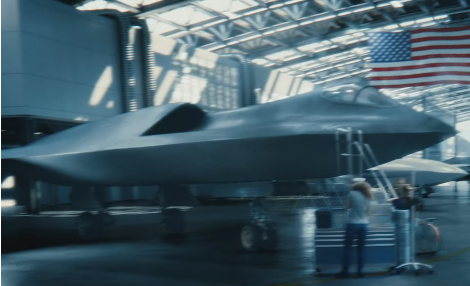
New video uploaded by NG's YT channel showing a different angle of their CGI fighter. From the front, it looks like a UFO! With a bit of B-21 essence. That nose is big, really BIG:
View: https://www.youtube.com/watch?v=vi86HJYTAO0


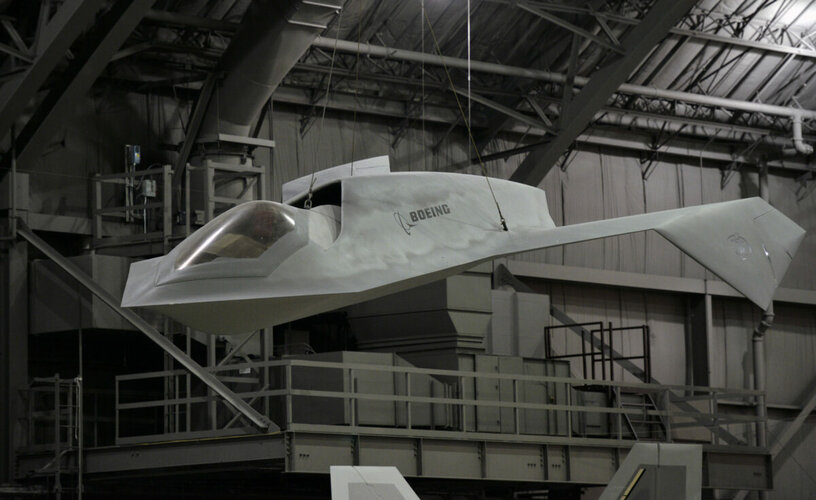
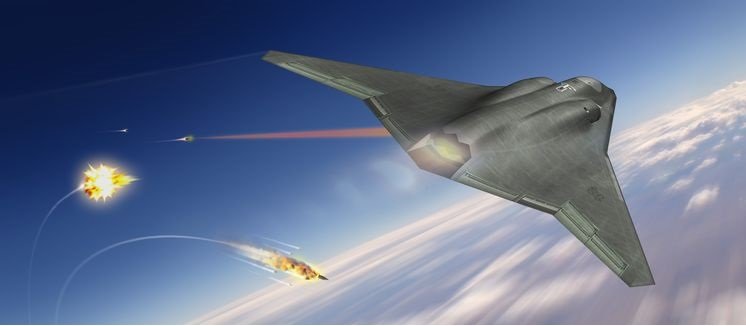
Looking back, has anyone noticed how the aircraft on the original video is basically WINGLESS? Lifting body, which directly contradicts F/A-XX supposed less reliance on stealth desired by the Navy, unless they are hinting at a navalized AF NGAD. This alone, by far, makes it the most extravagant and interesting concept I've seen so far, radical enough to differentiate from previous "6th Gen" concepts.
Screenshot 2023-03-11 at 01-24-49 Welcome to Northrop Grumman The Hangar.png
 

Attachments

  • Boeing-Bird-of-Prey-Wide-Jason-McDowell-scaled-e1678211355127.jpg
    Boeing-Bird-of-Prey-Wide-Jason-McDowell-scaled-e1678211355127.jpg
    131.6 KB · Views: 87
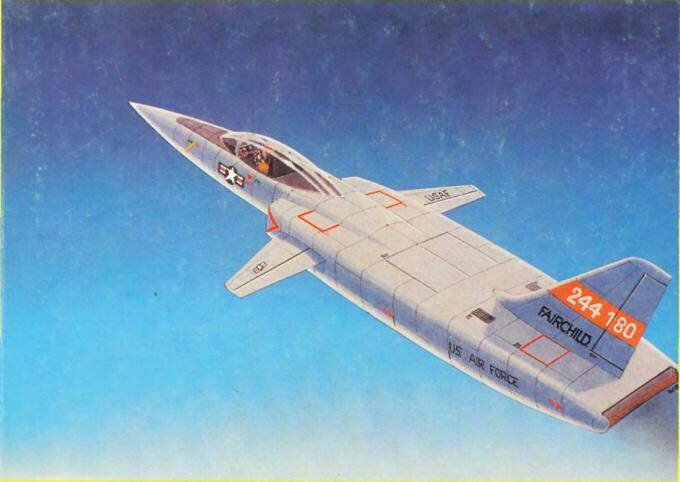
  • 1411761057_afti-00-680x482.jpg
    1411761057_afti-00-680x482.jpg
    32.8 KB · Views: 92
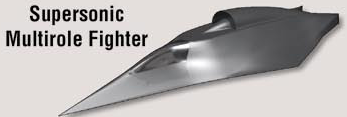
  • Screenshot 2023-04-13 at 00-37-20 aeroclipart2.png (PNG Image 1212 × 824 pixels).png
    Screenshot 2023-04-13 at 00-37-20 aeroclipart2.png (PNG Image 1212 × 824 pixels).png
    30 KB · Views: 104
  • Screenshot 2023-04-12 at 22-55-27 Overheard at Northrop Grumman Collier Trophy.png
    Screenshot 2023-04-12 at 22-55-27 Overheard at Northrop Grumman Collier Trophy.png
    168 KB · Views: 101
Looking back, has anyone noticed how the aircraft on the original video is basically WINGLESS? Lifting body, which directly contradicts F/A-XX supposed less reliance on stealth desired by the Navy, unless they are hinting at a navalized AF NGAD. This alone, by far, makes it the most extravagant and interesting concept I've seen so far, radical enough to differentiate from previous "6th Gen" concepts.
It's still the same concept shown since 2015, you can find a few more pictures looking for the Northrop keyword in this thread.

As you can see, it's not "wingless" but it has a cranked-arrow wing.
The CGI model is just too big to fit into the camera angle in the shot shown in the advert you linked above, but in the second picture you posted of it, you can see hints of where (look at the extreme left of the image) the wing starts to change its sweep:
ngad1highres_25991a83-7954-4e0f-9dbb-e5df052cc121-prv.jpg

1644370310423

1644447407860


The heritage of the concept is possibly related to ESAVE studies conducted with AFRL:
1644535151107

1644369434464
 
Interesting find, but why go for top mounted air intakes instead of side mounted? I do not understand the reasoning behind the decision that Northrop took, let’s see if they change it later on.
 
That intake placement makes more sense if you intend the platform to operate at high altitude where the dorsal surface is less likely to be exposed to radar emissions. If we assume that the manned NGAD is a high altitude super cruiser (which IMO seems almost a given), then intakes on top makes sense as a way to further mask them.
 
Ah! right thanks Josh-TN, so the NGAD will be super cruising at altitude unlike the F-22. I can see the point now.
 
Ah! right thanks Josh-TN, so the NGAD will be super cruising at altitude unlike the F-22. I can see the point now.

Well the F-22 also has a higher altitude cruise compared to most any other A2A platform, that's why I think NGAD as a high altitude super cruiser is a given. But in the case of NGAD I think maneuverability will be sacrificed for all round, broadband stealth and increased fuel capacity. But high top/cruise speed will likely still be a requirement to enable interceptions and impart more energy to ordnance.
 
New video uploaded by NG's YT channel showing a different angle of their CGI fighter. From the front, it looks like a UFO! With a bit of B-21 essence. That nose is big, really BIG:
View: https://www.youtube.com/watch?v=vi86HJYTAO0


Looking back, has anyone noticed how the aircraft on the original video is basically WINGLESS? Lifting body, which directly contradicts F/A-XX supposed less reliance on stealth desired by the Navy, unless they are hinting at a navalized AF NGAD. This alone, by far, makes it the most extravagant and interesting concept I've seen so far, radical enough to differentiate from previous "6th Gen" concepts.
View attachment 697729
Either the scale of the NGAD aircraft in the original ad has changed dramatically or those are two different aircraft.
 
Status
Not open for further replies.

Similar threads

Back
Top Bottom