Hi Sienar,
There is actually an explanation of the USAAF's thinking in the Joint Fighter Conference report;
Thanks a lot! I don't think it's really addressing the 0.60-caliber as such, but still a useful snapshot of the Army's mind at the time.
It seems a bit unfocused and not necessarily of watertight stringency, so I'll try to work my way through it in detail:
I believe the feeling in the Army generally is that we would like to have a lethal density pattern. The most bullets going across one place at a given instance. We would like to have the smallest caliber gun that can do the job.
The "most bullets across one place" is most "lethal" only if we're talking about bullets of the same lethality per bullet, which when comparing 12.7 mm to 20 mm clearly is not the case. "The smallest caliber gun that can to the job" probably implies that the 7.7 mm Browning is too small to do the job, but otherwise, the preference for smaller caliber is not explained.
If it takes a 22-mm. to tear a Messerschmitt or a Mitsubishi apart, we want 20’s, but as long as a 50 will do the job we feel that if we can carry a greater number of guns and a greater amount of ammunition with the same weight, with an equal or greater fire power, that is the gun we want.
That sounds sensible, but accounting for the greater lethality per projectile of the 20 mm cannon, the 20 mm cannon actually provides the greater destructive potential per weight. "A greater number of guns" really is of no value by itself ... four 20 mm cannon provide more firepower than eight 12.7 mm machine guns.
If you are strafing an airdrome you can put out more bullets. A Jap doesn’t care whether he gets killed by 20 mm’s or a 50 caliber. We can put out more bullets and we have more weight covering the same area.
To a degree, that might be justified, though my vague impression is that if you're not shooting at infantry, but at motor transport, 20 mm guns actually have an advantage. However, at the same Joint Fighter Conference, the US Navy said they very much preferred the 20 mm cannon for strafing since their didn't overheat in longer bursts (destroying the barrel liners and ruining accuracy ... there are some strafing videos on the Youtube channel "WW2 US Bombers" documenting this effect, though the video author seems to understimate the phenomenon).
I believe that with more guns, you can put out bigger density pattern for the training of your personnel. When we get sights to the point where we can pull the trigger just once and hit a fellow, then we can go to the bigger calibers.
That's quite unfocused ... a bigger pattern has a lower density, so what does he even mean?
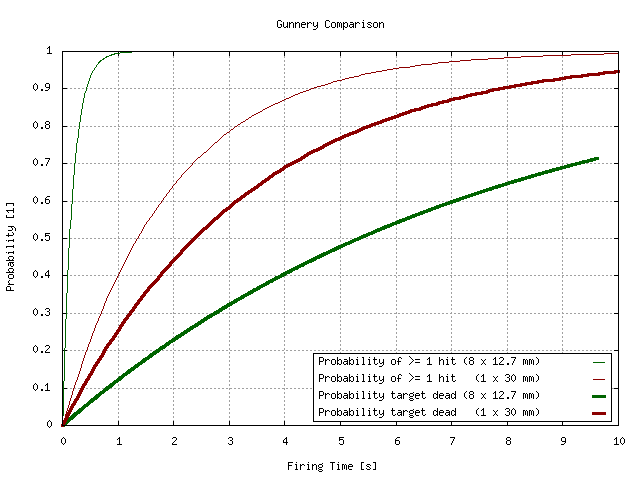
And the question really isn't just about hitting someone, it's about the product of rounds fired, the probability of a hit and the probability of destruction upon a hit. The last factor can totally change the answer to the question "Which weapon is best", and it seems to be ignored here. If at the same hit probability, you fire only half as many projectiles per second, but each projectile is three times as likely to bring down the target upon a hit, the weapon with the lower round count is better. If it has a lower hit probability, you still need to consider all factors to see whether is better, equal or worse.
That is the reason — we feel we can get a bigger density pattern.
[...]
In the P-47 with four guns in each wing, we recommend that they cross the first two guns at 250 yards, the next at 350, at 450 and 550. That gives you a density pattern in depth as well as width for about 200 yards, which in turn gives the mediocre pilot a better opportunity to hit an airplane in flight.”
Again, bigger pattern = lower density. That nose guns are much better for hitting fighter-sized targets is evident ... one of the Luftwaffe aces commented, "One gun in the nose is worth two in the wings". That's a bit simplified, but in average over all ranges, it's a good approximation.
If you look at the patterns of the P-38 and the P-47 for a straight, no-deflection stern shot against a P-47-sized target, it turns out that at most ranges, the P-38 achieves more hits with its four machine guns than the P-47 does with its eight. The exception is the convergence range of the P-47, where the bullet streams of both wing cross.
The staggered pattern where the bullet streams of each port/starboard machine gun pair cross at different ranges alleviates the disadvantage of the P-47 in making the range band in which it has an advantage a bit larger, but it also reduces the size of the advantage.
I am also surprised by the suggestion to use very long crossing distances, as by the USAAF's own training manuals, due to weapon dispersion, the 12.7 mm machine gun would not provide fire of lethal density beyond 400 yards.
Of course, I don't know Colonel Coats background. To me, it sounds as if he wasn't necessarily involved in the analysis and decision-making progress, but maybe accompanying the process from a related function, and just giving everyone present a run-down of what he understood from his perspective, so I don't intend to be overly critical. It's good that we have his account of the situation at the time!

Regards,
Henning (HoHun)