From Aviation magazine 1980,
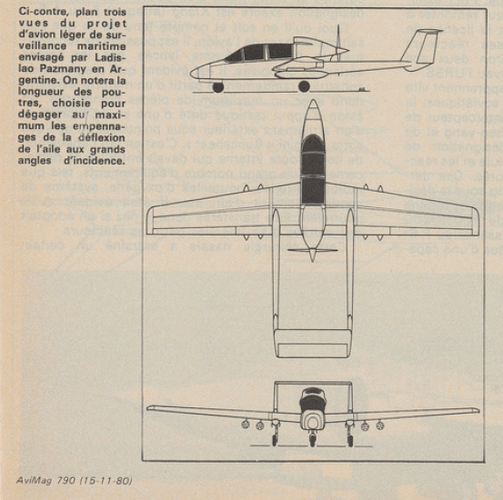
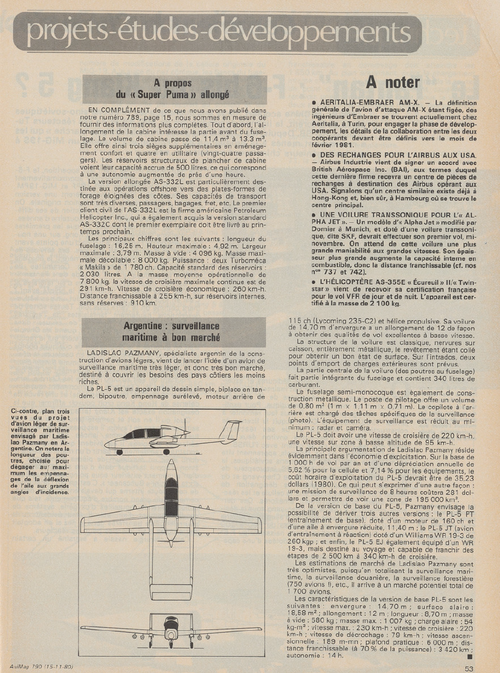
the Pazmany PL-5 Project.
From Technika Lotnicza 1981,
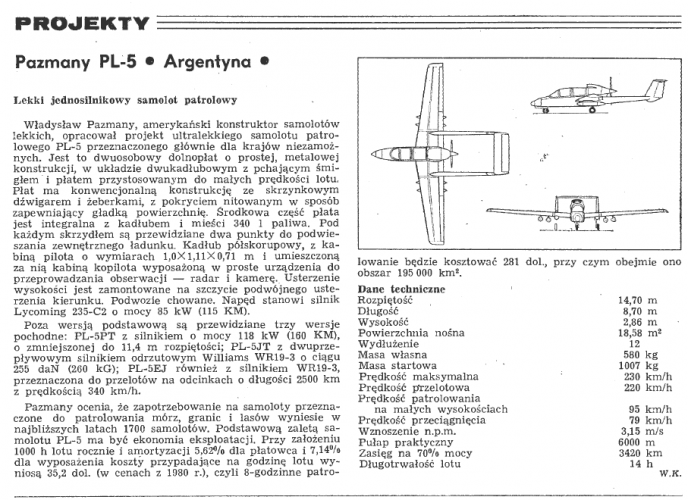
Władysław Pazmany, an American light aircraft designer, developed the PL-5 ultralight patrol aircraft, designed primarily for low-income countries.
It is a two-seat, low-wing monoplane with a simple, metal construction, a twin-fuselage configuration with a pusher propeller and an airfoil adapted for low-speed flight.
The airfoil has a conventional box-spar design with ribs, and a riveted skin to ensure a smooth surface. The center section of the airfoil is integral with the fuselage and holds 340 liters of fuel.
Two external cargo rigging points are provided under each wing. The fuselage is a semi-monocoque, with a pilot's cockpit measuring 1.0 x 1.11 x 0.71 m and a co-pilot's cockpit located behind it, equipped with simple surveillance equipment—radar and camera. The elevator is mounted atop the dual tailplane. The landing gear is retractable. Power is provided by an 85 kW (115 hp) Lycoming 235-C2 engine.
In addition to the basic version, three derivative versions are planned: the
PL-5PT with a 118 kW (160 hp) engine, with a reduced wingspan of 11.4 m; the PL-5JT with a Williams WR19-3 turbofan jet engine with 255 daN (260 kg) thrust; and the PL-5EJ, also with a WR19-3 engine, designed for 2,500 km flights at a speed of 340 km/h.
Pazmany estimates that demand for aircraft intended for maritime, border, and forest patrols will reach 1,700 in the coming years. The primary advantage of the PL-5 aircraft is its operational economy. Assuming 1,000 flight hours per year and depreciation of 5,62 % for the airframe and 7.14 % for the equipment, the costs per flight hour will be $35.2 (in 1980 prices), i.e., an 8-hour patrol will cost $281, covering an area of 195,000 km².