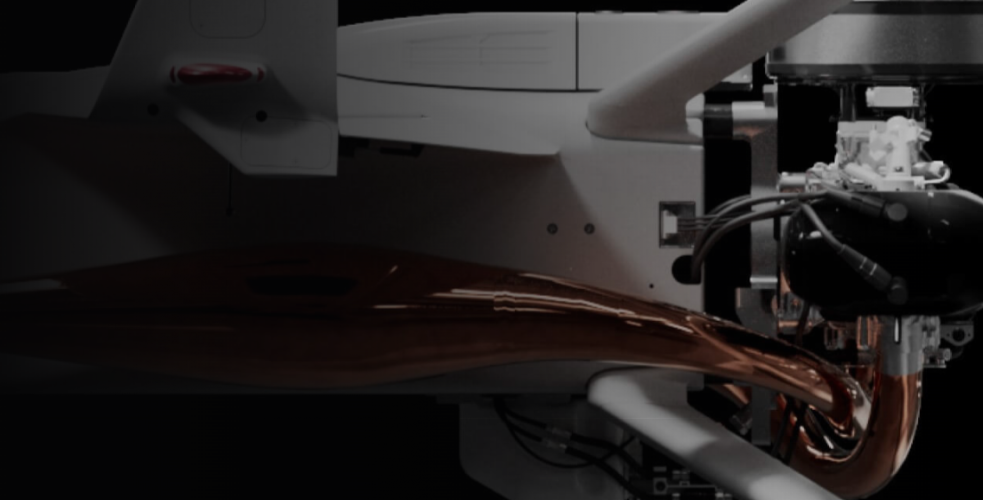
It has a muffler per se, yet it is more of a tuned pipe/muffler/exhaust.

Screenshot 2026-02-08 092620.png

More to do with power and matching the exhaust with the combustion cycle, yet the noise is much higher than a simple can muffler.

The powerplant is a rather heavy 288cc engine from Suter, difficult to make smaller engines running on heavy fuel.

https://suter-industries.ch/uav-engines/toa-288-twin-cylinder-air-cooled-uav-engine/
You can reduce some of the noise with an expansion chamber before the pipe, yet they do not seem to be worried about the sound signature much.

Regards,
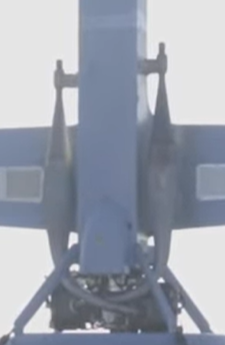
 
it's not a muffler but a diffuser to slow the exhaust flow, as it is reversed due to the aircraft tail sitter geometry, with a narrow section upstream that acts as a blowpipe (hence the magnified sound level). ;)

Screenshot 2026-02-08 011417.png

This thing my be red-hot when it comes for landing with the lucky sailor often depicted that has to come in contact for the shutdown procedure.
Also think at the fragility and immense drag of it.

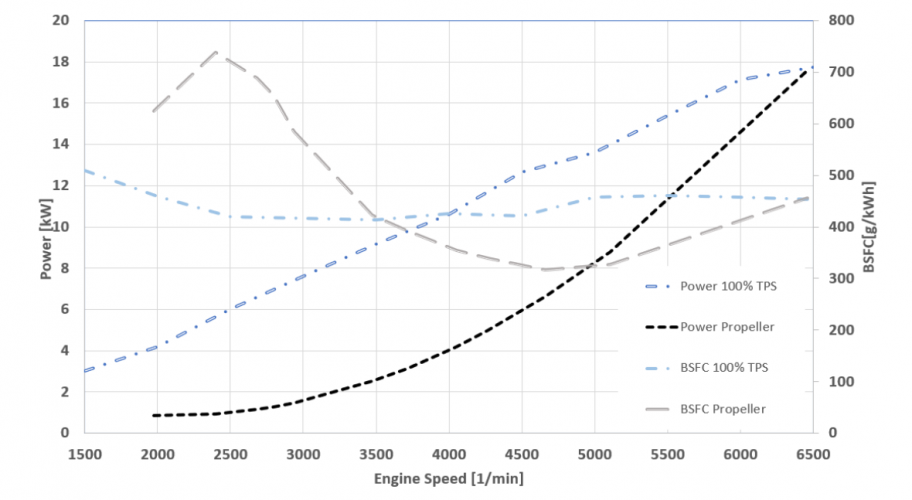
You can also see via the Technical Data Sheet, looking at the power curve at the propeller, that this thing might be screaming like hell during most the flight with a power climbing only past 4500rpm*

Screenshot 2026-02-08 013819.png

@Halcyon66 : Thanks for the direct link b/w.

*I took a Power to weigh ratio at takeoff of 1,4 at max available power and a cruise setting at 50% power (18/1,4/2=6kW <> 4800rpm)
 
Last edited:
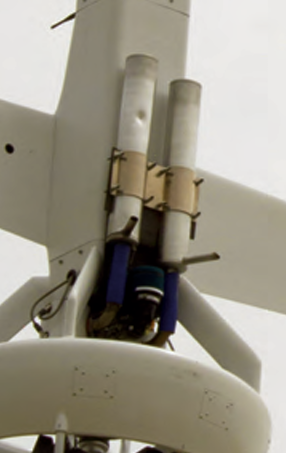
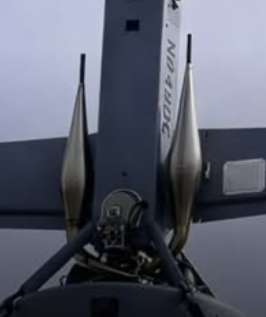
Actually, the original Martin V-bat (what it was first called when developed 15+ years ago) initially used a smaller two stoke RC engine, then moved to a 188cc 15hp Hirth, and had what we call canister mufflers that have a 90-degree exhaust port which are quieter yet do not increase output. And do not face forward or backward and therefore have less flow issues.

https://hirthengines.com/wp-content/uploads/2025-4201.pdf?x14649
Screenshot 2026-02-08 123429.png

Due to the 4201 being two stroke it had a oil injection system as it ran off gasoline. Therefore unable to run heavy fuels.

Now as before, the Shield V-Bat runs a heavy fuel engine in a small footprint and the only way to get max end power out of it is with tuned pipes.


Screenshot 2026-02-08 125159.png

Same as all the motor bikes and the like that have small capacity engines. Suter also makes motor bikes and exhaust systems.

https://www.suter500.com/menu/index.html
You can see the tuned pipe in that image before the expansion chamber.

So, before a tuned pipe uses pressure waves from its conical shape to boost power and allow the motor to breath better by improving scavenging and retaining more fresh fuel–air mixture in the cylinder. I think their setup is a bit of a shocker in regard to exhaust.

Additionally the design is a "Ducted propeller" not a "Ducted fan", the propeller has a high tip speed "AKA noise" and tip losses (drag) from using a propeller. If it was 3 bladed with proper tips (very small gap) sound signature would decrease and efficiently would increase.

Regards,
 
Last edited:
SWIT Drone.jpg

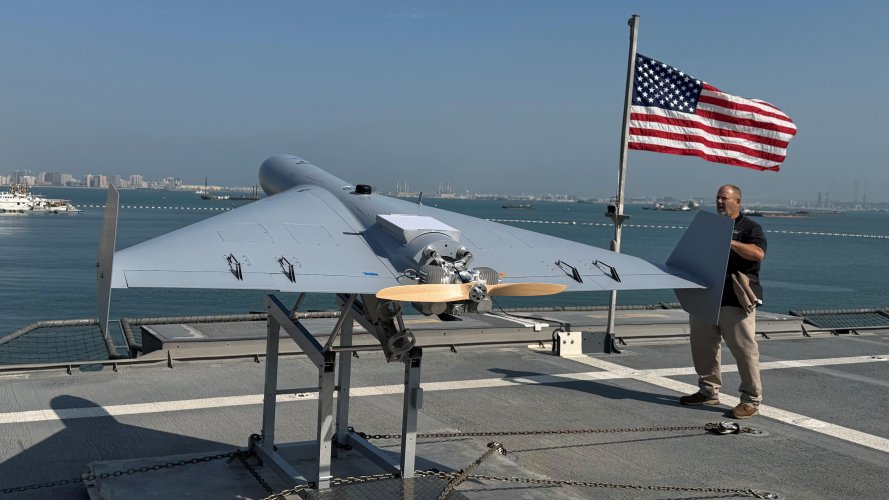
Rob Pavel, a Shipboard Weapons Integration Team logistician with Naval Air Warfare Center Weapons Division, conducts shipboard weapons integration work in support of the Low-cost Unmanned Combat Attack System aboard USS Santa Barbara (LCS 32). SWIT validates that weapons systems can be safely stored, moved, and handled at sea prior to operational use. LUCAS later successfully launched from the ship’s flight deck Dec. 16, 2025, as part of Task Force Scorpion Strike operations while operating in the Arabian Gulf.

SWIT prevents costly mistakes before weapons reach the fleet
 
The 21st Century, and that thing sports an engine smaller than my Dad's old lawnmower.

The string must have broke.

No, No! You have to prime it by pushing on the (rubber) nipple.

Rope replaced...add a little oil to the gas...okay...now pull.
 
Last edited:
The 21st Century, and that thing sports an engine smaller than my Dad's old lawnmower.

The string must have broke.
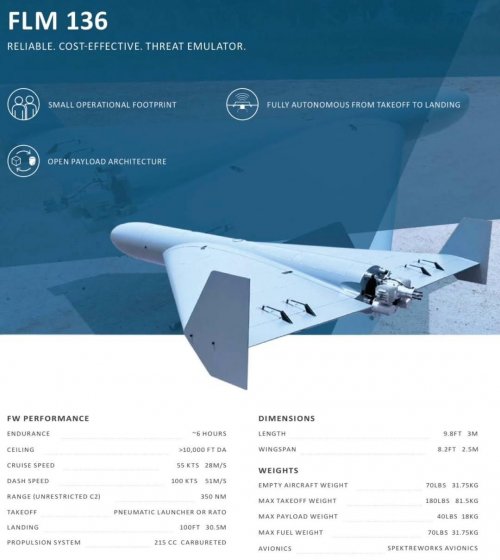
Yeah,it looks like its based on the s-131 rather than the s-136,tho the 215cc 2cyl engine is pretty low powered,maybe 15-20hp [at most],as opposed to around 30-35hp for the serat 01 rotary on the s-131.
Then again if you can get something into the air you dont need much power to keep it up there.The iranian shahed 123 uses the serat-01 rotary but can carry 2 semi recessed sadid glide bombs weighing up to 35kg each & this is a small drone,in fact it was this drone that lead iran to develop its vehicle assisted launch systems.
 

Attachments

  • 1753793574927.jpg
    1753793574927.jpg
    79 KB · Views: 7
Last edited by a moderator:
A teetering rotor helicopter as a military drone?!! (If you can´t picture it yet, it´s a lot of noisy Flop Flop Flop, Apocalypse Now type, but louder).
The good point is certainly in jamming protection: if the Robin Drone is lost, it would just have to call 911 asking for where came the last resident complaint to locate itself!
 
"Hello? Yes this is Chalkville Small Engine Repair. Look, I told you to not do airstrikes early in the morning because of the DEW....did you add oil to the gas like I told you?"

Who was that, dear?

"Hegs' again... that's why he looked flustered at the press conference today--it still won't crank."

Damn John Berkey for making me think we'd have anti-gravity by now...
 
https://www.airandspaceforces.com/air-force-revisiting-production-goals-cca-increment-2/
Back in April 2024, just after the Air Force narrowed the competition for Increment 1 of the CCA program to Anduril and General Atomics, then-Air Force Secretary Frank Kendall told Congress that the service expected to have “over 100 on order or delivered” as part of Increment 1. In the long term, he added, the Air Force could buy anywhere from 1,000 to 2,000 of the drones, which are envisioned as flying alongside and taking direction from manned fighters.

“It’s going to be a significant part of our force structure,” Kendall said at the time.

When Air & Space Forces Magazine asked White, the Direct Reporting Portfolio Manager for Critical Major Weapon Systems, whether Kendall’s production estimates still stand, he said the Air Force Futures directorate is in the process of revisiting them.

“The … requirements leads are really looking at, what is the right number?” White said. “We have a production number that we’re marching toward. How do you scale that, or do you start looking closer at Increment 2?”
Other questions to consider, White added, include:


  • “How much you want to ramp and scale Increment 1 above the baseline, if we do at all?”
  • What production will look like on Increment 2 of the program
  • Given the gap in production between those two increments, “would you be better off scaling greater?”
 
For me this was one of the interesting portions of the article,
The cost will likely change for Increment 2 of the program, depending on the requirements the Air Force settles on. Initial plans called for the CCA to be an “exquisite,” high-end, stealthy platform. But following wargames showing that large numbers of low-end CCAs would be more valuable in a Pacific fight, the service revisited the concept.
Will be interesting to see how Increment Two shapes out in that context and whether that provides more opportunity for non traditional vendors.
 
The problem is also in the narrative. Traditional vendors are understood to be contractors able to build complex products. But a low end CCA is also a simple product that can attract less mature industry that are traditionally trimmed for high end R&D. You don´t ask your automotive OEM to build a washing machine. Nobody would also in his sane mind hands a large sum of money to an appliance manufacturer for a modern car (although EV are blending the game set).

CCA are not much different. There is a level entry on the market accessible to new entrants (especially as most complex embarked systems are off-the-shelf products). That does not mean that Traditional Vendors are defficients. Just that, as they are structured for higher complexity, they can be less efficient for that range of product.

It´s the sole role of a buyer to select offerors according to the tender's requests. And this is a logical outcome, not a revolution...
 

Similar threads

Back
Top Bottom