
You are using an out of date browser. It may not display this or other websites correctly.
You should upgrade or use an alternative browser.
You should upgrade or use an alternative browser.
US Navy 6th Gen Fighter - F/A-XX
- Thread starter overscan (PaulMM)
- Start date

Longterm probably DEW/HEL but short term it should be guided rounds but I'vn't seen anything suggesting TRL7/8 yet.So it's going to have the ability to deploy a weapon with a very small danger close range. Maybe M61, maybe GAU12 or GAU22.
General air support is probably best handled by "as many SDBs as you can hang on the aircraft", however.
There could be better options than SDB in the future with less but reasonable range. It's speculative so I'll post something in the creative thread later.
Given there is no contract awarded there is also no prototype to appear.So have any officials or experts revealed when the prototype of this sixth-generation fighter aircraft might appear?
Scott Kenny
ACCESS: USAP
- Joined
- 15 May 2023
- Messages
- 19,517
- Reaction score
- 27,964
I'm not sure a HEL is a viable weapon versus ground troops. I'd sooner suspect/expect a railgun with kinetic solids.Longterm probably DEW/HEL but short term it should be guided rounds but I'vn't seen anything suggesting TRL7/8 yet.
There could be better options than SDB in the future with less but reasonable range. It's speculative so I'll post something in the creative thread later.
Ironically, it's quite problematic to get APKWS to work from an LO airframe.
I know I have stated this before but IMO F/A-XX won't have a cannon. USN was happy for F-35C to not have one bar the pod and seems unlikely the USN would want to risk a limited availability platform like F/A-XX, which is likely to have production numbers half the SH, to gun a target. So many new and interesting weapons coming out that should elevate LO CAS and that whole mission should become a CCA or ground force fire mission anyway.So it's going to have the ability to deploy a weapon with a very small danger close range. Maybe M61, maybe GAU12 or GAU22.
General air support is probably best handled by "as many SDBs as you can hang on the aircraft", however.
Scott Kenny
ACCESS: USAP
- Joined
- 15 May 2023
- Messages
- 19,517
- Reaction score
- 27,964
Certainly a possibility. I think it'll have a gun pod like the F-35 but slightly different shape.I know I have stated this before but IMO F/A-XX won't have a cannon.
I'm expecting around 350 birds or so. 12x carrier air wings. 2 FAXX squadrons per wing. 12 birds per squadron. 2 Fleet Replacement Squadrons, the two test&evaluation squadrons, Blue Angels, and I'm sure there's a couple I'm forgetting.F/A-XX, which is likely to have production numbers half the SH

In_A_Dream
ACCESS: Top Secret
- Joined
- 3 June 2019
- Messages
- 786
- Reaction score
- 926
I wonder how advanced the EW suite will be on the XX and whether they'll forgo outboard jammers when replacing the Growlers.

Kat Tsun
eeeeeeeeeeeeeee
- Joined
- 16 June 2013
- Messages
- 1,887
- Reaction score
- 2,666
Since the F/A-XX is replacing the F/A-18 it is expected to be able to do CAS. This is a key ability compare to just strike as in dropping bombs guided or not.
If the USN is smart it will delegate CAS to Marine drone teams, attack helicopters, and long range artillery wherever possible whenever possible. Fixed wing's CAS will just be dropping a self-guiding weapon into a killbox marked by observers anyway so it's not like it's actually any different from literally any other strike mission. You plug in GPS coordinates fed by a DAGR and release a glide bomb. Done!
The weapon in terminal probably be controlled by the ANGLICOs anyway.

EmoBirb
ACCESS: Top Secret
- Joined
- 18 January 2025
- Messages
- 2,693
- Reaction score
- 6,919
Could we pin this please? Given how often it has to be said.It shouldn’t be a surprise because it is primarily a strike aircraft.

- Joined
- 3 June 2011
- Messages
- 20,895
- Reaction score
- 19,084
Interesting that it's "F/A" and not "A/F". We've had both examples. (The Hornets, obviously, and then the A/F-X, that was to make up for the cancellation of NATF and ATA.) Not implying anything (F-117, F-111), just thought it was worth pointing out.Could we pin this please? Given how often it has to be said.

FighterJock
ACCESS: Above Top Secret
- Joined
- 29 October 2007
- Messages
- 7,227
- Reaction score
- 8,538
It would be mad to call it the A/F instead of F/A Sferrin.
- Joined
- 3 June 2011
- Messages
- 20,895
- Reaction score
- 19,084
Not if it was intended as primarily a strike aircraft. (Maybe politically.)It would be mad to call it the A/F instead of F/A Sferrin.
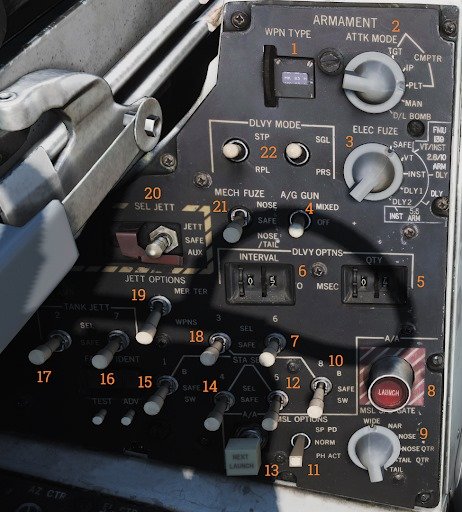
The F-14 always had the capability to drop bombs through the AWG-15 store management panel:Hearsay isn't facts. Probably the wrong thread, but I would like to see any prove of that, same for the F-15A. Only MSIP introduced basic AG capabilities in the F-15C and the F-14 received some basic AG capabilities ~1990 (Bombcat). Some basic provisions may have been included in the baseline design, but that's it. Even the cockpit stuff, let alone avionics in general weren't offering any AG modes/capabilities before that.
Attachments
FighterJock
ACCESS: Above Top Secret
- Joined
- 29 October 2007
- Messages
- 7,227
- Reaction score
- 8,538
Let's wait and see what designation the USAF gives the F/A-XX Sferrin whether A/F or F/A, it will be interesting to see what happens.
- Joined
- 28 January 2008
- Messages
- 1,645
- Reaction score
- 4,210
A/F would mean a primary attack mission with secondary fighter mission. F/A, the other way around. I think the USN wants a fighter with attack capability just like F/A-18 and F-35. Better yet, just a new fighter (like F-14) and a new LO attack platform, but wait, the USN tried the attack platform (ATA/A-12) and screwed it up. The USN really needs a new LO attack platform, the USN historically always had this capability.Let's wait and see what designation the USAF gives the F/A-XX Sferrin whether A/F or F/A, it will be interesting to see what happens.
It will be F/A. The reasons is simple. A pure strike aircraft makes a pure fighters like the A-6. But a fighter can be a strike aircraft anytime.
The F/A-XX is multirole and it will eventually replace both F18 and F35. It has to be good at both.
The F/A-XX is multirole and it will eventually replace both F18 and F35. It has to be good at both.

FighterJock
ACCESS: Above Top Secret
- Joined
- 29 October 2007
- Messages
- 7,227
- Reaction score
- 8,538
There was the F/A-22 Raptor for a while but that got discontinued, now it is just the plain F-22.
- Joined
- 3 June 2011
- Messages
- 20,895
- Reaction score
- 19,084
Won't replace the F-35C unless the USN cuts its carrier number WAY back.It will be F/A. The reasons is simple. A pure strike aircraft makes a pure fighters like the A-6. But a fighter can be a strike aircraft anytime.
The F/A-XX is multirole and it will eventually replace both F18 and F35. It has to be good at both.

Reddington777
ACCESS: Top Secret
- Joined
- 23 March 2025
- Messages
- 830
- Reaction score
- 2,746
Yes... if we could get stuff pinned to a thread, Id be happy to take the time to compile a history of known info to save quellish a few years of lifespan.Could we pin this please? Given how often it has to be said.
We can go and amend stuff later if need be

- Joined
- 6 August 2007
- Messages
- 4,530
- Reaction score
- 10,228
It will be F/A. The reasons is simple. A pure strike aircraft makes a pure fighters like the A-6. But a fighter can be a strike aircraft anytime.
The F/A-XX is multirole and it will eventually replace both F18 and F35. It has to be good at both.
These aircraft will be “replaced” by multiple aircraft types.
Reddington777
ACCESS: Top Secret
- Joined
- 23 March 2025
- Messages
- 830
- Reaction score
- 2,746
So we went from specialized to generalist and now back to specialized aircraft again.These aircraft will be “replaced” by multiple aircraft types.
Perhaps if you have to fly very long ranged missions, the jack of all trades but good at nothing kind of fighter isnt going to bring enough punch over longer sorties, hence going back to specialized aircraft?
I should add that I expect this swing back towards specialization to still retain some air to air capability whether thats detection modes or employable weapons, but more specialized aerodynamically and payload wise,
Last edited:
Scott Kenny
ACCESS: USAP
- Joined
- 15 May 2023
- Messages
- 19,517
- Reaction score
- 27,964
Best guess is that the LO attack-only platform for the USN is going to be a CCA, not a manned plane.A/F would mean a primary attack mission with secondary fighter mission. F/A, the other way around. I think the USN wants a fighter with attack capability just like F/A-18 and F-35. Better yet, just a new fighter (like F-14) and a new LO attack platform, but wait, the USN tried the attack platform (ATA/A-12) and screwed it up. The USN really needs a new LO attack platform, the USN historically always had this capability.
Scott Kenny
ACCESS: USAP
- Joined
- 15 May 2023
- Messages
- 19,517
- Reaction score
- 27,964
Sorry, should have grabbed all of these in one go.
The Growler replacement is going to be a CCA.
I think it'll have a pretty decent EW suite, not Growler level though.I wonder how advanced the EW suite will be on the XX and whether they'll forgo outboard jammers when replacing the Growlers.
The Growler replacement is going to be a CCA.
Specialized CCAs, not FAXX itself.So we went from specialized to generalist and now back to specialized aircraft again.
Perhaps if you have to fly very long ranged missions, the jack of all trades but good at nothing kind of fighter isnt going to bring enough punch over longer sorties, hence going back to specialized aircraft?
I should add that I expect this swing back towards specialization to still retain some air to air capability whether thats detection modes or employable weapons, but more specialized aerodynamically and payload wise,
- Joined
- 28 January 2008
- Messages
- 1,645
- Reaction score
- 4,210
Could be but no sizeable payloads unfortunately.Best guess is that the LO attack-only platform for the USN is going to be a CCA, not a manned plane.
- Joined
- 6 August 2007
- Messages
- 4,530
- Reaction score
- 10,228
So we went from specialized to generalist and now back to specialized aircraft again.
Perhaps if you have to fly very long ranged missions, the jack of all trades but good at nothing kind of fighter isnt going to bring enough punch over longer sorties, hence going back to specialized aircraft?
I should add that I expect this swing back towards specialization to still retain some air to air capability whether thats detection modes or employable weapons, but more specialized aerodynamically and payload wise,
The F/A-XX manned aircraft is a strike aircraft and "quarterback" for coordinating and controlling other platforms such as CCAs. All other roles are very low priority, the expectation is that these will largely be handled by other platforms such as CCAs. The majority of the future carrier air wing is planned to be unmanned.
This is why the MQ-25 is so important. The Navy has basically zero experience operating unmanned aircraft from carriers, but plans to make unmanned aircraft the majority of their force. MQ-25 is going to prove out operating "large" unmanned systems from carriers. How they can move forward with F/A-XX without unmanned aircraft experience is a question that has been getting asked a lot in Washington.
Scott Kenny
ACCESS: USAP
- Joined
- 15 May 2023
- Messages
- 19,517
- Reaction score
- 27,964
We're talking CCAs bigger than the X45/X47s, bays about the same size as those of the FAXX.Could be but no sizeable payloads unfortunately.
- Joined
- 28 January 2008
- Messages
- 1,645
- Reaction score
- 4,210
We'll have to see what type of CCAs come next or may in current development. The X-47B could be possible, already validated for carrier service. Boeing's X-45C Phantom Ray could be navalized. The point is that the X-45C and X-47B have flown and have complete design packages (plus the tooling drawing packages) but knowing the USN (not unless things can or could change), may want a clean-sheet design which would not make sense. I would keep the MQ-25 as a tanker, if the USN wants to add other capabilities to it then that could screw up the program, the USN does not have a good track record.We're talking CCAs bigger than the X45/X47s, bays about the same size as those of the FAXX.
Scott Kenny
ACCESS: USAP
- Joined
- 15 May 2023
- Messages
- 19,517
- Reaction score
- 27,964
The proposals out in the open have the MQ25s remaining as tankers.We'll have to see what type of CCAs come next or may in current development. The X-47B could be possible, already validated for carrier service. Boeing's X-45C Phantom Ray could be navalized. The point is that the X-45C and X-47B have flown and have complete design packages (plus the tooling drawing packages) but knowing the USN (not unless things can or could change), may want a clean-sheet design which would not make sense. I would keep the MQ-25 as a tanker, if the USN wants to add other capabilities to it then that could screw up the program, the USN does not have a good track record.
From the US perspective no one is talking CCA in that size range.We're talking CCAs bigger than the X45/X47s, bays about the same size as those of the FAXX.
The USN has five companies under dev contracts for CCA development from aircraft carriers.We'll have to see what type of CCAs come next or may in current development. The X-47B could be possible, already validated for carrier service. Boeing's X-45C Phantom Ray could be navalized. The point is that the X-45C and X-47B have flown and have complete design packages (plus the tooling drawing packages) but knowing the USN (not unless things can or could change), may want a clean-sheet design which would not make sense. I would keep the MQ-25 as a tanker, if the USN wants to add other capabilities to it then that could screw up the program, the USN does not have a good track record.
https://www.defensenews.com/newslet...ontracts-to-the-big-five-defense-contractors/
In fact, there is no conflict here. There are two design approaches: one based on fighter role, the other not based on attach role.It shouldn’t be a surprise because it is primarily a strike aircraft.
Typical examples of the former include the F-14 "Bombcat", F-15E, and F/A-18, while the latter is represented by the F-105, F-111 and F-35.
Given the two core missions of a CSG—strike and fleet air defense—and under the constraints of limited resources as well as the future trend of integrating UAVs into carrier air wings, I believe the USN will choose the first design approach. The reasons are as follows:
1)With current UAV technology, we cannot expect them to possess the air combat decision-making capability like E.D.I in the movie Stealth. However, existing UAVs are fully capable of performing AG missions. Compared with AA combat, AG is clearly a "simple task". Thus, UAVs can take over a considerable part of AG missions.
2)With China as the primary hypothetical adversary, it is essential to consider how to protect the security of the CSG itself. In addition to countering China’s version of the "Tu-16/22 + Kh-22" long-range anti-ship system, the U.S. Navy also has to face China’s naval CSG and anti-ship ballistic missiles.
Accordingly, carrier strike groups will still need to perform the following tasks:
1) Expanding the outer air defense perimeter of the CSG
2) Intercepting enemy aerial platforms that launch anti-ship missiles
3) Countering enemy long-range fighter aircraft operating forward
Last edited:
Scott Kenny
ACCESS: USAP
- Joined
- 15 May 2023
- Messages
- 19,517
- Reaction score
- 27,964
The mission space kinda sets X-47B as the smallest viable airframe for accompanying FAXX. X-47B bays are only big enough for 2x2000lb, one each. If we're lucky they can hold an AGM-158 each. Also, note that there was planned to be an even larger X-47C that was the full mission size.From the US perspective no one is talking CCA in that size range.
- How big an airframe do you need to haul 2x AGM-158B/Cs 1500km to their launch point? Better yet, how big an airframe do you need to haul 4x AGM-158B/Cs to their launch point?
- How big an airframe do you need to haul a minimum of 6x LRAAMs to a 250nmi BARCAP point and then to loiter there for a minimum of 5 hours?
- How big an airframe do you need to do Jamming and SEAD/DEAD of a target area some 1500km from the carrier, call it 2x JSOW or SiAW plus 7000lbs of jamming gear? (possibly/probably a dedicated airframe for this one, but same relation to the main CCA as a Growler to Super Bug)
- How big an airframe do you need to do CAS/carpet bombing with SDBs or 500lb JDAMs some 1500km away?
- How big an airframe do you need to carry 4-6x 2000lb JDAMs 1500km away?
I haven't seen a single proposal for the naval CCAs yet, aside from the X-47s.The USN has five companies under dev contracts for CCA development from aircraft carriers.
https://www.defensenews.com/newslet...ontracts-to-the-big-five-defense-contractors/
Personally, I believe the ideal composition of a carrier air wing would be "a new NATF + a new ATA + UAVs". The UAVs would assist the new NATF and the new ATA in performing AA combat missions and AG missions respectively. Yet the ideal is beautiful, while the reality is cruel. The U.S. Navy doesn't have sufficient budget, and the U.S. industry may not have sufficient industrial capacity.A/F would mean a primary attack mission with secondary fighter mission. F/A, the other way around. I think the USN wants a fighter with attack capability just like F/A-18 and F-35. Better yet, just a new fighter (like F-14) and a new LO attack platform, but wait, the USN tried the attack platform (ATA/A-12) and screwed it up. The USN really needs a new LO attack platform, the USN historically always had this capability.
Can you point to a CCA proposal in the US that is talking those munition payloads, ie any of them projected to carry 2000lb weapons or to the payload weights you are suggesting?The mission space kinda sets X-47B as the smallest viable airframe for accompanying FAXX. X-47B bays are only big enough for 2x2000lb, one each. If we're lucky they can hold an AGM-158 each. Also, note that there was planned to be an even larger X-47C that was the full mission size.
That's where we're at for airframe size.
- How big an airframe do you need to haul 2x AGM-158B/Cs 1500km to their launch point? Better yet, how big an airframe do you need to haul 4x AGM-158B/Cs to their launch point?
- How big an airframe do you need to haul a minimum of 6x LRAAMs to a 250nmi BARCAP point and then to loiter there for a minimum of 5 hours?
- How big an airframe do you need to do Jamming and SEAD/DEAD of a target area some 1500km from the carrier, call it 2x JSOW or SiAW plus 7000lbs of jamming gear? (possibly/probably a dedicated airframe for this one, but same relation to the main CCA as a Growler to Super Bug)
- How big an airframe do you need to do CAS/carpet bombing with SDBs or 500lb JDAMs some 1500km away?
- How big an airframe do you need to carry 4-6x 2000lb JDAMs 1500km away?
Any EW CCA are also going to be stand-in and likely to carry systems half the weight of an NGJ. Additionally with the modern suite of munitions coming along I don't think a SiAW is needed for CCA SEAD, a set of Barracuda-250s or equivalent with the right sensor might be enough.
Gambit 5 is the GA suggestion although it is still light on details. It doesn't appear to be planned for the payload ranges you are suggesting. I expect GA have a fair idea of the requirements the USN are asking for.I haven't seen a single proposal for the naval CCAs yet, aside from the X-47s.
In_A_Dream
ACCESS: Top Secret
- Joined
- 3 June 2019
- Messages
- 786
- Reaction score
- 926
Accordingly, carrier strike groups will still need to perform the following tasks:
1) Expanding the outer air defense perimeter of the CSG
2) Intercepting enemy aerial platforms that launch anti-ship missiles
3) Countering enemy long-range fighter aircraft operating forward
Some of that threat burden could be alleviated by spreading well fortified missile batteries across the Pacific. The USN would need to work with the Army to get kind of support but I think it'd help make the most of the F/A-XX by giving the fleet a little more flexibility & top cover for operations.
Accordingly, carrier strike groups will still need to perform the following tasks:
1) Expanding the outer air defense perimeter of the CSG
2) Intercepting enemy aerial platforms that launch anti-ship missiles
3) Countering enemy long-range fighter aircraft operating forward
The force composition and weapons shot amount requirement can be found in theCan you point to a CCA proposal in the US that is talking those munition payloads, ie any of them projected to carry 2000lb weapons or to the payload weights you are suggesting?
CSBA report:
REGAINING THE HIGH GROUND AT SEA
TRANSFORMING THE U.S. NAVY’S CARRIER AIR WING FOR GREAT POWER COMPETITION
- Joined
- 6 August 2007
- Messages
- 4,530
- Reaction score
- 10,228
Given the two core missions of a CSG—strike and fleet air defense—and under the constraints of limited resources as well as the future trend of integrating UAVs into carrier air wings, I believe the USN will choose the first design approach. The reasons are as follows:
The Navy has already chosen, the requirements are for strike aircraft. The manned aircraft itself isn’t going to be doing fleet air defense. They don’t want a Tomcat.
This has become a speculation / wishful thinking thread rather than discussion of the actual program.

Colonial-Marine
UAVs are now friend, drones are the real enemy.
- Joined
- 5 October 2009
- Messages
- 1,714
- Reaction score
- 1,820
But it has to be able to perform in the fleet air defense role simply because they're going to make up a large portion of a carrier's air wing. The F-35C is adequate at best for that mission, and eventually the F/A-XX is supposed to phase out the F/A-18s that serve in that role.
Is there some notion that the fighters of the carrier air wing shouldn't be directly contributing to the defense of the fleet from airborne threats?
Is there some notion that the fighters of the carrier air wing shouldn't be directly contributing to the defense of the fleet from airborne threats?
- Joined
- 3 June 2011
- Messages
- 20,895
- Reaction score
- 19,084
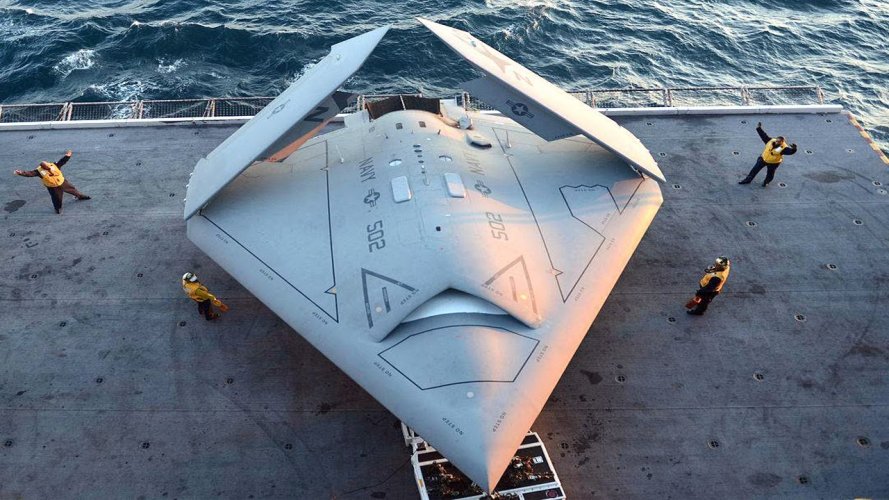
If only they'd had something to get experience with earlier they wouldn't be stuck in this situation now.This is why the MQ-25 is so important. The Navy has basically zero experience operating unmanned aircraft from carriers, but plans to make unmanned aircraft the majority of their force.
Attachments
Similar threads
-
 Leonardo TH-73 US Navy Advance Helicopter Training System
- Started by RavenOne
- Replies: 17
-
 USAF/USN 6th Gen Fighters - F/A-XX, F-X, NGAD, PCA, ASFS News & Analysis [2008- 2025]
- Started by Matej
- Replies: 10K
-

-
Northrop Gamma 3 series (U.S. Navy XFT-1 and XFT-2, Gamma 3A)
- Started by Justo Miranda
- Replies: 2
-
