
- Joined
- 3 June 2011
- Messages
- 20,895
- Reaction score
- 19,084
Enlighten me. Joke no funny.Hey,where have I heard this before

Enlighten me. Joke no funny.Hey,where have I heard this before

F-111B reference?Enlighten me. Joke no funny.
No money. Maintaining shipbuilding is a greater priority. The budget cuts after 1990 were fairly large. Maintaining and operating the existing fleet of ships consumes most of the shrinking budget.
The idea of going with the multi-role Super Hornet made sense of it performed as expected. The Super Hornet performed well below expectations. The Navy would never had purchased the Super Hornet had they known it would barely exceed the capability of the Classis Hornet.
I would have simply purchased more Classic Hornets and used the money saved to introduce the A-6F. A tanker version of the A-6F would see the Classic Hornet going far beyond the range of the current Super Hornet. The A-6F carrying four JASSM and two AMRAAM would have very long range strike capability that could protect itself.
I don't think it's a financial problem, because USN started the A-X project immediately after ATA ended, and A-X was still positioned as the replacement of A-6. Although A-X was later replaced by A/F-X, which finally merged with MRF to become JAST. This is obviously a result based on misjudgment of future strategy, especially a significant underestimation of the development of China. This result directly leads to the lack of tactical long-range strike aircraft with low observability in both the USAF and the USN.Peace dividend killed it.
It didn't help that the MDD A-12 ATA was never going to work, and that MDD ended up suing the Government over the lack of transfer of the stealth IP. (USAF playing fuck-fuck games with getting MDD access to the various programs)I don't think it's a financial problem, because USN started the A-X project immediately after ATA ended, and A-X was still positioned as the replacement of A-6. Although A-X was later replaced by A/F-X, which finally merged with MRF to become JAST. This is obviously a result based on misjudgment of future strategy, especially a significant underestimation of the development of China. This result directly leads to the lack of tactical long-range strike aircraft with low observability in both the USAF and the USN.
Indeed. I said this was the plan from the very start.Not to rage bait, but I would laugh SO HARD if the F-47 comes out with "beefier landing gear" as the F/A-XX. I don't want this, but would be worth a chuckle.
Then A-X had to become A/F-X when Cheney killed F-14D production
Off topic but no. While the F-14D was a better aircraft the decision to go with the SH was the right one. The USN needed an affordable jet and deck commonality. The issue was the length of time to a replacement which is a subsequent failure of the 2010s administrations and the USN and why we are at this point today.Congress should've over-ruled Cheney's decision before impeaching and removing him from office, the man was a crook.
The Super Bug is merely a project to satisfy accounting audits, but it's utterly useless for long-range attack capabilities. Just look at the current attack on Iran to see that.Super Hornet was seen as lower risk and therefore lower cost. So they could have Super Hornets sooner than any other options, with F-35 eventually replacing the Legacy Hornets.

Correct. And that was known at the time, but seen as an acceptable price to pay.The Super Bug is merely a project to satisfy accounting audits, but it's utterly useless for long-range attack capabilities. Just look at the current attack on Iran to see that.
The stretch-and-cut strategy didn't work for the Seawolf, F-22, B-2, or Peacekeeper. Not sure why this would be any different.The question is was it possible to have the program run at a slower pace, hence, distribute the cost over longer period of time? Like solving one issue one at a time.
This is not even comparible. Seragina is not suggesting cutting the total number of aircraft ordered. Stretching out only the development phase will mean less problems during low rate production. This is the exact opposite of concurrency in the F-35 program.The stretch-and-cut strategy didn't work for the Seawolf, F-22, B-2, or Peacekeeper. Not sure why this would be any different.

It also makes sense to let the USAF move forward with avionics development for the F-47 and then the Navy adds their required features.
Guess what happens to unit cost when you stretch out the development phase. Guess what happens to buy size when cost goes up.This is not even comparible. Seragina is not suggesting cutting the total number of aircraft ordered. Stretching out only the development phase will mean less problems during low rate production.
Yes it is the lowest risk option. We have more than a dozen successful examples of aircraft that had excellent outcomes. Avionics initially fielded as air-to-air only and the more advanced air-to-ground features were added later. Eurofighter, F-15E, F-16, KF-21 and many others.In engineering this always leads to excellent outcomes.
The prototypes will definitely be more expensive per aircraft. Extra aircraft development time will mean fewer problems are discovered during low rate production. Fewer low rate production aircraft will be required and full rate production will be hit sooner. This reduces the average unit cost of the production jets as a greater percentage of aircraft are built during full rate production.Guess what happens to unit cost when you stretch out the development phase. Guess what happens to buy size when cost goes up.
It is extremely lucky that USAF wants air-to-air only.
Not right. In fact, the F-14A, F-15A and F-16A have basic strike capability.Yes it is the lowest risk option. We have more than a dozen successful examples of aircraft that had excellent outcomes. Avionics initially fielded as air-to-air only and the more advanced air-to-ground features were added later. Eurofighter, F-15E, F-16, KF-21 and many others.
It is extremely lucky that USAF wants air-to-air only. This allows for more rapid avionics development and the Navy add the air-to-ground features. The USAF can then use these features as the commonality of the core code is high.
I was only expecting the strike part of NGAD to be SiAW or whatever other ARMs come into play with "Air Dominance".Since when?
NGAD has always been intended to have a strike capability.
The F-14A had, I repeated from hearsay on this site, A-7A level daylight strike capability. Which isn't too bad.Not right. In fact, the F-14A, F-15A and F-16A have basic strike capability.
Any examples of where that worked?The prototypes will definitely be more expensive per aircraft. Extra aircraft development time will mean fewer problems are discovered during low rate production. Fewer low rate production aircraft will be required and full rate production will be hit sooner. This reduces the average unit cost of the production jets as a greater percentage of aircraft are built during full rate production.
Extending the development period will not increase the unit cost during the production period. If anything improved production techniques will be discovered allowing for more efficient production.

Respectfully, I think I say for most people here, this larp has gone on too long. You have posted pages upon pages of pure speculation under the guise of it being “insider knowledge”. No sources, and in the worst cases completely illogical ideas. I for one do enjoy speculation, but there is a time and a place. It hurts the readability of these threads when its clogged with pure speculation.The prototypes will definitely be more expensive per aircraft. Extra aircraft development time will mean fewer problems are discovered during low rate production. Fewer low rate production aircraft will be required and full rate production will be hit sooner. This reduces the average unit cost of the production jets as a greater percentage of aircraft are built during full rate production.
Extending the development period will not increase the unit cost during the production period. If anything improved production techniques will be discovered allowing for more efficient production.
Fortunately, the Forum has an "ignore user" feature. The thing it may be missing is a "bridge" feature, where every troll account is only allowed to see posts from other troll accounts. But that's an admin/moderator thing not a basic user tool, so I wouldn't be able to see the ability to do that.Respectfully, I think I say for most people here, this larp has gone on too long. You have posted pages upon pages of pure speculation under the guise of it being “insider knowledge”. No sources, and in the worst cases completely illogical ideas. I for one do enjoy speculation, but there is a time and a place. It hurts the readability of these threads when its clogged with pure speculation.

Since when?
NGAD has always been intended to have a strike capability.

I think the best course of action is to create a thread in which the rest of us can’t read or comment or see for insidersource to express all the the stuff the sources inside his head tell him.
 .
.
View attachment 804193
Now I gotta go and update my model again
But as @Scott Kenny said - how "strikey" are we talking here? 2 - SiAWs? or multiple 2000 pounders?

Would you say that inage of the demonstrator you seen fit that bill?From the testimony I’ve seen I’d say it would be similar to the F-22.
So, whatever fits into the same box as the AAMs, then.From the testimony I’ve seen I’d say it would be similar to the F-22.
The ignore function does not stop you from seeing other people replying to someone who is no insider, and has no sources.Fortunately, the Forum has an "ignore user" feature. The thing it may be missing is a "bridge" feature, where every troll account is only allowed to see posts from other troll accounts. But that's an admin/moderator thing not a basic user tool, so I wouldn't be able to see the ability to do that.
The F-14A had, I repeated from hearsay on this site, A-7A level daylight strike capability. Which isn't too bad.
I think you may have misunderstood. The basic AG capability here refers to the use of “iron bombs” and rockets, not guided AG weapons. Both the 1974 F-14 SAC and the 1976 F-15A CS listed the AG weapons they supported at that time. Multirole capability has long been a tradition for carrier-based fighters in the USN, so it comes as no surprise that the F/A-XX will feature AG capability.Hearsay isn't facts. Probably the wrong thread, but I would like to see any prove of that, same for the F-15A. Only MSIP introduced basic AG capabilities in the F-15C and the F-14 received some basic AG capabilities ~1990 (Bombcat). Some basic provisions may have been included in the baseline design, but that's it. Even the cockpit stuff, let alone avionics in general weren't offering any AG modes/capabilities before that.
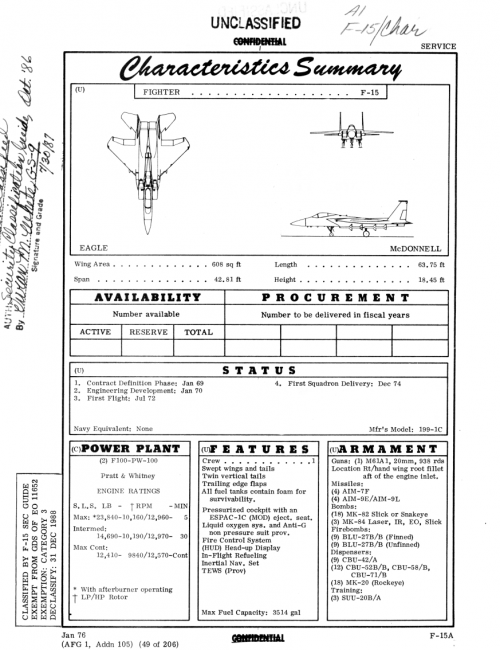
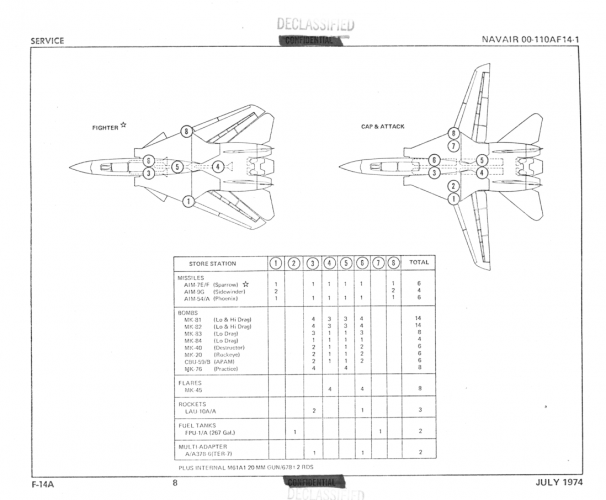
so it comes as no surprise that the F/A-XX will feature AG capability.
Exactly. This was standard requirement for any fighter aircraft during the cold war to be able to use all standard A2A and A2G weapons. Often nukes counted as standard, too. I suppose the only specialization was with ASM stores. Things with nukes changed with nuclear weapons agreement.I think you may have misunderstood. The basic AG capability here refers to the use of “iron bombs” and rockets, not guided AG weapons. Both the 1974 F-14 SAC and the 1976 F-15A CS listed the AG weapons they supported at that time. Multirole capability has long been a tradition for carrier-based fighters in the USN, so it comes as no surprise that the F/A-XX will feature AG capability.
So it's going to have the ability to deploy a weapon with a very small danger close range. Maybe M61, maybe GAU12 or GAU22.Since the F/A-XX is replacing the F/A-18 it is expected to be able to do CAS.


