I get all of that but if 100 lb is sufficient for a modern anti ship weapon why the overkill elsewhere? And what's so unique about 100 lbs warhead? Why not 70 lbs and use the other weight and volume for more fuel? How about 50 lbs and even more volume for space and fuel? I mean if we're mission killing tier 1 PLAN DDG's with subsonic missiles with 100 lb warheads...then that frees up quite a lot of resources for investments elsewhere and espensive overkills like LRASM etc.
 
I'd think you'd need to have aimpoint selection to ensure a mission kill. There are probably a lot of places on a Type 055 that could take a 100lb warhead and still keep fighting. Does LRASM have that? Also, I think the 1000lb warhead was because that's what JASSM already carried and it would minimize the modifications necessary. It would suck to swap out the 1000lb warhead for a 100lb warhead and 900lbs of ballast for example.
LRASM and JSM both pick their aim point and assume most any new build AShCM will as well. It does not require much effort to achieve that using off the shelf commercial equipment now adays. I think it was actually the major sticking point in developing JAASM back in the day.
 
I get all of that but if 100 lb is sufficient for a modern anti ship weapon why the overkill elsewhere? And what's so unique about 100 lbs warhead? Why not 70 lbs and use the other weight and volume for more fuel? How about 50 lbs and even more volume for space and fuel? I mean if we're mission killing tier 1 PLAN DDG's with subsonic missiles with 100 lb warheads...then that frees up quite a lot of resources for investments elsewhere and espensive overkills like LRASM etc.
I assume this is sarcastic. I chose 100 lbs because that’s the ballpark payload of a large number of low cost, low launch weight missiles hitting the market (Rusty Dagger, RAACM, Barracuda, etc). These weapons can be purchased in much larger numbers and also carried in much larger numbers. They would not completely replace LRASM but complement it.
 
I chose 100 lbs because that’s the ballpark payload of a large number of low cost, low launch weight missiles hitting the market (Rusty Dagger, RAACM, Barracuda, etc). These weapons can be purchased in much larger numbers and also carried in much larger numbers. They would not completely replace LRASM but complement it.
How much effort went into the effect of those warheads on higher end Chinese DDGs in making that trade? Or was it informed by other dynamics such as component availability. Cost targets etc
 
How much effort went into the effect of those warheads on higher end Chinese DDGs in making that trade? Or was it informed by other dynamics such as component availability. Cost targets etc
Costs, definitely. But it is still something dangerous enough that has to be dealt with.
 
Eating a 100 lb warhead along with the rest of the missile body and unburnt JP5 is probably like taking an 8” / 203mm howitzer round at the low end.
Depends on how much of said warhead is actually boom. 8" HC shells only hold ~22lbs of boom. Alaska-class 12" HC was an 80lb bursting charge. Iowa-class 16" HC shells had a ~150lb bursting charge.

So LRASM is roughly like getting hit with (guessing) twice the boom of a 16" HC at 2/3rds the speed.


I doubt even Type 55 is doing anything of note after that, and there’s no reason you can’t mix LRASM with a pile of those if you want an engineering or hanger deck kill.
Not for a few months, no.

But you could probably have it repaired to new within 6-9 months. And that's my problem with the lighter warheads. If the war goes longer than a few months, you need ship kills. Not mission kills. You need their shipyards building replacement ships, not new ships!
 
But you could probably have it repaired to new within 6-9 months. And that's my problem with the lighter warheads. If the war goes longer than a few months, you need ship kills. Not mission kills. You need their shipyards building replacement ships, not new ships!

The flip side is that there are not that many LRASM in inventory and that tactical aircraft cannot carry many of them. I would guess F-18E/F is limited to 4 at the expense of drop tanks, where as I would expect any <1000# store to fit tandem BRUs and the outer pylons like mk83. So ten. You might even fit two more on the fuselage stations if light enough and there were no separation issues (I am not sure what weight those are rated for). So salvo size and total munitions inventory could go way up with a smaller $200,000 weapon. A target still has to shoot them down or use counter measures against any incoming, even if it can tell the difference between a decoy/light missile and a LRASM. You could always saturate/exhaust the defense with cheap weapons and send AGM-158s in after as a finishing move, or mix the two types. But it certainly would be useful to have some aircraft throwing 10-12 missiles 500 mi.
 
My understanding is that functionally you’re looking at two LRASSMs per Bug based on useful range requiring three drop tanks
 
My understanding is that functionally you’re looking at two LRASSMs per Bug based on useful range requiring three drop tanks
More operationally likely than four, yes. But you could carry six <1000 lb missiles with three drop tanks. Also, when LRASM-ER comes out, it might make four missiles a more workable solution. They weigh less than a drop tanks; I would not have thought there any reason four could not be carried if the range penalty was acceptable. Centerline station I think has a lot of extra clearance requirements; I think I recall reading somewhere that the centerline drop tanks store has sone kind of waiver?
 
Last edited:
Josh true - it’s very possible a CAG could order a Bug launch with four LRASSM. That Bug would likely require intensive tanker support to get to operationally interesting ranges and if that a/c needs to trap for some stupid reason you’ve got to jettison at least two of of those LRASSMs.

Respectfully, I don’t see any evidence to support more than 2 per Super Hornet other than edge scenarios that are not helpful from a planning POV.
 
Two is far more likely I agree. It’s quite likely four, while maybe physically possible, was never even tested. IIRC the four Harpoon configuration was not actually tested until like 2020.
 
Don't mistake peace time configuration with war time ones. In war all are assigned targets and even if they weren't use, it was very common in the Vietnam war for BARCAP aircraft to ditch their loads every time.
Just like with the F-15C with ECM pods on the outboard station not being seen doesn't mean anything. You can find at least one scene from Afghanistan where it was carried.

In theory, a F18E could land with 4 LRASSM, with minimum 5% fuel (1% being contingency reserve fuel) and still have ~500 lb room or so. Ofc it has to ditch all A2A weapons and center drop tank, ofc. But it could be done in peace time.
 
I get all of that but if 100 lb is sufficient for a modern anti ship weapon why the overkill elsewhere? And what's so unique about 100 lbs warhead? Why not 70 lbs and use the other weight and volume for more fuel? How about 50 lbs and even more volume for space and fuel? I mean if we're mission killing tier 1 PLAN DDG's with subsonic missiles with 100 lb warheads...then that frees up quite a lot of resources for investments elsewhere and espensive overkills like LRASM etc.
The problem is not optimal hits when everything goes right; fairly light bombs could cripple cruisers during ww2 as well.

It was just not guaranteed or even very likely, which is unacceptable from operational point of view. Seekers get smarter, so does jamming.
But you could probably have it repaired to new within 6-9 months. And that's my problem with the lighter warheads. If the war goes longer than a few months, you need ship kills. Not mission kills. You need their shipyards building replacement ships, not new ships!
6-9 months is more like limping back after eating heavy torpedoes w/o TPS in WW2 terms.
I'd expect Chinese shipyards, given their "overcapacity", access to talents and supply chain doing way faster than that.

There was solid logic in doing actually killy weapons (2000lb quicksinks) from WW2 point of view. Provided there's going to be effective DC, single 1000lb penetrators for cruiser sized warship(052, 055) aren't actually that killy.
 
6-9 months is more like limping back after eating heavy torpedoes w/o TPS in WW2 terms.
I'd expect Chinese shipyards, given their "overcapacity", access to talents and supply chain doing way faster than that.
Depends on how many spare radars etc they have either available or ordered-once-damaged and ready to install. It's not just the welders that are needed to repair a ship.


There was solid logic in doing actually killy weapons (2000lb quicksinks) from WW2 point of view. Provided there's going to be effective DC, single 1000lb penetrators for cruiser sized warship(052, 055) aren't actually that killy.
That's my point.

Small weapons will let you win a battle or a short campaign with those mission kills. Big weapons will get you ship kills.
 
Just like with the F-15C with ECM pods on the outboard station not being seen doesn't mean anything. You can find at least one scene from Afghanistan where it was carried.

No? F-15s never carried outboard pylons. Up until the advanced Eagles i.e. F-15SA/QA/EX.
Plus I don't think F-15Cs ever deployed to Afghanistan.

In theory, a F18E could land with 4 LRASSM, with minimum 5% fuel (1% being contingency reserve fuel) and still have ~500 lb room or so. Ofc it has to ditch all A2A weapons and center drop tank, ofc. But it could be done in peace time.

Pretty sure all 2000lbs class weapons are too heavy to bring back. Single store limitation, not aircraft landing weight limitation.
 
No? F-15s never carried outboard pylons. Up until the advanced Eagles i.e. F-15SA/QA/EX.
Plus I don't think F-15Cs ever deployed to Afghanistan.
That's what I remember from the photo description. I do recon it's been a while and I don't have perfect memory. But it should predate the revelation of the F15SA/QA/EX nonetheless.
Pretty sure all 2000lbs class weapons are too heavy to bring back. Single store limitation, not aircraft landing weight limitation.
You mean a (standard A2G) 5000 lb rated station spec for the standard A2G rated 2.5 g pull spec with the typical 2x engieering safety margin? Well, apparently carrier landings incurre a max load factor of 5g. It seems both sides are on the same level of load factors.
 
That's what I remember from the photo description. I do recon it's been a while and I don't have perfect memory. But it should predate the revelation of the F15SA/QA/EX nonetheless.

Then the photo description is wrong.

You mean a (standard A2G) 5000 lb rated station spec for the standard A2G rated 2.5 g pull spec with the typical 2x engieering safety margin? Well, apparently carrier landings incurre a max load factor of 5g. It seems both sides are on the same level of load factors.

There's a reason the USN prefers the Mk83 over the Mk84.
There are plenty of pics showing Hornets/Super Hornets landing with unused ordnance, most of them with 500lbs weapons or the occasional Maverick. On endless GWOT patrols, they typically used those weapons. Heavier stores only against pre-planned targets. But I'm happy to be corrected.

Btw. any article that says "aircrafts" is automatically disqualified :p

As far as I know those outer wing-pylon stations were available for use.

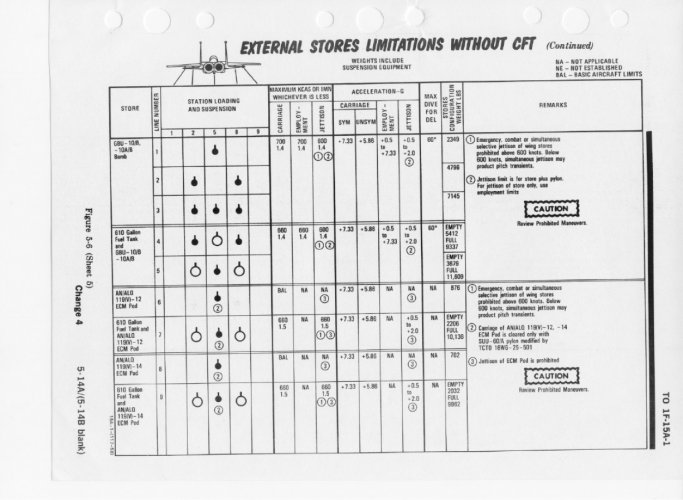
They caused stability issues and so were never used. AFAIK, A-D Eagles have the mounting points, Strike Eagles and derivates don't even have the mounting points. But I could be wrong about that. In any case, the A-D flight manual has stations 1/9 included, but without anything actually cleared, see attachment. The F-15E manual doesn't show stations 1/9 at all.
 

Attachments

  • 5-14A.jpg
    5-14A.jpg
    522.4 KB · Views: 236
Then the photo description is wrong.


There's a reason the USN prefers the Mk83 over the Mk84.
There are plenty of pics showing Hornets/Super Hornets landing with unused ordnance, most of them with 500lbs weapons or the occasional Maverick. On endless GWOT patrols, they typically used those weapons. Heavier stores only against pre-planned targets. But I'm happy to be corrected.

Btw. any article that says "aircrafts" is automatically disqualified :p


They caused stability issues and so were never used. AFAIK, A-D Eagles have the mounting points, Strike Eagles and derivates don't even have the mounting points. But I could be wrong about that. In any case, the A-D flight manual has stations 1/9 included, but without anything actually cleared, see attachment. The F-15E manual doesn't show stations 1/9 at all.
Maybe the outboard pylons were like 4-tanks on the F-22, and they didn't get around to fixing it until much later (or never, in the case of the F-22).
 

Just a current recap, nothing new.

Has Lockheed Martin finished their challenge that their proposal did not meet the Navy’s criteria for the combat aircraft?
 

Just a current recap, nothing new.

Has Lockheed Martin finished their challenge that their proposal did not meet the Navy’s criteria for the combat aircraft?
Lockheed did not file a protest on their elimination from the competition.
 
What I posted in the Lockheed "Classified Aero Program" string:

Very interesting the F-47 released illustration shows canards, McAir (now Boeing) was our (Northrop's) teammate on NATF-23 which had canards, a diamond wing planform, 2D thrust vectoring and three elevons per wing trailing edge. If you remove the NATF-23's two all-moving verticals and flatten out the canards a bit, its a surprising coincidence the similarity to the current F-47 concept. NG had no intention of bidding NGAD from the start and may have had a huge jump (and load of funding) regarding F/A-XX.

My speculations, I know these have been discussed before but I thought I would lump these to together for comments:
1. Boeing F-47 shares some design lineage with the Northrop/Mc Air NATF-23.
2. Boeing F-47 and Boeing F/A-XX share a similar design platform.
3. Boeing to be only contractor building F-47, probably yes, NG only prime involved in development and build of B-21 as an example.
4. NG F/A-XX evolved configuration of F-23 and NATF-23. YF-23/F-23/NATF-23 ahead of its time for the 1990s.
5. If Boeing wins F/A-XX, NG could be teammate (F/A-18 teaming worked very well throughout the decades).
6. If NG wins F/A-XX, Boeing could be teammate (again, F/A-18 teaming worked very well throughout the decades).
7. Boeing trying to perform on both F-47 and F/A-XX could be too much of a stretch in regards to managing the program and keeping the program on track.
8. NG X-47B program performed very well, NG now knows how develop, build and integrate carrier based aircraft, whether manned or unmanned.
9. NG bowed out of NGAD, I assume NG got substantial funding due it's F/A-XX concept way back and the USN really saw its merits over Boeing's design.
10. I could also be wrong for most of the above too and all, please share comments.
 
So is this program just awaiting award now? Last time I heard, it had approval from SecDef and was just waiting to get awarded. I think Reuters reported that about a month ago, which might have been right before the shutdown? I don't think anything further has been mentioned since?
 
So is this program just awaiting award now? Last time I heard, it had approval from SecDef and was just waiting to get awarded. I think Reuters reported that about a month ago, which might have been right before the shutdown? I don't think anything further has been mentioned since?
Pretty much. It seems like the ball has been in OSD's court for like the whole year.
 
So is this program just awaiting award now? Last time I heard, it had approval from SecDef and was just waiting to get awarded. I think Reuters reported that about a month ago, which might have been right before the shutdown? I don't think anything further has been mentioned since?
I don't recall that the government ever made a specific statement. It was reported in early October that Hegseth had "given the go ahead" based on sources supposedly close to him. If that's the case, it's very likely that the Navy needed to update proposals after the delay, which would trigger a possible second round of BAFO's. Nothing precludes an offeror from making substantial revisions at that point, which could cause a delay while evaluations are updated.
 
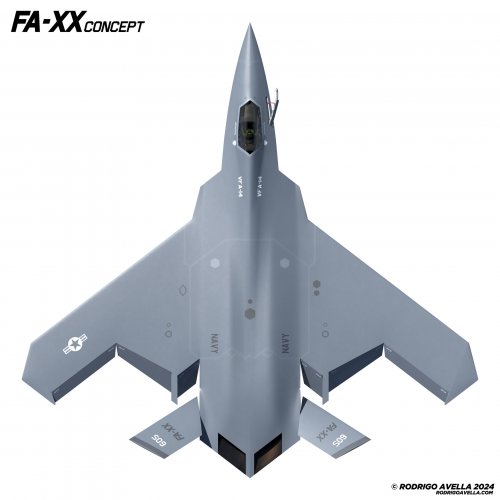
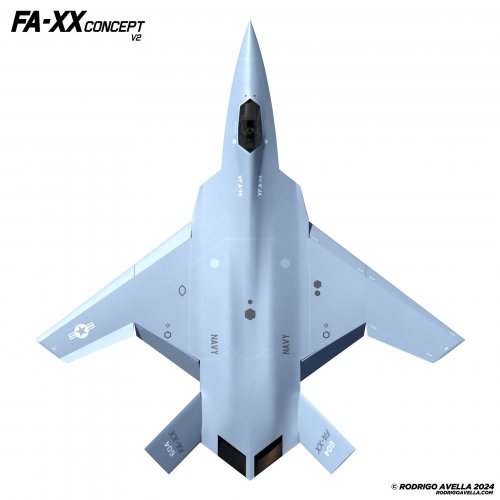
the V1 from Rodrigo is viable for carrier operations? how hard it would be to land without any leading edge controls?
 

Attachments

  • rodrigo-avella-04.jpg
    rodrigo-avella-04.jpg
    180.5 KB · Views: 177
  • rodrigo-avella-vista-4.jpg
    rodrigo-avella-vista-4.jpg
    181.3 KB · Views: 141
Could a lambda wing (like Rodrigo's V2 above) be designed fold the outer wing panels up and over to lay on top of the inner wing in flight to act as a VG wing with a smaller area? Designing the upper surface of the inner wing to fit in with the outer wing's airfoil would be complicated, but a variable camber outer panel could help that. If the folded wing is far enough from the leading edge of the inner wing, would it impact the airflow enough that the increased thickness reduces supersonic performance less than the decreased span increases performance?
 
I don't recall that the government ever made a specific statement. It was reported in early October that Hegseth had "given the go ahead" based on sources supposedly close to him. If that's the case, it's very likely that the Navy needed to update proposals after the delay, which would trigger a possible second round of BAFO's. Nothing precludes an offeror from making substantial revisions at that point, which could cause a delay while evaluations are updated.
Almost certainly the Govt cannot award the contract due to the short term CR that ended the shutdown and is in place only until 30 Jan. The CR had a few defense items in it including funding the E-7 but did not specifically mention F/A-XX so they probably cannot start a new program, ie Milestone B. I doubt they have gone back to Industry for BAFOs, unless the time period has elapsed but the more likely COA in that instance would be a request an extension of the submitted offers.
 
Last edited:
the V1 from Rodrigo is viable for carrier operations? how hard it would be to land without any leading edge controls?
I think considering its lambda has an inherently more benign behavior at low speeds due to the high aspect ratio outboard part (compared to delta-like things like the F-35) , I guess it's not too bad. However considering without leading edge controls, it would be very hard to control lift without creating drag (necessary for a Magic Carpet like system where the altitude can be controlled without changing the pitch).
For that I have 2 suggestions
1: If you have insane thrust, you might not care about drag that much
2: It's possible that the US has developed an autopilot system that can safely land an aircraft on a much more conventional trajectory, so Magic Carpet is not needed any more.

The possibility of using high-lift devices, like the MIG29K's Kruger flaps (small extending curved plates that increase the camber of the wing) also exists.
Btw, is it just me, but to me, v1 very much looks like an F22 if you chop the ends of the wings off :)
 
Opinion piece


...
"Too bad no one in Trump’s Pentagon can make a decision on the future of the Navy: a plane with the dull name of F/A-XX"

...
"... excuse after excuse wafts from the five-sided building about why the program shouldn’t move forward."
...
"The latest word is that the Pentagon will inflict another year or two delay on F/A-XX. That mistake could doom naval aviation."
 
Literally what good reason can they have not to go forward with the program, too much money? It’s adversaries don’t have one yet? Not worried about non homeland defense? Sometimes it seems like they just want to cancel stuff just to get it off their back.
 
Literally what good reason can they have not to go forward with the program, too much money? It’s adversaries don’t have one yet? Not worried about non homeland defense? Sometimes it seems like they just want to cancel stuff just to get it off their back.
One competitor hasn’t executed a clean sheet fighter program in decades and the other has their hands full with the F-15EX and F-47.
 
One competitor hasn’t executed a clean sheet fighter program in decades and the other has their hands full with the F-15EX and F-47.
And ? they are awaiting what ? that Chinese make 3 or 4 new 6th gen fighter models ? Come back Lockheed in the game if they doubt.
 

Similar threads

Back
Top Bottom