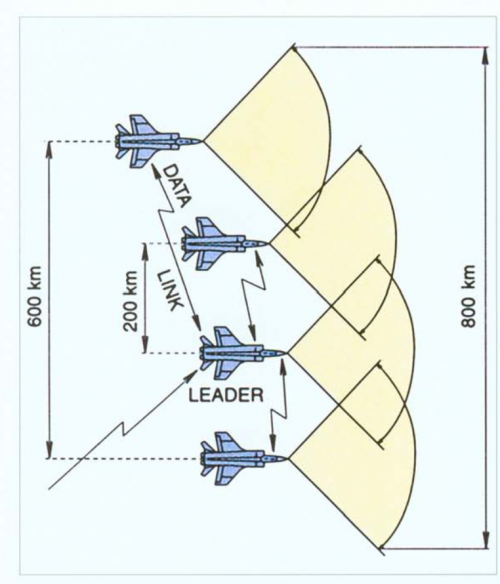
AWG-9/APG-71 is limited by the antenna design to ~370km. The backend can track targets at 750km, and did so when multiple Tomcats would datalink together.
I have seen that number before, but the only source of that is Wikipedia and there is no other reference so it is likely that the number is just utter nonsense. I also find it hard to believe that the slotted array APG-71 can out range PESA Irbis-E, given they are roughly the same size
.Besides, antenna is among the most important part of the radar, to say radar range is limited by antenna design is similar to saying “top speed is limited by aerodynamic”. It kinda obvious.
More reliable source seem to indicate that APG-71 has about 40% better range than AWG-9, which is a lot more reasonable in my opinion. That give it detection range of about 298 km against target with RCS of 5 m2
Moreover, F-35 can also lock target using its ASQ-239 and measure range by TDOA, completely passive and the range is basically as far as LOS as long as the target itself emit
AMRAAM-Ds have roughly the same range as Phoenix-A/B missiles.
Since they've been saying that AMRAAM-Ds more-or-less reach the threshold requirement for the AIM-260 RFP, I'd guess that the actual AIM-260 has a range close to that of the Phoenix-C missile. (with some pretty wide error bars on that guess!)
Ah, 2012. I remember it well - low rise jeans were still in style, "Gangnam Style" was a global phenomenon and the "Twilight" movies came to an end. The idea of a "quarterback" aircraft for unmanned minions was still 5 years away from being "a thing".
F/A-XX requirements were were so well defined in 2012, that three years later the Secretary of the Navy would publicly claim that the F-35C was going to "almost certainly" be the last manned fighter in the Navy .
It would be far more relevant to discuss the threat and whether current systems are adequate or not than reference a system from decades ago that addressed an environment that no longer exists. It seems very unlikely that anyone attempts a mass bomber strike with cruise missiles against a CSG - it would be nearly suicidal even with heavy escort. On the flip side, ballistic missiles launch from multiple domains (including bombers) is very much on the table. What combination of fighters and ordnance can address that? Alternatively, what other targets would help interrupt the kill chain?
So with the potential cancelation of this program to divert funding to the F-47, I am potentially reaching on this again but is there such an idea that the Navy could use the F-47 as the F/A-XX as a purely shore based air asset like the P-8? With the range and potential to be based in the island chains or even allied nations, is it possible that we will see a shore based fighter component for the Navy? Once again, pure speculation but it's an odd suspicion.
Highly unlikely, IMO. Only the USMC has operated shore-based fighters (F4Us before the RN figured out how to land them on carriers, and F7Fs later on), the USN has not since before WW2.
I have seen that number before, but the only source of that is Wikipedia and there is no other reference so it is likely that the number is just utter nonsense. I also find it hard to believe that the slotted array APG-71 can out range PESA Irbis-E, given they are roughly the same size
.Besides, antenna is among the most important part of the radar, to say radar range is limited by antenna design is similar to saying “top speed is limited by aerodynamic”. It kinda obvious.
More reliable source seem to indicate that APG-71 has about 40% better range than AWG-9, which is a lot more reasonable in my opinion. That give it detection range of about 298 km against target with RCS of 5 m2
Moreover, F-35 can also lock target using its ASQ-239 and measure range by TDOA, completely passive and the range is basically as far as LOS as long as the target itself emit View attachment 773255
Again, that range is claimed for the back end, not the antenna. Single-aircraft tracking range is said to be 370km or so. Put a bigger PESA or a GaN AESA antenna on it and you'll get significantly more range out of it.
The AIM-54C's GCU was significantly more advanced than the AIM-54A (The AIM-54B IIRC only had limited production before being superseded by the AIM-54C) and IIRC received several major redesign upgrades to its' GCU electronics.
That's why I believe the USN should invest more in long range fires to cover the strike role. With the basket of priorities that they have to balance, I can't see the FA-X/X being worth the heavy investment right now.
The claim of a 750 km tracking range for the APG-71 doesn’t appear to be backed by any reliable or official sources. The only place I’ve seen it mentioned is Wikipedia, and even there, no citation is provided for that figure. Frankly, I’m skeptical about its accuracy.
Such an extreme range raises several issues. First, pulse radar systems like the APG-71 can’t transmit and receive simultaneously, and to avoid range ambiguity they will wait for the return of the transmitted pulse before sending the next one. At 750 km, the round-trip time is substantial, which limits the pulse repetition frequency (PRF). To compensate for low PRF and still achieve long-range detection, you’d need extremely high pulse power. However, the APG-71’s peak power is around 10 kW not an exceptionally high value.
For comparison, the APG-81, with its 1,676 T/R modules, has an estimated peak power of about 16 kW, while the Irbis-E reaches up to 20 kW. Given these figures, there's no compelling reason to believe the APG-71 would outperform these more modern systems in detection range, especially not by such a massive margin
There is some comment in the Wikipedia implied that APG-71 can reach the 750 km range by datalink 2 or more F-14, but in my opinion, they likely mean the same thing with the claim that several Mig-31 linked can control a strip 800 km in length
Single-aircraft tracking range is said to be 370km or so. Put a bigger PESA or a GaN AESA antenna on it and you'll get significantly more range out of it.
Knowing the detection range without knowing the RCS value doesn't tell us a lot. For instance, both the Zaslon-M and Irbis-E radars are often cited with a 400 km detection range. However, this comparison is misleading without context: the Zaslon-M achieves that range against a target with a 20 m² RCS, while the Irbis-E does so against a much smaller 3 m² RCS
A mechanical scanned array like APG-71 has a central transmitter whereas AESA has hundreds or thousands of T/R modules, each acting as its own mini transmitter/receiver, so I don't think it is flexible to put an AESA array on APG-71. Of course, I don't doubt that a modern F-14 with a modern AESA can have good detection range, after all, APG-71 is roughly the size of Irbis-e, so an AESA or PESA version should have good detection range.
Back to APG-71, reliable source suggest that it has 40% better detection range compared to AWG-9, and since AWG-9 can detect target with RCS of 5 m2 from 213 km, we can expect APG-71 to do so from 298 km, that in optimum condition
Following this interview by F-14D pilot, he also claimed that in real world condition, APG-71 couldn't see at tanker at 190 miles (305 km)
AIM-120D-3 also said to use different flight profile to achieve even better range than AIM-120D (C-8). Back in 2021, USAF claimed they tested AIM-120D launched from F-15 and achieve the longest known air to air missile shot, so that should include AIM-54 shot as well https://www.flightglobal.com/fixed-...ssile-shot-with-aim-120-amraam/143293.articleThough to be fair, the maximum range doesn't seem to have a lot of value
According to this interview
The good PK shot is at around 20-30 miles (32-48 km), he also said that if they shot at 50 miles (80 km) then the target only need to change course by 25 degrees and the missile is defeated. F-35 armed with some thing like Meteor should achieve better NEZ and similar max range.
Ah, 2012. I remember it well - low rise jeans were still in style, "Gangnam Style" was a global phenomenon and the "Twilight" movies came to an end. The idea of a "quarterback" aircraft for unmanned minions was still 5 years away from being "a thing".
"A planned contract award is now on hold, postponing the once-imminent launch of the engineering and manufacturing development phase of the F/A-XX fighter, with Boeing and Northrop Grumman as the finalists..."
"A planned contract award is now on hold, postponing the once-imminent launch of the engineering and manufacturing development phase of the F/A-XX fighter, with Boeing and Northrop Grumman as the finalists..."
He lost faith in industry's ability to develop and deliver on a major aerospace project after apparently visiting a ship yard (from the article from Aviation Week).
So he's going to figure this out and basically everything is on hold until that happens and he may send everyone who's worked on this for years back to re-do their work. Most optimistic scenario here, they start a new program in a couple of years. The worst case, it just dies completely and they revive Super Hornet or ask Anduril or one of the 'new tech' bros to build a naval fighter.
He lost faith in industry's ability to develop and deliver on a major aerospace project after apparently visiting a ship yard (from the article from Aviation Week).
If he cancels everything and doesn't start anything new he can leave with a 100% track record when it comes to successful program starts during his tenure.
One of the key issues that remains is that the USN has a relatively young fighter fleet and an aging surface fleet. If you have to focus the funds one way or the other then it appears the surface has won out. Additionally we know the USN has had to focus on readiness over modernisation in recent years and some of the decisions made on F/A-XX funding in previous years was also based on this focus.
If F/A-XX does delay and come back again in a couple of years I expect LM will get another shot and we might also see a couple of non primes likes Andruil and GA give it a run.
He lost faith in industry's ability to develop and deliver on a major aerospace project after apparently visiting a ship yard (from the article from Aviation Week).
There's also a less gloomy interpretation here that assumes there's some level of competence still in this admin.
Here's some of the relevant bits from the article:
Phelan expressed his concerns about the defense industry's ability to deliver on F/A-XX in context of his reent tour of the Navy's shipbuilding yards, which revealed systemic problems with government management and contractor performance
"I do not have a lot of confidence. All of our programs are in trouble. We have a number of companies that are not performing. We've got to get those done.
...
All of our programs are a mess, to be honest. My best performing program is six months late and 67% over budget, " Phelan told the House Armed Services Committee during a hearing on the still-pending fiscal 2026 budget"
It sounds like he took a look at the shipbuilding projects and the way the Navy/DoD was working with the contractors and industrial base and became fearful that the same kind of mismanagement and contractor difficulties may have also crept into the F/A-XX. Given that Phelan is an outsider with zero military experience or knowledge, it might be reasonable to make such an assumption and want to take a close look at it before giving it an okay.
I think if I was in the position of deciding things, I'd probably have greater trust in the air force's management of the F-47 than the Navy's management of... well any program really. At the bare minimum, the air force's management of the B-21, CCAs and NGAD up until now seems to have produced results despite things like the E-7, KC-46 and T7 programs. The navy's program management on the other hand has, for a multitude of reasons within and not within it's control, ground to a halt.
"We're looking at the full composition of the air wing of the future and so we have to focus on the capabilities and the technologies that are going to win. And that includes manned and unmanned platforms that we have to look at," Phelan said.
This sounds more like the Navy (or just Phelan) is having a Frank Kendall NGAD moment. No matter how you look at it, the program itself is going to offer much better improvement over both the incumbant F-18s and the F-35s so I doubt the conclusion would be any different than the air force's, but it might be more a matter of how many we procure and maybe introducing Naval CCAs into the mix (which the navy has expressed reluctance to in the recent past).
This is, ofcourse, a more positive view of things. This administration has had a very mixed bag of decisions some of which are extremely concerning while others sounds like it's going in the right direction. I don't know. Maybe I'm just trying to make myself feel better about all this.
There is plenty of life left in the SH fleet. The USN received just over 600 Blk II jets and another 70 odd Blk III jets. All Blk III jets are capable of 10k flight hours and a portion of Blk II jets are being upgraded to Blk III standard taking them from the 6k to 10k flight hours. At the moment the line runs at 35 per year. Info on the upgrade is available here.
There is plenty of life left in the SH fleet. The USN received just over 600 Blk II jets and another 70 odd Blk III jets. All Blk III jets are capable of 10k flight hours and a portion of Blk II jets are being upgraded to Blk III standard taking them from the 6k to 10k flight hours. At the moment the line runs at 35 per year. Info on the upgrade is available here.
No, there is not. The majority of the Super Hornet fleet is bearing 9000 hours and will be there by 2030. This is the case the Navy has been making to Congress for many years. The UCLASS program was restructured from strike/ISR to tanker to take pressure off these aircraft - too late. The Super Hornet fleet is being “upgraded” as a stopgap to the F/A-XX transition.
That is incorrect. The Navy has made it clear, many, many times, that the FA-XX is a strike fighter.
Naval Aviation Vision 2030-2035
STATEMENT OF NICKOLAS H. GUERTIN ASSISTANT SECRETARY OF THE NAVY (RESEARCH, DEVELOPMENT AND ACQUISITION) AND LIEUTENANT GENERAL BRADFORD GERING DEPUTY COMMANDANT FOR AVIATION AND REAR ADMIRAL MICHAEL DONNELLY DIRECTOR AIR WARFARE BEFORE THE TACTICAL AIR AND LAND FORCES SUBCOMMITTEE OF THE HOUSE ARMED SERVICES COMMITTEE ON DEPARTMENT OF THE NAVY FISCAL YEAR 2025 BUDGET REQUEST FOR TACTICAL AVIATION APRIL 16, 2024
STATEMENT OF RADM ANDREW J. LOISELLE,USN, DIRECTOR, AIR WARFARE, U.S. NAVY, HEARING ON NATIONAL DEFENSE AUTHORIZATION ACT FOR FISCAL YEAR 2024 AND OVERSIGHT OF PREVIOUSLY AUTHORIZED PROGRAMS BEFORE THE COMMITTEE ON ARMED SERVICES HOUSE OF REPRESENTATIVES ONE HUNDRED EIGHTEENTH CONGRESS FIRST SESSION SUBCOMMITTEE ON TACTICAL AIR AND LAND FORCES HEARING ON FISCAL YEAR 2024 BUDGET REQUEST OF THE DEPARTMENT OF DEFENSE FOR FIXED–WING TACTICAL AND TRAINING AIRCRAFT PROGRAMS HEARING HELD MARCH 29, 2023
...etc.
So yeah, F/A-XX does not "exist to ensure air dominance". It is a strike fighter designed to replace the Super Hornet.
This fight is kind of silly. Since the A-12 debacle, the Navy has wanted only multirole fighters. Failing to find a replacement for the A-6 wasted time and money and set naval aviation back during a time of declining defense spending. It needed to fill the decks and replace attack aircraft and A2A fighter at the same time. Another issue is that the constraints of the carrier deck penalizes specialization. Advances in sensors and mission systems have also enabled combat aircraft to perform both roles at a high level. Saying that the F/A-XX replaces the Super Hornet is too simplistic. Yes, it will replace the SH in the inventory. But 5.5 Gen or 6th Gen, whatever the F/A-XX becomes, will bring new functions and new capabilities that the SH never had. And with it new roles and missions.
Whatever the case, a war with China will be an all hands on deck fight, especially as China develops news systems in the coming years. The main threat currently is arguably intermediate range ballistic missiles. The threat to the CSG from air breathing systems will become greater, not less, overtime. We've gone from having to counter H6 bombers to now the J36. At some point China will deploy the H20 bomber. Carriers have the advantage of mobility but their air wings lack mass. They will use whatever they have on hand to defend the carrier form attack.
Admiral Michael Donnelly, head of N98, has said, "Inherent in its design is its ability to participate in fleet defense. We can’t afford to have a break-glass capability or a really unique single-mission or single-phase-of-operation focus." Donnelly has also said that it will also penetrate enemy air defenses.
There is so little information on the F/A-XX that no one should be confident about anything. It might end up not having vertical tails. Who thought the F-47 had canards. But then we found out that it might not. May be F/A-XX will be similar to the Super Hornet? Something that is just good enough with a lot of warts, but something they can work with? A bigger threat is whether they even can afford more than a meager buy per year.
"The U.S. military’s top officer said Thursday that the Navy’s requirements for a next-generation stealth fighter jet are “still valid,” even though the Pentagon’s civilian leadership aims to cut the budget for the system while reassessing the program....."
No, there is not. The majority of the Super Hornet fleet is bearing 9000 hours and will be there by 2030. This is the case the Navy has been making to Congress for many years. The UCLASS program was restructured from strike/ISR to tanker to take pressure off these aircraft - too late. The Super Hornet fleet is being “upgraded” as a stopgap to the F/A-XX transition.
No, there is not. The majority of the Super Hornet fleet is bearing 9000 hours and will be there by 2030. This is the case the Navy has been making to Congress for many years. The UCLASS program was restructured from strike/ISR to tanker to take pressure off these aircraft - too late. The Super Hornet fleet is being “upgraded” as a stopgap to the F/A-XX transition.
Quellish the Blk I and II aircraft were not certified to fly to 9000 hours, there is no way that the bulk of the fleet can be at 9000 hours. I assume you are confused with the USMC classic Hornets which they plan to fly to 10000 with the fleet already quite old.
Along with the upgrade package, the USMC has separately been conducting comprehensive airframe inspections at navy depots to extend the service lives of individual Hornets – which have logged an average of about 8,000 flying hours – to 10,000h.
Boeing has completed the upgrade and life extension of the first two service life modification (SLM) F/A-18 Block III Super Hornets, delivering them to the U.S. Navy one month ahead of schedule from St. Louis and two months ahead of schedule from San Antonio. The upgraded jets have the same capabilities as Super Hornets being delivered from Boeing’s new-build production line.
The F/A-18 Block III conduced its first flight in May 2020. Its configuration adds capability upgrades that include enhanced network capability, longer range, reduced radar signature, an advanced cockpit system and an enhanced communication system. Boeing started converting existing Block II Super Hornets to Block III this year. The fighter’s life will be extended from 6,000 hours to 10,000 hours.
This is absolutely untrue. There is an enormous volume of information on the program available from the Department of Defense. I have thousands of pages of documents from the Navy, OSD, other DoD components and Congress about the program. To say there is little information about the program is just plain wrong.
The Navy is confident in their plan for the F/A-XX and the future of naval aviation. Not confident that they will execute it, but confident that this *is* the plan. The F/A-XX is a strike fighter and "quarterback" - that is part of the plan. The Navy, to their credit, does not have an absurd fixation on continuing the "fleet defense" mission as it was executed in the 1950s - unlike many of our forum members.
Quellish the Blk I and II aircraft were not certified to fly to 9000 hours, there is no way that the bulk of the fleet can be at 9000 hours. I assume you are confused with the USMC classic Hornets which they plan to fly to 10000 with the fleet already quite old.
The Original Recipe Hornets are being replaced by F-35s. They have nothing to do with F/A-XX.
I am not "confused". I am repeating what the Navy has planned, and what they have been telling Congress for more than 5 years. The Navy is desperate to replace the Super Hornets that are nearly at the end of their life and at the same time is experiencing a "strike fighter shortage".
But American submariners usually consider merchant ships their primary targets, and warships as targets of opportunity. How well will China handle having every single merchant ship flying their flag at sea sunk in the first 24-48 hours of hostilities?
I am not "confused". I am repeating what the Navy has planned, and what they have been telling Congress for more than 5 years. The Navy is desperate to replace the Super Hornets that are nearly at the end of their life and at the same time is experiencing a "strike fighter shortage".
Quellish what you believe the USN has been telling Congress doesn't represent the facts of the age of the SH fleet. The facts are quite clear on the age of the fleet. The SH fleet bearing 9000 hours average age and will be there by 2030 is not possible as the SH Blk II which makes the bulk of the fleet is not certified to fly to 9000 hours, it is only certified to 6000 flight hours. Only aircraft that have undergone the SLM can fly past 9000 hours. The initial estimate was 9000 hours but the SLM has since been upgraded to 10000 hours, 4000 hours of additional life per airframe.
Boeing delivered the first F/A-18E/F Super Hornet with a 1,500h service-life extension to the US Navy (USN) on 21 January. The Service Life Modification programme initially extends the aircraft’s usability from 6,000h to 7,500h.
Boeing and the USN plan to bring back the fighter aircraft for additional modifications starting in 2022. Those follow-up modifications will increase aircraft service life to 10,000h and integrate Block III upgrades, which include conformal fuel tanks, a faster mission computer and a more-robust communications system.
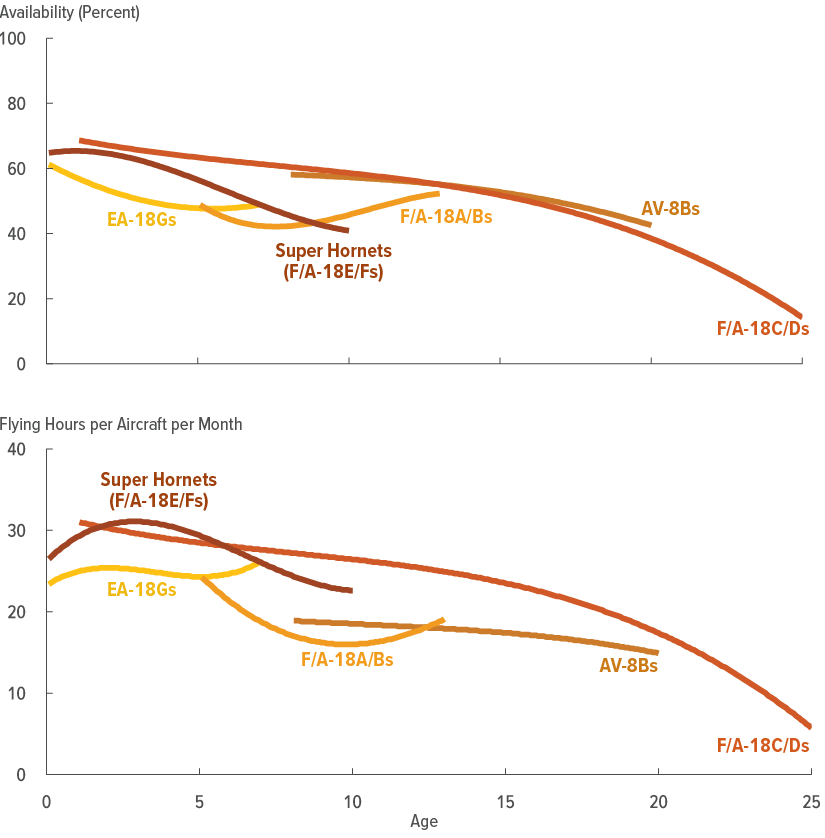
This chart shows the average monthly hours per aircraft by the SH fleet in their first ten years of service. While there was an initial hump above 30 hours per month it reduced down to below 25. If every aircraft in the SH fleet had been built in 2001 and had flown 30 hours per month from 2001 to 2025 then the hours flown per aircraft would be 8640 hours. Every SH aircraft was not built in 2001.
This selected acquisition report from 2013 lists the fleet total at 506 aircraft on 27 March. It also states the total hours flown by the SH fleet was over 1,131,122.
As of March 27, 2013, the program has delivered 506aircraft to the fleet (62 Low Rate Initial Production (LRIP) and 444 Full Rate Production (FRP)). This report solely reflects the domestic Program of Record (PoR) quantities.
As of January 30, 2013, Super Hornet aircraft have flown over 1,131,122 hours
Simple maths says 1,131122 hours divided by 506 aircraft gets us to an average aircraft hours flown in 2013 of just over 2235 hours per jet. Obviously there are jets higher than 2235 hours and there would be jets lower than 2235 hours.
Extrapolating out another twelve years from 2013 to 2025. Saying the fleet will fly the same number of hours would be incorrect, it will have flown more as the Classic Hornet left the fleet in 2019 with its last operational deployment in 2018. Some of that reduction is balanced by the increase in F-35C with 100 delivered by 2024.
To be at 8460 hours by 2025 the SH fleet would have had to have flown 45 hours per month, twice the trend of the first 12 years.
Fortunately we have this study https://www.cbo.gov/system/files/2024-06/60283-Super-Hornet.pdf which shows the average flying hours of the Super Hornet in the 2017-2021 was approximately 275 per year or 23 per month. We additionally have the graphic on slide 11 which shows how that 23 per month average was mixed over the fleet, some flying very high hours, some flying above average hours, most flying the average and a decent portion flying no hours. Hence the USN were averaging out the hours across the fleet.
23 hours per month over 5 years means each aircraft flew an average of approximately 1380 hours in that five year period.
The reality is the SH fleet wasn't available enough to have flown the hours you are suggesting over that last twelve years. Additionally the USN has added another approximately 200 SH in that twelve year period lowering again the average age of the fleet.
We also have this article from 2018 which states that is 2017 no SH had hit the 6000 flight hour mark yet.
The Super Hornet life extension program will begin whenever the first jet hits its 6,000 flight hour limit, and the company expects that will happen next year.
What I believe the Navy has been telling Congress? The Navy has been clear and consistent in their communications with Congress regarding the state of the F/A-XX program, the age of the F/A-18E fleet, and how the two relate. This has been in sworn testimony supports by facts. There is no "belief" here on my part or that of the Navy.
The facts are quite clear on the age of the fleet. The SH fleet bearing 9000 hours average age and will be there by 2030 is not possible as the SH Blk II which makes the bulk of the fleet is not certified to fly to 9000 hours, it is only certified to 6000 flight hours. Only aircraft that have undergone the SLM can fly past 9000 hours. The initial estimate was 9000 hours but the SLM has since been upgraded to 10000 hours, 4000 hours of additional life per airframe.
First, in my original post, "bearing" should have been "nearing". This was a typing mistake, but should not matter.
Second, your statements here are incorrect.
The F/A-18E, as delivered from the factory, was "certified" for 6000 hours.
The Service Life Extension Authorization process allows individual aircraft, after inspection, to be authorized ("placarded") to fly up to 7500 hours total before requiring a Service Life Extension. This is Phase I of the Service Life Modification program. Super Hornets that reach 6000 flight hours must either undergo the SLEA process or be removed from service.
Phase II of the SLM process involves extensive modification and upgrade of the aircraft, including to "Block III" standards (new cockpit, etc.). This is intended to extend the life of the airframe further, however this too is specific to individual airframes. Not every aircraft will have its life extended to 10,000 hours.
How can you have an average age of the fleet approaching 9000 hours if the aircraft are no certified to fly to that hour number and the first aircraft to be certified to fly past 9000 hours didn't finish the Blk III SLM until 2024.
This chart shows the average monthly hours per aircraft by the SH fleet in their first ten years of service. While there was an initial hump above 30 hours per month it reduced down to below 25. If every aircraft in the SH fleet had been built in 2001 and had flown 30 hours per month from 2001 to 2025 then the hours flown per aircraft would be 8640 hours. Every SH aircraft was not built in 2001.
This chart is from page 5 of the 2023 CBO report "Availability and Use of the F/A-18E/F Super Hornet Fighter Aircraft", which unfortunately you do not specifically cite. Strangely, later you cite a 2024 presentation, "Declines in Availability of Super Hornet Fighter Aircraft", which is based on two separate 2023 CBO reports, the previously mentioned one and "DECKPLATE and AMSRR: Comparing Two Ways to Measure the Availability of F/A-18E/F Super Hornet Aircraft ". We will come back to this.
The focus of this report was the "availability" of the F/A-18E to perform missions (training, combat, etc.). The analysis found that a 10 year old Super Hornet is equivalent to a 20 year old F/A-18(A/B/C/D) in terms of availability. The Super Hornets are both physically and operationally aging much faster than the Original Recipe Hornet. The same analysis estimates that the availability of Super Hornets will stabilize or decline further.
What the chart illustrates is: "Availability Rates and Flying Hours of Super Hornets and Other Navy Fighter and Attack Aircraft, by Age", where "age" is the age of the individual airframe in years.
Had you cited the 2024 report 61347 "Availability, Use, and Operating and Support Costs of F-35 Fighter Aircraft" you would have seen more specific numbers (and pretty graphs) such as on page 14, where the specific average number of flying hours for the F/A-18E in 2024 is given (221). This, too, is a naive "total flying hours / total number of aircraft owned".
But because both of these reports focus on the availability to perform missions there is a lot of information missing that is relevant to the discussion of both airframe aging and hours. How did CBO calculate the "average" number of flying hours? Did they (like you) perform a naive "total flying hours / total number of aircraft owned"? Or did they account for the number of airframes in depot maintenance , undergoing life extension, or otherwise non-operational but "owned" (and not accumulating flight hours)?
If you had the data the Navy provided to CBO (from DECKPLATE and AMSRR) you might know the answers to this and other questions about the CBO report and wether their analysis is relevant to your hypothesis.
The reality, from the same data CBO used, is that of the aircraft that COULD fly, the availability rate was higher, and the hours accumulated was higher as well. Aircraft that CAN fly are being flown at a much higher rate than those that cannot fly (due to depot maint, etc.). In the naive "flight hours / number of aircraft owned " analysis this is not taken into account. Nor are all the factors of operating carrier aircraft. For example, an airframe that is on shore after depot repair is not "operational" again until the carrier returns to port.
The data clearly shows the flight hours for each aircraft. The 2024 data shows a number of Super Hornets that are over 6000 flight hours and have no SLEA.
By April of 2017 one Super Hornet had already hit 6000 hours. By June of 2018 most of the early production aircraft were at or above 6000 hours. In April of 2018 the first two airframes to enter the SLM process were at 5600 and 6100 hours.
This first aircraft (BuNo 166619) to enter SLM was delivered in 2004. In 14 years it accumulated 5600 hours. Using your "simple maths" (5600/14), this is an average of 400 flight hours a year.
This should be “impossible” according to your “simple maths” approach.
Yes, after the 18 month SLM upgrade process it was placarded for 7500 hours. Not 9000 or 10000 hours, 7500 hours. Which, using the "simples maths" above of an average 400 flight hours per year, gives the airframe less than 5 years of additional life. It should be removed from operational service right about... now. It was scheduled to be removed from service by the end of 2025, but was lost to friendly fire in December 2024.
The fact is the majority of the Super Hornets (well over 60%) were produced before 2010. The data from the Navy shows that the distribution of flight hours is weighted heavily on those aircraft (the same data the CBO used in their 2023 and 2024 reports). The distribution of flight hours greatly affects aircraft availability fleet wide. The 2023 CBO reports found this, and the slide deck you cited as a source highlighted it. Those aircraft produced before 2010 have accumulated a very large number of flight hours and are the majority of the Navy Super Hornet fleet. These aircraft are swiftly approaching 9000 hours and the Navy projects that they will get there by about 2030.
I do get the feeling you may not have read or understood the very documents you are citing. For example, the slides on page 10 and 11 of "Declines in Availability of Super Hornet Fighter Aircraft" clearly show that the distribution of flying hours is very different than what you have claimed.
You may be confusing this aircraft with some other. 166619 was not in SLM from 2022 to 2024 and was photographed in 2022, 2023, and 2024 before being lost to friendly fire in December. Navy records for this aircraft confirm this, and do not show it was placarded for a 10000 hour service life.
Citing or referencing sources without reading or understanding them is pointless. It does not help anything. Creating fictional information to support some position or agenda is equally futile. In this case, it appears that the "sources" were picked because they appeared to support someone's position and some of the data was used to "extrapolate" using "simple maths" fictional numbers. It does not seem any attempt was made at all to understand the information that was used or the data it was based on. And at that point, why bother with sources at all?
But anyone is free to do.... that. And over the last year, in particular threads, I have seen a pattern of this behavior from certain individuals. They are free to do..... that. And I am free to decline to engage with those individuals, and any thread they participate in. And that is what I am going to do moving forward.
This site uses cookies to help personalise content, tailor your experience and to keep you logged in if you register.
By continuing to use this site, you are consenting to our use of cookies.


 .
.