Far enough out to sea, tsunami are less problematic. Same with rising (or for that matter falling)

The coast can then be used for airports and/or agrarian...then it can shake and liquefy during earthquakes with less structural damage.

Volcanic hazard? Tow it out of the reach of pyroclastic flows.
 
View attachment 781108View attachment 781109
Buckminster Fuller's Triton City: a city that would float on the water.

It's a smart idea given that 71% of the surface of this planet is covered by water and most of our crowded cities are on the water.

The development of strong and lightweight foamed metals and ceramics would all but eliminate the risk of sinking and make this quite a practical proposition.

If nothing else, floating highways and airports would be helpful to many urban challenges.
Here's something to chew on: Royal Caribbean's Icon of the Seas Cruise Ship is a city all to itself with 10,000 people (7,600 guests and 2,400 crew)
 
This urban form is standard in large parts of cities like Hong Kong, and has been since the 1970s. Indeed, a lot of the circulation systems in Hong Kong would have been initially designed in cooperation with British planners.

This is a very pleasant middle-class development built in the 70s, still very competitive, in many ways as good as or better than modern developments (better access to parks, more retail options etc).

639bda60-1f5e-11e7-ba38-4217a96bb749_1320x770_163613.JPG
img_wm_revamp.php
View attachment 778599


In addition to the famous Central Mid Levels escalator network in the financial district, footbridge networks to ensure grade separation of foot traffic and road traffic can be found all around Hong Kong. They weave between malls (many with air-conditioning) and various retail arcades located along the footbridge networks, and typically lead to subway stations.


img_wm_revamp.php
9d04c814400e1f904aa665e5d24cd085.JPG
2017100959db5c3124555.jpg
View attachment 778600
tseung-kwan-o-hong-kong-09-august-2020-top-view-of-hong-kong-city-2ptfrde.jpg


Different implementations of mixed retail + pedestrian grade separation from different eras (1980s, Sha Tin New Town vs 2000s, Tseung Kwan O New Town). Note the air-conditioned footbridges leading into the subway station/giant mall/transit hub podium thing in the new iteration. Also note residential developments on top. Retail is integrated into the pedestrian walkway system as in the original concept. These are all upper middle class to upper class developments.

And yes, the New Town terminology was carried over by British and British-adjacent urban planners. They might not have been able to build a New Town in Hook, but they sure as hell were able to build a New Town in Sha Tin.

These things were first popularized by Magic Motorways back in the late 1930s and the GM World's Fair Futurama in 1939, but implementation has been non-uniform.

cars1.jpg
View attachment 778602
tumblr_pr6i36QPXB1skkfpco1_1280.jpg

Hongkong is OK for pedestrians (despite the second level is often a labyrinth with many dead ends...) but terrible for disabled or people with a baby carriage. Building elevators on every crossing is not practical and so you need to use stairs or escalators very often. To prevent people from crossing streets on the street level, many fences have been erected, preventing wheel chairs from going anywhere...

I don't think, this is the way to go, it is also not compatible with most existing city structures and would turn ones beautiful cities in a Blade runner style metropolis....
 
despite the second level is often a labyrinth with many dead ends...
Wheelchairs should not be on the street either. They should be grade-separated with the rest of the pedestrians--hence the fences.

Accessibility is relatively good for East Asia, especially in more modern construction, avoiding changes of grade without stairs is very much a design goal; and there has been a recent elevator-retrofitting spree to improve accessibility in older construction for the elderly and the disabled. There are literally thousands of elevators scattered everywhere, connecting underground tunnels, hillsides, and pedestrian bridge networks.

Of course, older installations will have many more changes of grade, but this is unavoidable.

Navigability always encounters limitations unless you go with rather boring American-style square grids, and it is typical of cities that locals know all the shortcuts.

Aesthetically, Blade runner style metropoli are clearly the most beautiful urban form, but this is necessarily subjective. :p
 
I guess, as a Hong Kong citizan, you get used to it and can find all the hidden elevators. Luckily, I don't need them and so I take the stairs instead, but I have to say it is quite a labyrinth. You have to walk through supermarkets/shopping malls and you never know if you can continue your walk or have to go up/down/left/right....

Don't get me wrong, I really like Hong Kong, but I don't want to convert other cities (with exaptions) into that.

Attached is are two pic wich I took last week. With the 80th style Sky scrapers the narrow streets and Chinese/English advertisrment, I really felt like in Blade Runner....
 

Attachments

  • 20250819_232146.jpg
    20250819_232146.jpg
    3.8 MB · Views: 51
  • 20250819_222719.jpg
    20250819_222719.jpg
    1.7 MB · Views: 48
Turned up in my feed. One of those 'in the future we will have...' things.

In the early 1920s, fans of science and technology were certain that a world of frequent air travel was just over the horizon. People would be zipping from place to place like it was nothing. But there was just one problem for both dense urban areas and isolated mountaintops: How do you give planes enough space to take off and land?

Some people of the 20th century proposed circular runways on the top of tall buildings. Others imagined that constructing vertical takeoff and landing vehicles would be the solution. But this idea, published in the December 1923 issue of Science and Invention magazine, pictured runways built to jut out beyond the footprint of the building. And this design would work not just for the tops of tall buildings, but at mountain peaks as well.

The idea was credited to George F. Paul and was even imagined as something that could rotate in order to line up with the direction of the wind.

The new landing stage shown in the above drawing can be constructed anywhere, regardless of physical conditions surrounding it. It will accommodate landing in any weather and allow planes to hop off without a runway. The structure is of fabricated steel and automatically faces itself into the wind.

The illustration explained that the runway would be 500 feet long and 60 feet wide and showed little drawings of people to give the reader some perspective on just how large the landing space would be.

Another illustration showed what the landing pad might look like on top of a tall building in an urban area. A portion of the gigantic structure is listed as a “living quarters,” though it never explained who would be living up there. Would it be residential areas for anybody who wanted to live at what would essentially be an airport? Or is it more of a lighthouse situation, where the people overseeing the runway would be tasked with being on-site at all times? That part is never answered.

Source: Paleofuture

Pictures taken from the December 1923 issue of Science and Invention magazine (Novak Archive)
 

Attachments

  • 537116659_746691928147240_3294455047023146096_n.jpg
    537116659_746691928147240_3294455047023146096_n.jpg
    215.3 KB · Views: 36
  • 537372395_746692041480562_9037350348598460152_n.jpg
    537372395_746692041480562_9037350348598460152_n.jpg
    348.1 KB · Views: 39
Thinking of the above, futurology from 1930, the musical film, Just Imagine.

The 1920s and the early 1930s were a time when some people were starting to optimistically think of the future as both different from the present and excitingly good. Hugo Gernsback was certainly an influence.

One might think first of Metropolis as the definitive version of the future imagined in the past (and direct ancestor of Blade Runner), but this is a more lighthearted vision.


Attachments

  • photo-l-amour-en-l-an-2000-just-imagine-1930-5.jpg
    photo-l-amour-en-l-an-2000-just-imagine-1930-5.jpg
    68.9 KB · Views: 38
  • MV5BN2ZmNTI2NDgtNjYyZS00ODEyLWE3ZWUtNTY0YTlhYjAxMDIyXkEyXkFqcGc@._V1_.jpg
    MV5BN2ZmNTI2NDgtNjYyZS00ODEyLWE3ZWUtNTY0YTlhYjAxMDIyXkEyXkFqcGc@._V1_.jpg
    258.4 KB · Views: 36
  • justimagine_skyscrapers.jpg
    justimagine_skyscrapers.jpg
    128.3 KB · Views: 38
  • JustImagine23.png
    JustImagine23.png
    528 KB · Views: 38
In this film, there's a mixture of the megastructures envisaged by Hugh Ferris and the 'rational' modernism of Ludwig Hilberseimer, who under the patronage of Ludwig Mies van der Rohe established himself in Chicago in the 30s.

Ferris was nicknamed 'The Prince of Darkness' for his use of chiaroscuro - that is, shadow and light. Here the two are compared.
 

Attachments

  • 76b4cb18-9129-4d50-8ba3-43ef8fad88fa.jpg
    76b4cb18-9129-4d50-8ba3-43ef8fad88fa.jpg
    132.5 KB · Views: 48
  • 87445_29a_Ferris.jpg
    87445_29a_Ferris.jpg
    543.4 KB · Views: 59
2025 - 1973 = 52 years ! ... over half a century later the upper one still seems to be the norm ? (around here anyway !)
 

Attachments

  • 20250920_143737.jpg
    20250920_143737.jpg
    2.7 MB · Views: 67
2025 - 1973 = 52 years ! ... over half a century later the upper one still seems to be the norm ? (around here anyway !)
Ignoring the many, many downsides of water based freight, I don't think people would go out for leisurely strolls alongside barge canals
 
Ignoring the many, many downsides of water based freight, I don't think people would go out for leisurely strolls alongside barge canals

Oh, they definitely do so, at least so in Germany and France, inclosing myself...

In Germany have even been protests from ''Nimbies'' against a sound protection wall which would have limited the visibility and accessibility of a shipping canal.
 

A short BBC video on some interesting background, in particular the 'X-City' project, to the site of the UN headquarters in New York.

EDIT: Some more info on the project.
 
9781864706932-28-3-600x754.jpg
Urban Nucleus- Proposed by Cesar Pelli in 1966. It would be built in the Santa Monica Mountains with commercial, institutional, and parking use at the top of the mountain with residential units built on the slops and accessible by elevators. For those not familiar with the area, the SM Mountains are plagued by earthquakes, landslides, and as the events in January illustrated, wildfires.
 
Last edited:
View attachment 786134
Urban Nucleus- Proposed by Cesar Pelli in 1966. It would be built in the Santa Monica Mountains with commercial, institutional, and parking use at the top of the mountain with residential units built on the slops and accessible by elevators. This was clearly in a time when architects shrugged off concerns like wildfires, landslides, and earthquakes, all of which are huge problems in the Santa Monica Mountains.
Huh. That type of thing has showed up in the backgrounds of the Ghost in the Shell manga! And landslides and earthquakes are definitely a thing to worry about in Japan (or Hong Kong, depending on which manga you're reading)
 
Huh. That type of thing has showed up in the backgrounds of the Ghost in the Shell manga! And landslides and earthquakes are definitely a thing to worry about in Japan (or Hong Kong, depending on which manga you're reading)
But, as far as I know, wildfires aren't much of a problem, unlike California.
 
There was a time when personal aircraft for everyone seemed possible.

And London had quite a few plans for airports that would support it.

This video looks at some of those (Thames airport, Kings Cross, Skyport One, Charing Cross Heliport) and visualises London if we went down that fork in the road.

 
Last edited:
Any airport in that area would have to contend with mudflats, bird sanctuaries and the wreck of the SS Richard Montgomery. Perhaps it would make more sense to increase capacity at Gatwick and Luton or maybe move cargo traffic away from Heathrow
 
Any airport in that area would have to contend with mudflats, bird sanctuaries and the wreck of the SS Richard Montgomery. Perhaps it would make more sense to increase capacity at Gatwick and Luton or maybe move cargo traffic away from Heathrow
Why are the mudflats a problem? Subsidence?

dc2e2a7e-a3d9-4012-913b-b59bb943.jpg

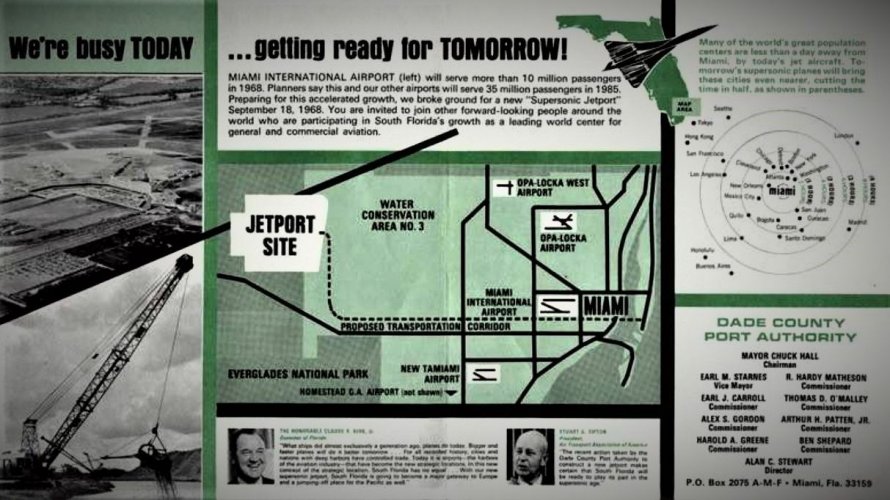
In keeping with the tradition of selling Florida swampland to unsuspecting marks as prime real estate, Dade County wanted to build a jetport in the middle of the Everglades.
 

Similar threads

Back
Top Bottom
