- Joined
- 18 October 2006
- Messages
- 4,782
- Reaction score
- 6,847
Did you mean uncrewed VTOL cargo platform…?


Did you mean uncrewed VTOL cargo platform…?
Sikorsky has officially turned America’s most prolific military helicopter, the UH-60 Black Hawk, into a fully unmanned drone aircraft, and it might just be a glimpse into the future of military aviation.
So, let's talk about the S-70UAS U-HAWK.
?) will go into production?

I agree that the USN might have a good case for the CQH-60L.
During the acquisition program.Edit: If this goes into production I wonder how long it will be before US Army and USMC troops start calling it the "U-Haul"
While there certainly are plenty H-60 platforms available, how many you can "man" with maintainers and software support personnel will remain the difficult part of employing the platform within the DOW. Asking the supporting maintainers to work on twice the number of aircraft means half the time on any one aircraft. Also remember naval H-60 have a lot of extra kit to fold up and go below deck.Good point! It has occurred to me that since the H-60 Blackhawk has been in service since 1979 I wonder how many (If any) of the early models are retired to the Boneyard at Davis-Monthan AFB? It would seem to me that they'd be good candidates for conversion into CQH-60s.
Aside from the military market would there be much of a market for a drone S-70?
IIRC the Seahawks fold automatically. Even if not, the ground crew does that, which may not even be airedales and so just ship's force.While there certainly are plenty H-60 platforms available, how many you can "man" with maintainers and software support personnel will remain the difficult part of employing the platform within the DOW. Asking the supporting maintainers to work on twice the number of aircraft means half the time on any one aircraft. Also remember naval H-60 have a lot of extra kit to fold up and go below deck.
Slung loads is what comes to mind. Fire bombing, helicopter logging. Oh, and resupply of said dudes.Civil utilization will come down to cost to operate. Is there a profitable niche for the aircraft?
Each aircraft still requires maintenance. Unless you replace some of the platforms (as in U-HAWK is not additive to the fleet) you will need more folks for the workload. Certainly it is feasible that U-HAWK could replace some of the cross deck transfer and potentially do more effort (more weight per lift or fly longer), but it is not free.IIRC the Seahawks fold automatically. Even if not, the ground crew does that, which may not even be airedales and so just ship's force.
Slung loads is what comes to mind. Fire bombing, helicopter logging. Oh, and resupply of said dudes.

Each aircraft still requires maintenance. Unless you replace some of the platforms (as in U-HAWK is not additive to the fleet) you will need more folks for the workload. Certainly it is feasible that U-HAWK could replace some of the cross deck transfer and potentially do more effort (more weight per lift or fly longer), but it is not free.
I am not sure you need this level of modification to make a UH-60 a good fire bomber. If the payload is increase enough maybe. I think just putting the MATRIX software into a UH-60, removing the seats, and unneeded avionics would net you ~1000 lbs without having to completely rebuilding the aircraft.
Bottomline, cost/productivity will decide if the U-HAWK is fielded. Sikorsky is looking for a means to exist post Multi-year 11 and CH-53K and casting about with an number of options to see if any of them catch on.


I only flew Gliders in my life but why would they remove pedals ? That sounds so stupidI don't like the 4-axis stick. Helo are all about torque and you need muscle memory for that with your eyes out of the cockpit. I think they went too far. IMOHO, the combination of thumb and wrist action while in an off-center position in roll and pitch is very difficult to master precisely, something you absolutely want to be able to do while inserting such a big airframe within a forest canopy or city street.
But let´s see how the market reacts.
https://www.skyryse.com/skyos
I personally agree with having pedals, however, like many things aviation, I am old. I don't like looking at ten metric tons of poop on my primary display and having to push eight different bezel buttons to change radio frequencies or go to the next waypoint. I did all of that with boiler gauges, knobs, and switches. That was along time ago. Modern aviators are accepting of these things and if your trained to do yaw control with your wrist I suspect the aviators will do just fine. I will note that the RAH-66 did not have pedals the cyclic control had the yaw control and 10% power control in the vertical axis as well. The old thyme helicopter pilots on the Comanche program figured out how to use it much to the irritation of their equally old thyme helicopter pilots.I don't like the 4-axis stick. Helo are all about torque and you need muscle memory for that with your eyes out of the cockpit. I think they went too far. IMOHO, the combination of thumb and wrist action while in an off-center position in roll and pitch is very difficult to master precisely, something you absolutely want to be able to do while inserting such a big airframe within a forest canopy or city street.
But let´s see how the market reacts.
https://www.skyryse.com/skyos
The flight controls were fly-by-wire with a right sidearm controller for pitch, roll, and yaw control. A left side collective pitch controller was used.
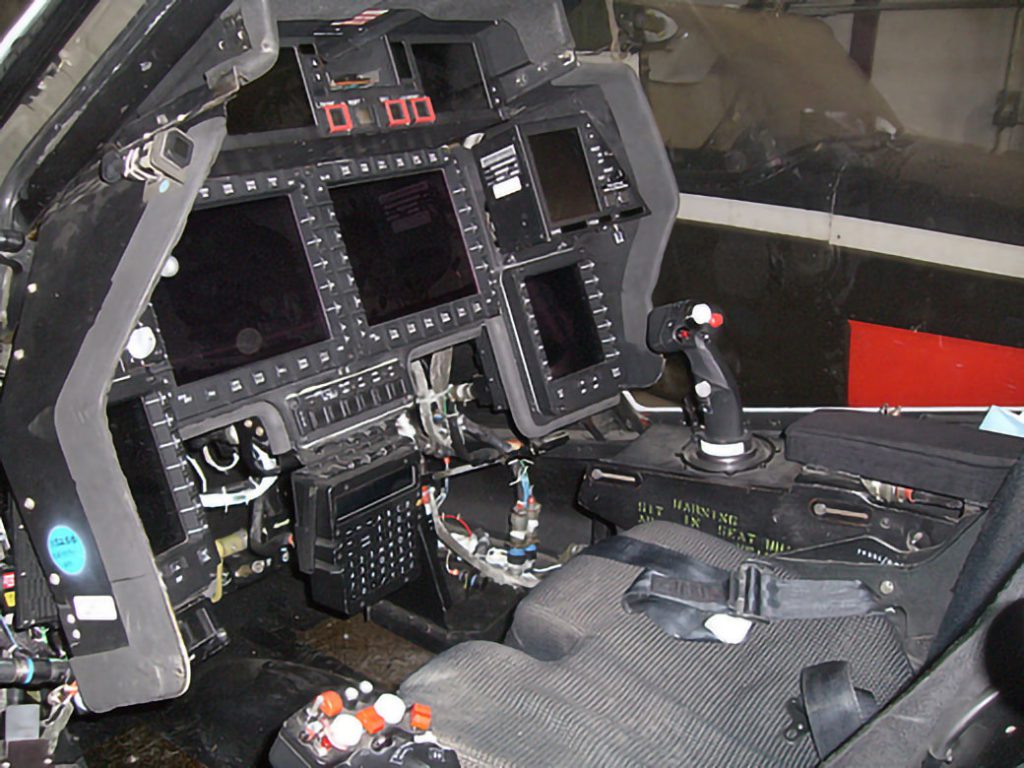
Am I seeing that correctly?Well, it´s not about old and new but about achieving precision in controlling an aircraft. When you start having ample deflection in pitch and roll, the wrist action to sustain a yaw movement is not constant or linear since human are not built like a well balanced mechanism. So you either loose dexterity to maintain your flightpath or need constant correction altering your trajectory in the 3 axis.
3 axis is really enjoyable for smooth deflection, I concede, but, at least to me, doesn´t apply to tactical flight or emergency situations. Add the smooth movement required to control the cyclic with what seems to be a slider under the thumb and it might be easier to master both Latin and ancient Greek in the time you would need for a check ride!
You are citing the Comanche controls from Sikorsky, but probably there is some confusion. I read:
https://sikorskyarchives.com/home/s...copter-innovation-era/boeing-sikorsky-rah-66/
If you need to take a hand off the collective to poke at the MFDs, wouldn't the slew switch for engine power belong on the cyclic?Very good points. As there have been few aircraft with this flight control methodology it is likely not well researched.
As to Comanche I should have been more precise. The primary pitch control remained a collective lever on the left side of the cockpit. The cyclic grip was given a.10% power modulation capability. This was to allow the pilot an ability to use their left hand to manipulate MFD action. Likely would not have been used in forward combat areas as much as originally envisioned.
Today this is remedied by providing a thumb driven slew switch, usually on the collective lever.
The picture is of one of the two prototype. The planned production aircraft was not to have as many MFD.Am I seeing that correctly?
7 or 8 MFDs?
If you need to take a hand off the collective to poke at the MFDs, wouldn't the slew switch for engine power belong on the cyclic?


But SOAR "Kings of Parasite Drag" might see nothing wrong.Maybe someday a helicopter manufacturer will announce a drag reduction package, instead of addition.

I can't fault them for trying to get as much milage out of Black Hawk as possible. If you don't want to spend the money on a dedicated attack helicopter and already operate the H-60 it doesn't seem like a bad idea.Fully agree.
Another troubling display of a general lack of imagination by LM Sikorsky.

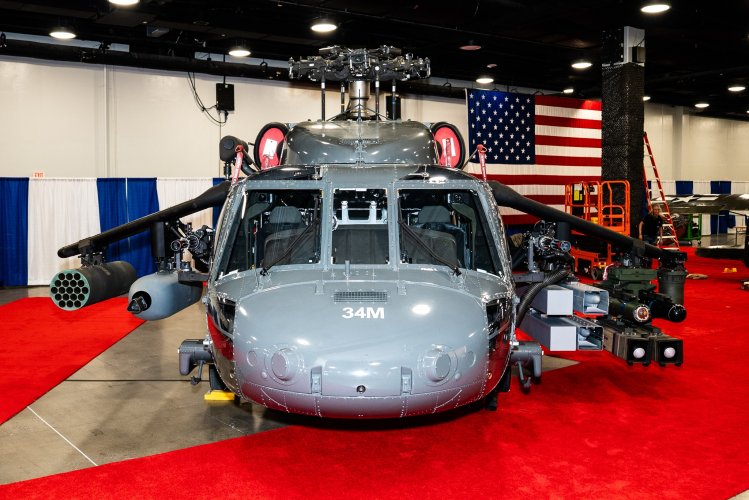
Video on YouTube:The War Zone said:The H-60 Black Hawk Gunship Evolves With New Wings And Weapons
Sikorsky unveiled a new incarnation of its Armed Black Hawk helicopter at the Army Aviation Warfighting Summit in Nashville in April 2026.TWZ's Jamie Hunter spoke with Sikorsky's Matt Isaacson about how this opens up new mission sets and provides greater flexibility, while minimizing the need for separate fleet types.