
UFAG/MARE AH Aircraft Designations

Apophenia

ACCESS: Top Secret
Senior Member
Joined
25 July 2007
Messages
4,916
Reaction score
5,538
UFAG/MARE Corporate History

This thread will cover the products, designs, and designators of UFAG (the Ungarische Flugzeugfabrik A.G.) aka MARE (Magyar Repülőgépgyár Rt.) - which operated in the Budapest region from 1915 until March 1920.

The firm had been formed in 1912 as a joint effort between Ganz Danubius Rt. and various Manfréd Weiss enterprises. Its original name was the Magyar Léghajó és Repülőgép Rt. (Hungarian Airship and Aircraft Co.). [1] The CEO was financier Camillo Castiglioni (who controlled several Austro-Hungarian aviation firms); [2] the Technical Director was engineer and French-trained pilot Viktor Wittmann; while the Chief Engineer was Béla Oravecz.

The Magyar Léghajó és Repülőgép Rt. took over a factory to the east of Pest. However, lacking space for an aerodrome, airframes had to be transport to Rákosmező (Hungary's first airport) for final assembly and flight-testing. With no original designs of its own, Magyar Léghajó és Repülőgép Rt. undertook the license-building of Lohner aircraft.

Later, to speed both production and testing of aircraft, a new property was sought with sufficient space for both factory and a grass aerodrome. In 1915, a property was found in the carpentry district of Albertfalván and the firm was rebranded as the Ungarische Flugzeugfabrik A.G. or Magyar Repülőgépgyár Rt. As UFAG (or MARE) the firm would continue license production as well as, eventually, designing and producing its own, original aircraft designs.

Although building military aircraft in Hungary was banned after WW1, some limited production (or at least finishing of incomplete airframes) was undertaken in 1918-1919 at the MARE facility (the German-language UFAG branding being largely dropped by the now-independent Hungary).

After 21 March 1920, the formerly state-controlled MARE became Budapest-based Neuschloß-Lichtig Flugzeugbau A.-G. aka Neuschlozs-Lichtig Repülőgépgyár és Faipari Rt. (or Neuschloss-Lichtig Aircraft Factory and Woodworking Co. Ltd.). With a limited market for aircraft, Neuschlozs-Lichtig soon focused its attention exclusively on furniture production.

On Usage and Designation Styles

As a note on usage, I should acknowledge that I refer throughout to Austro-Hungarian army aviation as the k.u.k. Luftfahrtruppen (or the Imperial and Royal Aviation Troops). [3] In reality, the Kaiserliche und Königliche Luftfahrtruppen only came into existence in July 1915. Prior to that, this force was referred to as the Luftschifferabteilung (the LA or Airship Department).

I also refer specifically to the naval air arm - the Kaiserliche und Königliche Seeflieger - as both aircraft operator and order-issuing body. I don't known the details but, in all likelihood, ordering would have fallen to another entity within the k.u.k. Seeflieger's parent organisation - the Kaiserliche und Königliche Kriegsmarine. Possibly a signifigant historical detail but the distinction felt off-topic here.

UFAG k.u.k. LFT Role Designators

I can find no trace whatever of any internal, corporate designations or type numbers for UFAG products. As a result, this thread will be more about finding ways of organising UFAG-built aircraft in a useful way.

The next post will begin listing aircraft built by UFAG for k.u.k. LFT by their role designators. These rather generic designations followed the German Idflieg system. For the most part, the role designator listings will simply point the way to the relevant 'design' (Bauart) numbers.

These Bauart numbers also form the first part of k.u.k. Luftfahrtruppen individual aircraft serials (or Flugzeugnummern). This, in turn, makes it easier to follow the progression of production orders.

_________________________________________________


[1] It is doubtful that the Magyar Léghajó és Repülőgép Rt. put any work into actual airship design. By 1912, the Landstreitkräfte had already decided that military airships had no future. A dramatic foonote to this decision was the fate of the 68 m long, semi-rigid airship M.III Körting - destroyed in a fatal collision with a military Farman MF biplane on 20 June 1914. Thus ended the story of Austro-Hungarian military airships.

[2] Besides UFAG (established in partnership with Lohner), Camillo Castiglioni also controlled MLG (Motor-Luftfahrzeug-Gesellschaft mbH); Oesterreichisch-ungarische Albatros-Werke Ges.mbH, and Phoenix-Flugzeugwerke A.G. In the German Reich, Castiglioni controlled the Hansa- und Brandenburgische Flugzeugwerke A.G. and the Bayerische Motoren-Werke GmbH (later, A.G.).

[3] Also known as Császári és Királyi Légjárócsapatok in Hungarian. Note that Wiki is confused about the k.u.k. Militär Aeronautische Anstalt (the MAA or Military Aeronautical Institute). This was never the name of the army air arm.

The MAA was an R&D unit first based at the Vienna Arsenal and later at Fischamend. During WW1, Fischamend also operated as a repair and modification depot - such work often resulted in an '(Fd)' suffix be appended to indicate major changes made.
_________________________________________________
 
Last edited:
Ungarische Flugzeugfabrik A.G./Magyar Repülőgépgyár Rt.

Role Designators for UFAG/MARE Aircraft


There are a number of ways to organise Austro-Hungarian military aircraft. One is by the German-style generic role designators adopted by the k.u.k. Luftfahrtruppen in 1915. Those designators were based on role letter system adopted from the German Idflieg followed by a Roman numeral indicating how many designs the firm had created for that role category (or at least, how many such designs proceeded far enough to warrant an official role designator being issued by the k.u.k. LFT).

Another mimicry of the Idflieg system was to append abbreviated suffixes (in parentheses) to identify airframes produced by a second company under license. This is particularly handy with UFAG - which produced both a C.I(U) and the unrelated C.I. Such designations are easier to understand when properly ascribed. The former refers to the Lohner C.I(U) - ie: a UFAG-built example of the Lohnerwerke's first armed recce or 'C' type. [2] The latter refers to the UFAG C.I - ie: UFAG's first original design in this armed recce category.

K.u.k. Luftfahrtruppen role designators are probably the least useful way to arrange the aircraft types of an individual airframe maker. Nevertheless, it is usually by those role designators that AH military aircraft types are best known today. So, I will provide an alpha-numeric listing of those designators along with a reference to each aircraft type's series number(s).

_________________________________________________

[1] Note that the k.u.k. Luftfahrtruppen numbering system drew a distinction between prototypes or development machines and 'production prototypes'. The latter had more to do with working out details of producibility and, despite being 'prototypes', such airframes were included within the production type series.

[2] As this shows, modern usages like 'UFAG C.I(U)' are both redundant and somewhat misleading.

_________________________________________________

UFAG-built Aircraft by k.u.k. LFT Role Designator

As was common practice in 1914-1915, the k.u.k. Luftfahrtruppen often applied the originating company's producer code number to licensed-built aircraft. As a result, the first four entries below have Lohnerwerke Bauart numbers.

All early MLR/UFAG landplane production was of licensed versions of the Lohner Pfeilfliger type (which received Lohner series numbers). I will list these aircraft by those Lohner Bauart numbers. However, due to the relative obscurity of these types, I will then refer to them by their more familiar k.u.k. Luftfahrtruppen role designators.

Only when UFAG began license-production of the Hansa-Brandenburg LDD [1] in 1915 was the firm considered large enough to warrant its own producer code. Thereafter, the k.u.k. LFT switched to using UFAG-specific series numbers beginning with '6' - based on UFAG's new producer code number.

_________________________________________________


B.II(U) - 1915 2-seat reconnaissance biplane
- See: UFAG series 12.4; licensed Lohner B.II
-- NB: Series number assigned to Lohnerwerke

B.III(U) - 1915 2-seat advanced trainer biplane
- See: UFAG series 14.5; licensed Lohner B.III
-- NB: Series number assigned to Lohnerwerke

B.IV(U) - 1915 2-seat trainer biplane; no DC
- See: UFAG series 15.5; licensed Lohner B.IV
-- NB: Series number assigned to Lohnerwerke

B.VII(U) - 1916 2-seat reconnaissance biplane
- See: UFAG series 17.5; licensed Lohner Type J
-- NB: Series number assigned to Lohnerwerke

C.I(U) - 1915 licensed Hansa-Brandenburg LDD
- See: UFAG series 61, 63, 64, 67, 68, 69, 169, 269, 369

C.I - 1916 2-seat armed reconnaissance biplane
- See UFAG series 161

_________________________________________________

[1] Some sources claim that UFAG also license-produced the Lohner Type Jc as the 'C.I(U)'. Since this Lohner C.I was an armed evolution of the the B.VII - which had been produced by UFAG - this is an understandable mistake. However, in reality, there was no C.I(U) other than the Hansa-Brandenburg.

BTW: It may be noted that Hansa-Brandenburg is often referred to in this tread simply as 'Brandenburg'. This follows the preferred contemporary Austro-Hungarian usage.

_________________________________________________
 
Last edited:
Ungarische Flugzeugfabrik A.G./Magyar Repülőgépgyár Rt.

UFAG Aircraft Type Series Number


Aircraft Bauart numbers should be a foolproof way of referencing k.u.k. Luftfahrtruppen airplanes ... but it isn't. As noted, not until UFAG began building licensed Brandenburg LDDs - as C.I(U)s - did the k.u.k. LFT award UFAG with its own specific series number - '6'.

In typical k.u.k. Luftfahrtruppen fashion, the '60' series was reserved for prototypes and experimental airframes. [1] And this creates a challenge when listing series in numerical order.

The airframe number (Flugzeugnummer) - 60.01 - indicates the first purely experimental design from UFAG. But this was not the first designation in this new system - the UFAG 61 series predates Flugzeugnummer) 60.01 by almost three years. So, none of this is quite as orderly as it seems.

Still, the best way of listing UFAG aircraft types would seem to be by Bauart number. Within those series listings, I will use ranges of Flugzeugnummern to note production orders and sub-types. Mention will also be made of design origin (either by UFAG designer or licenser name) and the k.u.k. Luftfahrtruppen role designator (just to complete the circle).

Confused yet?

_________________________________________________

UFAG 60 Series - Experimental & Development Aircraft

Below is listed UFAG prototypes and experimental aircraft for the k.u.k. LFT:

UFAG 60.01 - 1918 improved Bauart 161 C.I; x 1
-- 60.01: 1st prototype for a proposed C.II series
-- 60.01: 1 x 230 hp Hiero 6N 6-cyl.; span 9.50 m
-- 60.01: Bauart 161 airframe with minor changes*
-- * Incl. greater span & aerodyn. balanced rudder
-- 60.01: Built/flown/tested in the Summer of 1918

UFAG 60.02 - (Project) 1918 monoplane fighter
-- 60.02: Shoulder-mounted, V-strutted wings*
-- * Min. resemblance to reputed E.V inspiration
-- 60.02: 1 x 150 hp Le Rhône(St);** span 8.50 m
-- ** Local, Steyr-built Le Rhône rotary engine
-- 60.02: Possible desig. UFAG D.I; unconfirmed

UFAG 60.03 - 1918 improved Bauart 161 C.I; x 1
-- 60.03 - 2nd prototype for proposed C.II series [2]
-- 60.03: 1 x 230 hp Hiero 6N 6-cyl.; span 10.30 m
-- 60.03: Similar in appearance to Bauart 161/C.I
-- 60.03: By UFAG chief designer ing Béla Oravecz
-- 60.03: Increased span; aerodyn.-balanced rudder
-- 60.03: Built/flown/tested in the Summer of 1918
-- 60.03: Flars tests found a/c to be good performer [3]

_________________________________________________

[1] As previously noted, the k.u.k. Luftfahrtruppen series system distinguished between prototypes or development machines and 'production prototypes' - with the latter included within the production type series.

[2] Note that Wiki erroneously reports the UFAG 60.03 as being an evolution of the by-then obsolete Brandenburg C.I(U) airframe. It was, of course, nothing of the sort.

[3] August 1918 trials revealed that, compared with the UFAG C.I, 60.03 had superior glide characteristics as well as a lower landing speed. In a climb competition held on 19 Sept 1918, the 60.03 came a close second behind the WKF 80.07. Despite coming in second, the 60.03 received a production order for what would have become the UFAG C.II ... had the war lasted longer.

Why the UFAG 60.03 was preferred for the production order is unclear. Likely the proposed C.II's close structural relationship with the in-production UFAG C.I was the most important factor. By contrast, Alfred Gassner's WKF 80.07 was an entirely new design.

_________________________________________________
 
Last edited:
Ungarische Flugzeugfabrik A.G./Magyar Repülőgépgyár Rt.

UFAG Production Aircraft for the k.u.k. LFT


As noted, with the license-production of the Hansa-Brandenburg Type DD recce biplane - as the Brandenburg C.I(U) - UFAG established itself as a major airframe constructor. Accordingly, the k.u.k. Luftfahrtruppen switched from using Lohner '1' series numbers to a new, UFAG-specific Serie beginning with '6'. [1]

We have already covered the out-of-sequence '60' series prototype and experimental types. Here, we will cover UFAG/MARE production types for the k.u.k. Luftfahrtruppen beginning with the Bauart 61.

__________________________________________

[1] Before C.I(U) or C.I(Ph) production was ever considered, Flars bought the prototype Type DD (w/n DD94) and assigned it Flugzeugnummer 05.07 - '05' being the foreign supplier code for Germany's Hansa-Brandenburg.

__________________________________________

UFAG 6x Series - Production Aircraft

UFAG Bauart 61 - 1915 Brandenburg C.I(U)
- Bauart 61: Licensed Brandenberg Type LDD
- Bauart 61: 1 x 160 hp Austro Daimler AD6
-- Bauart 61 was built from Phoenix drawings
-- Some Bauart 61 C.I(U) trainer conv.,* 1917
-- Rear gun ring removed for dual controls
- Serie 61.5: 160 hp Mercedes D.III; x 10 **
-- ** Flars placed Bauart 61.5 order Oct 1915

UFAG Bauart 62 - 1917 Brandenburg G.I(U)
- Bauart 62: Hansa-Brandenburg lic.; x 12
- Bauart 62: 2 x 160 hp AD6; span 18.00 m
- Bauart 62: 3-seat tractor-engined bomber
-- G.I(U) bomber proved poor performed*
-- * Mainly used for large calibre gun trials

UFAG Bauart 63 - 1915 Brandenburg C.I(U)
- Bauart 63 : 1 x 160 hp Mercedes D.III 6-cyl.
-- Early C.I(U) contracts concerned avail. engines

UFAG Bauart 64 - 1915 Brandenburg C.I(U)
- Bauart 64 : 1 x 160 hp Austro Daimler AD6
-- Above-wing mg in Flars MWF Nr.2 mount
- Bauart 64.5: Brandenburg-assigned serials

UFAG Bauart 65 - 1917 Brandenburg D.I (KD) [1]
- Bauart 65 : Ernst Heinkel's KD 'Star-Strutter'
- Bauart 65 : 1 x 160 AD6 6-cyl.;* span 8.50 m
- Bauart 65 : Planned UFAG prod.; no deliveries
-- * Powering 65.5; 65.7 had a 150 hp AD6
-- * Phoenix-built D.Is had the 185 hp AD6
-- See hesham's reply #8

UFAG Bauart 66 - 1916 Brandenburg C.II(U)
- Bauart 66 : Hansa-Brandenburg Typ K / C.II*
- Bauart 66 : 160 hp Mercedes D.III; span 9.40 m
-- 66.51 : 1st prototypes; flew October 1916
-- 66.81 : 1st prototypes; flew in June 1917
- Bauart 66 : Poor results from flight tests [2]
-- Abandoned for UFAG 161 series/UFAG C.I
-- * Not to be conf. with UFAG's 60.03/C.II

UFAG Bauart 67 - 1916 Brandenburg C.I(U)
- Bauart 67 : 1 x 160 hp Austro Daimler AD6
-- Bauart 67 had completely cowled engines

UFAG Bauart 68 - 1916 Brandenburg C.I(U)
- Bauart 68 : 1 x 160 hp Austro Daimler AD6
- Bauart 68 : As 64; struct. differences intro'd

UFAG Bauart 69 - 1917; more powerful C.I(U)
- Bauart 69 : Jan 1917; 1 x 200 hp Hiero(Fi) 6L
-- Before 69.5; 1 x 200 hp Hiero(H) engines
-- Some Bauart 69 fitted w/ full engine cover

UFAG Bauart 161 - 1916 C.I recce biplane; x 341
- Bauart 161 : 2-seater infl. by German HB KDC
-- 161.01 : 1st prod'n prototype for UFAG C.I
-- 161.01 : 1 x 200 hp Hiero 6L; span 8.92 m
-- 161.02 : 2nd prod'n prototype for UFAG C.I
-- 161.02 : 1 x 230 hp Hiero 6N; 'I' wing struts
- Bauart 161 : Prod'n type; parallel struts; x 22
- Bauart 161 : 1 x 230 hp Hiero 6N; span 9.12 m
- Bauart 161 : Flugzeugnummern 161.03 - 161.22
- Bauart 161 : Flugzeugnummern 161.31 - 161.250
-- Bauart 123: Licensed UFAG C.I(Ph) by Phoenix
-- Bauart 123 : Flugzeugnummern 123.01-123.40

UFAG Bauart 169 - 1917; more powerful C.I(U) deriv.
- Bauart 169: 1 x 210 hp Benz Bz.IVa 6-cylinder
- Bauart 169: Wind-driven wireless transmitter
--- Most Bauart 169 fitted with full engine cover

UFAG Bauart 269 - 1918; more powerful C.I(U)
- Bauart 269: 1 x 200 hp Austro Daimler AD6
-- Some used by Hungarian Red Air Arm, 1918
-- Brandenburg: Unlicensed RO Bauart 269; x 120
-- Brandenburg: 1922-23; Arsenalul Aeronauticii
-- Brandenburg: Captured 200 hp Austro Daimler

UFAG Bauart 369 - 1918; Hiero-engined C.I(U)
- Bauart 369: 1 x 230 hp Hiero 6N (or 6L?)
-- Bauart 369.35 not fitted w/ full cowling
-- Bauart 369 deliveries Aug 1917 to Nov 1918
-- Aero A.14: Unlicensed CZ Bauart 369 prod'n [3]
-- Aero A.14: 1 x 230 hp Hiero N; span 12.30 m
-- Aero A.15: Unlicensed CZ Bauart 369 prod'n
-- Aero A.15: 1 x 230 hp Hiero L; span 12.30 m
-- NB: Aero based A.26 on Phoenix Bauart 26

UFAG Bauart 469 - 1918; revised Bauart 369/C.I(U)
- Bauart 469: Orig. to be an armoured attack a/c
-- Experiments with 6 x downward-firing mgs
- Bauart 469: Armour shortage; delivered as recce

__________________________________________

[1] In reply #8, we see mention of Flugzeugnummern 65.5 and 65.7. Presumably that means that UFAG had been approved to build at least seven 'production prototype' Brandenberg D.I(U) fighters. But, apparently, none were delivered to the k.u.k. LFT.

[2] The C.II(U)/UFAG 66 series prototypes revealed a slow climb rate; poor glide ratio and longitudinal stability as well as a high landing speed.

[3] Wiki claims that the Brandenburg C.I had been built - as the Ae.10 - by Aero during WW1. Of course, this is nonsense. Aero Letňany did not exist until 1919 and the 1922 Ae.10/A.10 was a limousine-style passenger-carrier of original design.

__________________________________________

In the next post, we will cover UFAG production of maritime aircraft for the Kaiserliche und Königliche Seeflieger.

__________________________________________
 
Last edited:
Ungarische Flugzeugfabrik A.G./Magyar Repülőgépgyár Rt.

UFAG/MARE Aircraft for the k.u.k. Seeflieger


Prior to the establishment of UFAG/MARE, the Magyar Léghajó és Repülőgép Rt. license-built Lohnerwerke designs for what later became the k.u.k. Luftfahrtruppen and the k.u.k. Seeflieger - the naval air arm of the Kaiserliche und Königliche Kriegsmarine.

As noted earlier, before to the UFAG name change and move to Albertfalván, the absence of an airfield at the Pest location provided challenges for assembly and testing of landplanes. But not so for flying boats which could be assembled on site for testing in the nearby Danube.

Aircraft Klasse System of the k.u.k. Seeflieger

While the k.u.k. Luftfahrtruppen adopted the German Idflieg role designator system, the k.u.k. Seeflieger applied a klasse system. In effect, this worked like hull numbers applied to classes of warships. For UFAG-produced aircraft, the relevant Klassen are klasse L, klasse K, and klasse S.

AFAIK, klasse L simply stood for 'Lohner flugboot'. [1] Klasse K was for Kampfflugboot (or Combat flying boat) - K-Boote being fast enough to operate as flying boat fighters. Both Klassen of operational boats were numbered sequentially.

Klasse S was for Schuleflugboot (or School flying boat). These training boats had their own numbering sequence, separate from the operational types.

The Klassen are numbered but, as noted, these are more akin to hull numbers than to an actual designation system. I have arranged the Klassen below, dividing them up by the type of engine fitted. Depending upon your viewpoint, the result may be a somewhat useful compendium or an utter fool's errand. Either way, enjoy ...

___________________________________


[1] The predecessor to the L-Boote was the klasse E - named for Etrich, leader of the design team. By the time of the klasse L, Igo Etrich had parted ways with the Lohnerwerke.

___________________________________


UFAG Klasse L & Klasse S Flying Boats

Lohner Klasse L - 1915 pusher flying boat; x 70
-- Klasse L covered 2 x UFAG Lohner variants
- Lohner T : 2-seat pusher-prop biplane flying boat [1]
- Lohner Tl: Base model; unequal span 16.20 m; x 58
- Lohner Te: Light-weight model; span 16.00 m; x 12
- Lohner S : Lower-powered trainer model; x 13

UFAG-Built Lohner Klasse L - By Engine

Lohner Tl - 1 x 160 hp Austro Daimler AD6; x 7 (1 x re-eng.)
- Original engine: L90, L91, L92, L93, L94, & L95
- Re-engined airframe: L53

Lohner Tl - 1 x 165 hp Benz Bz III 6-cylinder; x 1
- L96

Lohner Tl - 1 x 145 hp Hiero 6E 6-cylinder; x 8 (4 x re-eng.)
- Original engine: L52, L97, L98, & L99
- Re-engined airframes: L54, L55, L56, L57

Lohner Tl - 1 x 150 hp Rapp Rp III 6-cyl.; x 6
- L53, L54, L55, L56, L57, & L59

Lohner Te - 1 x 160 hp Austro Daimler AD6; x 1
- L65

Lohner Te - 1 x 150 hp Benz Bz III 6-cylinder; x 3
- L58, L60, & L61

Lohner Te - 1 x 150 hp Rapp Rp III 6-cyl.; x 6
- L59, L62, L66, L67, L68, & L69

Lohner Te - 1 x 145 hp Hiero 6E 6-cylinder; x 3
- L63 & L64

Lohner S klasse Flying Boats

Lohner S - 1 x 110 hp Benz Bz.II 6 -cylinder; x 2
- S10 (later bS10) & S11 (bS11); Benz/S klasse

Lohner S - 1 x 90 hp Mercedes D.I 6-cyl.; x 10
- S7 (mS7), S8 (mS8) & S9 (mS9) Mercedes/S klasse
- S12, S13, S14, S15, S16, S17, & S18*
-- * No sign of engine prefix for hull numbers

Lohner S - 1 x 100 hp Mercedes D.I 6-cyl.; x 1
- S19; unclear on reason for different output

UFAG Klasse K Flying Boats

Weichmann K - 1916 sequiplane* flying boat; x 5
-- Theodor Weichmann design; pusher propeller
- Weichmann K: 1 x 150 hp Rapp Rp III; span 16.00 m
- Weichmann K: Built by UFAG, Oeffag, & others
-- * German = Anderthalbdecker ('half plane')

Weichmann K - All UFAG prod'n; 150 hp Rapp Rp III
- K163, K164, K165, K166, & K167

Hansa-Brandeburg FB - 1915 pusher flying boat
-- German derivative of AH Lohner Te series
- Hansa-Brandeburg FB: Pusher; span 16.00 m

UFAG-Built Brandenburg Klasse K - By Engine

Hansa-Brandeburg FB - 1 x 175 hp Rapp Rp IIIa; x 12
- K168, K169, K170, K171, K172, K173, K174, K175, K176
- K180, K181, K182

Hansa-Brandeburg FB - 1 x 160 hp Mercedes D.IIIa; x 4
- K177, K178, K179, K183

Hansa-Brandeburg FB - 1 x 185 hp Austro Daimler; x 29
- K203, K204, K205, K206, K207, K208, K209, K210,
- K211, K212, K213, K214, K215, K216, K217, K218, K219,
- K220, K221, K222, K223, K224, K225, K226, K227,
- K228, K229, K230, K231, K232

Hansa-Brandeburg FB - 1 x 200 hp Hiero 6L 6-cyl.; x 17
- K233, K234, K235, K236, K237, K238, K239, K240
- K241, K242, K243, K244, K245, K246, K247, K248
- K249

Hansa-Brandeburg FB - 1 x 230 hp Hiero 6N; x 1
- K260

Weichmann KG - 1916 sequiplane flying boat; x 2
-- Theodor Weichmann design; pusher propeller
- Weichmann KG: 1 x 300 hp AD12; span (??) m
- Weichmann KG: Enlarged Weichmann K*
-- * KG = Klasse K (Kampfflugboot) Groß (large)

Weichmann KG - 1 x 300 hp Austro Daimler AD12; x 2
- K301 & K302

Hansa-Brandenburg W.13 - 1917 flying boat; x 60*
- Brandenburg W.13: 2-seat; larger than others
- Brandenburg W.13: Pusher prop; span 20.40 m
-- * Not all complete/delivered; see details below

Hansa-Brandenburg W.13: 350 hp Austro Daimler V12; x 43
- K365, K366, K367, K368, K369, K370, K371, K372, K373
- K374, K375, K376, K377, K378, K379, K380, K381, K382
- K383, K384, K385, K386, K387, K388, K391, K392, K393
- K394, K395, K396, K396, K396, K397, K398, K399, K400
- K401, K402, K403, K404, K405, K406, & K408

Hansa-Brandenburg W.13: Airframes lacking engines; x 9
- K407, K409, K410, K411, K412, K413, K414, K415, & K416

Hansa-Brandenburg W.13: Airframes destroyed by fire; x 8
- K389, K390, K417; K418; K419; K420; K421, & K422

________________________________________

[1] Generally, Lohner klasse L 'boat variants are referred to as Type T (longer-span) and Type Te (shorter span). However, with UFAG-built klasse Ls, the former are most often referred to as the Type Tl. As a result, I am using the (perhaps more accurate) Type T as a generic which includes both the Tl and Te.

Other uncertainties surround the lower-powered training derivative - the Lohner Type S. Many sources claim only a single prototype was built along with a small number of Type Rs. However, this not supported by the overall klasse numbers.

On a minor note, an attempt was made to rationalise the UFAG-built Lohner S klasse numbers. The earliest Benz-powered aircraft received a 'b' suffix (eg: S10 becoming mS10) while Mercedes-powered airframes received an 'm' (eg: S7 becoming mS7). Perhaps because all later UFAG production airframes were Mercedes-powered, the k.u.k. Seeflieger did not persist with these engine type prefixes.

________________________________________

And that's it. As always, corrections and helpful additions welcome.

________________________________________
 
Last edited:
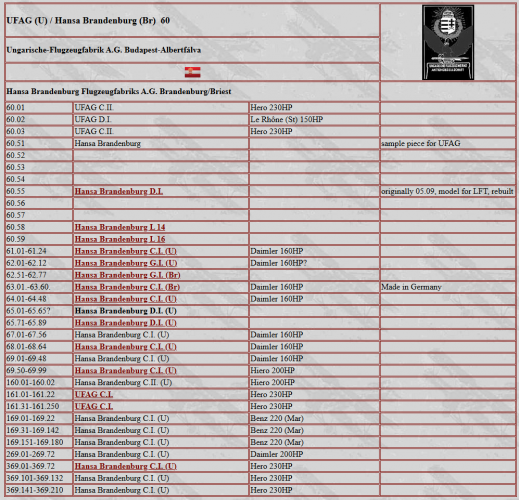
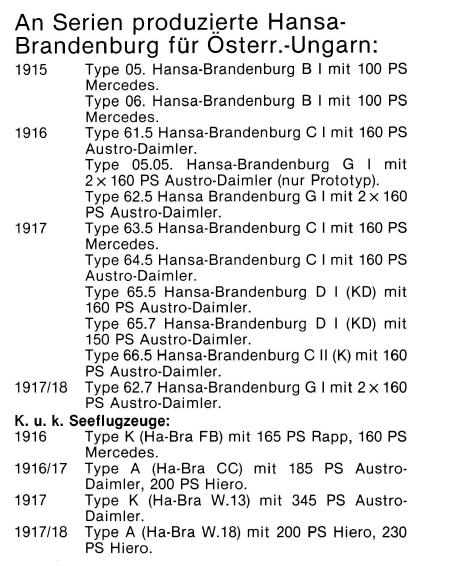
Amazing work as usual my dear Apophenia,

and from this Polish old site, I hope that should be help.
 

Attachments

  • 1.png
    1.png
    321 KB · Views: 14
Thanks @hesham. There are a number of oddities in that clipping.

I had seen those 60.5x serials listed elsewhere but couldn't make sense of them. After all, how many pattern airframes of a single type does one company actually require?

The Brandenburg-built airframes receiving serials in the UFAG range is equal bizarre ... but it really did happen! So, who knows about that 60.5x range?
 

Similar threads

Back
Top Bottom