- Joined
- 25 July 2007
- Messages
- 4,916
- Reaction score
- 5,538
UFAG/MARE Corporate History
This thread will cover the products, designs, and designators of UFAG (the Ungarische Flugzeugfabrik A.G.) aka MARE (Magyar Repülőgépgyár Rt.) - which operated in the Budapest region from 1915 until March 1920.
The firm had been formed in 1912 as a joint effort between Ganz Danubius Rt. and various Manfréd Weiss enterprises. Its original name was the Magyar Léghajó és Repülőgép Rt. (Hungarian Airship and Aircraft Co.). [1] The CEO was financier Camillo Castiglioni (who controlled several Austro-Hungarian aviation firms); [2] the Technical Director was engineer and French-trained pilot Viktor Wittmann; while the Chief Engineer was Béla Oravecz.
The Magyar Léghajó és Repülőgép Rt. took over a factory to the east of Pest. However, lacking space for an aerodrome, airframes had to be transport to Rákosmező (Hungary's first airport) for final assembly and flight-testing. With no original designs of its own, Magyar Léghajó és Repülőgép Rt. undertook the license-building of Lohner aircraft.
Later, to speed both production and testing of aircraft, a new property was sought with sufficient space for both factory and a grass aerodrome. In 1915, a property was found in the carpentry district of Albertfalván and the firm was rebranded as the Ungarische Flugzeugfabrik A.G. or Magyar Repülőgépgyár Rt. As UFAG (or MARE) the firm would continue license production as well as, eventually, designing and producing its own, original aircraft designs.
Although building military aircraft in Hungary was banned after WW1, some limited production (or at least finishing of incomplete airframes) was undertaken in 1918-1919 at the MARE facility (the German-language UFAG branding being largely dropped by the now-independent Hungary).
After 21 March 1920, the formerly state-controlled MARE became Budapest-based Neuschloß-Lichtig Flugzeugbau A.-G. aka Neuschlozs-Lichtig Repülőgépgyár és Faipari Rt. (or Neuschloss-Lichtig Aircraft Factory and Woodworking Co. Ltd.). With a limited market for aircraft, Neuschlozs-Lichtig soon focused its attention exclusively on furniture production.
On Usage and Designation Styles
As a note on usage, I should acknowledge that I refer throughout to Austro-Hungarian army aviation as the k.u.k. Luftfahrtruppen (or the Imperial and Royal Aviation Troops). [3] In reality, the Kaiserliche und Königliche Luftfahrtruppen only came into existence in July 1915. Prior to that, this force was referred to as the Luftschifferabteilung (the LA or Airship Department).
I also refer specifically to the naval air arm - the Kaiserliche und Königliche Seeflieger - as both aircraft operator and order-issuing body. I don't known the details but, in all likelihood, ordering would have fallen to another entity within the k.u.k. Seeflieger's parent organisation - the Kaiserliche und Königliche Kriegsmarine. Possibly a signifigant historical detail but the distinction felt off-topic here.
UFAG k.u.k. LFT Role Designators
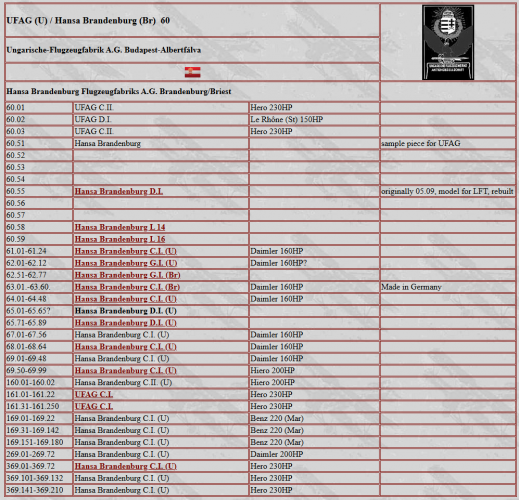
I can find no trace whatever of any internal, corporate designations or type numbers for UFAG products. As a result, this thread will be more about finding ways of organising UFAG-built aircraft in a useful way.
The next post will begin listing aircraft built by UFAG for k.u.k. LFT by their role designators. These rather generic designations followed the German Idflieg system. For the most part, the role designator listings will simply point the way to the relevant 'design' (Bauart) numbers.
These Bauart numbers also form the first part of k.u.k. Luftfahrtruppen individual aircraft serials (or Flugzeugnummern). This, in turn, makes it easier to follow the progression of production orders.
_________________________________________________
[1] It is doubtful that the Magyar Léghajó és Repülőgép Rt. put any work into actual airship design. By 1912, the Landstreitkräfte had already decided that military airships had no future. A dramatic foonote to this decision was the fate of the 68 m long, semi-rigid airship M.III Körting - destroyed in a fatal collision with a military Farman MF biplane on 20 June 1914. Thus ended the story of Austro-Hungarian military airships.
[2] Besides UFAG (established in partnership with Lohner), Camillo Castiglioni also controlled MLG (Motor-Luftfahrzeug-Gesellschaft mbH); Oesterreichisch-ungarische Albatros-Werke Ges.mbH, and Phoenix-Flugzeugwerke A.G. In the German Reich, Castiglioni controlled the Hansa- und Brandenburgische Flugzeugwerke A.G. and the Bayerische Motoren-Werke GmbH (later, A.G.).
[3] Also known as Császári és Királyi Légjárócsapatok in Hungarian. Note that Wiki is confused about the k.u.k. Militär Aeronautische Anstalt (the MAA or Military Aeronautical Institute). This was never the name of the army air arm.
The MAA was an R&D unit first based at the Vienna Arsenal and later at Fischamend. During WW1, Fischamend also operated as a repair and modification depot - such work often resulted in an '(Fd)' suffix be appended to indicate major changes made.
_________________________________________________
This thread will cover the products, designs, and designators of UFAG (the Ungarische Flugzeugfabrik A.G.) aka MARE (Magyar Repülőgépgyár Rt.) - which operated in the Budapest region from 1915 until March 1920.
The firm had been formed in 1912 as a joint effort between Ganz Danubius Rt. and various Manfréd Weiss enterprises. Its original name was the Magyar Léghajó és Repülőgép Rt. (Hungarian Airship and Aircraft Co.). [1] The CEO was financier Camillo Castiglioni (who controlled several Austro-Hungarian aviation firms); [2] the Technical Director was engineer and French-trained pilot Viktor Wittmann; while the Chief Engineer was Béla Oravecz.
The Magyar Léghajó és Repülőgép Rt. took over a factory to the east of Pest. However, lacking space for an aerodrome, airframes had to be transport to Rákosmező (Hungary's first airport) for final assembly and flight-testing. With no original designs of its own, Magyar Léghajó és Repülőgép Rt. undertook the license-building of Lohner aircraft.
Later, to speed both production and testing of aircraft, a new property was sought with sufficient space for both factory and a grass aerodrome. In 1915, a property was found in the carpentry district of Albertfalván and the firm was rebranded as the Ungarische Flugzeugfabrik A.G. or Magyar Repülőgépgyár Rt. As UFAG (or MARE) the firm would continue license production as well as, eventually, designing and producing its own, original aircraft designs.
Although building military aircraft in Hungary was banned after WW1, some limited production (or at least finishing of incomplete airframes) was undertaken in 1918-1919 at the MARE facility (the German-language UFAG branding being largely dropped by the now-independent Hungary).
After 21 March 1920, the formerly state-controlled MARE became Budapest-based Neuschloß-Lichtig Flugzeugbau A.-G. aka Neuschlozs-Lichtig Repülőgépgyár és Faipari Rt. (or Neuschloss-Lichtig Aircraft Factory and Woodworking Co. Ltd.). With a limited market for aircraft, Neuschlozs-Lichtig soon focused its attention exclusively on furniture production.
On Usage and Designation Styles
As a note on usage, I should acknowledge that I refer throughout to Austro-Hungarian army aviation as the k.u.k. Luftfahrtruppen (or the Imperial and Royal Aviation Troops). [3] In reality, the Kaiserliche und Königliche Luftfahrtruppen only came into existence in July 1915. Prior to that, this force was referred to as the Luftschifferabteilung (the LA or Airship Department).
I also refer specifically to the naval air arm - the Kaiserliche und Königliche Seeflieger - as both aircraft operator and order-issuing body. I don't known the details but, in all likelihood, ordering would have fallen to another entity within the k.u.k. Seeflieger's parent organisation - the Kaiserliche und Königliche Kriegsmarine. Possibly a signifigant historical detail but the distinction felt off-topic here.
UFAG k.u.k. LFT Role Designators
I can find no trace whatever of any internal, corporate designations or type numbers for UFAG products. As a result, this thread will be more about finding ways of organising UFAG-built aircraft in a useful way.
The next post will begin listing aircraft built by UFAG for k.u.k. LFT by their role designators. These rather generic designations followed the German Idflieg system. For the most part, the role designator listings will simply point the way to the relevant 'design' (Bauart) numbers.
These Bauart numbers also form the first part of k.u.k. Luftfahrtruppen individual aircraft serials (or Flugzeugnummern). This, in turn, makes it easier to follow the progression of production orders.
_________________________________________________
[1] It is doubtful that the Magyar Léghajó és Repülőgép Rt. put any work into actual airship design. By 1912, the Landstreitkräfte had already decided that military airships had no future. A dramatic foonote to this decision was the fate of the 68 m long, semi-rigid airship M.III Körting - destroyed in a fatal collision with a military Farman MF biplane on 20 June 1914. Thus ended the story of Austro-Hungarian military airships.
[2] Besides UFAG (established in partnership with Lohner), Camillo Castiglioni also controlled MLG (Motor-Luftfahrzeug-Gesellschaft mbH); Oesterreichisch-ungarische Albatros-Werke Ges.mbH, and Phoenix-Flugzeugwerke A.G. In the German Reich, Castiglioni controlled the Hansa- und Brandenburgische Flugzeugwerke A.G. and the Bayerische Motoren-Werke GmbH (later, A.G.).
[3] Also known as Császári és Királyi Légjárócsapatok in Hungarian. Note that Wiki is confused about the k.u.k. Militär Aeronautische Anstalt (the MAA or Military Aeronautical Institute). This was never the name of the army air arm.
The MAA was an R&D unit first based at the Vienna Arsenal and later at Fischamend. During WW1, Fischamend also operated as a repair and modification depot - such work often resulted in an '(Fd)' suffix be appended to indicate major changes made.
_________________________________________________
Last edited: